Roborock Qrevo Curv 2 Flow review: a roller mop that scrubs as it goes
Roborock swaps its spinning pads for a self-cleaning roller mop that is washed and scraped while it works. It scrubs hard floors with real pressure and keeps carpets dry with a pop-out shield, but corners, small obstacles and the missing mop-only mode hold it back.
In this review
The Roborock Qrevo Curv 2 Flow is Roborock's first roller-mop robot, and the roller is the reason to buy it. It presses down hard, is rinsed and scraped continuously while it cleans and leaves hard floors noticeably fresher than spinning pads do on everyday grime. It is less convincing in corners and around small clutter, and it is a tall robot. For homes with lots of open hard flooring, it is one of the most interesting mopping robots you can buy right now.
In short, it's an excellent mopping robot in a merely good vacuum. The SpiraFlow roller is among the best first-generation roller mops available, and at around $700 it's strong value for homes with mostly hard floors. Weaker carpet cleaning, the tall body and missing corner reach keep it from being a universal recommendation, but if clean hard floors are your priority, it's very hard to beat at this price.
Roborock Qrevo Curv 2 Flow at a glance
Roborock Qrevo Curv 2 Flow pros and cons
- Roller mop is rinsed and scraped in real time, so it doesn't smear dirty water
- Strong downward pressure for everyday stains and footprints
- Roller Shield covers the mop on carpet to keep rugs dry
- 20,000 Pa suction with an anti-tangle system
- Dock washes the roller at 167°F and dries it with 131°F air
- Handles fresh kitchen spills in a single pass
- Roborock app with room-by-room settings, 30 water levels and Matter support
- Around 140–150 minutes of runtime
- One of the best-looking docks available
- Corners and wall edges are inconsistent
- Small objects such as cords and socks can still be missed
- Tall at almost 4.7 inches, so it fits under fewer cabinets
- No dedicated mop-only mode
- No automatic detergent dispenser
- Mediocre on high-pile carpet and pet hair in rugs
- Modest threshold climbing of about 0.4–0.8 inches
Who should buy the Roborock Qrevo Curv 2 Flow?
- Homes with large areas of tile, vinyl, laminate or sealed wood
- Busy kitchens and entryways that need daily mopping
- Families with kids or messy pets on hard floors
- Households with a mix of hard floors and low or medium-pile rugs
- Anyone who disliked streaks from spinning-pad robots
- People who want a dock that looks good in a living space
- Homes with low sofas and beds
- Rooms with many tight corners and furniture legs
- Floors often covered with cables, socks or toys
- Anyone who wants a pure mopping mode
- Homes with mostly high-pile carpet or heavy-shedding pets and lots of rugs
- Homes with tall door thresholds
First impressions of the Roborock Qrevo Curv 2 Flow
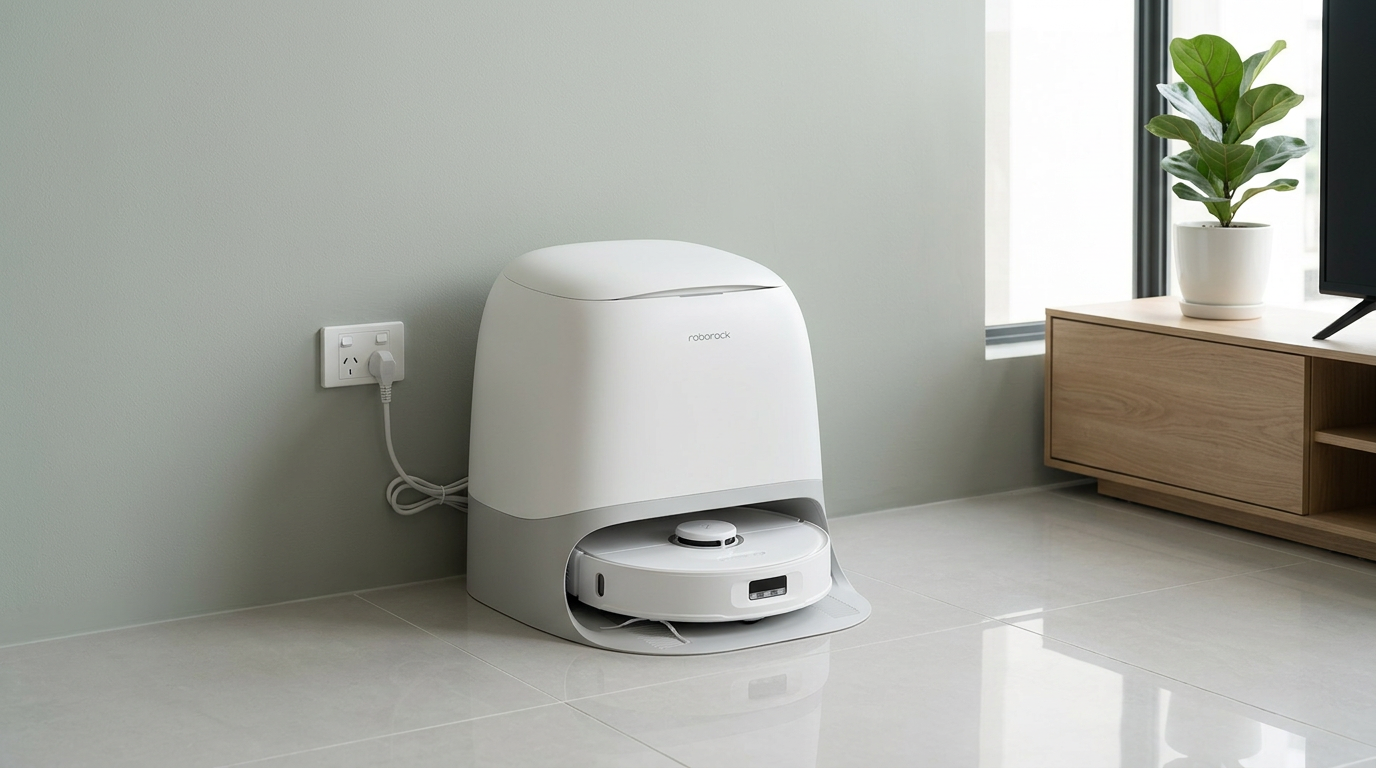
The Qrevo Curv 2 Flow looks like the Qrevo Curv family at first glance: the same soft, curved dock and a round robot with a LiDAR turret on top.
Turn the robot over, though, and the difference is obvious.
Instead of two spinning mop pads, there is a single wide roller across the back.
That roller is the whole point of this model.
Roborock calls it SpiraFlow, and it's designed to work more like a floor scrubber than a damp cloth.
The Curv 2 Flow keeps the look of the Curv line: a glossy white body and a rounded, domed dock.
Build quality is excellent. Panel gaps are tight, nothing creaks, and the roller assembly sits securely. The glossy top does pick up fingerprints easily.
The bigger design issue is height. At 4.7 inches, it's one of the taller robots on the market. The LiDAR turret doesn't retract, and the roller mechanism needs room inside the body.
It wouldn't fit under several low sideboards and sofas that slimmer models like the Saros 10R (under 3.2 inches) clear easily. If you have low furniture, measure before you buy.
Measure first: hold a tape measure under your sofa, bed and sideboards. You need at least 4.7 inches of clearance, plus a little extra so the robot doesn’t get wedged.
The curved dock is one of the best-looking robot vacuum docks you can buy.
What the Qrevo Curv 2 Flow actually is
The Qrevo Curv 2 Flow is a robot vacuum and roller mop with a multifunction dock.
The roller is about 10.6 inches wide and spins at around 220 rpm.
Eight hydration points spread clean water across it, and a built-in scraper pulls dirty water off the roller while the robot moves.
That means the robot isn't dragging a dirty pad around the room between dock visits, which is the main weakness of many pad-based mops.
Suction is rated at 20,000 Pa, up from 18,500 Pa on the original Qrevo Curv.
A DuoDivide split main brush resists hair tangles, and the robot uses PreciSense LiDAR for mapping plus Reactive AI obstacle avoidance with an RGB camera.
There's also a DirTect feature that is meant to spot different types of mess and adjust suction or water flow on the fly.
The dock: what it does for you
The curved dock empties the robot's dustbin into a bag and refills the onboard water tank.
It washes the roller with 167°F water and then dries it with 131°F hot air.
The dock holds a 1-gallon clean water tank and a 0.8-gallon dirty water tank, according to independent testing.
The base is detachable, which makes it easier to clean the washing area.
One feature you might expect at this price is missing: there is no automatic detergent dispenser, so you add floor cleaner to the clean water tank yourself.
The dock measures about 18 × 18 × 18 inches, so it's large but not unusually so. Alongside the 1-gallon clean and 0.8-gallon dirty water tanks, it holds a 2.6-quart dust bag.
After each job, the dock:
- Empties the dustbin
- Washes the roller in 167°F water
- Dries it with 131°F hot air for about three hours
- Refills the robot's water tank
- Cleans its own washing tray
Because you add cleaning solution straight into the clean water tank, some people will count the missing detergent dispenser as a gap. Others prefer it to buying small proprietary cartridges.
Tip: use a low-foaming floor cleaner made for robot mops, such as Roborock’s own solution, and stick to the recommended dose. Regular floor soap can foam up and leave residue in the dock.
Qrevo Curv 2 Flow design and setup
The robot is tall for a 2026 Roborock, at almost 4.7 inches including the LiDAR turret.
That's noticeably taller than the slim Qrevo Edge and Saros models, so check the clearance under your sofa and bed.
Threshold climbing is modest. Measured results range from about 0.4 to 0.8 inches, and there's no lifting chassis, so standard door transitions are fine but tall thresholds will stop it.
Setup runs through the Roborock app: scan the code, fill the water tank, and let the robot map your home.
Reviewers report that the first map takes only a few minutes in an apartment, though mirrors and glass doors can create phantom rooms you'll need to clean up in the app.
- Set up carpet zones in the app. Carpet detection is good, but it can occasionally misclassify a carpeted room and mop it.
- Turn off “Less Collision”. It’s on by default, and with it on the robot can behave hesitantly and actually bump into things more.
- Clean up the first map. Mirrors and glass doors can create phantom rooms, so delete or merge them before you set schedules.
Qrevo Curv 2 Flow performance
Mopping with the SpiraFlow roller
The roller presses down with roughly 15 newtons of force, more than twice the pressure of the original Curv's pads.
In independent tests, fresh spills like milk and mayonnaise came up in one pass, while dried sauce needed a second pass.
Because the roller is scraped continuously, it should leave fewer dirty streaks on large floors.
Results do vary by floor: one lab test saw streaks on dark tiles and weaker results on dried-on stains.
In practice, the SpiraFlow system is excellent on fresh messes. It cleaned up these in a single pass:
- Ketchup, mayonnaise, milk and coffee grounds
- Sticky fruit compote
- An olive oil trail tracked across a kitchen
Several owners say it's the first robot mop good enough to replace their manual mopping. Because the roller stays wet, the robot also returns to the dock less often during long jobs.
The system isn't perfect, though:
- Dried-on stains are no easier for it than for good spinning-pad mops. They still take multiple passes.
- Uneven wetting: with eight nozzles across a 10.6-inch roller, faint dry lines can show on dark tiles. Turning the water flow up in the app largely fixes this, and on light floors you may never notice it.
- Stain detection is less reliable than on other Roborocks, so the robot doesn't always focus on dirty spots by itself.
- There's no full mop-only mode. Mop-only cleaning exists only for spot and zone cleaning, which is a dealbreaker for some buyers.
Tip: seeing faint dry lines on dark tiles? Raise the water flow a few steps for those rooms in the app. With 30 levels, you can fine-tune it per room.
Edges and corners
The roller can shift sideways toward the wall, but edge coverage is the most debated part of this robot.
Testers saw it get within about half an inch of walls on some runs and leave wider gaps on others.
Corners are a known weak spot because the front brushes don't extend outward.
There's no extending side-brush arm like the one on the original Curv, so 90° corners get missed and usually need a manual touch-up.
Good to know: in kitchens and bathrooms with lots of 90° corners, plan on a quick manual wipe of the corners every so often. The roller simply can’t reach into them.
Vacuuming and carpets
With 20,000 Pa of suction, the Curv 2 Flow handles dust, crumbs and hair well on hard floors and short-pile rugs.
It is weaker on thick carpet, which is typical for robots in this class.
When it detects carpet, the mop lifts up to 0.6 inches and a Roller Shield slides around the roller to keep rugs dry.
On hard floors, it picks up rice, crumbs and cat litter reliably. The two lifting side brushes help sweep debris into the main brush, and the DuoDivide split main brush resists tangling well, with almost no hair wrap over weeks of use.
Carpet is a different story. High-pile rugs are left with crumbs behind, especially along edges and in corners. The most critical lab testing found pet hair pickup from carpet poor, because the brush doesn't agitate carpet fibers deeply enough.
Owners of heavy-shedding dogs are divided. Some are happy with it, while one owner with two German Shepherds called it the most hands-on robot they'd owned.
Pet owners: if most of your floors are rugs and you have a heavy shedder, this isn’t the strongest choice. Look at the alternatives below first.
Carpet protection, on the other hand, works very well. When the robot detects carpet, the roller lifts 0.6 inches and the shield slides over it, and even high-pile rugs stayed dry.
A few other weaknesses: the internal dustbin fills faster than its size suggests, very fine debris can spill back out, the dust bag doesn't seat perfectly in some docks, and pet hair can clump in the emptying chute.
Navigation and obstacle avoidance
LiDAR navigation is reliable and systematic, with good room coverage.
Obstacle avoidance uses Reactive AI with an RGB camera. It works well on hard floors but is noticeably less reliable on carpet.
A quick floor check before a run is still a good habit with this model.
It ran over flat white cables, got caught on tote bag straps and rug tassels, and didn't always avoid pet waste.
Threshold climbing is modest at about 0.4–0.8 inches, with no lifting chassis. Standard door transitions are fine, but tall thresholds will stop it.
- Thin cables and charger cords
- Bags with straps, and rugs with tassels
- Socks, toys and other small items
- Pet accidents. Avoidance isn’t reliable enough to trust
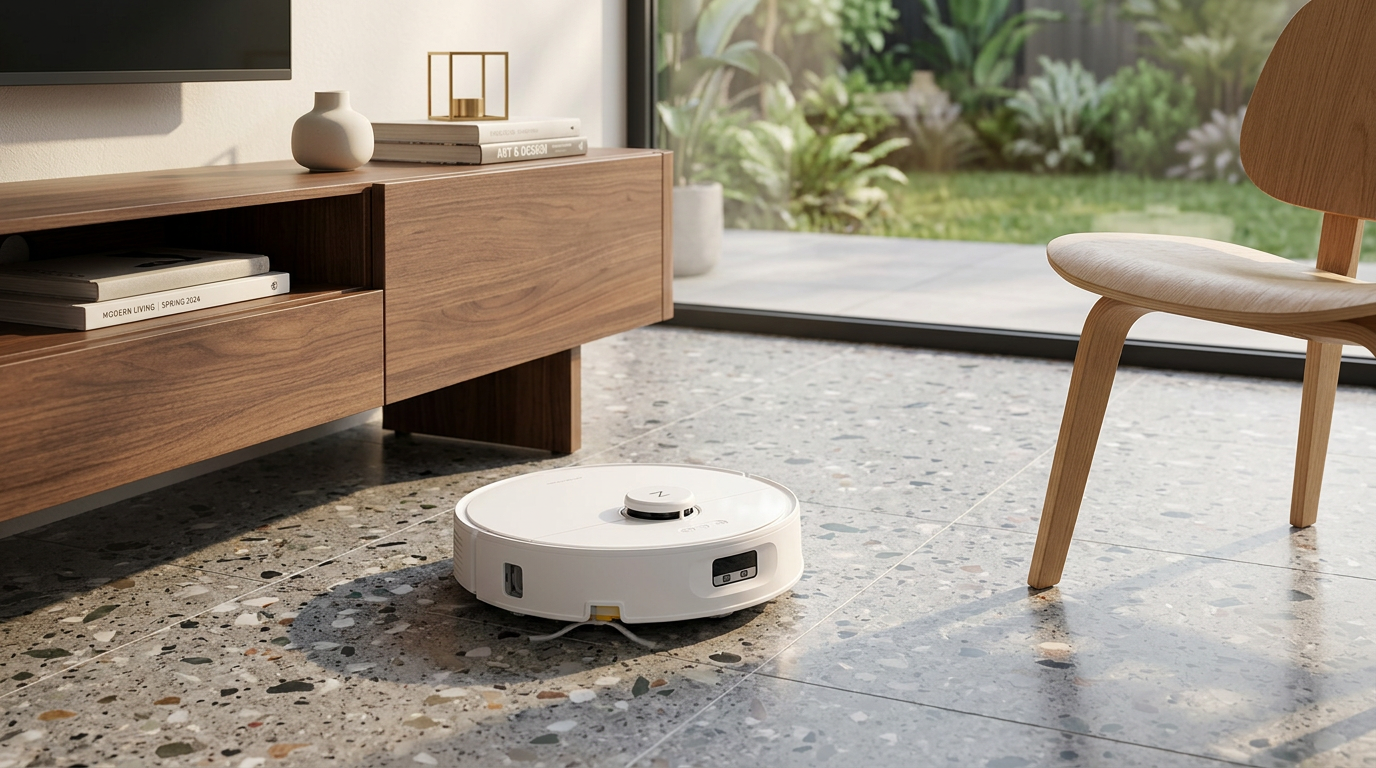
At almost 4.7 inches tall, the robot fits under fewer cabinets than slimmer Roborock models.
How loud is the Qrevo Curv 2 Flow?
Roborock doesn't lead with a noise figure for this model.
Independent testing measured around 45 dB at about three feet while the dock dried the roller, which is quiet but noticeable when it runs for a few hours.
As with any self-emptying dock, the dust evacuation is the loudest moment, but it only lasts a few seconds.
Tip: schedule cleaning for when you’re out or early in the day, so the roughly three-hour drying cycle is finished by the evening.
Maintenance: what you still have to do
The dock handles most daily care, but a few jobs are still yours.
- Refill the clean water tank and empty the dirty water tank
- Add floor cleaner yourself, since there’s no auto-dosing
- Check the front brushes now and then, because sticky spills can clog them
- Replace the dust bag, filter, brushes and roller over time
Routine maintenance is mostly simple: the bin, roller and scraper slide out easily, and voice prompts confirm you've reinstalled them correctly.
Some jobs are more involved. The side brushes need a screwdriver to remove, the mop cover is held by small screws that are easy to lose, and the roller can't go in the washing machine.
Tip: keep a small screwdriver and a cup nearby when you service the mop cover, so the tiny screws don’t go missing.
Consumables include dust bags, filters, side brushes, the main brush, the roller and cleaning solution. Costs are reasonable because Roborock's parts ecosystem is well established.
The standard warranty is 12 months in some regions, and a few owners report frustrating experiences with customer service.
The Roborock app
The Roborock app offers multi-floor maps, room splitting, no-go zones, carpet settings and scheduling.
Carpet handling can be set with one tap, and the robot switches suction and mop lift automatically.
One odd omission is a full mop-only mode: mop-only cleaning is available only for spot and zone cleaning.
Voice control works with Alexa, Google Home and Siri once rooms are named, and Matter support makes smart home integration easier.
Tip: name your rooms in the app before you link Alexa, Google Home or Siri. Then commands like “clean the kitchen” work straight away.
The app remains a highlight. It offers room-by-room suction and water settings with 30 levels of water flow, carpet mapping by shape and pile type, no-go zones and schedules, plus a live camera view and a pet patrol mode.
Battery life is good, at roughly 140–150 minutes of runtime, which is enough for most apartments in one go. Larger homes trigger a recharge break, and recharging takes close to three hours.
Is the Roborock Qrevo Curv 2 Flow worth the money?
The Qrevo Curv 2 Flow lists at $999.99, but it often sells for around $700–$850 in the US.
That puts it against Roborock's own spinning-pad flagships.
If your home is mostly open hard floor and mopping matters most to you, the roller is a real upgrade: you get top-tier mopping without paying flagship prices.
If you have lots of corners, low furniture or thick carpet, a spinning-pad model with an extending mop arm may suit you better.
Price tip: the $999.99 list price is rarely what people pay. It regularly sells for around $700–$850, so wait for a deal rather than paying full price.
Prices change often, so check the current price on Amazon before you buy.
Roborock Qrevo Curv 2 Flow specifications
From Roborock and the Amazon listing.
Qrevo Curv 2 Flow vs Qrevo Curv vs Qrevo 2 Pro
Here is how the roller-mop Curv 2 Flow compares with Roborock's spinning-pad models.
| Qrevo Curv 2 Flow | Qrevo Curv | Qrevo 2 Pro | |
|---|---|---|---|
| Mop type | Roller | Dual spinning pads | Dual spinning pads |
| Suction | 20,000 Pa | 18,500 Pa | Up to 25,000 Pa |
| Edge mopping | Shifting roller | FlexiArm | FlexiArm |
| Carpet protection | Roller Shield | Mop lift | Mop lift and removal |
| Best for | Deep hard-floor mopping | Thresholds, design | Value |
Best Roborock Qrevo Curv 2 Flow alternatives
If corners matter more than raw scrubbing, a spinning-pad model with an extending mop is the safer pick.
The Roborock Qrevo 2 Pro brings FlexiArm edge mopping and a hot-wash dock for much less money.
The original Roborock Qrevo Curv uses spinning pads with a FlexiArm and a lifting chassis.
Both the original Curv and the Qrevo Curv X are better all-rounders than the Curv 2 Flow, with an extending side brush and better threshold climbing. The Saros 10R is slimmer and stronger overall if your budget allows, and the Dreame X60 Max Ultra Complete is the pick for tall thresholds.
How I tested and scored the Roborock Qrevo Curv 2 Flow
I scored four areas, and each gets its own subscore.
- Mopping (8.6): everyday dirt, dried stains, streaks and edge coverage.
- Vacuuming (8.0): pickup on hard floors, rugs and carpet, including pet hair.
- Dock and upkeep (8.4): how much of the maintenance the dock takes over, and what is left for you.
- Navigation (7.6): mapping accuracy, thresholds and how it handles obstacles.
The overall score is an editorial rating. I also checked Roborock's published specifications and compared them with independent test results and other Roborock models.
Roborock Qrevo Curv 2 Flow FAQ
Is the Roborock Qrevo Curv 2 Flow worth it?
If you have lots of open hard flooring and mopping matters most, yes. The self-cleaning roller scrubs harder than most spinning pads. If you have many corners or low furniture, look at a spinning-pad model with an extending arm.
How is a roller mop different from spinning pads?
A roller covers a wider strip and is rinsed and scraped continuously, so it does not drag dirty water around. Spinning pads are usually better at reaching into corners.
Does it keep carpets dry?
Yes. It lifts the mop by up to 0.6 inches and deploys a Roller Shield around the roller when it detects carpet.
How strong is the suction?
Roborock rates it at 20,000 Pa.
Does it have a detergent dispenser?
No. You add floor cleaner to the clean water tank yourself.
How tall is it?
About 4.7 inches, including the LiDAR turret, which doesn't retract.
Does it have a mop-only mode?
Not a full one. Mop-only cleaning is available only for spot and zone cleaning.


- Hands-on testing of the Roborock Qrevo Curv 2 Flow
- Amazon product listing for the Roborock Qrevo Curv 2 Flow (ASIN B0FXG2BDTJ), October 2026
- Gizmodo: Roborock Qrevo Curv 2 Flow review
- Notebookcheck: Roborock Qrevo Curv 2 Flow review
- Review published.
- Added testing notes on mopping, vacuuming, navigation, dock, maintenance and the app; corrected threshold climbing.