Roborock Qrevo Curv review: the robot that climbs over thresholds
The Qrevo Curv pairs 18,500 Pa suction and zero-tangle brushes with an AdaptiLift chassis that climbs thresholds up to 1.6 inches, a FlexiArm for edges and a striking rounded dock that washes mops in hot water. It is excellent on hard floors, but it is tall and pet hair on carpet is its weak spot.
In this review
The Roborock Qrevo Curv launched as a $1,600 flagship and now sells for a fraction of that, which changes the picture completely. You get a climbing chassis, an extending side brush and mop, zero-tangle brushes and a hot-water dock that looks better than most furniture. It is tall at 4.1 inches and weaker with pet hair in carpet, but for mixed homes with raised thresholds it is one of the best-value premium robots around.
The Qrevo Curv is an excellent hard-floor machine with standout edge cleaning, strong stain removal and a dock that takes over most of the routine work. It is less convincing at pulling fine dirt and pet hair out of carpet, and you still need to pick up cables, socks and small toys before it runs. Buy it for hard floors, corners and raised thresholds, not as a full replacement for a carpet vacuum.
Roborock Qrevo Curv at a glance
Roborock Qrevo Curv pros and cons
- AdaptiLift chassis climbs thresholds up to 1.6 inches
- Zero-tangle DuoDivide main brush and FlexiArm Arc side brush
- FlexiArm extends the side brush and mop into corners
- Hot-water mop washing, warm-air drying and dock self-cleaning
- Mops lift 0.7 inches on carpet
- Excellent hard-floor pickup and edge cleaning in independent tests
- Fast, accurate mapping and around 120 minutes of runtime
- Rounded dock looks great in a living room
- 4.1 inches tall, so it misses low furniture
- Weak on fine debris and pet hair in carpet
- Obstacle avoidance is inconsistent with small toys
- Mop lift can leave low-pile rugs slightly damp
- The dock is wide
- Launch price was high, so check you are getting a discount
Who should buy the Roborock Qrevo Curv?
- Older homes with raised door thresholds
- Mostly hard floors with a few rugs
- Long hair in the household
- People who want a full-service dock that looks good
- Anyone who wants flagship features at a mid-range price
- Homes with low sofas and beds
- Thick carpet with lots of pet hair
- Small rooms where a wide dock won't fit
- Buyers who want the newest model
First impressions of the Roborock Qrevo Curv
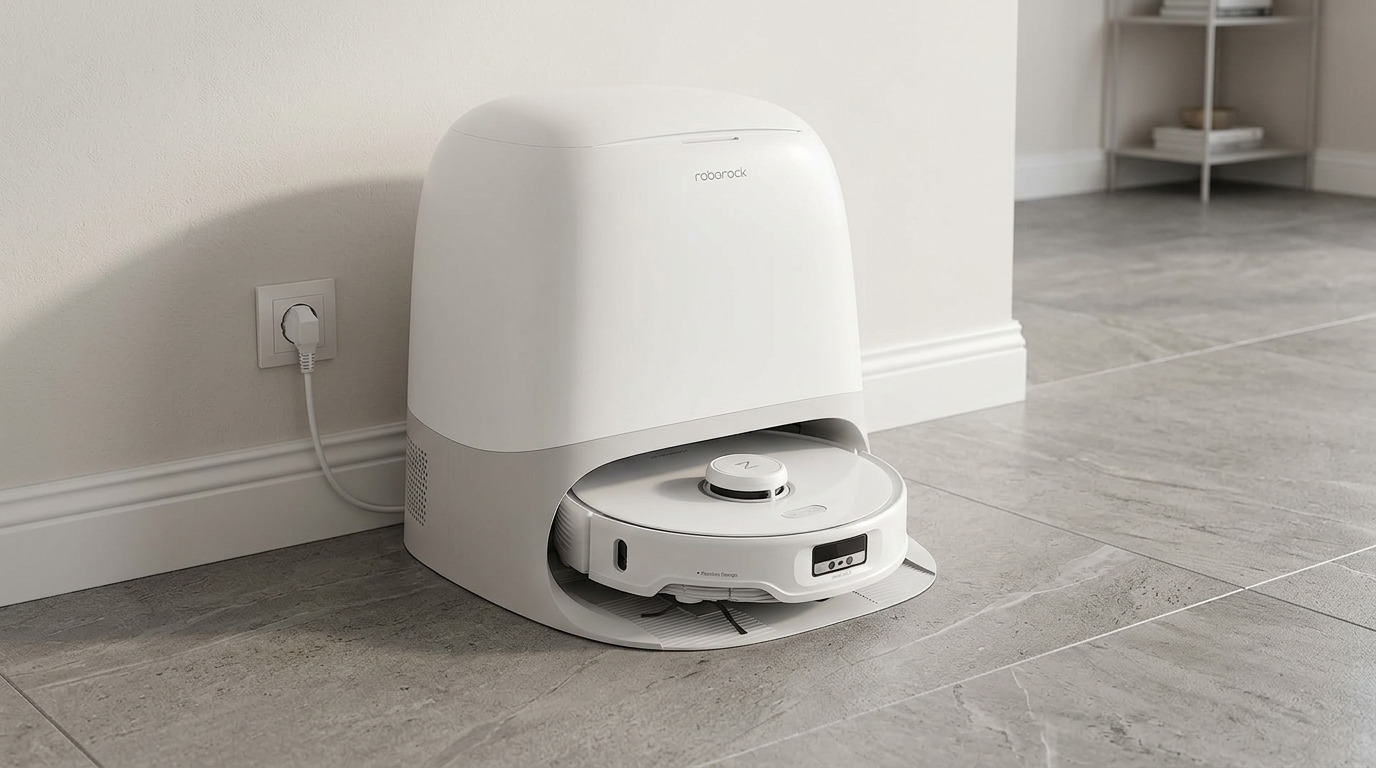
The first thing you notice is the dock.
It is soft, rounded and white, more like a design object than a cleaning station.
The robot itself has a familiar round shape with a LiDAR turret, but it hides a clever chassis underneath.
The Qrevo Curv was Roborock's first robot with AdaptiLift, and it remains one of the most capable at crossing obstacles.
The robot measures about 13.9 × 13.7 × 4.1 inches and weighs 8.6 lb. It is mostly plastic but feels solid and well assembled, and a magnetic top cover gives quick access to the dustbin. The brushroll, mop pads and bin come out easily for cleaning, although fitting the side brush takes a screwdriver.
Tip: Choose the dock spot before you unbox. It is about 17.7 inches wide, deep and tall and needs a power outlet nearby, plus some open floor in front so the robot can dock cleanly.
The dock is roughly 17.7 inches wide, deep and tall, so plan a dedicated spot near a power outlet. Underneath the robot you will find two drive wheels, a split rubber brushroll, the extending side brush and two round spinning mop pads, with a camera and obstacle sensors up front and the LiDAR turret on top.
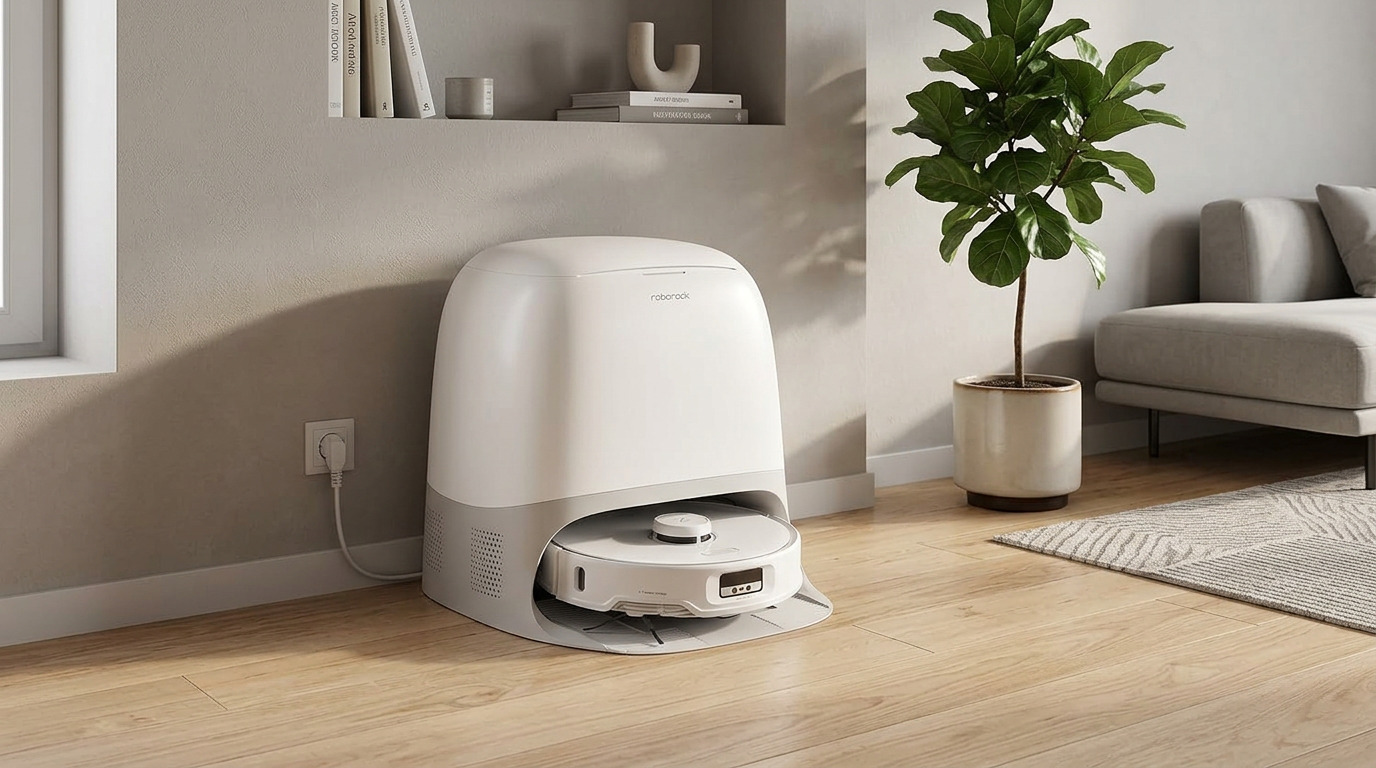
The rounded dock washes and dries the mop pads and cleans itself after each run.
What the Qrevo Curv actually is
The Qrevo Curv is a robot vacuum and mop with a multifunction dock.
It has 18,500 Pa of HyperForce suction and a DuoDivide main brush that is split in the middle to channel hair into the bin instead of wrapping it.
The FlexiArm Arc side brush and a FlexiArm mop extend outward to reach corners and baseboards.
Navigation combines LiDAR with Reactive AI 3D structured light for obstacle recognition.
Mops lift by 0.7 inches when the robot detects carpet.
AdaptiLift: climbing thresholds and rugs
AdaptiLift lets the robot raise its body to clear thresholds up to 1.6 inches, according to Roborock.
It also adjusts its stance on carpet and can lift itself free when it gets stuck.
That makes a real difference in homes with raised doorways between rooms, which stop many robots completely.
Independently adjustable wheels let the robot change its height and approach angle, which gets it over many raised thresholds and rug edges that stop conventional robots. Results still depend on the obstacle: it cannot climb stairs, shag rugs are hit and miss, and in PCMag's testing a dining-table leg interrupted one cleaning run.
Tip: If the robot keeps getting caught under a dining table, draw a no-go zone around the cluster of chair and table legs in the app and clean that spot by hand.
The dock: what it does for you
Roborock's Multifunctional Dock 3.0 empties the robot's bin automatically, with a dust bag that lasts up to around 10 weeks.
It refills the water tank, washes the mop pads in hot water and dries them with warm air.
It also cleans itself after each session.
The dock is wide, so measure your space before you buy.
The standard dock holds about 4.2 quarts of clean water and about 3.4 quarts of dirty water, with a dust bag of about 2.6 quarts. Exact figures vary by model and region. Mop-wash water reaches up to about 167°F, and a self-cleaning wash tray reduces grime build-up. Versions with a plumbing connection draw clean water and drain wastewater automatically, so you never handle the tanks.
It is not maintenance-free. You still refill the clean tank, empty and rinse the dirty tank, swap the dust bag and check the wash tray from time to time.
Standard dock. Exact figures vary by model and region.
Qrevo Curv performance
Vacuuming on hard floors
Hard floors are where the Qrevo Curv shines.
In Tom's Guide's tests, it picked up 100% of cereal and kitty litter on hardwood, and 99.2% of dog hair.
That is about as good as robot vacuums get.
PCMag's controlled tests back this up. On hardwood, it collected about 90.85% of rice and 88.65% of sand, strong results next to rival flagships. The spinning side brush occasionally flicked debris, but mostly swept it into the robot's path rather than across the room.
The FlexiArm side brush is the real advantage. It reaches out along walls and into corners, where round robots usually leave a line of dust, and the extending mop does the same for edges. In a long-term home test, the robot cleaned room edges first and then covered the floor in tidy rows, leaving very little visible dust or cat hair.
On hard floors and along edges, few robots do better. Fine dirt deep in carpet is where it falls short.
Carpets and pet hair
On carpet, it still picked up nearly all cereal and litter in the same tests.
Pet hair in carpet was the weak spot, at around 68%.
If you have a long-haired dog and lots of carpet, that is worth knowing.
PCMag saw the same split. The robot picked up 100% of rice on carpet, but only 36.03% of sand in its fine-debris stress test. That is in line with several premium rivals, yet it shows that the automatic settings do not pull fine dirt out of carpet fibres.
The split rubber brushroll is good at stopping hair from wrapping, but that does not mean it extracts more hair from deep pile. It handles larger debris and routine upkeep on low-pile carpet well. For thick carpet, heavy shedding or deeply embedded dirt, keep a conventional vacuum around.
Share of scattered debris collected in one automatic run. Orange marks the weakest result.
Mopping
The spinning pads handle everyday spills and stuck-on kitchen stains well, and the FlexiArm mop gets close to baseboards.
It is still not a replacement for spot-cleaning a really stubborn mess.
The two pads spin at about 200 rpm, and one swings out to reach along walls and into corners. You can vacuum and mop in one pass, adjust water flow, set room-by-room routines and add extra passes. In PCMag's raspberry-jam test, it removed most of the stain without smearing sticky residue and seeds across the floor, leaving only a small trace.
The mops lift when the robot detects carpet, but not always high enough: a low-pile rug came away slightly damp in home testing. If you have lots of rugs, take the pads off for vacuum-only runs. Because the pads are washed at the dock rather than rinsed continuously, very dirty floors and muddy paw prints need more frequent pad washes and extra passes. Think everyday spills and kitchen marks, not a muddy hallway.
Tip: For kitchens and entrances, raise the mop-wash frequency in the app so the pads go back to the dock more often and do not spread dirt around. If you have lots of rugs, remove the pads for vacuum-only runs.
Navigation and obstacles
LiDAR mapping is quick, and room labeling in the app is easy.
In Tom's Guide's testing, obstacle avoidance was good, including spotting charging cables.
PCMag's results were more mixed. Mapping was fast and accurate: a 1,500 sq ft apartment took about nine minutes, and only a few room labels and dividers needed fixing in the app. The first full clean took about 102 minutes, including a mid-run trip back to wash the mops, and a later run about 89 minutes. The 6,400 mAh battery lasted around 120 minutes.
Obstacle avoidance was less dependable. The robot ran over a small plastic toy and bumped into a ball, a spring-shaped toy and a felt bird, although it avoided most of the other test objects. Clear away cables, socks and small toys before letting it run unattended.
From PCMag testing. The first run included a mid-run trip back to the dock to wash the mops.
Quick checklist before an unattended run
- Pick up cables and chargers
Loose cords can wrap around the brushes or get dragged across the room.
- Clear small toys and socks
In testing it ran over a small toy and bumped into several others.
- Check shag rugs and rug edges
AdaptiLift helps, but thick shag can still trap it. Add a no-go zone if needed.
- Check the water tanks
Refill the clean tank and empty the dirty one so the dock can keep washing the mops during the run.
How loud is the Qrevo Curv?
Spec sites put the Qrevo Curv at around 65 dB at higher suction settings.
Quieter modes are available, and mapping runs are notably quiet.
The auto-empty cycle is the loudest moment, but it is short.
Maintenance: what you still have to do
Refill the clean water tank and empty the dirty water tank regularly.
In one long-term test, the dirty water bin needed emptying about once a month in a small home cleaned weekly.
Replace the dust bag when the app asks, and check sensors, wheels and brushes now and then.
Roborock's recommended replacement intervals are roughly every 6 to 12 months for the main brush, 3 to 6 months for the side brush and 1 to 3 months for the mop pads, depending on use. Clean the brushroll and filter regularly too. Budget for these parts and dust bags as an ongoing cost on top of the purchase price.
Roborock's recommended intervals. Heavy use shortens them.
The Roborock app
The Roborock app is well designed, with quick mapping, room labeling, no-go zones and per-room settings.
The robot works with Google Home, Alexa and Siri Shortcuts.
The app supports multiple maps, so you can carry the robot between floors, and it handles automatic carpet detection, mop lifting and schedules per room. There is also a built-in voice assistant. The front camera can be used for remote viewing, patrols and checking on pets, and you can switch those features off if you prefer.
Expect to spend some time on setup, especially carpet avoidance, mop-wash frequency and room-specific settings. Once that is done, it runs with very little input.
Privacy tip: If you do not use remote viewing, patrols or pet checks, switch the camera features off in the app.
Is the Roborock Qrevo Curv worth the money?
The Qrevo Curv launched at $1,599.99.
It now often sells for around $760 to $850, which makes it much easier to recommend.
At that price, you get a climbing chassis, an extending brush and mop, and a hot-water dock.
If you need a slimmer robot for low furniture, the Qrevo CurvX is the better pick.
Prices move often, so check the current price on Amazon before you buy.
Roborock Qrevo Curv specifications
From Roborock and the Amazon listing.
Qrevo Curv vs Qrevo CurvX vs Qrevo 2 Pro
Here is how the original Curv compares with its slimmer sibling and Roborock's value model.
| Qrevo Curv | Qrevo CurvX | Qrevo 2 Pro | |
|---|---|---|---|
| Suction | 18,500 Pa | 22,000 Pa | Up to 25,000 Pa |
| Height | 4.1 in | 3.1 in | About 3.8 in |
| Lifting chassis | Yes, 1.6 in | Yes, 1.6 in | No |
| Edge cleaning | FlexiArm brush and mop | FlexiArm mop | FlexiArm mop |
| Best for | Thresholds, design | Low furniture | Value |
Best Roborock Qrevo Curv alternatives
If you need a slimmer robot, the Roborock Qrevo CurvX keeps the climbing chassis in a 3.1-inch body.
If you don't need to climb thresholds, the Roborock Qrevo 2 Pro offers a hot-wash dock for less.
The Roborock Qrevo Curv S5X is a slightly more compact take on the same idea.
How we researched and scored the Roborock Qrevo Curv
This review brings together two in-depth independent reviews of the Qrevo Curv: PCMag's controlled lab tests (rice, sand and raspberry-jam tests, plus mapping, runtime and obstacle tests in a 1,500 sq ft apartment) and a long-term household test in an apartment with a cat.
I scored four areas, and each gets its own subscore.
- Vacuuming (8.5): pickup on hard floors, rugs and carpet, including pet hair.
- Mopping (8.3): everyday dirt, stuck-on stains and edge coverage.
- Navigation (8.5): mapping, thresholds and obstacle avoidance.
- Dock and upkeep (8.4): how much of the maintenance the dock takes over, and what is left for you.
The overall score is an editorial rating. I also checked Roborock's published specifications and compared them with independent test results and other Roborock models.
Roborock Qrevo Curv FAQ
Is the Roborock Qrevo Curv still worth it?
At its current discounted price, yes, especially for homes with raised thresholds and mostly hard floors. It is less suited to low furniture or heavy pet hair in carpet.
How high can the Qrevo Curv climb?
Roborock says AdaptiLift clears thresholds up to 1.6 inches.
How tall is the Qrevo Curv?
4.1 inches, including the LiDAR turret.
Does it tangle with long hair?
The DuoDivide main brush and FlexiArm Arc side brush are designed to prevent hair from wrapping.
Does it wash mops with hot water?
Yes. The dock washes the pads with hot water, dries them with warm air and cleans itself.
How long does the battery last?
About 120 minutes in independent testing, from a 6,400 mAh battery. A full clean of a 1,500 sq ft apartment took roughly 90 to 100 minutes.
Is it good on carpet?
It picks up larger debris on carpet well, but fine dirt and pet hair embedded in the fibres are its weak spots. In one lab test it collected only about 36% of sand from carpet.
Does it avoid obstacles like toys and cables?
Mostly, but not reliably. In testing it ran over a small toy and bumped into several objects, so tidy the floor before it runs.
Does it work with Alexa or Google Home?
Yes, plus Siri Shortcuts.


- PCMag: Roborock Qrevo Curv review (lab and home testing)
- Independent long-term household test of the Roborock Qrevo Curv
- Amazon product listing for the Roborock Qrevo Curv (ASIN B0D81675BQ), October 2026
- Tom's Guide: Roborock Qrevo Curv review
- Robovacguide: Roborock Qrevo Curv specs
- Added independent lab and home test results for hard floors, carpet, mopping, navigation, battery, dock and upkeep. Expanded specs, pros and cons and FAQ.
- Review published.