Roborock Saros 20 review: huge suction in a slim body
A flagship robot vacuum and mop with 36,000 Pa of suction, a chassis that climbs tall thresholds and a dock that washes its mops in hot water. It cleans hard floors, edges and carpet very well, keeps hair off its brushes and set a threshold-climbing record in lab testing. But obstacle avoidance is inconsistent from home to home, it’s expensive, and it’s only a modest step up from the Saros 10R.
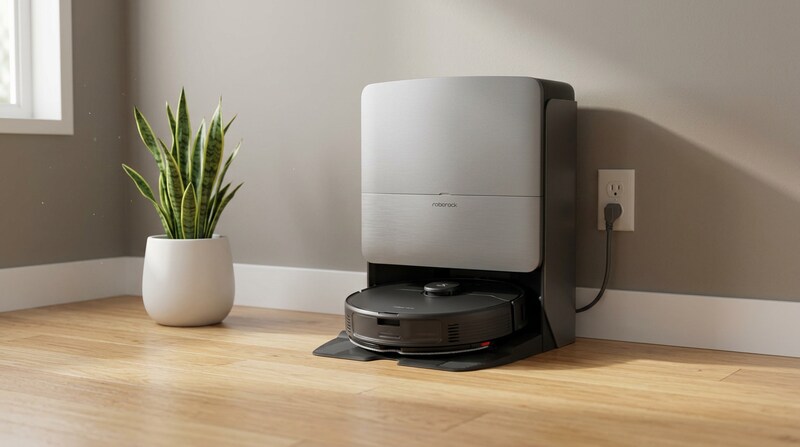
In this review
I like the Roborock Saros 20 because it puts powerful vacuuming, automated mopping and a dock that handles most of the upkeep into one system. The seven independent reviews I studied agree on its strengths: excellent hard-floor and edge cleaning, strong carpet pickup for a robot, zero hair tangling in testing and a chassis that crosses thresholds most robots can’t. Where they disagree is obstacle avoidance. Some testers called it nearly hands-off, while others found it getting stuck, dragging rugs and missing small objects. It isn’t cheap, and owners of a Saros 10 or 10R won’t gain much by upgrading. But if your home has raised thresholds, pets or low furniture, this is one of the strongest premium robots you can buy right now.
Roborock Saros 20 at a glance
Roborock Saros 20 pros and cons
- 36,000 Pa of advertised suction, among the highest available
- Excellent hard-floor and edge cleaning
- Above-average sand and pet-hair pickup from carpet in lab tests
- Zero tangling in a 7-inch hair test, thanks to the split DuoDivide brush
- AdaptiLift Chassis 3.0 climbed a record 2.24-inch single step in one lab test
- Slim 3.13-inch body fits under low furniture
- Above-average stain removal with less leftover water, so fewer streaks
- Highly automated dock: 212°F mop washing, hot-air drying, auto-empty, detergent dosing
- Matte dock hides fingerprints better than the glossy Saros 10R station
- Detailed app with remote camera view and Matter support
- Expensive at full price
- Only a modest upgrade over the Saros 10R
- Obstacle avoidance varies a lot between testers, especially on carpet
- Pet-waste avoidance wasn’t reliable in every test
- Small onboard dust bin, about 8.8 ounces
- Fine dust can stay embedded in carpet
- Sticky, dried stains may need a second pass
- Battery range slightly below average
- Large dock needs clearance in front
- Scheduling in the app is more complicated than it needs to be
Who should buy the Roborock Saros 20?
- Homes with raised thresholds or steps between rooms
- Households with pets and long hair
- Mixed hard floors and low- to medium-pile carpet
- Rooms with low sofas, beds and cabinets
- Anyone who wants a dock that handles most of the upkeep
- Owners of a Saros 10 or 10R
- Cluttered homes with lots of cables, toys and tasseled rugs
- Pets that have frequent accidents
- Very large homes that need maximum runtime per charge
- Anyone on a tight budget
Saros 20 test results at a glance
Before the details, here’s how the Saros 20 did in Vacuum Wars’ lab tests, compared with the average robot vacuum they’ve tested.
Longer bars are better on every line.
Source: Vacuum Wars lab results. Stain, coverage and airflow bars are scaled for comparison.
What the numbers mean: The Saros 20 measured below average for airflow and bench suction, yet it picked up more debris than average in real cleaning tests. Real-world pickup matters more than the suction figure on the box.
What the Roborock Saros 20 is
The Roborock Saros 20 is Roborock’s flagship robot vacuum and mop for 2026, and the successor to the Saros 10R.
It shares a lot with the 10R: a laser-free navigation system, twin spinning mop pads and a large self-maintaining dock called the RockDock.
What’s new is mostly about power, reach and hair handling.
Roborock quotes 36,000 Pa of suction, up from 20,000 Pa on the Saros 10R.
That is one of the highest figures on any robot vacuum you can buy.
The other headline is the AdaptiLift Chassis 3.0.
It lets the robot raise its body to climb over thresholds and small steps that would stop most robots at the door.
That’s the feature I find most interesting, because thresholds are one of the most common reasons a robot never cleans part of a home.
Roborock says it handles single thresholds up to about 1.8 inches and two-step thresholds up to about 3.5 inches combined.
The body stays slim, at 3.13 inches tall.
That matters more than it sounds, because the space under sofas, beds and kitchen toe kicks is exactly where a stick vacuum struggles and dust builds up.
For hair, Roborock uses a dual anti-tangle setup: a split DuoDivide main brush and a FlexiArm Arc side brush that reaches out toward edges.
For mopping, there are two rotating mop pads, and one of them can extend toward walls and furniture legs.
The RockDock empties the dust bin, washes the mops with 212°F water, dries them with 131°F air and doses detergent on its own.
On paper, it’s about as complete as a robot vacuum gets.
Saros 20 design and the RockDock
The Saros 20 robot is a dark, round disc without the raised laser turret older Roborocks had.
Instead of a spinning lidar tower, it relies on Roborock’s StarSight Autonomous System 2.0, which combines 3D time-of-flight sensing with an RGB camera.
Losing the turret is what makes the low 3.13-inch height possible.
It’s still not light: Tech Advisor notes the robot weighs more than 11 pounds.
Build quality is generally solid, with sturdy plastic and well-fitted parts.
RTINGS found the buttons a little mushy and noted that the glossy surfaces on the robot can scratch.
Overall, the design is a refinement of the Saros 10R rather than a redesign.
The RockDock is the big part of the package.
It’s a tall, boxy station with a matte finish that hides fingerprints and smudges better than the glossy dock on the Saros 10R.
It needs a permanent spot against a wall with an outlet nearby, plus clear space in front so the robot can drive in and out.
Tech Advisor found its depth awkward in smaller rooms.
Inside the dock are the clean and dirty water tanks, the dust bag and the detergent reservoir.
Roborock also dries the dust bag with fresh air, which should help keep odors down between bag changes.
Notebookcheck noted that setup took about 10 minutes through the app, including mapping.
Tip: Measure the spot before you buy. Allow for the dock’s depth plus a few feet of open floor in front of it, and avoid placing it right next to a rug edge or a threshold.
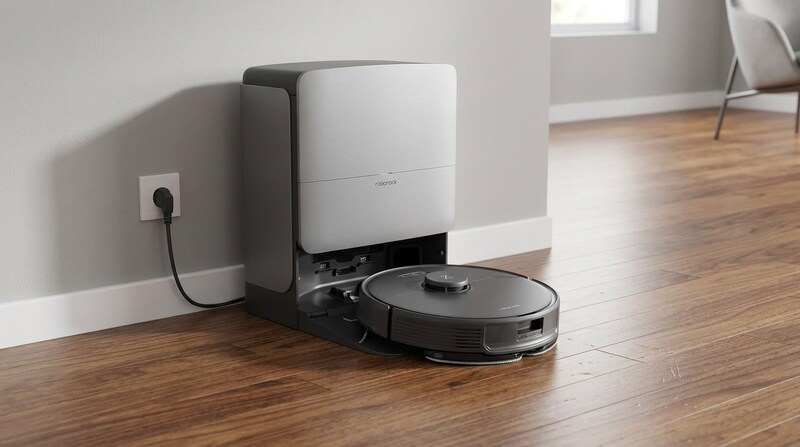
The RockDock needs a permanent spot near an outlet. Plan the location before you unbox it.
Saros 20 vacuuming performance
Vacuuming is where the Saros 20 earns most of its score, and it’s the area where reviewers agree the most.
The 36,000 Pa figure is a lab number, but the independent tests I studied show it translates into real pickup.
Interestingly, Vacuum Wars measured airflow of 15 CFM against a 17 CFM average, and bench suction at less than half the average.
That didn’t show up in actual pickup, which was above average, so I wouldn’t read much into it.
Hard floors and edges
Hard floors are the Saros 20’s best surface.
RTINGS found very little debris left after a single pass, from everyday dirt to larger crumbs.
Tech Advisor saw it pick up flour and larger debris thoroughly, with only small bits getting caught in the wheel treads and dropped later.
Android Authority called the edge and corner cleaning the most effective it had tested, crediting the FlexiArm system that pushes the side brush and mop pad out toward walls.
Edges are where many robots leave a visible gray line, so this is a meaningful strength.
Carpet
On carpet, the Saros 20 is strong for a robot.
Vacuum Wars measured 89% of embedded sand removed from medium-pile carpet, against a 78% average.
Tech Advisor saw it collect all the oats from a mid-pile carpet, though some flour stayed embedded even at max suction.
On a medium-pile carpet, Notebookcheck saw the Saros 20 remove most of its test dirt in a normal pass and nearly all of it with the cross-pattern deep cleaning mode on.
RTINGS found fine particles harder to get out of both low- and high-pile carpet, with some debris left along edges and baseboards.
It also noticed that the lifting chassis can help with some debris and make fine-particle pickup worse with others.
Tip: For high-traffic rugs, schedule a weekly deep clean with the cross-pattern route instead of relying on the default single pass. And keep a regular vacuum around for a monthly deep clean of thick carpet.
The bottom line: it’s a great daily maintenance cleaner for carpet, but not a full replacement for a strong upright vacuum.
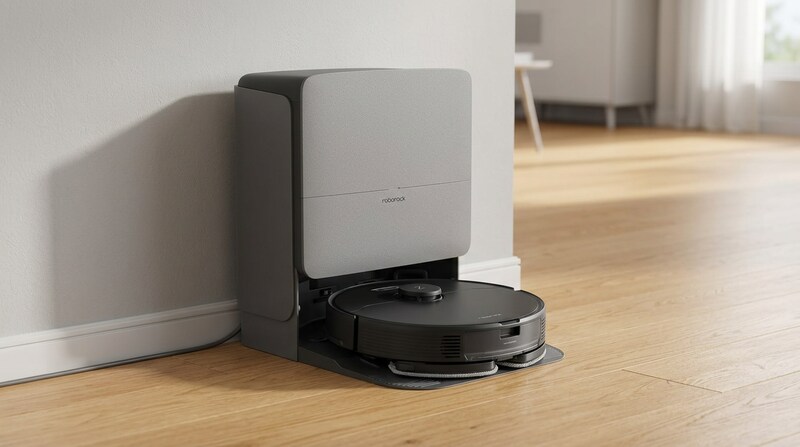
The low-profile robot is built to reach under furniture where dust collects.
Pet hair and anti-tangle performance
Pet owners have good reasons to look at the Saros 20.
Its DuoDivide main brush is split in the middle, which steers hair off the roller instead of letting it wrap.
In Vacuum Wars’ 7-inch hair test, it finished with no tangling at all, against an average of 26% tangled.
Just A Dad Approved used it daily for three months in a home with a shedding dog and never had to cut hair off the brushes.
RTINGS found it picked up most pet hair from carpet in one pass, an improvement over the Saros 10R.
Vacuum Wars also measured 88% of pressed-in pet hair removed from carpet, against an 82% average.
The weak spot is the onboard dust bin.
It holds about 8.8 ounces, against an average of about 12.7 ounces, and RTINGS found it can act full before it actually is, which cuts suction.
Tip for pet homes: Set the dock to empty the bin after every cleaning, not just at the end of a full run. During heavy shedding season, split big homes into two room-based cleanings so the bin never gets close to full.
Can the Saros 20 climb thresholds?
The AdaptiLift Chassis 3.0 is the most practical upgrade in the Saros 20, and it’s the reason I’d look at this model over cheaper Roborocks if a home has raised transitions.
The robot lifts its body to step over obstacles in one or two stages.
Roborock rates it for two-step thresholds up to about 3.5 inches combined, as long as each step stays within spec.
Vacuum Wars got it over a single 2.24-inch step after a few repositioning attempts.
That beat the previous best in their testing, held jointly by MOVA and Dreame.
In Notebookcheck’s test, it climbed a 1.8-inch ledge, although the movement looked labored at times.
A Reddit owner said it reliably crosses a bathroom threshold that defeated several earlier robots, including a Roborock Qrevo Slim.
It does all this while staying just over 3 inches tall, low enough to get under most furniture.
There’s a reality check, though.
GearBrain’s robot crossed a raised kitchen transition of roughly 1.5 inches, but sometimes struggled and got stuck.
Just A Dad Approved found the climbing slower and less polished than Dreame’s ProLeap system.
So the published figures aren’t a guarantee.
Tip: Measure your tallest threshold and look at its shape. A rounded or beveled edge is much easier to climb than a sharp, square step. If yours is close to the limit, buy from a store with an easy return policy.
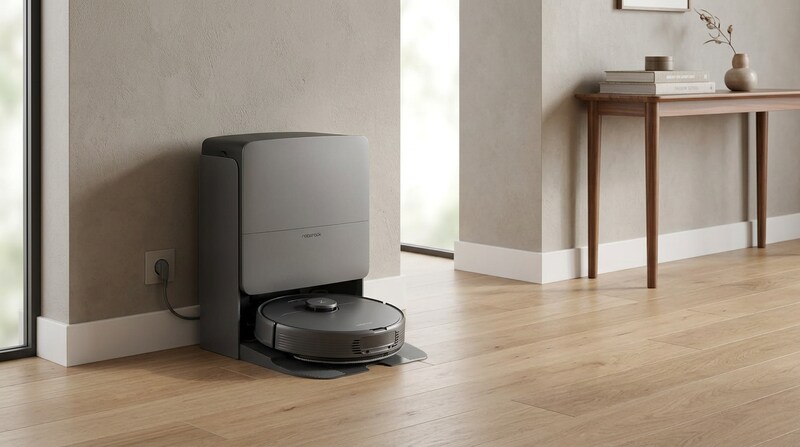
Hallways and doorways are where the AdaptiLift chassis makes the biggest difference.
Saros 20 mopping performance
Mopping on the Saros 20 uses two pads spinning at up to 200 RPM, pressed down with about 3 pounds of force.
One pad can swing out to reach along walls and around furniture legs.
On carpet, the robot lifts the mops out of the way by roughly an inch.
It can also detect wet spills and switch to mop-only mode for them.
In the lab, mopping was a clear strength.
Vacuum Wars gave it a stain-removal score of 116, against a 94 average, while leaving about 15% less excess water behind than average, which helps avoid streaks.
Its overall mopping score of 25.2 beat the 20.3 average.
Notebookcheck said it beat some other two-mop robots and removed dried-on stains.
Real homes were a bit tougher.
RTINGS found it doesn’t reliably slow down and spend extra time on dirty spots, so stubborn stains needed a second pass, and some residue still remained.
Tech Advisor saw the first pass spread a dried, sticky sauce around; a deeper second clean removed what was visible, but the spot still felt a little sticky after drying.
Spinning pads also carry dirty water around more than the newer roller-mop designs, and Notebookcheck concluded it doesn’t match the best roller-mop robots on that front.
Tip: For sticky kitchen spills, run a targeted spot clean on the deep-mop setting right away, or wipe the worst of it by hand first. Daily light mopping works better than waiting for stains to dry in.
If floor washing is your top priority, Roborock’s own Saros 20 Flow, with its SpiraFlow roller mop, is worth a look.
The dock does help a lot with hygiene.
It washes the pads with hot water after cleaning and dries them with warm air, which should keep the musty smell that plagues cheaper mopping robots at bay.
Noise and battery life
Noise reports for the Saros 20 vary depending on who you ask.
Notebookcheck measured about 60 dB in standard suction mode and just under 70 dB at full power, with drying in the dock running at a quiet 38 dB or so.
Both Android Authority and GearBrain described it as quiet, even at max suction.
My reading is that it’s normal for a powerful robot: noticeable at full power, fine in standard mode.
Battery life is a small weakness.
Vacuum Wars measured 1.44 minutes of cleaning per 1% of battery, against a 1.56-minute average, which works out to about 1,040 square feet per charge versus a typical 1,170.
Notebookcheck cleaned about 540 square feet in roughly 1.5 hours with mopping and finished with just over 40% left, which suggests around 750 square feet per charge in that mode.
The 6,400 mAh battery recharges in about 2.5 hours, and fast charging helps.
Tip for large homes: Turn on recharge-and-resume in the app so the robot tops up and finishes the job, and schedule the biggest rooms first while the battery is full.
Maintenance: what the dock does and what you still do
The RockDock takes over most routine chores, and that’s a big part of why I like the Saros 20.
It empties the robot’s bin into a bag, washes the mops with very hot water, dries them with hot air, dispenses detergent and refills the robot’s tank.
It can also drop off the mop pads for vacuum-only runs, and dirt detection can trigger extra cleaning or mop washing.
Roborock rates the mop wash at 212°F.
Vacuum Wars and Tech Advisor described the water as very hot, though one Reddit owner doubted it really felt like boiling-water washing.
Tech Advisor estimates a dust bag lasts about 65 days, and Android Authority refilled the clean water tank about once a week.
Maintenance is reduced, not eliminated.
Just A Dad Approved found hands-on upkeep minimal over three months, but RTINGS lists several parts that still need regular attention.
Here’s what I’d plan for:
- Every few days
Empty the dirty water tank and refill clean water.
- Weekly
Check the main brush, side brush and front wheel for hair and debris, and rinse the dock’s removable wash tray.
- Every two months or so
Swap the dust bag and top up the detergent.
- On Roborock’s schedule
Replace the mop pads, filter and brushes as the app reminds you.
Tip: Notebookcheck’s test unit came without detergent, and Roborock recommends its own solution. Budget for a bottle and a spare pack of dust bags when you order.
The dock handles emptying, mop washing and drying, but the water tanks still need you.
App and smart home features
The Roborock app is one of the most detailed in the category, with room-by-room settings, mapping, no-go zones, schedules, and suction and water controls.
The Saros 20 supports both 2.4 GHz and 5 GHz Wi-Fi, works with Alexa and Siri Shortcuts, and is Matter compatible.
GearBrain found Alexa and Siri easy to set up, while Matter, Home Assistant and Google took more digging.
There’s also a built-in voice assistant called Rocky, which Notebookcheck said sometimes responded without hearing its wake phrase.
The camera supports remote viewing and video calls, so you can check on a room or a pet while you’re away, and you can turn it off if privacy is a concern.
The software isn’t flawless.
Tech Advisor found scheduling more complicated than it should be, and ran into a setting that seemed to let wet mop pads cross carpet.
Just A Dad Approved had to fix the carpet zones by hand after the first map got them wrong.
Some owners also report occasional mapping errors or trouble finding the dock.
Tip: After the first mapping run, check that every rug and carpet is marked correctly, and set carpets to “lift mops” or “avoid when mopping.” It takes five minutes and prevents wet pads on your rugs.
What owners are saying
Owner experiences are mixed, which is common for robots this complex.
These are individual reports, not proof of widespread problems, but they show the range of what to expect.
Tip: Register the robot in the Roborock app and keep your proof of purchase. If the dock or navigation acts up early, warranty support is much easier with both on file.
Is the Roborock Saros 20 worth the money?
The Saros 20 lists at $1,599.99, and when I checked on October 20, 2026, Amazon listed it for $1,189.99.
At full price, it’s a serious investment.
At a discount, it looks much more reasonable for what you get.
Whether it’s worth it depends mostly on what you have now and what your home looks like.
If you already own a Saros 10 or 10R, I wouldn’t upgrade.
Notebookcheck and Android Authority both describe the Saros 20 as a modest improvement, and RTINGS found the 10R’s obstacle avoidance more dependable and its stain cleaning more effective in some cases.
If you’re coming from an older or cheaper robot, the jump is much bigger.
You get far stronger suction, better edge cleaning, near tangle-free brushes, a dock that washes mops with hot water, and a chassis that can reach rooms your old robot couldn’t.
A robot that can’t get into a room isn’t cleaning it, however strong its suction is.
If your home has raised sills, the Saros 20 solves a real problem.
If it doesn’t, a cheaper model may give you most of the cleaning for less.
- Your tallest threshold is under about 1.8 inches, or it’s a two-step transition within spec.
- You have a wall spot with an outlet and open floor in front for the dock.
- Your floors are mostly hard floors or low- to medium-pile carpet.
- You’re willing to tidy cables and small objects before runs.
- You don’t already own a Saros 10 or 10R.
Prices move a lot on robot vacuums, so check the current price on Amazon before you buy.
Roborock Saros 20 vs Saros 10R
The Saros 10R is the model the Saros 20 replaces at the top of Roborock’s lineup, and it’s still on sale.
Here’s how they compare.
| Saros 20 | Saros 10R | |
|---|---|---|
| Suction | 36,000 Pa | 20,000 Pa |
| Height | 3.13 in | 3.14 in |
| Threshold climbing | Up to about 3.5 in in two steps | Up to about 1.6 in |
| Mop washing | 212°F | 176°F |
| Main brush | Split DuoDivide | Single roller |
| Dock finish | Matte | Glossy |
| Battery | 6,400 mAh | 6,400 mAh |
| Navigation | StarSight 2.0, no laser tower | StarSight 2.0, no laser tower |
| Side brush | Extends, doesn’t lift | Extends and lifts |
Pick the Saros 20 if your home has tall thresholds, lots of long hair, or you want the strongest suction and hottest mop washing.
Pick the Saros 10R if you find it at a big discount, your floors are mostly level, and steadier obstacle avoidance matters more to you.
Roborock Saros 20 specifications
From Roborock’s published specifications, the Amazon listing and independent reviews.
Best Roborock Saros 20 alternatives
If the price or the focus of the Saros 20 doesn’t fit, Roborock’s own lineup has several options.
The Saros 20 Flow keeps the 36,000 Pa suction but swaps the spinning pads for the SpiraFlow 2.0 pressurized roller mop, so it’s the one to pick if floor washing matters most.
The Saros 20 Sonic uses Roborock’s vibrating sonic mop instead, which suits homes with lots of tile.
The Saros 10R is the previous flagship and a good buy if it’s discounted and your thresholds are low.
How I researched and rated the Roborock Saros 20
This is a researched review, not a long-term test of our own.
I started from Roborock’s published specifications and the Amazon listing, then compared hands-on and lab results from Vacuum Wars, RTINGS, Tech Advisor, Notebookcheck, Android Authority, GearBrain and Just A Dad Approved, plus owner reports on Reddit.
Where those sources disagreed, such as on obstacle avoidance and noise, I say so above.
- Vacuuming (9.0): pickup on hard floors, edges and carpet in published tests, plus anti-tangle performance.
- Navigation (7.8): obstacle avoidance, mapping and threshold climbing. Lowered from 8.4 after adding the RTINGS and Tech Advisor results.
- Mopping (8.0): stain removal, coverage and how well the dock keeps the pads clean.
- Value (7.6): price against features, and against the Saros 10R and other alternatives.
The overall score of 8.1 is an editorial rating.
Roborock Saros 20 FAQ
Is the Roborock Saros 20 worth it?
For most buyers coming from an older or cheaper robot, yes, especially in homes with raised thresholds, pets or low furniture. It rates 8.1 out of 10 in our review. If you already own a Saros 10 or 10R, the upgrade is small.
How strong is the Saros 20 suction?
Roborock rates it at 36,000 Pa, up from 20,000 Pa on the Saros 10R. Lab airflow measured below average, but real-world pickup on carpet and hard floors was above average.
How high can the Saros 20 climb?
Roborock rates the AdaptiLift Chassis 3.0 for single thresholds up to about 1.8 inches and two-step thresholds up to about 3.5 inches combined. Vacuum Wars got it over a record 2.24-inch single step with some repositioning, but GearBrain saw it get stuck on a 1.5-inch transition at times. Threshold shape matters as much as height.
How tall is the Roborock Saros 20?
The robot is 3.13 inches tall. It has no raised laser turret, so it fits under many sofas, beds and cabinets.
Is the Saros 20 good for pet hair?
Yes. Its split DuoDivide brush had zero tangling in a 7-inch hair test, and one reviewer used it daily for three months with a shedding dog without cutting hair off the brush. The small onboard bin fills quickly, so set the dock to empty it often.
Does the Saros 20 avoid pet waste?
Results are mixed. Just A Dad Approved found it handled pet accidents well, but RTINGS found it couldn’t reliably avoid pet waste. If your pet has frequent accidents, don’t rely on the robot alone.
Does the Saros 20 mop well?
For everyday mopping, yes. In lab testing it was clearly above average at lifting stains and left less excess water than most robots. Sticky, dried-on stains may need a second pass, and roller-mop robots like the Saros 20 Flow do better at avoiding dirty-water spread.
Does the Saros 20 work on carpet?
Yes. It lifts its mops on carpet and removed 89% of embedded sand from medium-pile carpet in lab testing. Fine dust can stay embedded, so it won’t fully replace a strong upright vacuum.
What does the RockDock do?
It empties the dust bin into a bag, washes the mops with hot water, dries them with warm air, dries the dust bag and adds detergent automatically. You still refill clean water, empty dirty water and check the brushes.
Does the Saros 20 work with Alexa, Google and Matter?
It works with Alexa and Siri Shortcuts and is Matter compatible. Reviewers found Google and Matter setup less straightforward than Alexa.
Saros 20 or Saros 10R?
The Saros 20 has much stronger suction, a better threshold-climbing chassis, better hair handling and hotter mop washing. RTINGS found the 10R’s obstacle avoidance more dependable. If you already own a 10R, it isn’t worth upgrading.


- Vacuum Wars: Roborock Saros 20 lab test results and top-20 robot vacuum ranking
- RTINGS: Roborock Saros 20 review
- Tech Advisor: Roborock Saros 20 review
- Just A Dad Approved: Roborock Saros 20 three-month review
- Notebookcheck: Roborock Saros 20 review
- Android Authority: Roborock Saros 20 review
- GearBrain: Roborock Saros 20 review
- Owner discussions on Reddit
- Amazon product listing for the Roborock Saros 20 (ASIN B0G64MM1HM), October 2026
- Images: illustrations created from Roborock’s product photo, not photos from testing
- Review published.
- Added independent lab results on mopping, carpet pickup, obstacle avoidance, threshold climbing, battery and dust bin size.
- Added RTINGS, Tech Advisor, Just A Dad Approved and owner findings, a pet hair section, test-result charts and setup tips. Navigation score lowered to 7.8; overall score now 8.1.