ROPVACNIC Robot Vacuum and Mop review: budget 2-in-1 cleaning without the frills
The ROPVACNIC Robot Vacuum and Mop Combo is a budget 2-in-1 that vacuums and mops in the same run, with adjustable water flow, an app and a remote. It is surprisingly capable on hard floors and easy to use. It doesn’t build a lidar map, doesn’t empty itself, and its mop is a light wipe rather than a scrub.
In this review
I like the ROPVACNIC Robot Vacuum and Mop Combo because it delivers the basics of robot cleaning, vacuuming plus a light mop, without asking you to learn a complicated system.
Owners consistently praise its suction for the money and how easy the app is to use. It is best in small to medium homes with hard floors, where its simpler navigation is less of a handicap. If you want precise room maps, self-emptying or real scrubbing, you’ll need to spend more.
The short answer
- Buy it if you want an affordable robot that vacuums and wipes hard floors in small to medium homes.
- Its biggest strengths are strong suction for its class, adjustable water flow and simple controls.
- Its weak spots are basic navigation, no self-empty dock and a mop that only handles light grime.
- Deals on this model come and go, so check today’s price before you buy.
ROPVACNIC Robot Vacuum and Mop at a glance
ROPVACNIC Robot Vacuum and Mop pros and cons
- Strong suction for a budget robot
- Vacuums and mops in the same run
- Adjustable water flow
- App and remote control
- Easy setup and a simple app
- Slim enough for many sofas
- Low barrier to entry
- No lidar mapping
- No self-empty dock
- Mop is a light wipe, not a scrub
- Mop doesn’t lift for rugs
- Small bin needs frequent emptying
- Brand has a short track record
Who should buy the ROPVACNIC Robot Vacuum and Mop?
- First-time robot vacuum owners
- Apartments and small homes
- Mostly hard floors
- Light daily mopping
- Buyers on a tight budget
- Renters who want something simple
- Large, multi-room homes
- Wall-to-wall carpet
- Homes that need deep scrubbing
- Anyone who wants a self-empty dock
How the ROPVACNIC rates in my research
I rated this robot by combining the manufacturer’s specs with a large sample of owner reviews, then weighting each area by how much it affects daily life with the machine.
The strongest theme is value. Owners repeatedly say suction is better than they expected at this level, and that the app is quick and responsive.
The weakest theme is navigation. Without lidar, it doesn’t plan routes as neatly as mapped robots, so coverage in bigger homes is less predictable.
Mopping lands in the middle. It keeps floors fresh between deeper cleans, but it won’t lift dried-on spills.
Scores are my editorial ratings out of 10, based on specifications, published information and owner reports.
My tip: Judge this robot against other budget models, not against all-in-one robots with washing docks. Within its class, the score looks much better.
First impressions of the ROPVACNIC
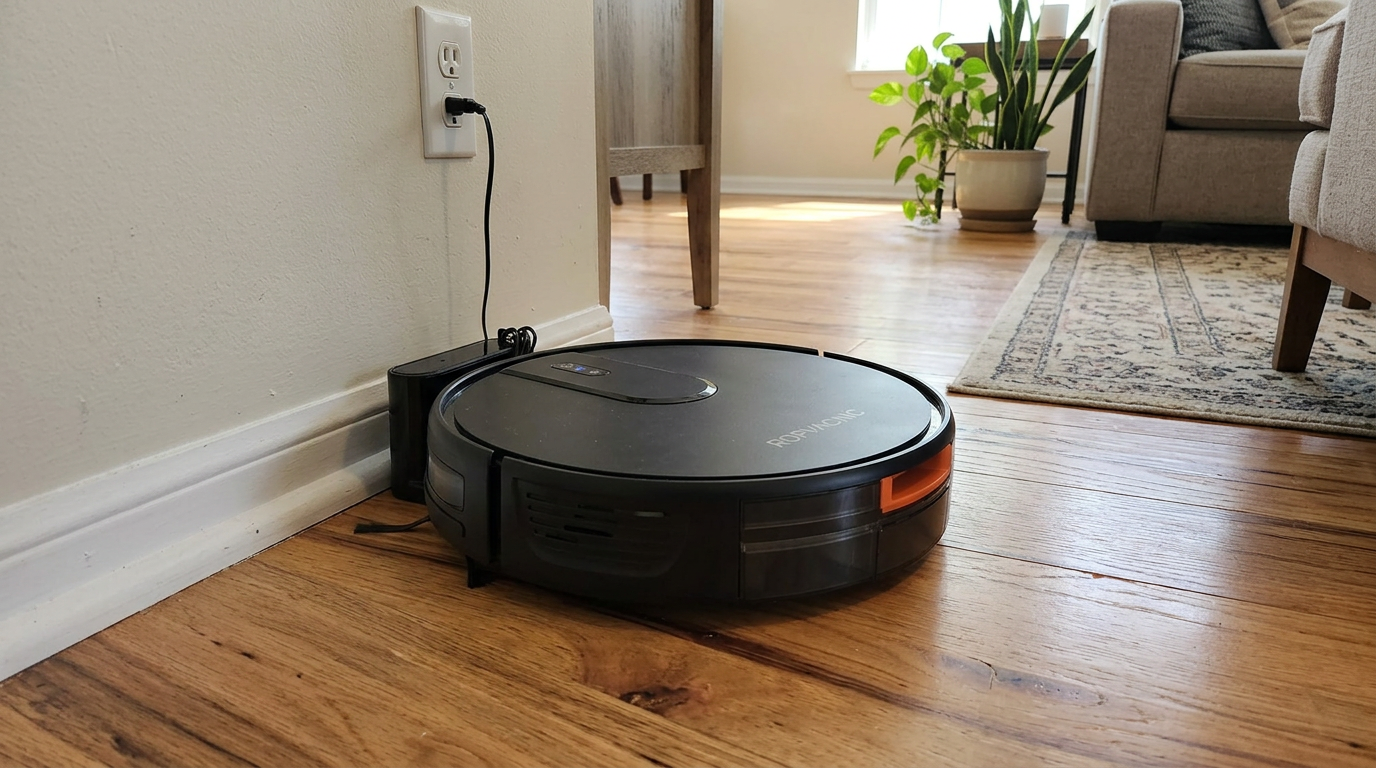
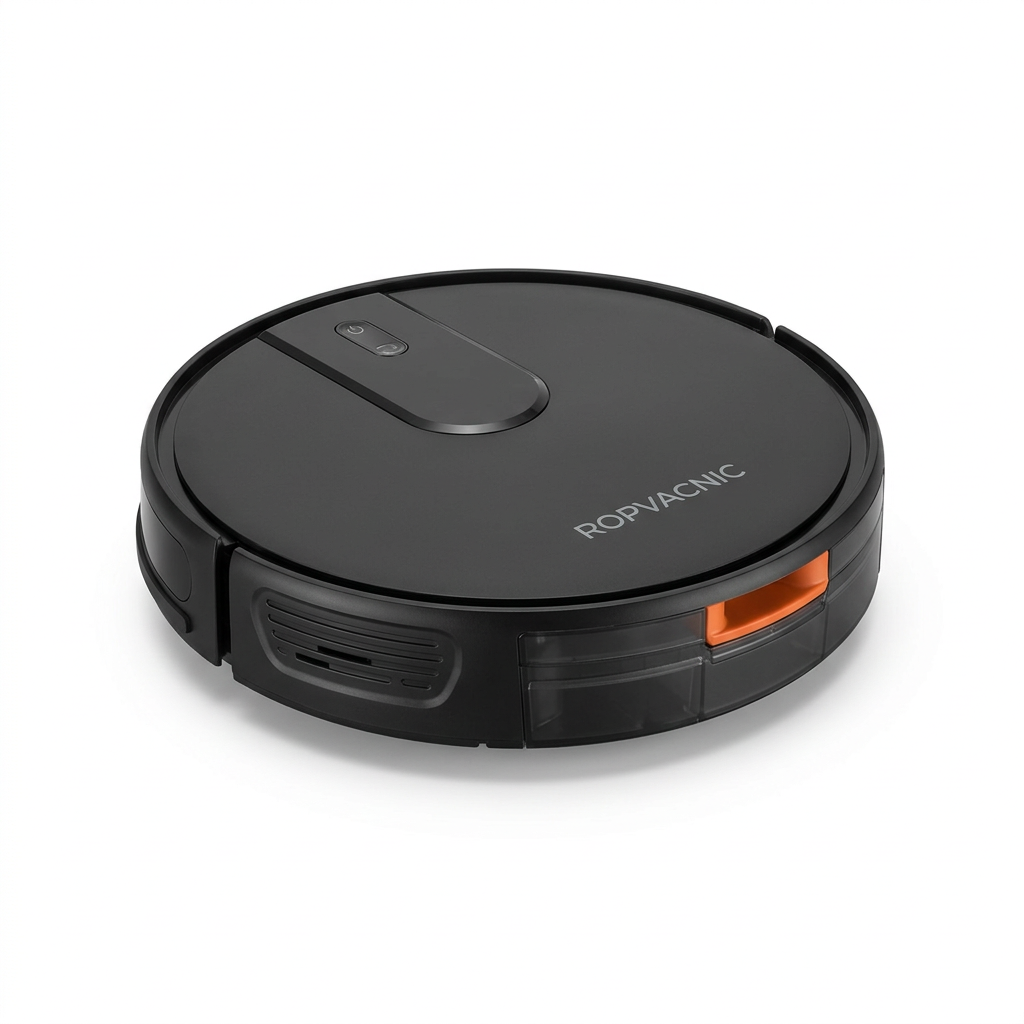
The ROPVACNIC arrives as a classic round robot with a compact charging dock. There’s no tower, no bulky base station and no water tanks on the dock, which makes it easy to tuck into a corner.
Getting started is simple. You charge the robot, pair it with the app over Wi-Fi, and press start, or skip the app entirely and use the remote.
That flexibility is one of its best features. Owners who don’t want an app on their phone can run everything from the remote, while others enjoy scheduling from the app.
A compact design that fits easily into smaller homes.
The robot is slim, so it reaches under many sofas, beds and TV stands that taller lidar robots can’t clear.
The first run is a good test. Watch where it goes, note any spots where it gets stuck, and you’ll know which rooms need a little prep before scheduled cleans.
What the ROPVACNIC Robot Vacuum and Mop is
This is a budget combo robot. It carries a dustbin and a water tank at the same time, so it can vacuum and mop in one pass instead of two separate runs.
It returns to a charging dock on its own when the battery runs low, but the dock doesn’t empty the robot or wash the mop. Those jobs are yours.
The cleaning system
ROPVACNIC describes a three-stage cleaning path: side brushes sweep debris inward, the main brush agitates and lifts it, and suction pulls it into the bin.
Suction is the headline number on the listing, and it is high for a budget robot. ROPVACNIC sells versions with different suction ratings, so check the exact figure on the listing you’re buying.
The mopping system
The mop is a flat pad attached under the robot. A small pump feeds water onto the pad, and you can choose between several flow levels to match the floor.
That electronic control matters. Cheaper gravity-fed mops can drip when the robot stops, while a pump only releases water when it’s moving.
What it leaves out
There’s no lidar turret, no camera, no self-empty base and no mop lifting. It is a focused, entry-level robot rather than a premium one with fewer features.
Key features, decoded
Budget robot listings are full of jargon. Here is what the key terms on this one mean in practice.
ROPVACNIC dock and design
The dock is a simple charging station. It plugs into the wall, and the robot backs onto its contacts to recharge.
Because it doesn’t empty or wash anything, the dock is small and quiet. There’s no loud emptying cycle, which some owners actually prefer.
The trade-off is maintenance. You’ll empty the dustbin by hand after most runs, refill the water tank before mopping, and rinse the mop pad yourself.
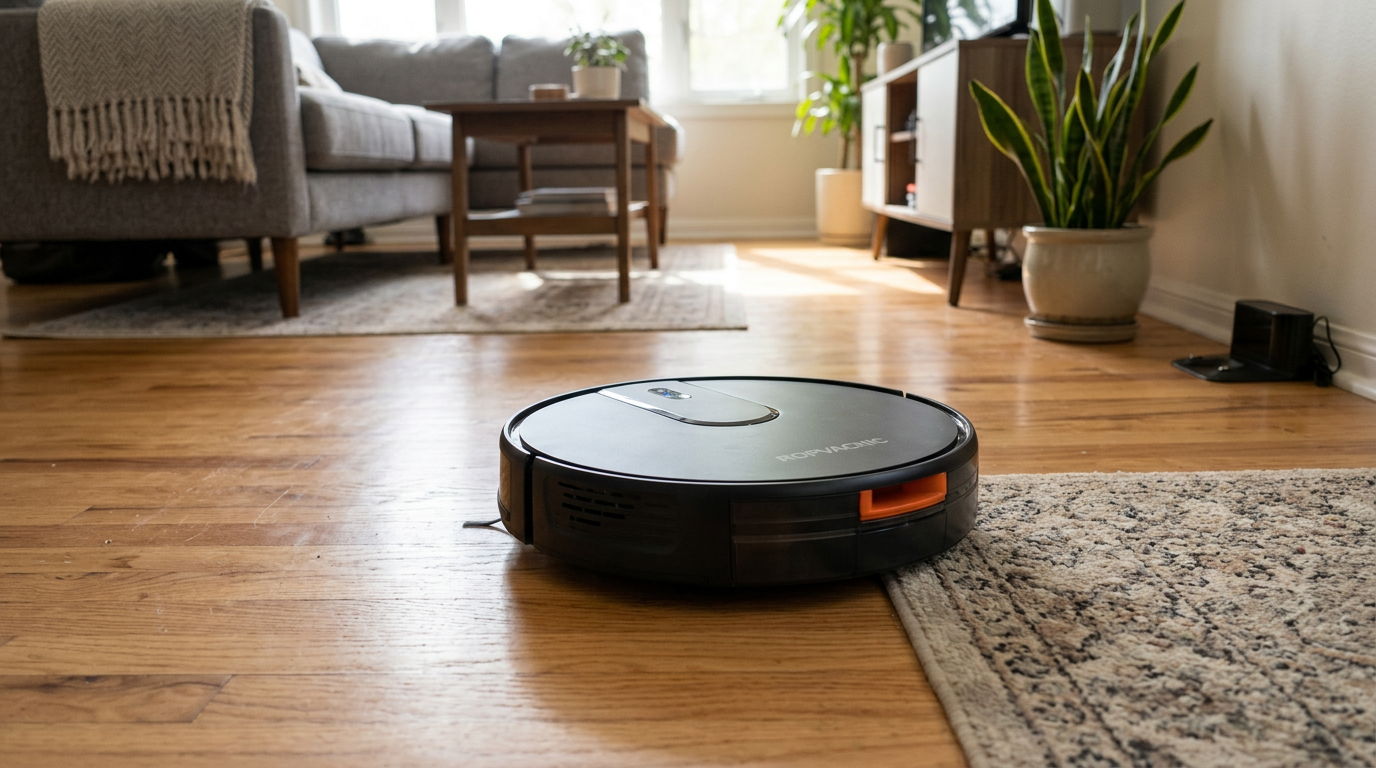
The mop keeps hard floors fresh between deeper cleans.
Give the dock some clear space on each side and in front. Robots without lidar find their way home more reliably when the approach is open.
My tip: Place the dock against a wall in a central spot with a clear runway in front. It noticeably improves how often the robot finds its way back.
The robot’s slim profile is a real advantage for cleaning under furniture, where dust tends to collect out of sight.
ROPVACNIC vacuuming performance
Suction is the ROPVACNIC’s strongest selling point, and owner feedback backs it up. People regularly describe it picking up dust, crumbs and pet hair better than they expected.
Hard floors
On hardwood, laminate, vinyl and tile, it performs well. The side brushes sweep debris toward the center, and the main brush and suction take care of the rest.
Fine dust along baseboards gets most of the attention it needs, though corners aren’t fully reached, as with most round robots.
Low-pile rugs
On thin rugs and low-pile carpet, it does a respectable job of surface pickup. It is fine for keeping a living room rug tidy day to day.
Medium and thick carpet
This is where budget robots fall behind. Without the sustained airflow and agitation of pricier machines, embedded dirt in thicker carpet isn’t fully removed.
Bin capacity
The dustbin is on the small side, which is common at this level. In a home with pets, you’ll likely empty it after every run.
My tip: Empty the bin after every clean, even if it doesn’t look full. A half-full bin reduces airflow and pickup faster than you’d think.
Pet hair and tangled hair
For a budget robot, the ROPVACNIC handles pet hair reasonably well. Owners with cats and short-haired dogs report noticeably less fur drifting around the house.
The brush design is meant to reduce wrapping, but no robot at this level is truly tangle-free. Long human hair and long pet coats still wrap around the brush and side brush hubs over time.
A quick brush check once a week is the best habit. Most models include a small cleaning tool for exactly this job.
Because the bin is small, heavy-shedding pets will fill it quickly. Plan on emptying it daily during shedding season.
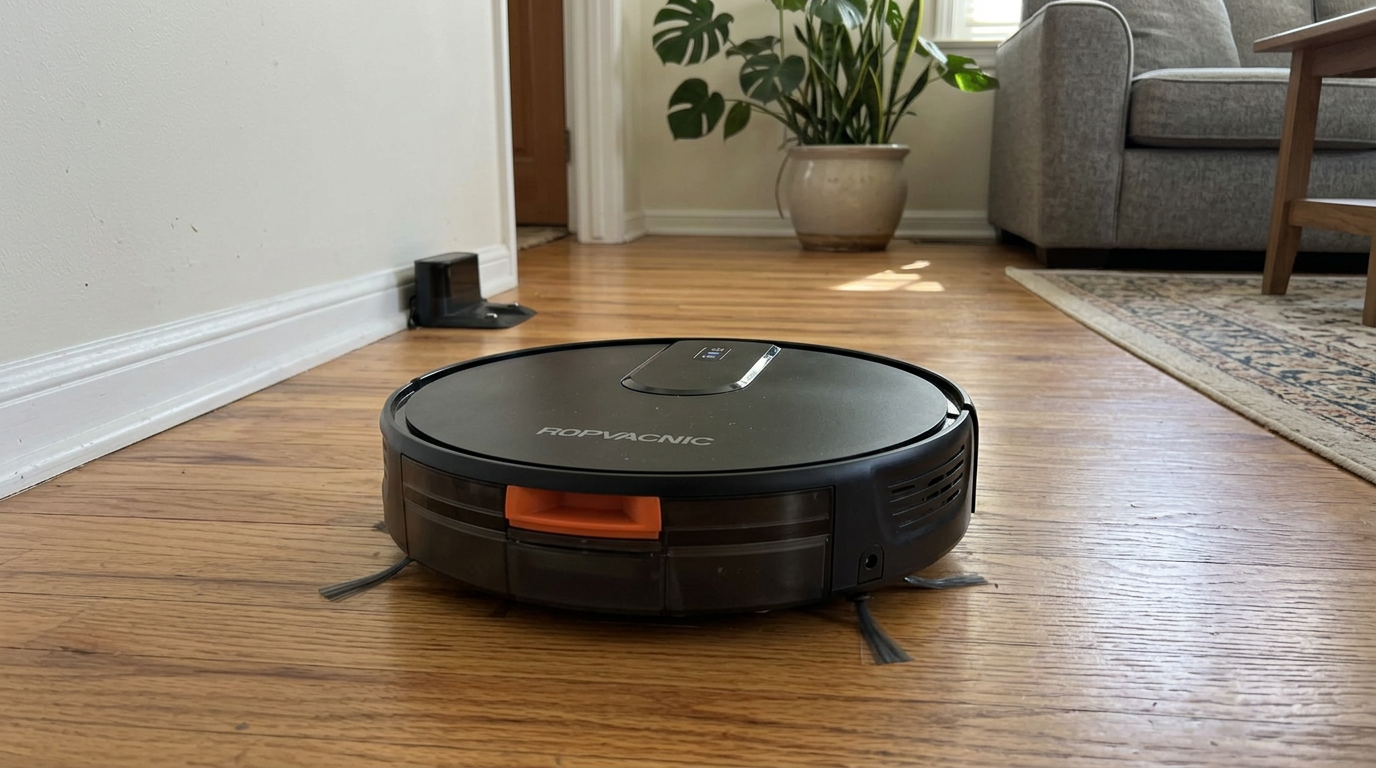
Check the brushes weekly to keep hair from building up.
My tip: Run it every day in shedding season. Short, frequent runs keep hair from clumping into balls that robots struggle to pick up.
ROPVACNIC mopping performance
The mop is a flat pad that wipes the floor as the robot drives. With adjustable water flow, you can keep it barely damp for wood floors or wetter for tile.
It does a good job of removing light dust and footprints, the kind of film that makes floors look dull. Floors feel fresher after a combined run.
It doesn’t scrub. There’s no spinning, vibrating or pressing action, so dried-on spills, sticky drinks and muddy paw prints usually need a manual touch.
Carpet and rugs
The mop doesn’t lift itself over rugs. That means you need to remove the mop pad or block rugs off before a mopping run, or the robot will wipe them too.
This is the most common complaint about budget mopping robots, and it applies here.
Hardwood floors
Use the lowest water setting on wood. Too much water on sealed hardwood can leave streaks, and on poorly sealed floors it can cause damage over time.
My tip: Rinse and air-dry the mop pad after every run. A damp pad left on the robot can start to smell within a day or two.
Navigation, obstacles and coverage
The ROPVACNIC doesn’t use lidar. It relies on onboard sensors to detect walls, furniture and stairs, then follows patterns to cover the floor.
In small, open rooms, that works fine. In larger or busier layouts, coverage is less predictable, and it may clean some areas twice while missing others on a single run.
Obstacle avoidance
Owners report that it moves around furniture and some obstacles without hitting them hard, which is encouraging at this level.
Small items such as charging cables, socks and pet toys are still a risk. Pick them up before each run.
Stairs and drops
Cliff sensors under the robot help it avoid falling down stairs. They work best on light floors and can be fooled by very dark rugs.
Getting home
It returns to the dock on its own when the battery is low, though without a map, docking depends on having a clear path.
My tip: Close doors to rooms you don’t want cleaned. Without a map or no-go zones, a closed door is the simplest boundary.
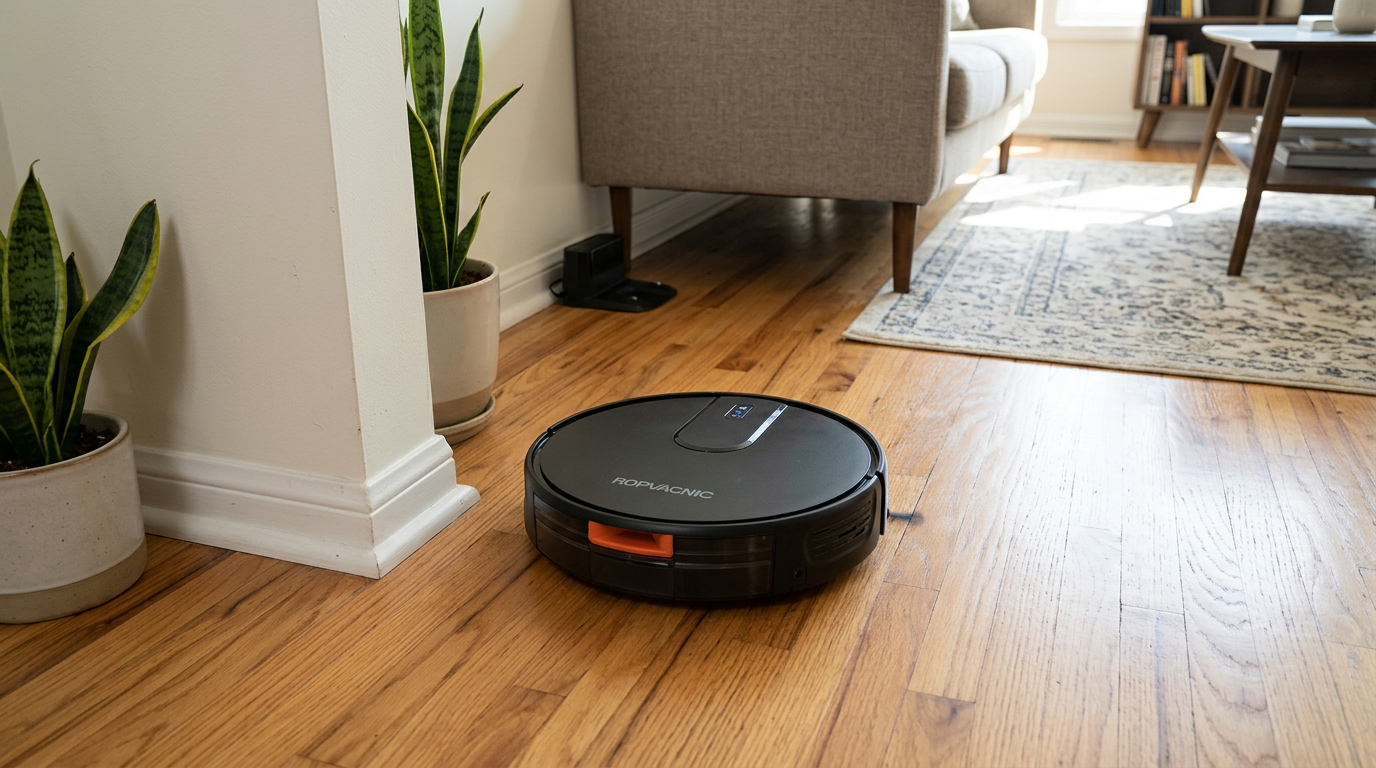
Clear floors help sensor-based robots cover more ground.
Battery, app and controls
Battery life is suited to small and medium homes. The robot runs until its battery is low, then returns to its dock to recharge.
Mopping adds weight and drag, so combined runs use the battery faster than vacuum-only runs.
The app is one of the pleasant surprises here. Owners describe it as easy to use, with quick response when you start or stop the robot.
You can schedule cleans, adjust suction, change water flow and pick cleaning modes from the app or the remote.
Expect fewer smart features than premium robots. There are no detailed room maps or virtual walls drawn on a floor plan.
Like most robots, it connects over 2.4 GHz Wi-Fi. If you prefer not to use an app at all, the remote handles everyday control.
How loud is the ROPVACNIC?
At normal suction, the robot runs at a level most people can talk over. Turning suction up makes it louder, as with any vacuum.
There’s no self-empty dock, so you also avoid the sudden emptying roar that self-empty bases make.
If noise matters, start with a lower suction setting on hard floors. You’ll often get similar results with less sound.
Living with the ROPVACNIC over time
Budget robots tend to show their weak spots after a few months, so long-term owner reports are worth reading carefully.
The most common long-term praise is that it keeps doing its job with simple care. Owners who clean the brushes and filter regularly report steady performance.
The most common long-term complaints involve wear items and mapping limits. Side brushes fray, filters clog, and the lack of a map becomes more noticeable as owners rely on it more.
ROPVACNIC is a newer brand without a long track record, so it is worth keeping your receipt and registering any warranty that comes with the robot.
The maintenance routine
Daily: empty the bin and rinse the mop pad. Weekly: clear hair from the brushes and wipe the sensors. Monthly: tap out or replace the filter.
That routine takes only a few minutes, but skipping it is what usually makes budget robots seem to get worse over time.
How the ROPVACNIC handles each floor type
Hardwood
Hardwood is one of its best surfaces. Suction clears dust and crumbs easily, and a barely damp mop removes the light film that dulls the finish.
Keep the water low and avoid mopping unsealed or waxed wood at all.
Tile and grout
On tile, the robot vacuums well and the mop freshens the surface. Grout lines are harder, since a flat pad glides over them rather than scrubbing into them.
Laminate and vinyl
Laminate and luxury vinyl plank are ideal. They are flat and smooth, so the robot moves easily and the mop leaves an even finish.
Low-pile rugs
Low rugs are fine for vacuuming. Remove the mop pad first, and the robot will climb on and tidy the surface.
Thick carpet and shag
Very thick carpet and shag rugs are the hardest surface for any budget robot. Expect surface tidying rather than deep cleaning, and keep shag out of its path entirely.
My tip: If you have a mix of floors, run a vacuum-only schedule for the whole home and a separate mopping run for the hard-floor rooms with doors closed.
Budget robot vs lidar robot: does mapping matter?
The biggest difference between the ROPVACNIC and pricier robots is mapping. It is worth understanding what you actually give up.
A lidar robot spins a laser to measure the room, builds a floor plan, and cleans in straight, efficient rows. It knows which room it is in and where it has already been.
A sensor-based robot like the ROPVACNIC reacts to what it bumps into or detects nearby. It covers the floor using movement patterns rather than a saved plan.
In a studio or a two-bedroom apartment, that difference is small. The robot has fewer rooms to cover, and repeated runs fill in any spots it missed the first time.
In a large house with long hallways and many doors, mapping matters a lot more. A mapped robot can clean one room on demand, skip another, and finish faster.
What you can do instead
You can get much of the benefit of room selection by closing doors. Run the robot in one area at a time, and you’ll get more consistent coverage.
Scheduling also helps. Daily runs mean that any spot missed today will likely be covered tomorrow, which keeps the floors looking clean overall.
Open layouts suit sensor-based navigation best.
When it makes sense to spend more
The ROPVACNIC is a great fit for a lot of people, but there are clear signs you’d be happier with a more expensive robot.
If you find yourself emptying the bin every day and wishing you didn’t have to, a self-empty dock will change your routine more than any other upgrade.
If you have carpet in most rooms, a robot with higher sustained suction and better agitation will pull more dirt out of the pile.
If your kitchen floor gets sticky often, a robot with spinning or pressurized mop pads will make a visible difference.
If you live on two floors or in a large home, lidar mapping with saved maps will make the robot faster and more predictable.
If none of those apply, there’s little reason to spend more. A budget robot that runs every day often keeps floors cleaner than an expensive one that sits in its dock.
What owners say about the ROPVACNIC
Owner feedback is mostly positive, with a clear split between people who bought it as an affordable helper and people who expected premium features.
- Suction is better than expected for the money
- The app is quick and easy to use
- Moves smoothly between vacuum and mop modes
- Handles tight spaces well
- Great first robot for busy households
- Mopping is light and doesn’t lift stains
- Small bin fills quickly
- Coverage in larger homes is inconsistent
- Some owners want a self-empty version
If you know what you’re buying, a budget combo that keeps floors tidy every day, you’re likely to be happy.
Check the exact version
ROPVACNIC sells this robot in more than one configuration, with different suction ratings. Read the listing carefully so you know which one you’re getting.
The brand is newer than the big names, so long-term reliability data is thinner. Register the warranty and keep your proof of purchase.
Where the ROPVACNIC fits best
Apartments and condos
Small, open layouts are perfect for this robot. Simpler navigation matters less when there are only a few rooms to cover.
Hard-floor homes
Hardwood, laminate, vinyl and tile let both the vacuum and the mop do their best work.
Pet households
Short-haired pets are a good match. Long-haired breeds will mean more brush cleaning and more frequent bin emptying.
Larger homes
In a big, multi-room house, a lidar robot with room mapping will clean more efficiently and more predictably.
Running costs to plan for
Running costs are low. There are no dust bags, no cleaning solution cartridges and no washing dock to maintain.
You’ll replace a few wear parts over time. Here is how I’d think about them.
| Consumable | Relative cost |
|---|---|
| Dust bags | None, manual bin |
| Filters | Low |
| Side brushes | Low |
| Mop pads | Low |
| Main brush | Low to medium |
| Battery | Medium, after a few years |
Relative cost over a typical year of daily use.
Mop pads are the item you’ll want to have spares of. Rotating two or three pads means one can dry while another is in use.
My tip: Buy a replacement kit with filters, side brushes and mop pads when you buy the robot. Having spares on hand makes it easy to stay on schedule.
How to get the best results from the ROPVACNIC
- Clear the floor first
Pick up cables, socks and toys before every run.
- Start with the remote
Learn the modes with the remote, then move to the app for schedules.
- Use low water on wood
Keep sealed hardwood just damp to avoid streaks.
- Remove the mop for rugs
The mop doesn’t lift, so take it off for carpeted rooms.
- Empty the bin every run
A clear bin keeps suction strong.
- Close doors
Use doors to keep it in the rooms you want cleaned.
- Wipe the sensors
Clean the cliff and bump sensors monthly with a dry cloth.
A sensible cleaning schedule for the ROPVACNIC
- Daily: vacuum main rooms
Run the kitchen and living areas every day to stay ahead of crumbs and hair.
- Every few days: vacuum and mop
A combined run on hard floors keeps them looking fresh.
- Weekly: brush check
Clear hair from the main and side brushes and rinse the filter housing.
- Monthly: deeper care
Replace or clean the filter and check the wheels for trapped hair.
What I’d check before buying the ROPVACNIC
A few simple questions will tell you whether this budget combo suits your home.
How big is your home?
Small to medium homes are the sweet spot. Large homes benefit from lidar mapping.
How much carpet do you have?
A few low rugs are fine. Lots of thick carpet calls for a more powerful, mapped robot.
How much mopping do you need?
For light, regular wiping, it’s fine. For sticky kitchens and muddy entryways, you’ll need a scrubbing mop.
Do you want to empty a bin?
There’s no self-empty dock, so you’ll empty the bin after most runs.
How low is your furniture?
Its slim body fits under many sofas, but measure the gap under your lowest pieces.
My tip: Check which suction version and accessories are included in the listing you’re buying. The bundles can differ.
Is the ROPVACNIC Robot Vacuum and Mop worth the money?
The ROPVACNIC makes sense as an affordable way to automate daily floor care. It vacuums well for its class and adds a light mop for hard floors.
You give up the conveniences that cost more: lidar mapping, self-emptying, mop lifting and real scrubbing.
For a small apartment with hard floors, that trade is easy to accept. The robot handles most daily mess and leaves you with deeper cleaning only now and then.
For a larger home, a robot with mapping and a self-empty dock will save you more time, even if it costs more upfront.
My bottom line is that this is a capable budget helper. Buy it for what it is, and it is good value.
ROPVACNIC vs Tikom G8000 Max
The closest rival is the Tikom Robot Vacuum and Mop Combo, another budget 2-in-1 with app and remote control.
| ROPVACNIC | Tikom G8000 Max | |
|---|---|---|
| Type | Vacuum and mop combo | Vacuum and mop combo |
| Navigation | Sensor-based | Gyro-based |
| Water control | Electronic, multiple levels | Adjustable |
| Self-empty | No | No |
| Control | App and remote | App and remote |
| Mop lifting | No | No |
Both are close. I’d pick the ROPVACNIC if suction and a responsive app top your list.
The Tikom stands out for long runtime and a roomy bin for its size, which helps in slightly larger homes.
ROPVACNIC Robot Vacuum and Mop specifications
Specifications from the manufacturer listing. Suction varies by version, so check your listing.
Best ROPVACNIC alternatives
If the ROPVACNIC isn’t quite right, these are the models I’d look at next.
Each of these costs more, but each solves one of the ROPVACNIC’s main limitations.
How I researched and rated the ROPVACNIC
This is a researched review. I based my verdict on the manufacturer’s specifications and a large sample of owner reviews, focusing on patterns that showed up repeatedly.
I scored it in these areas:
- Pickup on hard floors, rugs and carpet
- Mopping quality and water control
- Navigation, obstacles and docking
- Ease of use, maintenance and value
Because it is a budget model, I compared it mainly against other budget robots rather than premium all-in-one machines.
ROPVACNIC Robot Vacuum and Mop Combo FAQ
Does the ROPVACNIC vacuum and mop at the same time?
Yes. It carries a dustbin and a water tank, so it can vacuum and mop in the same run.
Does it have lidar mapping?
No. It uses onboard sensors rather than a lidar turret, so it doesn’t build a detailed room map.
Does it empty itself?
No. You empty the dustbin by hand after most runs.
Can I control it without an app?
Yes. It comes with a remote, and you can also use the app for scheduling and settings.
Is it good for pet hair?
It handles pet hair well for a budget robot. Expect to empty the bin often and check the brushes weekly.
Does the mop lift over carpet?
No. Remove the mop pad or keep it out of carpeted rooms when mopping.
Is it safe on hardwood?
Yes, on a low water setting. Keep the pad just damp on sealed wood.
How does it find its dock?
It heads back on its own when the battery is low. A clear path in front of the dock helps.
Is the ROPVACNIC worth it?
It is good value for small homes with hard floors. Skip it if you want mapping or a self-empty dock. check today’s price.


- ROPVACNIC product specifications for the ROPVACNIC Robot Vacuum and Mop Combo
- Published independent test results
- Owner reviews and long-term owner discussions
- Amazon product listing for the ROPVACNIC Robot Vacuum and Mop Combo
- Review first published.