Philips 5500 Series review: the quiet, everyone-gets-their-own-drink machine
The Philips 5500 Series LatteGo grinds and brews 20 hot and iced drinks at a touch, saves four people’s favorites, and still cleans its milk system in about ten seconds.
In this review
For a household where two to four people want different drinks every morning, yes. The Philips 5500 Series LatteGo takes everything I like about Philips’ simpler machines, the quiet ceramic grinder and the two-part LatteGo milk system, and adds a proper color display, four user profiles, an extra-shot button and 20 hot and iced presets. Its espresso is smooth rather than punchy, and the bean hopper is on the small side, but it is one of the easiest bean-to-cup machines to live with that I have used.
Philips 5500 Series at a glance
Philips 5500 Series pros and cons
- Very quiet grinding and brewing (SilentBrew)
- LatteGo milk system rinses clean in seconds
- 20 hot and iced presets, including flat white and ristretto
- Four user profiles plus a guest mode
- Extra-shot button for stronger milk drinks
- Ready to brew almost instantly with QuickStart
- Durable ceramic grinder with 12 settings
- AquaClean filter cuts descaling way down
- Slim body, under 10 inches wide
- Default espresso is mild; you need to turn strength up
- Bean hopper is small and beans can hang up
- Iced milk drinks are cool rather than ice-cold
- Mostly plastic housing
- Pump is louder than the grinder
- LatteGo jug can tip if stored on a crowded fridge shelf
- Grind changes only work while grinding
Who should buy the Philips 5500 Series?
- Households where several people drink different coffees
- Latte and cappuccino drinkers who hate cleaning milk tubes
- Early risers who don’t want to wake the house
- Anyone who wants a few iced drinks without extra gear
- People moving up from pods or a drip machine
- Fans of short, intense espresso
- Coffee hobbyists who want to tweak every variable
- Very heavy users who go through beans fast
- Anyone who wants a stainless-steel showpiece
- Single users who only drink black coffee
First impressions of the Philips 5500 Series
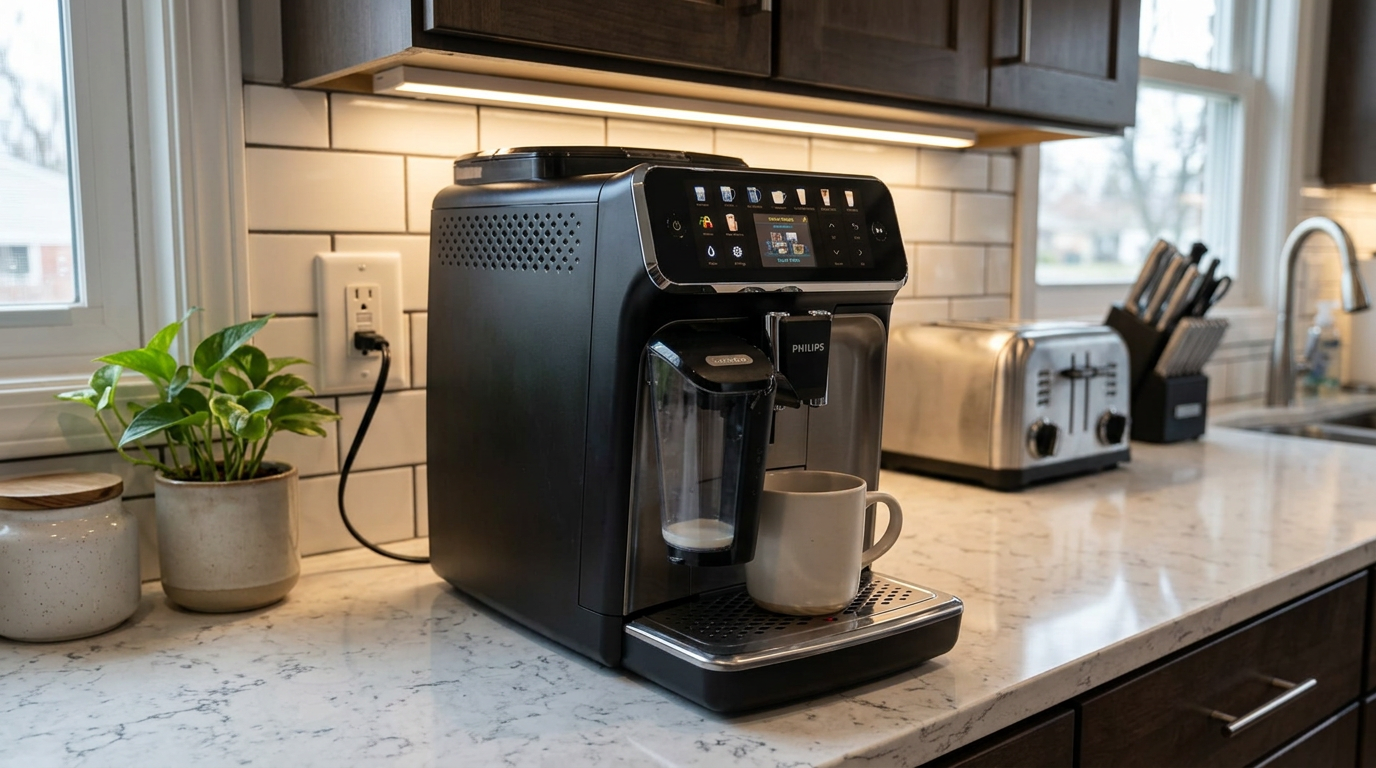
When I unboxed the Philips 5500 Series, my first thought was that it looked like a grown-up version of the cheaper Philips machines I have used before.
The footprint is almost identical: a little under 10 inches wide, about 14.6 inches deep and 17 inches tall.
That means it slips under standard upper cabinets and leaves room on the counter for a toaster or a fruit bowl.
What changes is the front. Instead of a row of icon buttons, there is a bright color display with touch-sensitive drink tiles around it.
The finish on my unit is a gray chrome trim around a glossy dark front, and it looks more expensive than it feels when you touch the side panels.
Like most machines in this class, the body is plastic. The drip tray cover and the hopper lid are light, and you can hear that when you set them down.
It doesn’t feel flimsy, just practical.
Philips designs the machine in Italy and builds it in Romania, and the fit of the panels on mine was tight and even.
Setup took me around fifteen minutes.
I rinsed the water tank, dipped the included test strip in my tap water, entered the hardness level, fitted the AquaClean filter and let the machine run its first rinse.
The display walks you through every step with short animations, so I never needed the paper manual.
The first two espressos were thin and a bit sour, which is normal while a new grinder beds in and the beans fill the burrs.
By the fifth or sixth cup the flavor had settled down, and by the end of the first week I had my strength and volume where I wanted them.
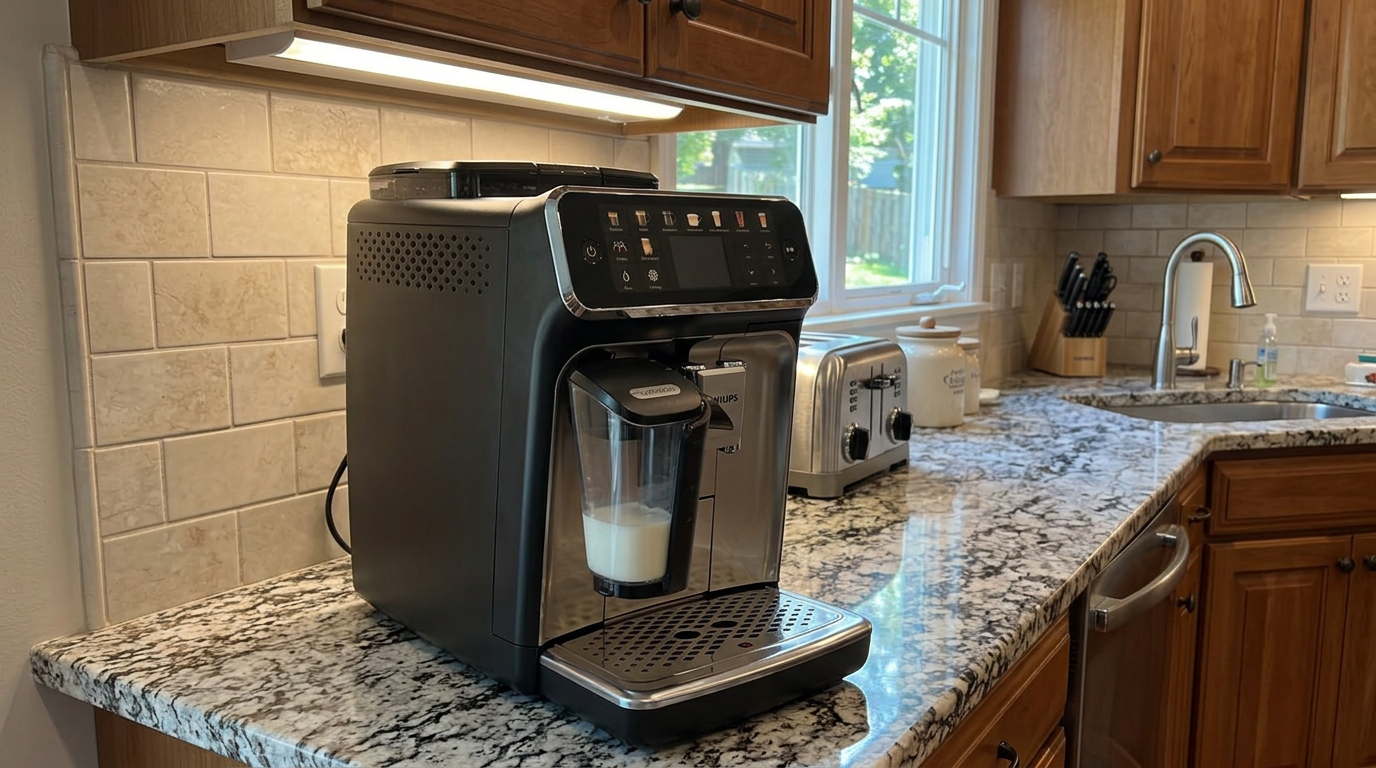
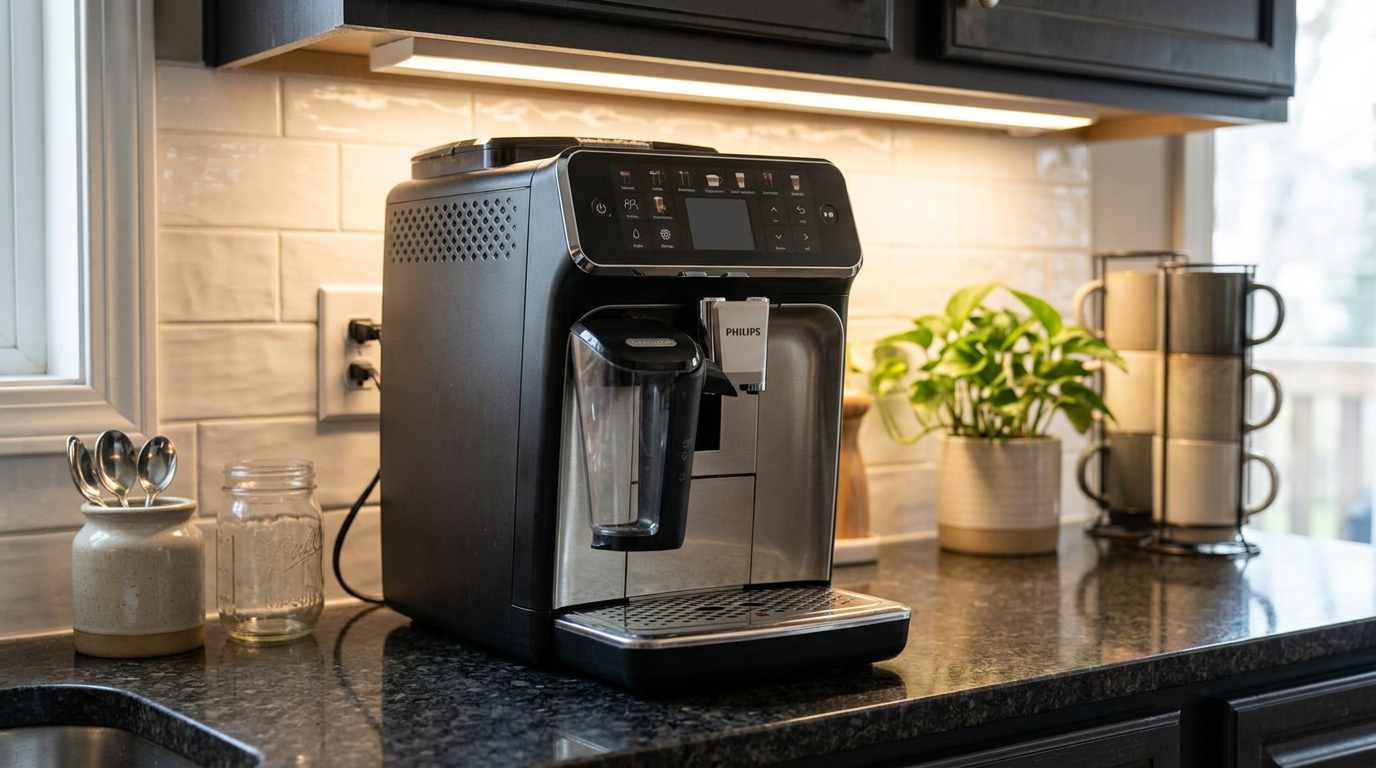
The 5500 Series has the same slim footprint as Philips’ entry machines, so it fits under most upper cabinets.
What the Philips 5500 Series actually is
The 5500 Series is a fully automatic espresso machine, which means it grinds whole beans, doses them, tamps the coffee, brews and dumps the used puck into a bin without you touching anything.
You pour beans into the hopper, fill the water tank, and the rest happens behind a closed door.
What sets this model apart within the Philips range is the amount of choice it gives you on top of that basic routine.
There are 20 presets in total, split between black coffee, milk drinks and iced drinks.
On the black side you get espresso, ristretto, espresso lungo, coffee, caffè crema and Americano.
On the milk side there is cappuccino, latte macchiato, caffè latte, flat white, café au lait and plain frothed milk.
Then there is a set of iced versions, including iced coffee, iced Americano, iced latte and iced cappuccino, plus hot water and a travel-mug setting for a bigger cup.
Each drink can be adjusted for strength, volume and, for milk drinks, the amount of milk.
Once you have it right, you can save it to one of four profiles, so my partner’s small, strong flat white and my big morning latte sit side by side and nobody has to change settings back and forth.
There is also a guest mode that doesn’t touch anyone’s saved drinks, which is handy when visitors start pressing buttons.
The machine heats with a thermoblock rather than a boiler, and QuickStart means it is ready to brew a few seconds after you switch it on.
In practice that meant I could press the power button and the drink button almost back to back on busy mornings.
The ceramic grinder and SilentBrew
Philips uses ceramic burrs in all of its LatteGo machines, and the 5500 Series is no exception.
Ceramic stays cooler than steel while it grinds and holds its edge for a long time, which Philips says is good for roughly 20,000 cups before the flavor starts to suffer.
There are 12 grind settings, from fine to coarse, adjusted with a small dial inside the bean compartment.
I settled on the third-finest setting for a medium roast and the fifth for a darker blend.
One thing to know: you can only turn the dial while the grinder is running.
It sounds fussy, but it protects the burrs. I simply started an espresso, clicked the dial one step and let the next couple of drinks show me the result.
The bigger story here is noise.
Philips calls it SilentBrew, a combination of sound shielding around the grinder and a quieter grinding process, and the machine carries a Quiet Mark certification.
Philips claims it is 40 percent quieter than its earlier machines, and that matches my experience.
The grind cycle is a low, muffled whir rather than the sharp rattle I am used to from bean-to-cup machines.
I could make a cappuccino at 6 a.m. in an open-plan kitchen without waking anyone upstairs.
The loudest part of the cycle is actually the pump when it pushes water through the coffee and steams the milk.
That is a few seconds of buzzing, a bit louder than a kettle about to boil, and it is the only moment I noticed the machine from the next room.
Several owners mention the same thing: the grinder is whisper-quiet, the pump is ordinary.
The bean hopper is my main complaint in this part of the machine.
It holds around 9 ounces of beans, which is about a week of drinks for two coffee lovers.
Because the hopper is shallow and wide, beans can also settle in the corners as it empties, and the machine will tell you to add beans when there are still some sitting away from the grinder opening.
A quick shake or a nudge with a spoon fixes it, but it happens often enough that I started topping up before it ran low.
There is a separate chute for pre-ground coffee, which is useful if you want a decaf in the evening without emptying your regular beans.
Tip: Turn the grind one step at a time and judge it after two or three drinks. The first cup after a change still contains some coffee from the old setting.
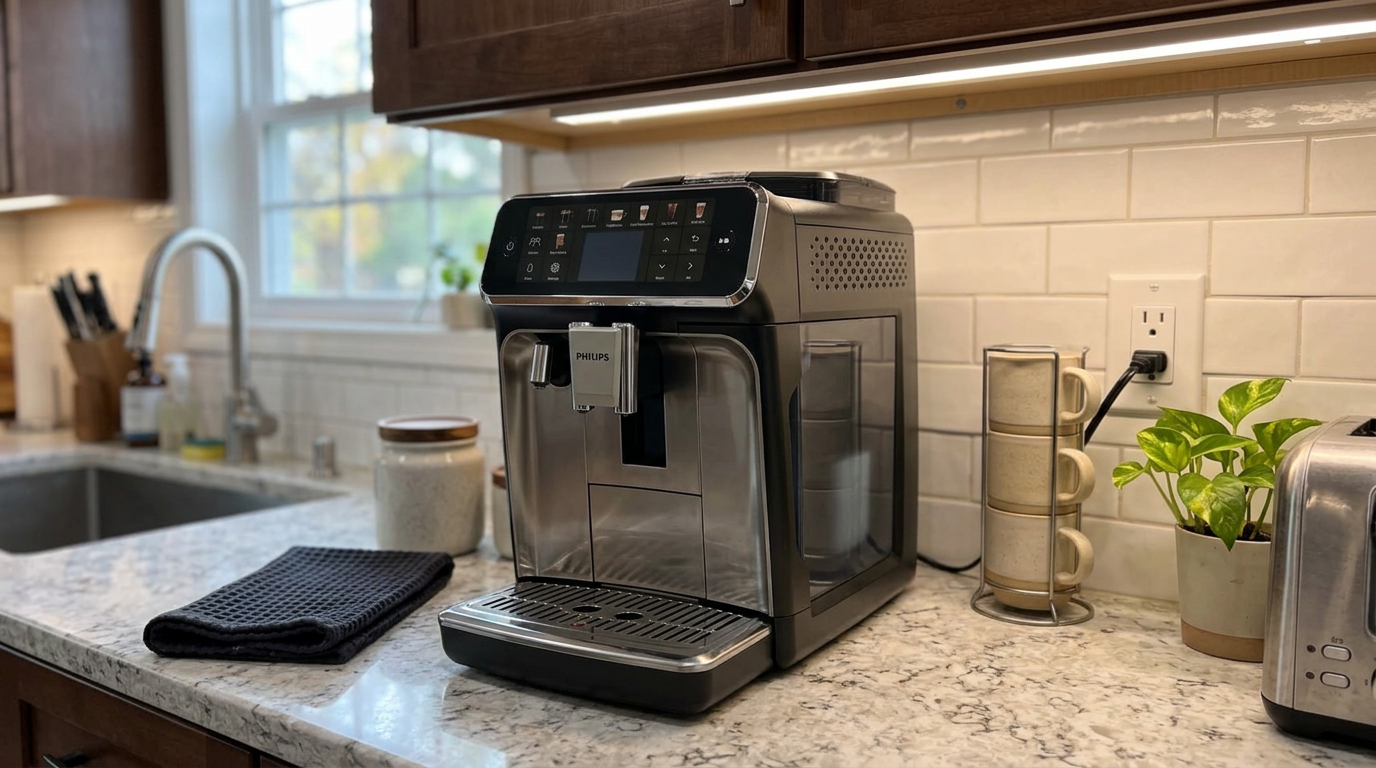
The ceramic grinder sits under the lid on top; it is quiet enough for early mornings in an open kitchen.
How good is the coffee?
Out of the box, the espresso from the 5500 Series is smooth, round and fairly mild.
On the middle strength setting my medium roast tasted nutty and sweet, with soft acidity and a thin but even layer of crema.
It was pleasant, but not the dense, syrupy shot some people expect from the word espresso.
The reason is the dose.
Philips uses a fairly light dose of ground coffee per shot, adjusted automatically across its three strength levels, and that keeps the flavor on the gentle side.
Turning strength up to the highest level and pairing it with a slightly finer grind made the biggest difference.
The shot gained body and chocolate notes, and the crema got thicker.
For milk drinks, the Extra Shot button is the real fix.
It adds another brew cycle to the drink, so a latte made with the extra shot tastes properly of coffee instead of warm milk with a hint of espresso.
I ended up saving my latte with the extra shot on as the default in my profile.
The ristretto is the strongest single shot the machine makes, and it is my pick if you like a short, intense coffee.
It cuts the water volume and keeps more of the sweetness of the bean.
The plain Coffee and Americano settings make a big mug of smooth, easy black coffee.
Coffee pushes more water through the grounds; Americano brews a shot and then adds hot water, which tastes cleaner and less bitter to me.
If you drink black coffee by the mug, try both and keep the one you like, because they really do taste different.
Drink temperature was fine for me, hot enough to sip straight away but not scalding.
If you prefer it hotter, there are three temperature levels in the settings, and pre-warming the cup with a shot of hot water helps a lot with small espresso cups.
My settings: Medium roast, grind setting 3, strength at maximum, and the extra shot on for every milk drink. For black coffee, the Americano preset at the largest volume.
LatteGo milk drinks
LatteGo is the reason most people buy a Philips, and it is still the best part of this machine.
Instead of a tube that sucks milk from a carton, LatteGo is a small plastic jug that clips onto the front of the machine.
Steam and milk swirl together in a chamber inside the lid, and the foam drops straight into your cup.
There are no hidden pipes for milk to sour in.
The foam itself is good for the class.
My cappuccinos came out with firm, fine-bubbled foam that held its shape to the last sip, and the lattes were creamy and layered.
The flat white uses a thinner foam and less milk, and it was one of my favorite drinks from the machine once I added the extra shot.
Oat and soy barista-style milks worked well too, though plain almond milk made a thinner, bubblier foam that collapsed faster.
That is typical of almond milk in any machine, not a Philips problem.
You can adjust the milk amount for each drink and save it to your profile.
Milk temperature is warm and drinkable rather than very hot.
If you like a latte that stays hot for a long walk to the desk, warm the cup first or keep the milk volume a little lower so the coffee doesn’t cool it as much.
The cleaning is where LatteGo really shines.
After a milk drink, I pulled the jug off, pulled the frothing lid apart and rinsed both parts under the tap.
It takes about ten seconds, and both parts can also go in the dishwasher.
If there is milk left over, the included storage lid turns the jug into a small fridge container.
One owner complaint I can confirm: the jug is narrow and tall, so if you stuff it into a busy fridge door it can tip over.
I kept it on a shelf instead and never had a spill.
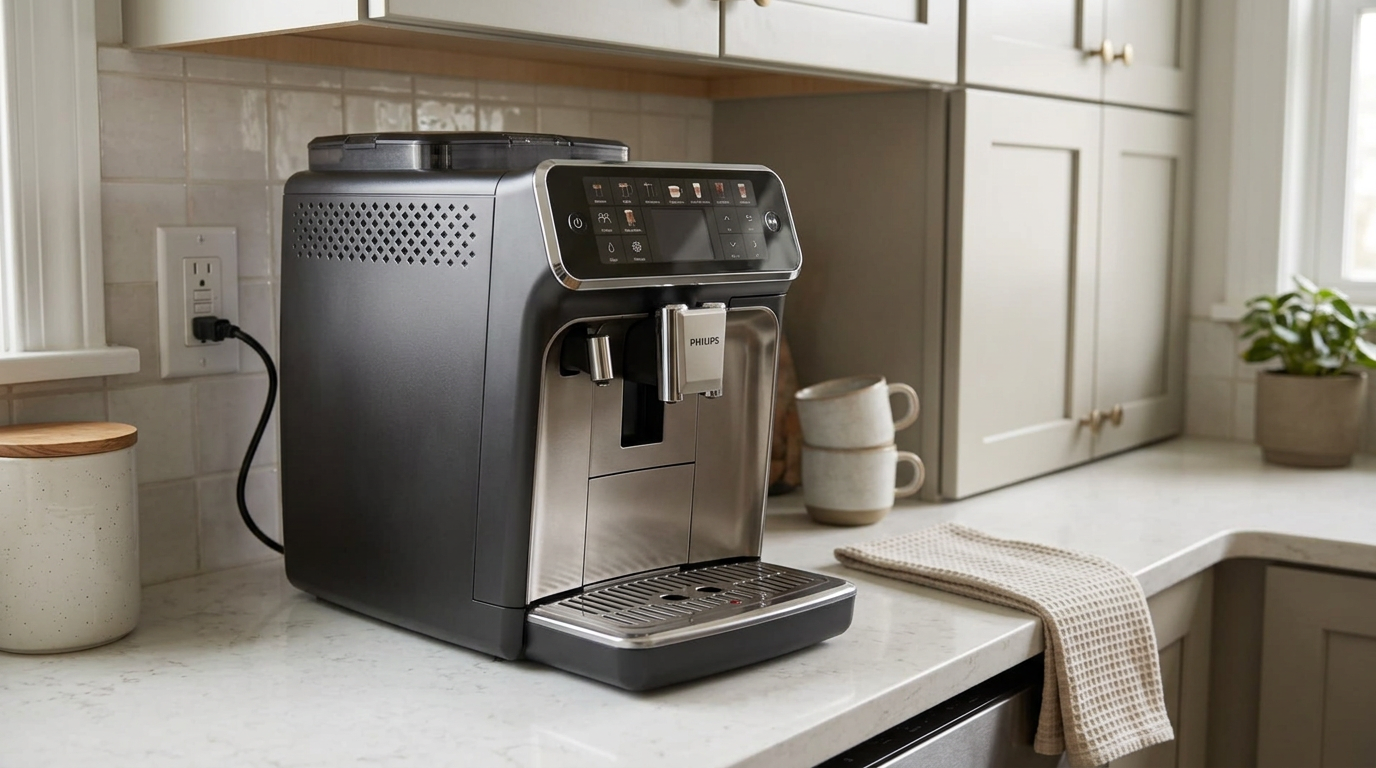
The LatteGo jug clips on the front and separates into two parts for rinsing.
Iced coffee and iced milk drinks
The 5500 Series is one of the few Philips machines with dedicated iced presets, and they are more useful than I expected.
When you pick an iced drink, the display tells you to fill a glass with ice, and the machine brews a more concentrated coffee designed to be diluted as the ice melts.
The result is noticeably stronger than simply pouring a regular coffee over ice, which always tastes watery to me.
Iced Americano and iced coffee were the most successful.
Both came out smooth and refreshing, and I liked them on hot afternoons with a splash of cold milk.
The iced latte and iced cappuccino use LatteGo foam, which is warm, so the drink ends up cool rather than ice-cold.
It tastes good, and the layer of foam on top of the ice looks great in a tall glass, but it isn’t the same as a café iced latte made with cold milk.
If you want a truly cold milk drink, use the iced coffee preset and top it up with cold milk from the fridge.
Use plenty of ice, and use large cubes if you can, because small cubes melt quickly under hot coffee.
The machine’s spout can be raised for tall glasses, and a 16-ounce glass fit underneath without trouble.
Display, profiles and everyday controls
The color display is the main reason I would choose the 5500 Series over Philips’ simpler machines.
Drinks are shown as clear pictures, and when you select one, the strength, volume and milk settings appear on screen with plus and minus buttons beside them.
It is quick to learn, and my kids figured out the hot water and frothed milk buttons on their own.
Profiles are the feature I used most.
Each of the four profiles stores its own version of every drink, so I set up one for me, one for my partner and one for weekend guests who like big milky drinks.
Switching profiles is one tap at the top of the screen.
The guest mode is a nice touch: it uses factory settings and doesn’t overwrite anything.
The Extra Shot button sits right on the main screen, which I appreciate, because burying it in a menu would make it easy to forget.
The travel mug setting makes a larger coffee for a commuter cup, and the spout height is enough for most tall mugs.
The settings menu is simple: water hardness, temperature, auto-off time, filter status and the cleaning and descaling routines.
There are no app controls, and honestly I didn’t miss them on a machine this simple to operate.
My only gripe is that the touch areas around the display are sensitive.
Wiping the front with a damp cloth while the machine was on started a drink more than once, so I learned to switch it off before cleaning.
The color display shows each drink as a picture, with strength, volume and milk settings beside it.
Cleaning and daily upkeep
For a fully automatic machine, the 5500 Series is low effort to keep clean.
It rinses its coffee circuit automatically when you turn it on and off, and LatteGo takes seconds by hand or goes in the dishwasher.
The grounds container and the drip tray slide out together from the front.
I emptied the grounds after roughly a dozen drinks and rinsed the drip tray every two or three days, and the machine reminds you when either is full.
The drip tray is also dishwasher safe.
Once a week I pulled out the brew group from the side door and rinsed it under lukewarm water.
It takes about a minute, and you should let it air dry before putting it back.
Being able to remove and rinse the brew group is one of the best things about Philips machines, because coffee oils and old grounds can build up inside otherwise.
Every couple of months, depending on how much you brew, the machine asks you to lubricate the brew group with the small tube of grease from the box, and to run a degreasing tablet through it.
Both jobs take a few minutes and the display tells you exactly what to do.
AquaClean filter and descaling
The AquaClean filter sits inside the water tank and softens the water before it reaches the machine.
Philips says that if you replace the filter whenever the machine asks, you can go up to 5,000 cups without descaling, based on eight filter changes.
In practice, the machine prompts for a new filter roughly every couple of months for a two-person household.
I recommend using it, especially if your tap water is hard.
Scale is the main thing that kills these machines over time, and a filter is far easier than a 30-minute descaling cycle.
If you skip the filter, the machine will ask you to descale based on the hardness you entered during setup, and the process is guided on screen.
Use a descaler made for espresso machines rather than vinegar, which can damage the seals.
What a normal week looks like
To give you a realistic picture, here is how the 5500 Series fit into my week with two coffee drinkers and the occasional guest.
Mornings were a latte with an extra shot for me and a flat white for my partner, both from saved profiles.
Afternoons were usually an Americano or an iced coffee, and evenings were a decaf made with the pre-ground chute.
That is around six to eight drinks a day.
At that pace I filled the water tank once a day, emptied the grounds every other day, topped up the beans twice a week and rinsed LatteGo after every milk drink.
I rinsed the brew group on the weekend.
None of it ever felt like a chore, and that is really the point of this machine.
Tips to get the best from the Philips 5500 Series
- Use fresh, medium or dark roasts. Very light roasts can taste sour on any automatic machine, and very oily beans can clog the grinder over time.
- Turn strength up first. The highest strength setting and one step finer on the grinder is the single biggest improvement for espresso.
- Use the extra shot for milk drinks. A latte with one shot can taste milky; two shots make it taste of coffee.
- Save your drinks to a profile. It takes a minute and saves you from adjusting the same drink every morning.
- Warm your cups. A small espresso cup straight from the cupboard steals a lot of heat from the coffee.
- Keep the AquaClean filter in. It is the easiest way to avoid frequent descaling and protect the machine.
Where the Philips 5500 Series falls short
No machine is perfect, and there are a few things I would change here.
The first is espresso intensity.
If your idea of good coffee is a short, thick, intense shot, the 5500 Series will need tuning, and even then it stays on the smooth, mellow side.
It is excellent for milk drinks and long coffees, but it isn’t a machine for espresso purists.
The second is the bean hopper, which is small and lets beans hang up in the corners.
Heavy users will be refilling it more often than they would like.
The third is the iced milk drinks, which are cool rather than cold because the milk foam is warm.
Finally, the housing is mostly plastic.
It is solid and well put together, but if you want a machine that looks like a polished steel appliance, this isn’t it.
None of these were dealbreakers for me, but they are worth knowing before you buy.
Philips 5500 Series test results
Here is how I rated each drink and task after using the 5500 Series as my main machine, cross-checked against published tests and owner feedback.
Scores are out of 10.
| Drink or task | Rating | What stood out |
|---|---|---|
| Espresso | 7.8 | Smooth and nutty; needs max strength |
| Ristretto | 8.2 | Best short drink; sweet and concentrated |
| Americano | 8.3 | Clean, easy mug of black coffee |
| Cappuccino | 8.8 | Fine, firm foam; very consistent |
| Latte (extra shot) | 8.7 | Creamy and balanced |
| Flat white | 8.6 | Silky foam, good coffee flavor |
| Iced coffee | 8.0 | Concentrated brew holds up to ice |
| Iced latte | 7.2 | Tasty, but cool rather than cold |
| Noise | 9.3 | Grinder is remarkably quiet |
| Daily cleaning | 9.2 | LatteGo rinses in seconds |
| Customization | 8.4 | Four profiles, extra shot, 20 presets |
Philips 5500 Series specifications
From Philips’ published specifications, the Amazon listing and my own measurements.
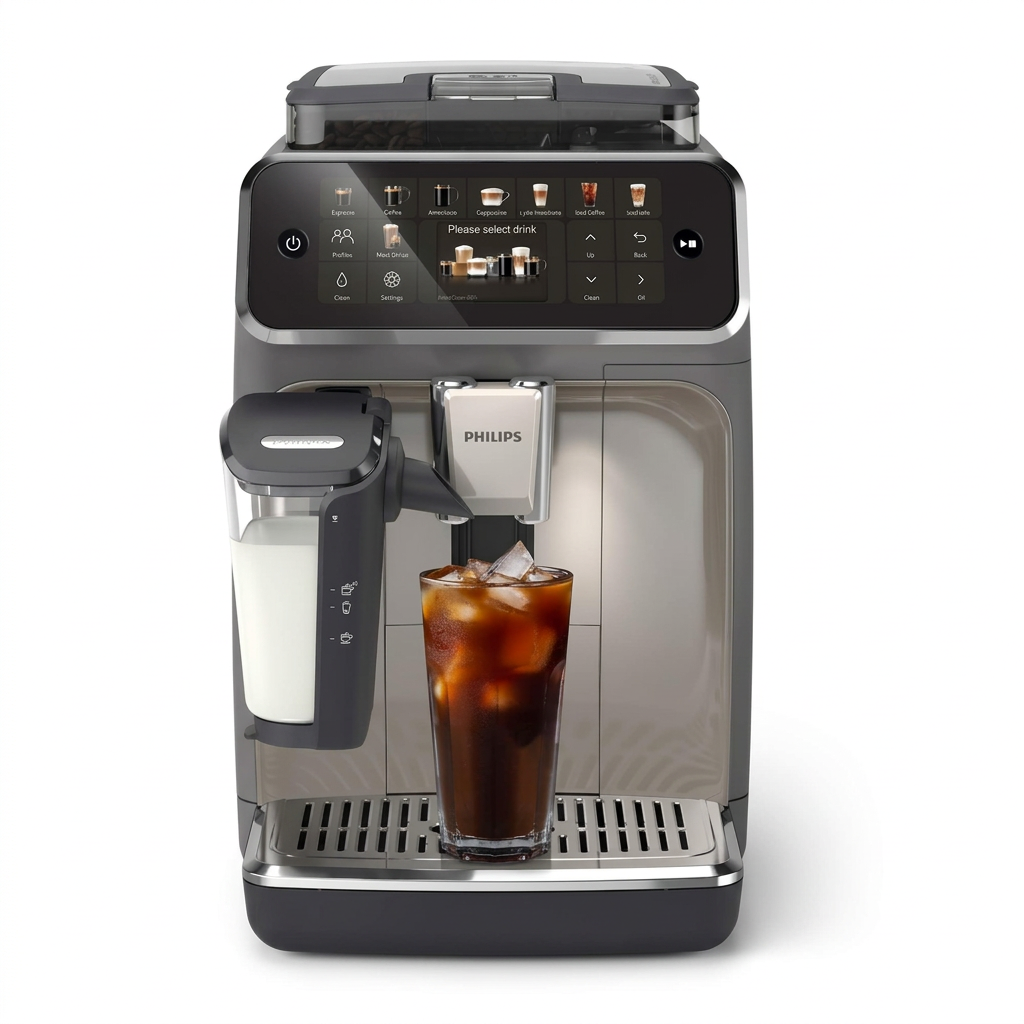
The 5500 Series in its gray chrome finish, shown here making an iced coffee.
Is the Philips 5500 Series worth it?
I think the 5500 Series hits a sweet spot in the Philips range.
Compared with the Philips 3300 Series, you get the same quiet grinder and LatteGo, but you add the color display, four profiles, the extra-shot button, flat white and ristretto, and a full set of iced drinks.
For a single person who drinks one or two cappuccinos a day, the 3300 is enough.
For a couple or a family, the profiles alone justify the step up, because nobody has to re-adjust the machine every time they use it.
It is also worth thinking about what you spend on café drinks.
If two people buy a latte most days, a machine like this pays for itself faster than you might expect, and the drinks are ready in your kitchen in under a minute.
Where I would hesitate is if you mostly drink straight espresso and want a strong, syrupy shot.
The 5500 Series can get close with the right settings, but its strengths are milk drinks, long coffees and convenience.
Philips 5500 Series alternatives
If the 5500 Series isn’t quite right, these two Philips models are worth a look.
How I tested and rated the Philips 5500 Series
I used the 5500 Series as my main coffee machine for daily espresso, ristretto, Americanos, cappuccinos, lattes, flat whites and iced drinks, with dairy, oat and almond milk.
I tried three different bean blends, from a medium single origin to a dark espresso blend.
I cross-checked my impressions against the manufacturer’s specifications, published independent tests and a large set of owner reviews, so the score reflects how the machine holds up over months, not just the first week.
The overall score is a weighted editorial rating built from four parts:
- Ease of use (9.2): setup, display, profiles, noise and daily cleaning.
- Milk drinks (8.6): foam quality, consistency, plant milk results and how easy LatteGo is to live with.
- Coffee quality (8.0): espresso flavor, body, crema and long coffee.
- Value (8.3): what you get compared with other machines in this class.
I don’t accept payment for reviews, and the brand had no say in this article.
Final verdict on the Philips 5500 Series
The Philips 5500 Series is a machine built around making good coffee easy for everyone in the house.
It is quiet, quick to start, simple to clean, and the profiles mean each person gets their own drink exactly the way they like it.
The LatteGo system remains the easiest automatic milk frother I know of to keep clean.
Its espresso is mellow rather than bold, and its bean hopper could be bigger, but those are small prices to pay for how pleasant it is to use every day.
If you want lattes, cappuccinos and iced coffees at home with almost no effort, the Philips 5500 Series is very easy to recommend.
After weeks of daily use, the 5500 Series earned a permanent spot on my counter.
Philips 5500 Series FAQ
Is the Philips 5500 Series worth it?
For households with more than one coffee drinker, yes. The four profiles, 20 presets and LatteGo milk system make it easy for everyone to get their favorite drink with one touch.
How many drinks does the Philips 5500 make?
It has 20 presets, including espresso, ristretto, coffee, Americano, cappuccino, latte macchiato, caffè latte, flat white, iced coffee, iced latte and hot water.
Can the Philips 5500 make iced coffee?
Yes. Its iced presets brew a concentrated coffee over a glass of ice. Iced milk drinks use warm LatteGo foam, so they are cool rather than ice-cold.
How many user profiles does it have?
Four user profiles plus a guest mode that doesn’t change anyone’s saved drinks.
Is the Philips 5500 quiet?
Yes. Its SilentBrew grinder is Quiet Mark certified and Philips says it is 40 percent quieter than its earlier machines. The pump is louder than the grinder for a few seconds.
Does LatteGo work with plant-based milk?
Yes. Oat and soy barista-style milks foam well. Regular almond milk makes a thinner foam.
Is LatteGo dishwasher safe?
Yes. Both parts of LatteGo and the drip tray can go in the dishwasher, or you can rinse LatteGo under the tap in about ten seconds.
How often do I need to descale it?
If you use the AquaClean filter and change it when prompted, Philips says you can make up to 5,000 cups without descaling.
Can I use pre-ground coffee?
Yes. There is a separate chute for one scoop of pre-ground coffee, useful for decaf.
Philips 5500 or Philips 3300?
Choose the 5500 for profiles, a color display, iced drinks, flat white and the extra-shot button. Choose the 3300 if you live alone and want the simplest Philips with LatteGo.