De’Longhi Rivelia review: two hoppers, rich espresso and a machine that learns your beans
The De’Longhi Rivelia swaps between two bean hoppers, guides you to the right settings for every coffee and froths milk three different ways, all from a compact machine with one of the nicest touchscreens in its class.
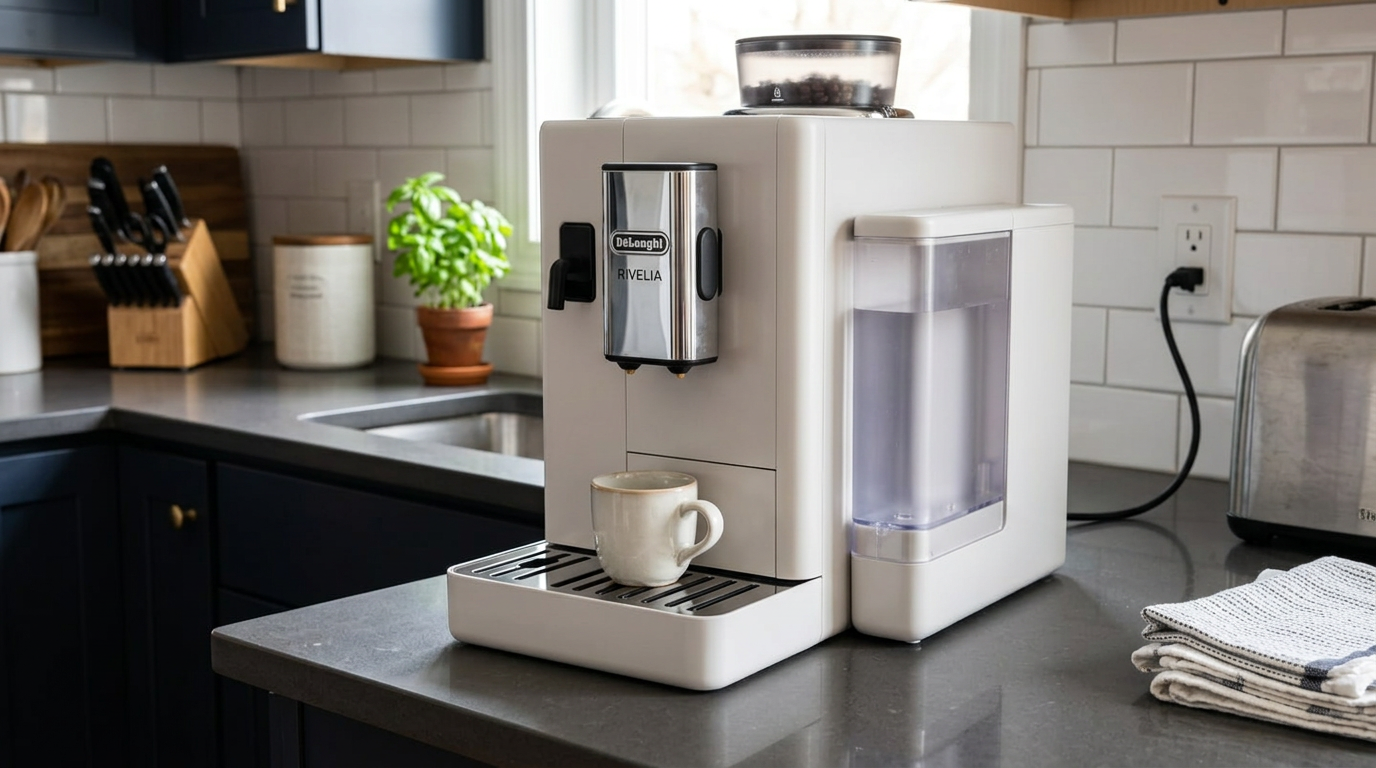
In this review
For people who want rich espresso and properly textured milk without learning barista skills, yes. The De’Longhi Rivelia pairs a touchscreen that is a pleasure to use with two swappable bean hoppers, a guided Bean Adapt setup that genuinely improves your coffee, and a milk carafe with three foam settings. It brews some of the fullest-bodied espresso I have had from a push-button machine. The hoppers aren’t airtight and share one grind setting, plant milks are hit or miss, and cold foam needs an extra accessory, but this is a machine that makes great coffee feel effortless.
De’Longhi Rivelia at a glance
De’Longhi Rivelia pros and cons
- Rich, full-bodied espresso with thick crema
- Two swappable 8.8-oz hoppers make regular-to-decaf switching easy
- Adjustable milk foam and four profiles suit the whole household
- One shared grind setting, so very different roasts are a compromise
- Plant milks can froth poorly, and cold foam costs extra
- Small water tank and limited room for tall travel mugs
Who should buy the De’Longhi Rivelia?
- Households that split regular and decaf
- Couples and families with different drink preferences
- Anyone who wants café-style drinks without barista skills
- People who alternate between very light and very dark roasts
- Anyone who relies on plant milk or wants cold foam or true cold brew
- Heavy drinkers who fill tall travel mugs every day
First impressions of the De’Longhi Rivelia
The De’Longhi Rivelia is one of the better-looking fully automatic machines I have had on my counter.
My unit is the Sand Beige finish, a warm, matte color with chrome-look accents around the spout and the milk carafe, and it looked right at home next to white cabinets and a marble-style counter.
It also comes in black, white and gray if beige isn’t your thing.
The shape is a neat, rounded box with a cylindrical bean hopper on top.
At roughly 9.75 inches wide, 17 inches deep and 14.75 inches tall with the hopper fitted, it is compact for a machine with this many features.
It weighs about 21.4 pounds, so sliding it forward to reach the side door is easy enough.
Lifting it is another matter: there are no obvious handholds, so think about where it will live if you expect to move it often.
The water tank sits on the side and can be filled from above without removing it, which is handier than it sounds.
| Measurement | Size | What it means in your kitchen |
|---|---|---|
| Width | About 9.75 in | Compact enough for a tight counter |
| Depth | About 17 in | Measure your counter before you buy |
| Height | About 14.75 in with the hopper | Taller than some comparable models |
| Weight | About 21.4 lb | Easy to slide, awkward to lift |
Up close it is mostly plastic, as almost every machine in this class is.
The parts click together firmly, though, and nothing on my unit felt loose or rattly.
Setup took me around fifteen minutes.
The touchscreen walks you through each step:
- Choose your language.
- Set your water hardness.
- Fit the water filter.
- Rinse the system.
- Start Bean Adapt for your first beans.
I recommend doing it right away; it makes the first cups noticeably better.
The number of adjustments can feel like a lot at first, so expect to spend a week or two experimenting with beans, strength, grind and volume.
Once your favorites are saved, daily use comes down to a single tap.
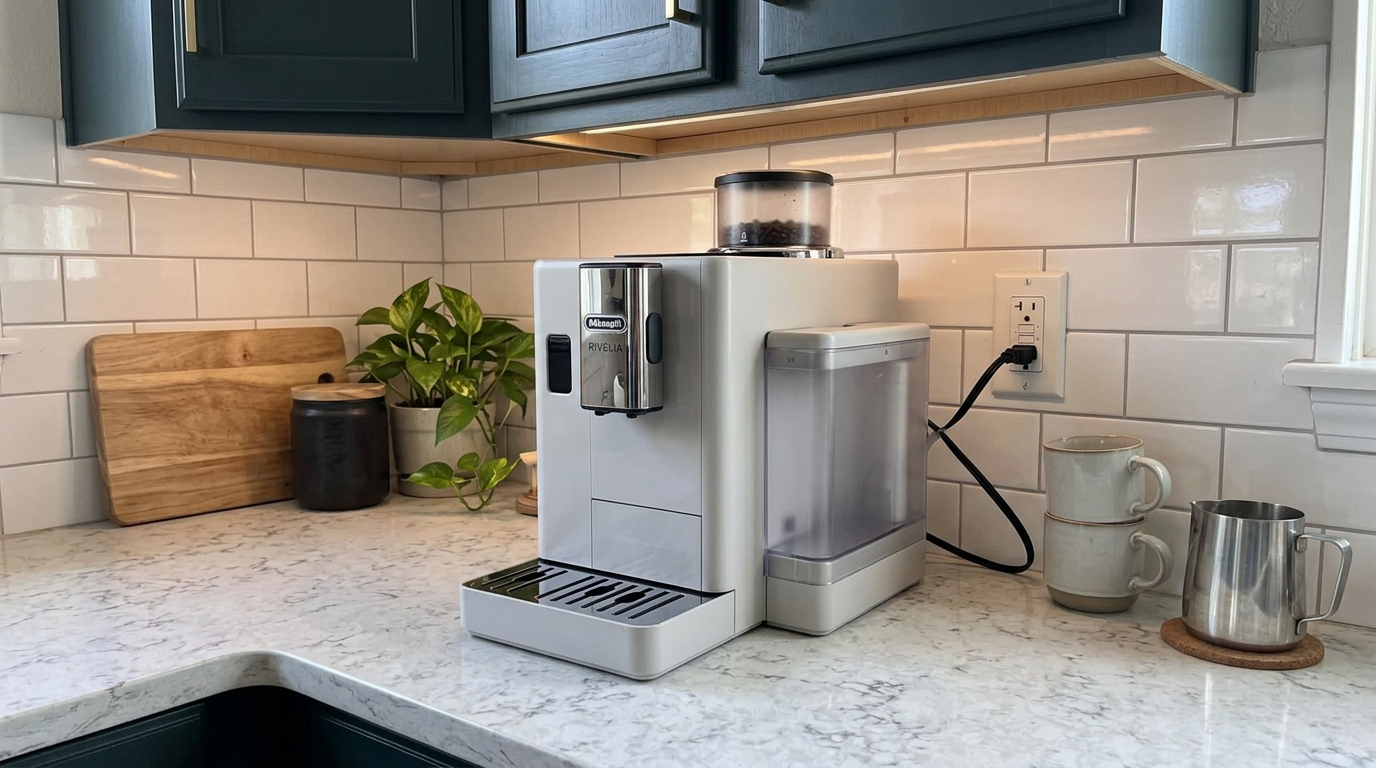
The Sand Beige Rivelia is compact for a dual-hopper machine and looks at home in a light kitchen.
What the De’Longhi Rivelia actually is
The Rivelia is a fully automatic espresso machine that sits in the middle of De’Longhi’s range, above the entry-level button machines and below the brand’s big flagship models.
It grinds, doses, tamps, brews and froths at the touch of a button, and it adds three features that set it apart: two swappable bean hoppers, a guided Bean Adapt setup and a milk carafe with three texture settings.
De’Longhi lists 18 preset recipes for this model.
| Category | Drinks | Good to know |
|---|---|---|
| Black coffee | Espresso, double espresso, lungo, long coffee, Americano, regular coffee | Long coffee uses a pulsed brew |
| Milk | Cappuccino, latte, latte macchiato, flat white, cortado, espresso macchiato, plain hot milk | Latte macchiato pours milk first, then espresso on top |
| Iced | Iced coffee, espresso over ice | The screen tells you how much ice to add |
| Hot water | Tea and other hot drinks | Measured at about 194–203°F |
Each drink lets you adjust intensity and quantity, and there is an extra-shot function for stronger milk drinks.
Save the extra shot as part of your recipe, and the machine adds it automatically, so you never have to brew a separate espresso.
You can save your version of every drink to one of four user profiles.
My partner had a small, strong cortado saved, and I had a bigger cappuccino with a double shot, and neither of us ever had to touch the other’s settings.
Two hoppers and Bean Switch
The dual hoppers are the Rivelia’s headline feature, and they are a joy for anyone who drinks more than one kind of coffee.
Each hopper holds about 8.8 ounces of beans, and the whole cylinder twists off the top of the machine.
You twist the other one on, and you have switched coffees.
- Fill the second hopper.
- Unlock and remove the installed hopper.
- Brew or purge the beans left in the grinder.
- Fit the replacement hopper.
- Lock it into place and follow the screen.
What makes De’Longhi’s version clever is what happens to the beans already inside the grinder.
When you remove a hopper, the Rivelia enters Bean Switch mode and asks whether you want to purge the leftover coffee or use it to make one last drink.
About 0.35 ounces of beans stay in the grinder, roughly one drink’s worth, so I usually brewed a final regular espresso before putting the decaf hopper on in the evening.
Brewing them means nothing goes to waste, but each option has a trade-off.
| Bean Switch option | What happens | Choose it when |
|---|---|---|
| Brew one last drink | Uses up the 0.35 oz in the grinder; the next drink may carry a little of the old coffee | You are moving between two similar blends |
| Purge the grinder | Sends the leftover beans to the grounds container | You want to avoid caffeine carryover into decaf |
Our tip: Purge the grinder when you switch from regular to decaf for someone who needs to avoid caffeine.
There are two small catches.
The leftover drink uses whatever is in the grinder, so you can’t change its strength, and it is a little smaller than a full shot.
More important, the hoppers aren’t airtight.
They are fine for a week or so of beans, but you shouldn’t treat the spare hopper as a storage container for coffee you won’t use for a month; keep that in a sealed canister instead.
The grinder is a burr grinder with 13 settings, adjusted with a dial inside the bean compartment.
As with most automatic machines, turn it only while it is grinding, one step at a time.
I found the second-finest setting best for a medium roast and the fourth for a dark blend.
That dial is shared by both hoppers, and the machine doesn’t change it for you when you swap.
This is the real limit of the dual-hopper idea: a dark roast and a light roast may not both extract well at the same setting.
| What you keep in the two hoppers | How well it works | Why |
|---|---|---|
| Regular blend + comparable decaf | Best use | Similar roast, so one grind setting suits both |
| Two similar blends | Very good | Little or no grinder adjustment needed |
| Medium roast + dark roast | Workable | Move the dial between my second and fourth settings |
| Very light roast + very dark roast | Compromise | No single grind setting suits both |
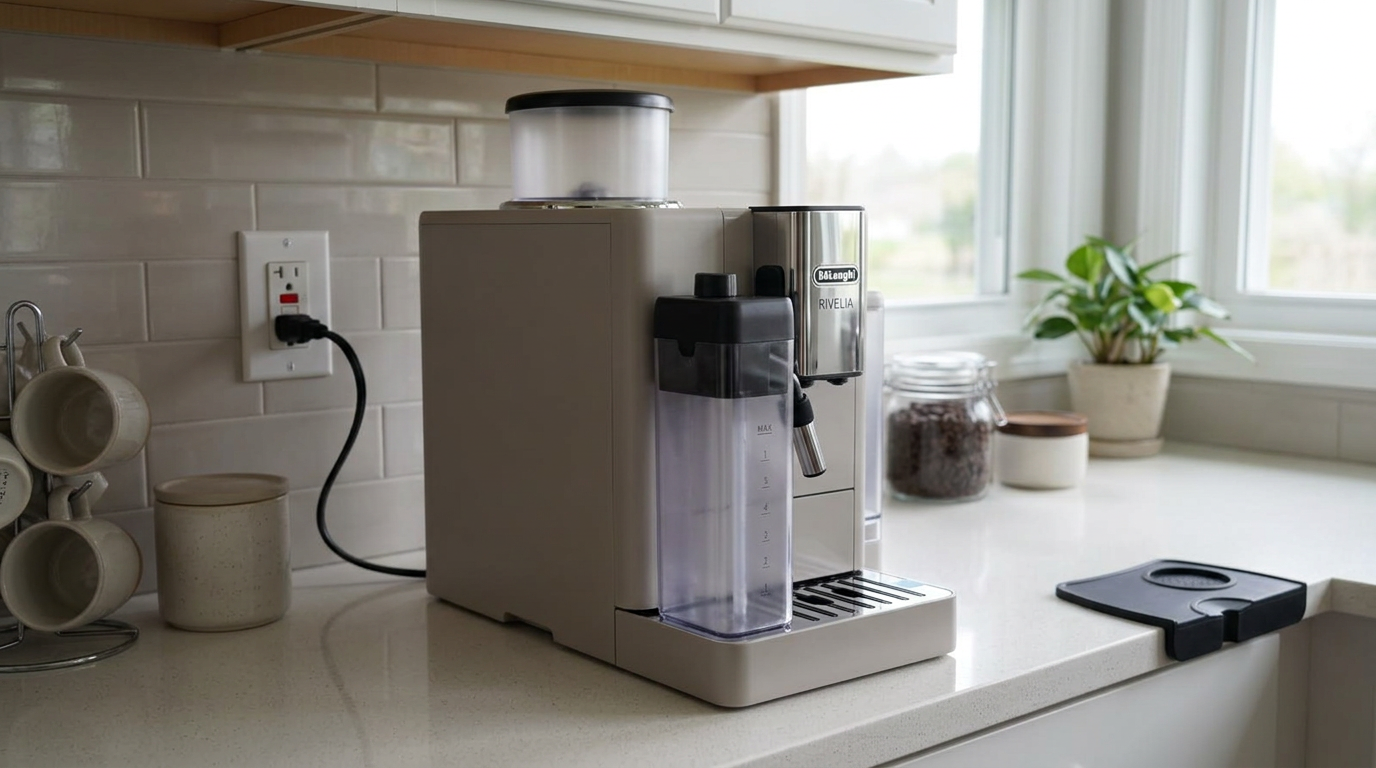
The bean hopper twists off the top, and the second hopper can hold decaf or a different roast.
Bean Adapt: guided dialing in
Bean Adapt is the feature I expected to ignore and ended up using every time I opened a new bag.
Different beans need different settings, and working those out is the part of espresso that frustrates most beginners.
Bean Adapt turns it into a short conversation with the touchscreen.
You tell the machine roughly what you have loaded, for example a medium or dark roast, and it suggests a starting grind, dose and brewing temperature.
You brew a coffee, then tell the Rivelia how it tasted: too bitter, too sour or just right.
It adjusts its recommendations based on your answer, and after two or three cups you save the result.
The saved profile is linked to that bean, so your recipe settings can follow each coffee.
The grinder dial is the exception, since it is a physical control you have to move yourself.
For my dark espresso blend it pointed me toward a slightly coarser grind and lower temperature, which took the harsh edge off.
For a lighter, fruitier coffee it pointed me finer and hotter, and the sourness I tasted at first disappeared.
| What I tasted | Coffee | Where Bean Adapt pointed me | Result |
|---|---|---|---|
| Too bitter or harsh | Dark espresso blend | Slightly coarser grind, lower temperature | Harsh edge gone |
| Too sour | Lighter, fruitier coffee | Finer grind, higher temperature | Sourness gone |
If you already know how to dial in espresso, you can skip Bean Adapt and adjust things yourself.
But for most people this is one of the most genuinely useful features I have seen on an automatic machine.
Our tip: Run Bean Adapt with every new bag, even of the same coffee, because fresher or older beans can need a different grind.
How good is the coffee?
This is where the Rivelia earns its score.
Once dialed in, its espresso is rich, full-bodied and round, with a thick, even crema.
It leans toward chocolate and caramel notes rather than bright fruit, which is typical of automatic machines, but it tasted more like café espresso than I expected.
Fresh beans make the biggest difference, and the machine grinds finely enough to form a compact puck.
In one detailed test at high intensity, it used about half an ounce of ground coffee to pour about one ounce of espresso.
That dose is comparable to some higher-end De’Longhi automatics, even though the brew group, at about 1.7 inches across, is slightly smaller than on certain other De’Longhi models.
My favorite settings were maximum intensity, the second-finest grind and a shorter shot of about one fluid ounce.
The factory volumes are on the long side for my taste, which is common on this kind of machine.
The easy fix is to stop the drink when it looks right; the Rivelia then asks if you want to save that volume, and next time it brews exactly that amount.
Our tip: Use fresh beans and save a shorter one-ounce shot before you touch any other setting.
The double espresso and the cortado were standouts.
You won’t get the flavor depth of a good traditional portafilter machine, but you also don’t have to grind, dose, tamp or time anything yourself.
The long coffee uses a pulsed brew that gives a smoother mug than simply running more water through the grounds, and the Americano adds hot water to a shot for a clean, easy black coffee.
Strength and water volume are adjustable on the longer drinks, so the Rivelia can replace a separate basic coffee maker for many people.
For milk drinks, the extra-shot function is worth using; a latte with two shots has real coffee flavor.
There is also a pre-ground chute, with a little scoop that stores inside the machine.
It works, but it is fussy.
The chute lifts out for cleaning, which helps stop old coffee from building up.
Use exactly one level scoop of a medium grind, and you will get a decent decaf; overfill it and it can clog.
With two hoppers, though, I found it easier to keep decaf beans in the second hopper and leave the chute alone.
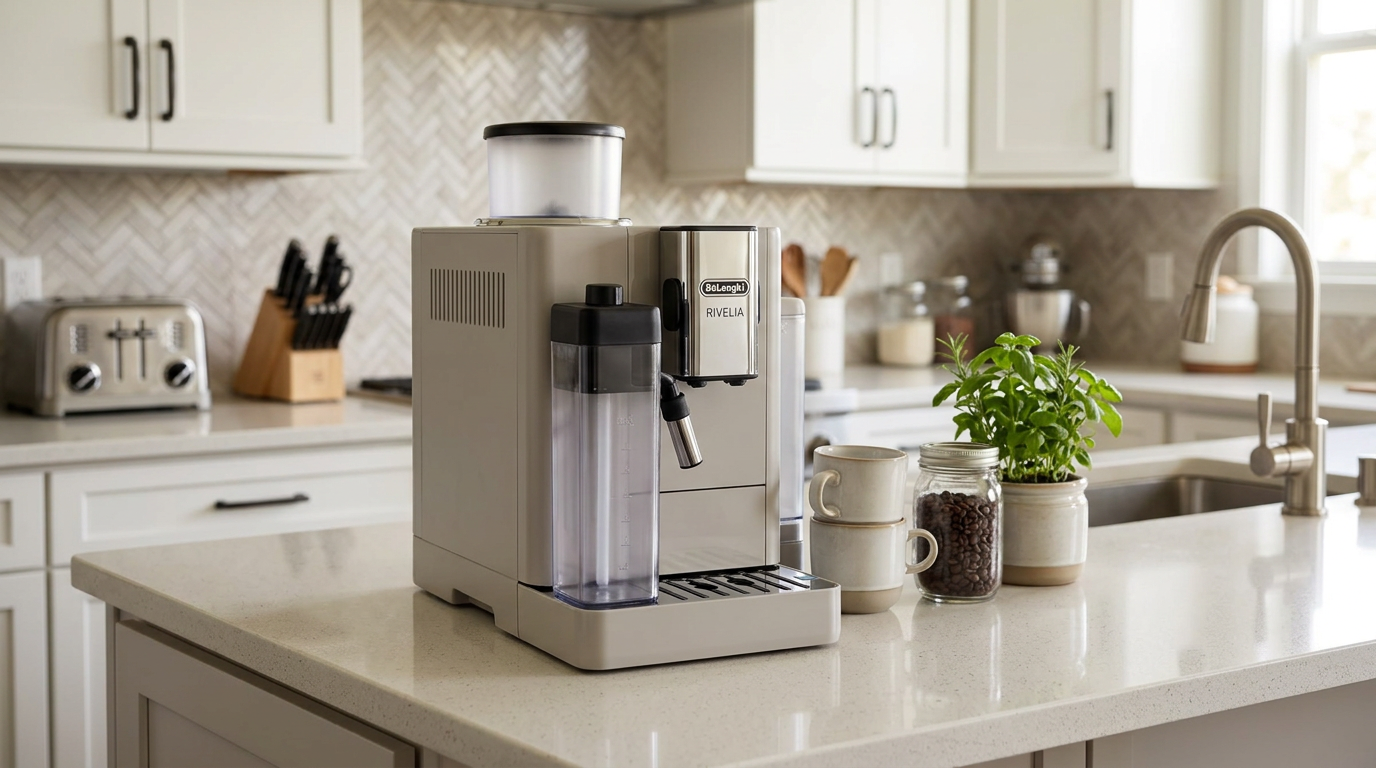
Dialed in with Bean Adapt, the Rivelia brews a rich espresso with thick crema.
Milk drinks with LatteCrema Hot
The Rivelia comes with De’Longhi’s LatteCrema Hot system, an insulated-style milk carafe that clips onto the front of the machine and pours foam straight into the cup.
On top of the carafe is a dial with three positions: hot milk, soft foam and dense foam.
That dial makes a bigger difference than I expected.
| Dial position | Texture | Best for |
|---|---|---|
| Hot milk | Mostly hot milk, little foam | Lattes for people who dislike froth |
| Soft foam | Silky and fine | Flat whites and lattes |
| Dense foam | Thick and airy | Classic cappuccino |
You can also stop the dial between the marked positions, and you can change it while a drink is being made.
Our tip: Nudge the foam dial between its marked positions to fine-tune a drink without wasting any milk.
On many automatic machines you get one foam texture for every drink, and it ends up a compromise that suits nothing perfectly.
Here, my cappuccinos and flat whites actually tasted like different drinks.
The foam quality is excellent for an automatic machine: fine bubbles, stable to the bottom of the cup, and creamy rather than stiff.
It is still slightly foamier than milk steamed by hand by someone who knows what they are doing.
Plant milks were the most inconsistent part of testing.
Three alternative milks, tried across different settings, never produced a satisfying froth.
A replacement carafe gave the same result, and De’Longhi support said the system works best with regular 2% dairy milk.
A separate standalone frother solved the problem; it was easier to clean and could froth while the machine brewed.
If you depend on oat, almond or another plant milk, don’t assume the built-in carafe will froth your brand well.
The one thing to know is temperature.
De’Longhi keeps the milk at a pleasant drinking temperature rather than very hot, and some owners find it too mild.
Measured milk temperature was about 140–149°F, which suits milk-based coffee but won’t satisfy anyone who likes it very hot.
It was right for me, but if you like your latte scalding, warm the cup first and use a slightly smaller milk quantity.
The carafe holds enough milk for several drinks and can go back in the fridge between uses.
After each milk drink, the machine prompts you to run a quick auto-clean, which flushes the spout with hot water and steam.
It takes a few seconds and keeps the milk path fresh.
For a latte macchiato the machine pours the milk first and then extracts the espresso on top, and you can stop either stage at the point you like before saving the recipe.
If you want iced lattes with cold foam, you need the separate LatteCrema Cool accessory, which is sold separately.
Without it, the iced drinks are black coffees over ice, which you can top with cold milk yourself.
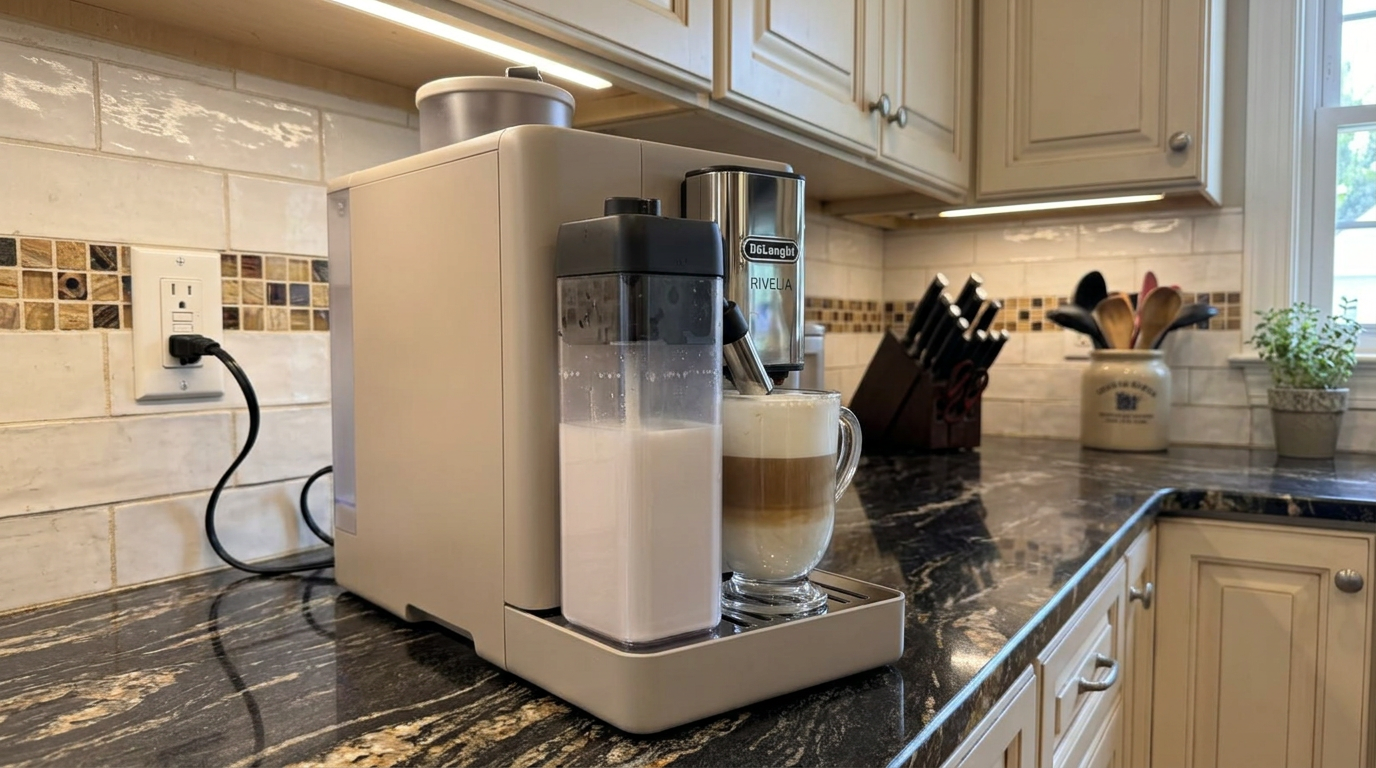
The LatteCrema Hot carafe has a dial for hot milk, soft foam or dense foam.
Iced coffee on the Rivelia
The iced recipes are simple and work well.
When you choose iced coffee or espresso over ice, the screen tells you how many ice cubes to put in the glass before it brews.
Follow that number and use full-size cubes, and the drink comes out strong and cold rather than watery.
Small or half-melted ice is the most common reason iced coffee from any machine tastes thin.
Espresso over ice was my favorite: a double shot poured over a glass of ice, then topped with a splash of cold milk and a little syrup.
It is not as elaborate as a full cold foam drink, but it is quick and refreshing on a hot afternoon.
Just don’t be misled by the iced icons on the screen: the machine pours hot espresso over ice, and it doesn’t do cold extraction.
| Cold drink | Out of the box? | How it works |
|---|---|---|
| Iced coffee | Yes | Hot coffee brewed over the suggested amount of ice |
| Espresso over ice | Yes | Hot shot poured over ice; add your own milk |
| Cold milk foam | No | Needs the separate LatteCrema Cool accessory |
| True cold brew | No | Requires a machine built for cold extraction |
Touchscreen, profiles and everyday use
The Rivelia’s color touchscreen is one of the best I have used on a machine at this level.
It is bright, responsive and easy to read, with large drink pictures and simple sliders for intensity and quantity.
Buttons beside the screen filter the menu into categories, such as black coffee or milk drinks, so you aren’t scrolling through all 18 recipes every time.
The four user profiles each have a color and an icon, and switching takes one tap.
Every drink you change and save stays in that profile.
My only complaint is the position of the screen.
It sits on top of the machine rather than angled toward you on the front.
Depending on your counter height, that can make it hard for children and shorter users to see and reach, and it can be inconvenient for wheelchair users.
The screen also handles maintenance.
It tells you when to empty the grounds and the drip tray, when to refill water or beans, when the filter needs changing and when to descale, and it walks you through each job step by step.
Settings for rinsing, descaling, the water filter, sounds and automatic standby all live here too, so you rarely need the printed manual.
The color touchscreen shows each drink with sliders for intensity and quantity.
Speed, noise and heat-up
The Rivelia heats up quickly.
From switching it on, it runs a short rinse and is ready to brew in well under a minute, so it never held up my morning.
A single espresso took about 30 seconds once the machine was warm, and a cappuccino a little over a minute including the milk.
The carafe auto-clean adds a few seconds after each milk drink, but you can walk away and drink your coffee while it runs.
Grinding is a short, firm burst, about as loud as most automatic machines but not harsh, and measured operating noise was about 66–68 dB.
The brewing and frothing are quieter, with a low pump hum and a soft hiss from the milk spout.
In an open-plan kitchen you will hear it, but nobody in my house ever complained about early-morning coffee.
One thing I liked: the machine keeps the cup tray area tidy.
There is very little spitting or dripping from the spout after a drink, and the adjustable spout height means a small espresso cup sits close to the outlet, which keeps the crema intact.
Taller glasses for lattes fit once you raise the spout, but tall travel mugs may not fit under it at all.
| Cup | Fit under the spout | Good to know |
|---|---|---|
| Small espresso cup | Sits close to the outlet | Keeps the crema intact |
| Latte glass | Fits with the spout raised | Raise the spout first |
| Shorter, wider mug | Best choice for big drinks | Easiest way to brew a large coffee |
| Tall travel mug | May not fit | Brew into a cup and transfer |
The auto-off timer and energy-saving mode are adjustable in the settings, so you can keep it ready for a few hours if you drink coffee throughout the day.
Our tip: Brew into a shorter, wider mug and pour it into your travel mug if the mug won’t fit under the spout.
The hot-water outlet runs at about 194–203°F, which is handy for tea, though its plastic spout feels like a weak detail at this price.
Cleaning and maintenance
Day-to-day cleaning on the Rivelia is about average for a fully automatic machine, which is to say easy.
The machine rinses itself when it turns on and off.
| Job | How often | Time or notes |
|---|---|---|
| Automatic rinse | At switch-on and switch-off | Handled by the machine |
| Carafe auto-clean | After each milk drink | A few seconds |
| Empty grounds and drip tray | About every 10 drinks, or sooner | Both slide out from the front |
| Wash carafe parts | I did it daily; do it at least weekly | A couple of minutes in warm, soapy water |
| Rinse brew group | Weekly | Pull it out through the side door; rinse in warm water |
| Descale | When prompted; every 6–8 weeks with hard water | About 20 minutes, guided on screen |
Empty the grounds container regularly even when it isn’t full, and support it as you remove it, because a part can drop and spill the contents.
Our tip: Empty the grounds before the screen asks, because damp pucks can grow mold if they sit too long.
The auto-clean helps, but it is no substitute for taking the carafe apart, since milk residue builds up quickly.
Being able to remove the brew group makes a real difference to how fresh the coffee tastes over time.
Water quality matters for long-term reliability, because calcium and magnesium build up inside the water system.
Install the included filter and replace it as prompted, or use filtered water if you skip it.
Use a descaler made for espresso machines rather than vinegar.
What a normal week looks like
In my kitchen, the Rivelia made six to eight drinks a day for two people.
| Time of day | Drinks | Machine task |
|---|---|---|
| Morning | Double espresso and cappuccino | Carafe auto-clean after the milk drink |
| Mid-afternoon | Flat white or cortado | Carafe auto-clean |
| After dinner | Decaf latte | Swap to the decaf hopper; wash the carafe |
The 47-ounce water tank is the one thing I wished were bigger, especially for large Americanos.
If you mostly drink espresso, you may rarely think about it; a busy household will refill it daily.
What long-term owners report
Because a coffee machine has to earn its place over months, I also went through a large number of owner reviews and long-term reports.
| What owners mention | Reaction | Does it match my testing? |
|---|---|---|
| Coffee quality | Often praised as the best they have had from an automatic | Yes |
| Dual hoppers | A feature people didn’t know they needed | Yes |
| Touchscreen and guidance | Popular, especially after pod machines | Yes |
| Milk temperature | Some find it not hot enough | Comfortable, about 140–149°F |
| Airtight hopper storage | Some wish the spare hopper sealed tightly | Yes, use a canister for long storage |
| Cold foam as an extra | A few dislike paying more for it | Yes |
| Screen position and tank size | Raised by a smaller group | Yes, both are real trade-offs |
I saw very few reports of reliability problems, and most of those were solved by regular brew group rinsing and descaling on schedule.
As with any automatic machine, the owners who are happiest after a year are the ones who keep up with the simple weekly cleaning.
Tips to get the best from the De’Longhi Rivelia
- Run Bean Adapt for every new bag. It takes three cups and makes a noticeable difference.
- Trim the factory volumes. Stop a drink when it looks right, then save that volume.
- Use the dense foam setting for cappuccinos. Save soft foam for lattes and flat whites.
- Brew a last drink when switching between similar coffees. Bean Switch lets you use the leftover beans instead of purging them.
- Keep spare beans in a sealed canister. The hoppers aren’t airtight, so don’t store beans in them for weeks.
- Warm your cups. It helps if you find the milk drinks too mild.
- Note the grind step for each coffee. The dial is shared, so you have to move it yourself when you swap.
- Save the extra shot. Build it into a recipe and the machine adds it automatically.
- Use 2% dairy for reliable foam. It is what De’Longhi support recommends for the carafe.
- Keep the filter current. Filtered water limits scale inside the machine.
Where the De’Longhi Rivelia falls short
The Rivelia gets most things right, but a few points are worth knowing.
| Drawback | Who it affects | Workaround |
|---|---|---|
| One shared grind dial | People who alternate very different roasts | Pair similar coffees, or move the dial at each swap |
| Hoppers aren’t airtight | Anyone leaving a second coffee on standby for weeks | Keep about a week of beans in it; store the rest sealed |
| Plant milk results are mixed | Oat, almond and other plant-milk drinkers | Use a standalone frother |
| Milk temperature is moderate | People who want a very hot latte | Warm the cup and use a little less milk |
| No cold foam or cold brew | Iced-latte and cold-brew fans | Buy LatteCrema Cool for foam; use another brewer for cold brew |
| Small water tank | Busy homes and big Americano drinkers | Top it up from above each day |
| Limited mug clearance | Travel-mug users | Brew into a shorter cup and transfer |
| Top-mounted screen | Children, shorter and wheelchair users | Consider counter height before buying |
| No obvious handholds | Anyone moving it often | Give it a permanent spot |
| Fussy pre-ground chute | Occasional ground-coffee users | Use exactly one level scoop |
None of these took away from how much I enjoyed the coffee, but they are worth weighing.
De’Longhi Rivelia test results
Here is how I rated each drink and task after using the Rivelia as my main machine, cross-checked against published tests and owner feedback.
Scores are out of 10.
| Drink or task | Rating | What stood out |
|---|---|---|
| Espresso | 8.8 | Full-bodied, chocolatey, thick crema |
| Double espresso | 8.9 | Rich and balanced |
| Cortado | 8.7 | Strong coffee, silky milk |
| Americano | 8.2 | Clean, easy black coffee |
| Cappuccino (dense foam) | 8.9 | Stable, airy foam |
| Flat white (soft foam) | 8.8 | Silky microfoam |
| Espresso over ice | 8.1 | Strong when you follow the ice count |
| Bean switching | 9.2 | Brew or purge the leftover 0.35 oz |
| Ease of use | 9.1 | Excellent touchscreen, guided setup |
| Daily cleaning | 8.0 | Carafe still needs regular washing |
De’Longhi Rivelia specifications
From De’Longhi’s published specifications, the Amazon listing and my own measurements.
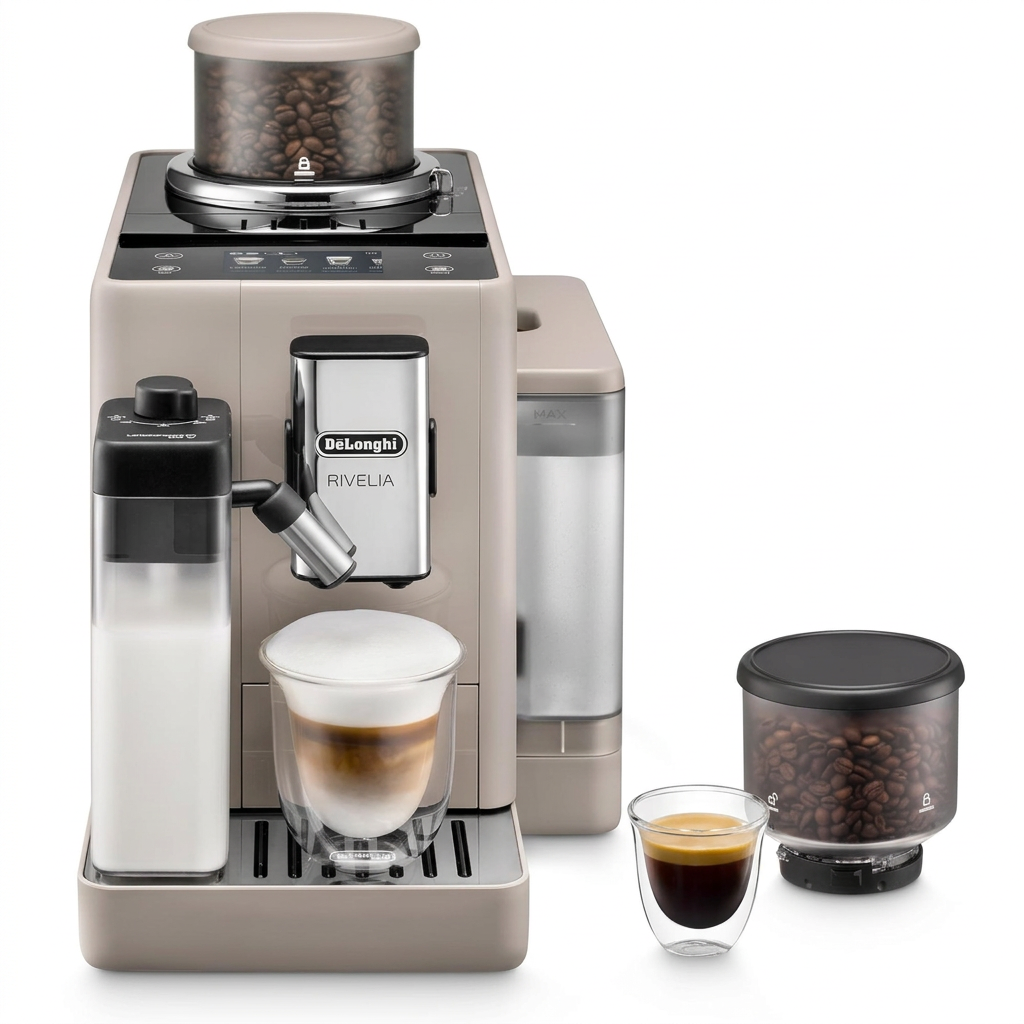
The Rivelia in Sand Beige with its milk carafe and the second bean hopper.
Is the De’Longhi Rivelia worth it?
I think the Rivelia is one of the most well-rounded fully automatic machines you can buy.
The espresso is genuinely good, the milk texture is better than most push-button systems thanks to the three-setting dial, and Bean Adapt helps you get there without any coffee knowledge.
The dual hoppers are the cherry on top if you drink decaf or like rotating coffees.
Compared with De’Longhi’s simpler Magnifica Start, you are paying for the touchscreen, the profiles, the second hopper, Bean Adapt and a much wider drink menu.
| Feature | Rivelia | Magnifica Start |
|---|---|---|
| Bean hoppers | 2, swappable | 1 |
| Controls | Color touchscreen | Buttons |
| Bean Adapt | Yes | No |
| User profiles | 4 | No |
| Milk | LatteCrema Hot with 3-position dial | Automatic frother |
| Drink menu | 18 presets | Classic drinks |
If you drink one or two cappuccinos a day from the same bag of beans, the simpler machine covers you.
If several people use the machine, or you care about getting the most from good beans, the Rivelia is the better long-term buy.
Where I would hesitate is if iced lattes with cold foam are the main reason you are buying, or if you can’t do without plant milk.
In those cases, factor in the cost of the cold foam accessory or a standalone frother before you decide.
De’Longhi Rivelia alternative
If you don’t need two hoppers or a touchscreen, De’Longhi’s entry machine is the simpler choice.
How I tested and rated the De’Longhi Rivelia
I used the Rivelia as my main coffee machine for espresso, double espresso, cortados, Americanos, cappuccinos, lattes, flat whites and iced coffee, with dairy and plant milks.
I ran Bean Adapt with three different coffees and switched between the two hoppers daily.
I cross-checked my impressions against the manufacturer’s specifications, published independent tests and a large set of owner reviews, so the score reflects how the machine holds up over months, not just the first week.
The overall score is a weighted editorial rating built from four parts:
- Coffee quality (8.7): espresso flavor, body, crema and long coffee.
- Milk drinks (8.8): foam texture, the three-setting dial, temperature and plant milk results.
- Ease of use (9.0): touchscreen, profiles, Bean Adapt, bean switching and cleaning.
- Value (7.9): what you get compared with other machines in this class, including the cost of cold foam.
I also measured milk and hot-water temperature and operating noise, and those readings appear in the test results above.
I don’t accept payment for reviews, and the brand had no say in this article.
Final verdict on the De’Longhi Rivelia
The De’Longhi Rivelia makes some of the best espresso and milk drinks I have had from a fully automatic machine, and it makes getting there easy.
Bean Adapt takes the guesswork out of new coffees, the two hoppers make decaf effortless, and the three-setting milk dial gives each drink the foam it deserves.
The touchscreen and four profiles keep everyone in the house happy.
The hoppers could be airtight, plant milks are unpredictable and cold foam should be included, but for regular and decaf drinkers those are small marks against a machine that gets the coffee itself so right.
If you want café-quality espresso and cappuccinos at the touch of a button, the De’Longhi Rivelia is an easy machine to recommend.
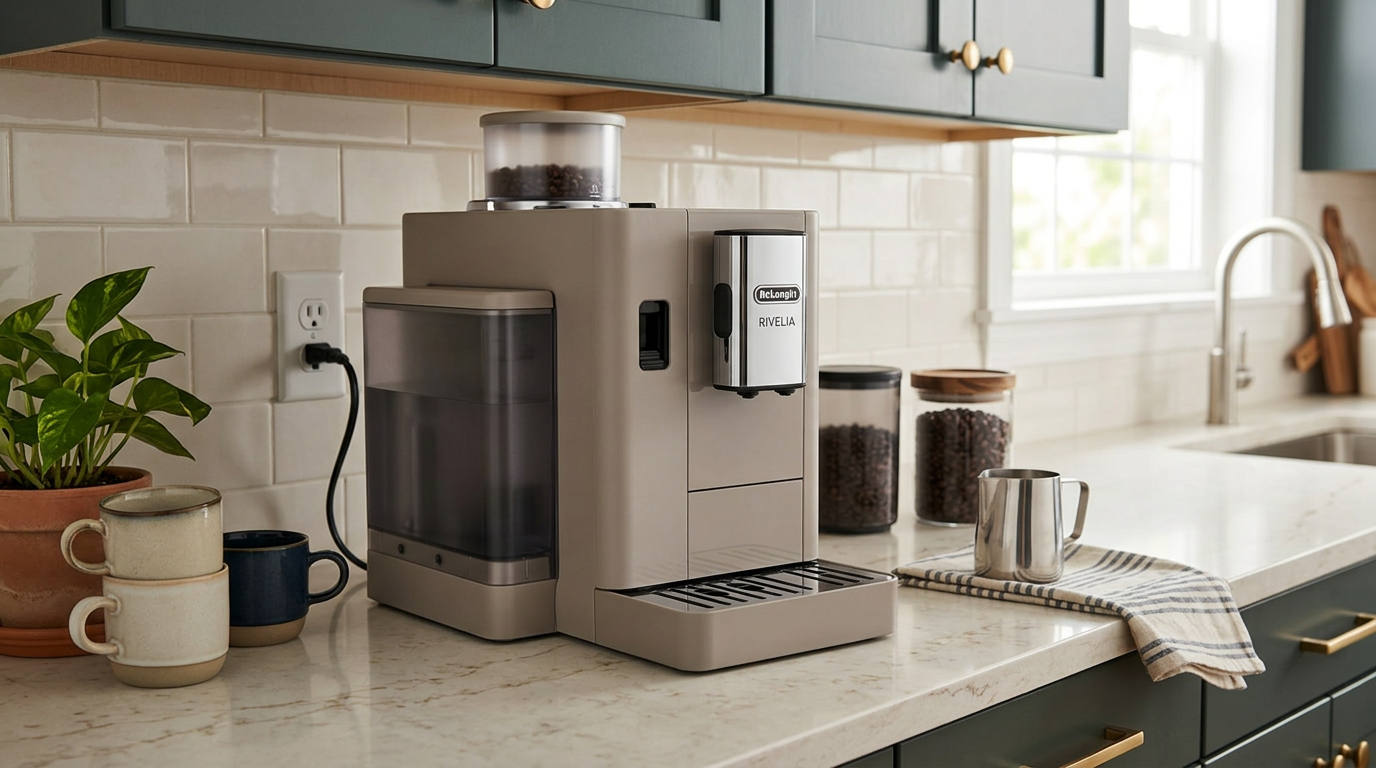
After weeks of daily use, the Rivelia earned a permanent spot on my counter.
De’Longhi Rivelia FAQ
Is the De’Longhi Rivelia worth it?
For people who want rich espresso and well-textured milk drinks without barista skills, yes. Bean Adapt, two hoppers and a three-setting milk dial set it apart from simpler machines.
How many drinks does the Rivelia make?
This model lists 18 preset recipes, including espresso, lungo, Americano, cappuccino, latte, flat white, cortado, latte macchiato, iced coffee and espresso over ice.
What is Bean Adapt?
A guided setup where you tell the machine about your beans, taste a few coffees and give feedback. It recommends grind, dose and temperature changes and saves the recipe for those beans; you turn the grinder dial yourself.
How do the two bean hoppers work?
Twist one hopper off and another on. Bean Switch mode lets you use the beans left in the grinder for one last drink or purge them.
Does each hopper get its own grind setting?
No. Both hoppers share one grinder dial, so the Rivelia suits two similar coffees best. Very different roasts mean moving the dial yourself or accepting a compromise.
Are the Rivelia’s bean hoppers airtight?
No. They are fine for about a week of beans, but store longer-term beans in a sealed container.
Can the Rivelia make cold foam?
Not out of the box. Cold foam and iced milk drinks need the separate LatteCrema Cool accessory. The included LatteCrema Hot carafe makes hot milk and two styles of hot foam.
Can the Rivelia make cold brew?
No. It pours hot coffee or espresso over ice and doesn’t do cold extraction.
Do tall travel mugs fit under the spout?
Tall travel mugs may not fit. Shorter, wider mugs work better, or you can brew into a cup and transfer the drink.
Does the Rivelia froth plant-based milk?
Results are mixed. The carafe works best with regular 2% dairy milk, and three plant milks failed to froth satisfactorily in testing, so a standalone frother may be a better choice.
How many user profiles does it have?
Four, each with its own saved version of every drink.
Can I use pre-ground coffee?
Yes, there is a pre-ground chute with a scoop stored inside the machine, but it works best with exactly one level scoop.
How often do I need to descale it?
The machine tells you based on your water hardness; with hard water it can be every six to eight weeks. The included water filter stretches that out.