Martha Stewart 5.3QT stand mixer review: strong mixing, lighter build
I baked with the Martha Stewart 5.3QT Tilt Head Stand Mixer for three weeks. It kneaded dense dough without stalling, and its silicone-edge beater nearly ended my spatula habit. The tradeoff is a lighter body that visibly flexes under heavy dough.
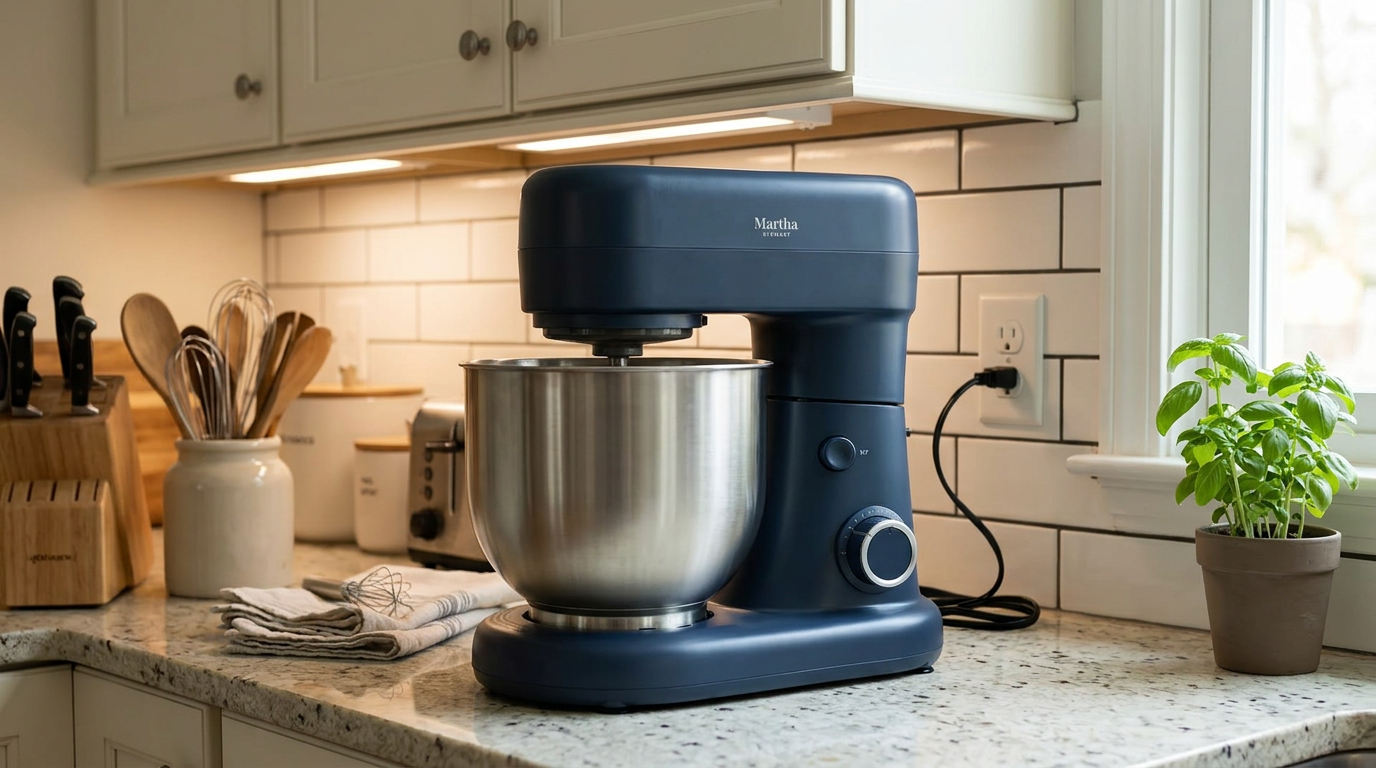
In this review
After three weeks of bread, cookies, cake and whipped cream, I rate this mixer 8.4 out of 10. It's easy to use, quieter than I expected, and very good at getting batter fully mixed. It isn't a heavy, all-metal machine, and you'll see that when the dough gets stiff. For regular home baking without the heavy lifting, I think it's a very good choice.
Martha Stewart 5.3QT mixer at a glance
Martha Stewart 5.3QT mixer pros and cons
- Pushed through dense yeast dough without stalling or overheating
- Silicone-edge beater got rid of dry flour pockets
- Suction-cup feet kept it from walking across the counter
- Quiet hum on low and no harsh whine on high
- Tilt head opens smoothly at the press of a button
- Light enough to lift out of a cabinet easily
- Roomy 5.3-quart stainless steel bowl
- Head and tilt joint wobble under heavy dough
- Splash shield can shift when the head shakes
- Suction feet mean lifting it, not sliding it
- No front hub for add-on attachments
- Not made for commercial-style daily production
Who should buy this stand mixer?
- Beginners moving up from a hand mixer
- Home bakers making cookies, cakes and weekend bread
- Anyone who stores a mixer in a cabinet between uses
- Kitchens with smooth quartz or granite counters
- Families baking larger batches for gatherings
- Bakers making very stiff dough several times a week
- Small home bakeries with daily production
- People who want grinders, rollers and other add-ons
- Anyone who wants the solid feel of a die-cast body
How the mixer scored
These are the scores from my three weeks with the mixer.
Ease of use came out on top, and build quality was the clear low point.
For noise, a higher score means a quieter, more pleasant machine.
First impressions
A stand mixer tends to be judged by how heavy and serious it looks.
The Martha Stewart 5.3QT made me rethink that a little.
It's noticeably light for a mixer with a bowl this size, and the first thing I enjoyed was simply how easily it came out of the cabinet.
That matters more than it sounds.
A mixer that's a chore to move tends to stay put, or stay unused.
This one felt like something I'd actually get out for a single batch of whipped cream.
The controls took no time to figure out.
There's a speed dial and a button that releases the head, and the attachments click into place without any guesswork.
I was making cookie dough without opening the manual for much more than the attachment steps.
Then I made the first heavy dough, and I got both sides of this mixer at once.
The motor kept going without complaint, but the head was moving around more than I'd like to see.
That pretty much sums up the next three weeks: strong mixing in a lighter body.
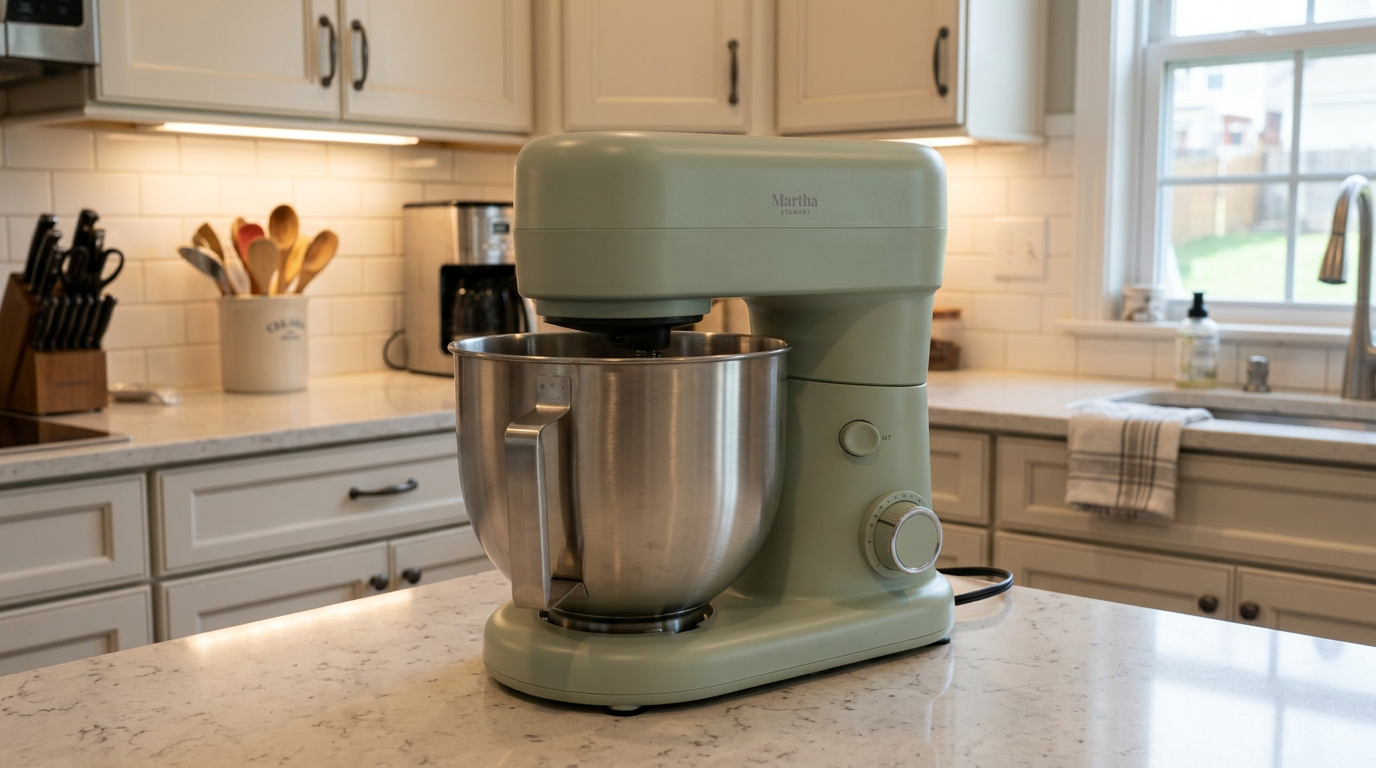
It looks at home on a counter, and it’s light enough to put away between bakes.
What this mixer actually is
This is a tilt-head stand mixer with a 5.3-quart stainless steel bowl, 12 speeds and a motor rated at 660 watts.
Tilt-head means the top of the machine hinges upward, so you can reach the bowl and swap tools from above.
It's the common layout for home mixers, and it's the opposite of a bowl-lift design, where the head stays fixed and the bowl rises into place.
The mixer comes with three tools: a stainless steel whisk, a dough hook and a flat beater with a flexible silicone edge.
A removable splash shield with a pour chute is included as well.
That's a complete kit for most home baking, so you won't need to buy anything extra to get going.
The mixing action is planetary, which means the tool spins while also traveling around the bowl.
That movement is why a good stand mixer can reach almost everything without you holding it.
It's also the biggest step up from a hand mixer, along with having both of your hands free.
Design and setup
The body has soft, rounded lines and a clean, modern look.
Listings show colors including Honeydew Green, Linen White and Caviar Gray, though the choice can vary by seller.
The bowl has a handle, and the mixer base has suction-cup feet to hold it in place.
The housing is lightweight and uses synthetic parts rather than a heavy die-cast metal shell.
The listed weight is about 9 pounds.
That's the reason it's so easy to carry, and it's also the reason for the wobble I'll get to shortly.
Setup has a set order, and it's worth following.
Raise the head with the release button, twist the splash shield onto the head, push the tool upward and twist it until it locks, and then lower the head until it locks too.
If you attach the tool first, the shield is more awkward to fit.
After a couple of uses, that order became automatic.
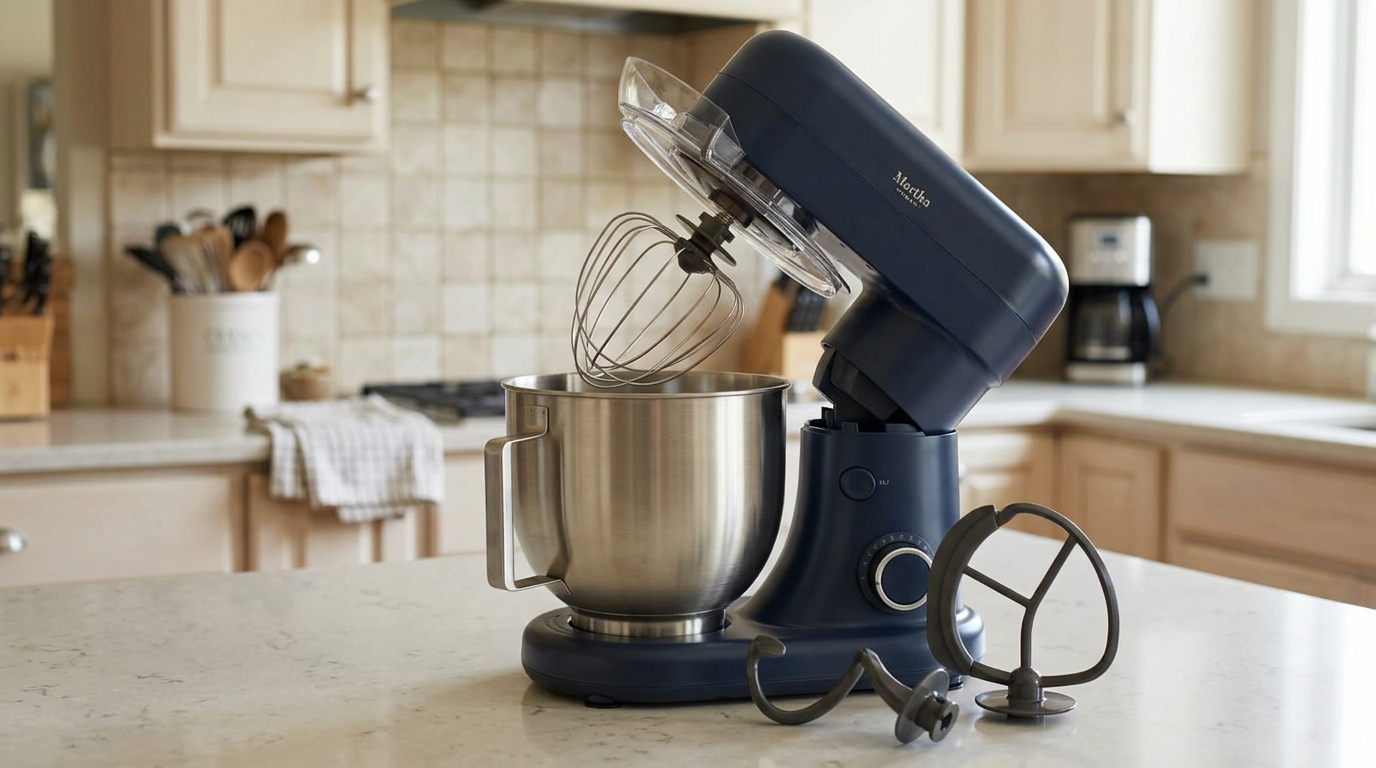
The tilt head opens wide enough to swap tools or add ingredients easily.
The tilt mechanism is one of my favorite parts.
The release button is smooth and intuitive, and the head springs open with almost no effort.
When I wanted to add ingredients or change tools, I never had to wrestle with it.
I gave ease of use a 9.0, the highest score of the four categories.
Dial, button and click-in tools all do just what you'd expect.
Pick a smooth, clean spot, because the suction feet need it to grip well.
The attachments: what each one does best
Using the right tool makes more difference than which of the 12 speeds you choose.
This is how I'd match them up after using all three.
| Tool | Best for | What I made with it |
|---|---|---|
| Dough hook | Yeast dough and heavy pastry | Yeast rolls, pizza dough, corn tortilla dough |
| Silicone-edge beater | Batters, cookie dough, frosting | Chocolate chip cookies, lemon pound cake |
| Wire whisk | Whipping and adding air | Whipped cream, whipped potatoes, shredded chicken |
The silicone-edge beater
This is the best thing about the mixer.
The flexible edge follows the curve of the stainless steel bowl closely, so it wipes the sides and bottom as it goes around.
With my lemon pound cake and cookie dough, it got rid of the dry flour pockets that standard metal beaters usually leave at the bottom and sides.
I stopped halting the mixer to scrape it down.
The only time I still needed a spatula was for a final sweep when pouring wet batter into a pan.
That's a real time saver, and it also makes the results more consistent.
I'm happy this tool comes in the box, because on many mixers a scraping beater is a separate purchase.
The dough hook
The hook handled every dough I gave it, including yeast rolls, pizza dough and corn tortilla dough.
It takes the physical work out of kneading, and that's the main reason many people buy a stand mixer at all.
The whisk
The whisk is for whipped cream, egg whites and other light mixtures that need air.
I got good results on fresh whipped cream, and I also used it for whipped potatoes and shredded chicken.
The splash shield
The shield does its job well and has a generous pour spout, so you can add flour or liquid while the mixer runs.
My one complaint shows up with heavy dough.
When the head shakes, the guard can shift slightly out of place.
It's a small annoyance, and with dense dough I'd keep an eye on it or leave it off once the dry ingredients are combined.
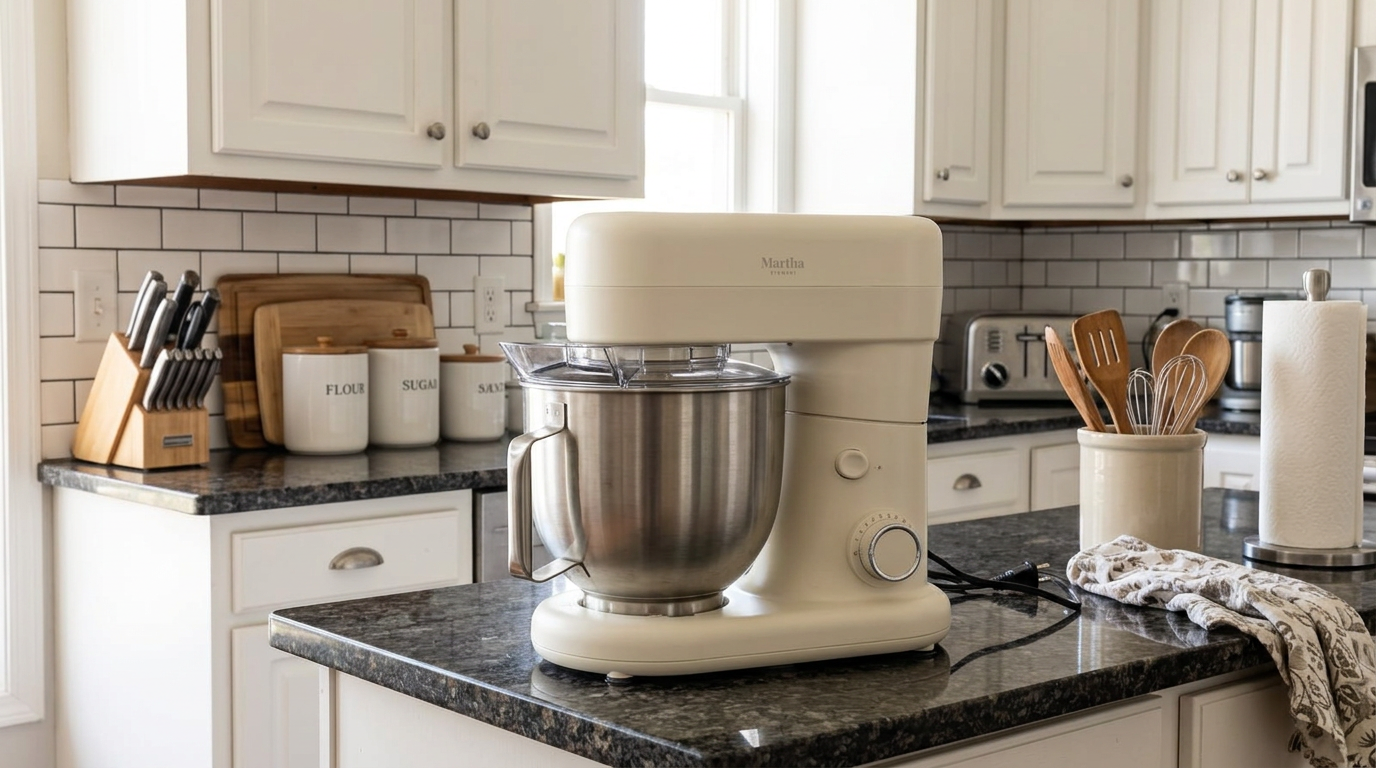
The pour chute lets you add ingredients with the mixer running.
Performance: dough, batter and whipping
Three weeks gave me time to try the mixer across the full range of home baking, from stiff doughs to light cream.
Dense dough and bread
This is where budget mixers often give up, so it was the test I cared about most.
The motor delivered surprisingly solid torque and pushed through dense yeast doughs without stalling or overheating.
At no point did I feel it was straining.
I also didn't have to rescue a batch or stop to let the machine recover.
The one catch is structural rather than mechanical, and I'll cover it in the next section.
I'd still start every stiff dough on a low speed and bring it up gradually.
Going straight to high speed under a heavy load puts needless strain on any motor.
Cookies and cake batter
Medium-thick mixtures are the sweet spot for this mixer.
Chocolate chip cookie dough came together evenly, and the pound cake batter was smooth with no hidden streaks of flour.
Mixing scored an 8.5, and these two jobs are the main reason.
The coverage around the bowl was excellent, and the silicone edge took care of the places the tool would otherwise miss.
Whipped cream and light jobs
I whipped cream at speeds 10 to 12, and the mixer made quick work of it.
The high speeds need attention, because cream can go from perfect to overwhipped very quickly.
I'd step down a few speeds as it starts to thicken, so you have more control at the finish.
The 12-speed dial
Twelve speeds is more than most people will use, but the range is helpful.
The low end is gentle enough to start dry ingredients without throwing flour around, and the top end is fast enough for whipping.
This is the speed map I'd use as a starting point.
| Speeds | Use it for | Tool |
|---|---|---|
| 1–3 (low) | Combining ingredients, folding, starting heavy dough | Hook or beater |
| 4–7 (medium) | Cake batter, cookie dough, general blending | Beater |
| 8–12 (high) | Whipping cream, egg whites, light frosting | Whisk |
What each bake showed me
The scores only tell part of the story, so here's how each type of bake went.
Yeast rolls were the first real workout for the dough hook.
The motor kept a steady pace and the dough came together without any drama, but this was where I first noticed the head moving.
Pizza dough gave me the same impression.
The mixer did the work, I watched the head flex, and nothing went wrong.
Corn tortilla dough was a nice change, and the hook handled it well.
Chocolate chip cookie dough is probably what most buyers will make most often.
It's thick, it's full of add-ins, and it's a good test of whether the beater reaches the bottom of the bowl.
This one did, and I wasn't left with a floury layer underneath.
The lemon pound cake was where the silicone edge impressed me most.
Pound cake depends on an even batter, and I got one without stopping to scrape.
Fresh whipped cream showed off the top of the speed range and the fact that this mixer doesn't shriek when it's working hard.
Whipped potatoes and shredded chicken pushed it beyond baking, and that's when it started to feel like a general kitchen helper.
Across all of those jobs, the pattern was consistent.
The lighter the mixture, the more polished the mixer felt.
The heavier the dough, the more I noticed its lighter construction.
Stability: the wobble is real
Here's the part you should weigh before buying.
The head and the tilt joint visibly wobble and shake under heavy loads.
The mixer doesn't lose its grip and the motor doesn't struggle, but with a dense dough the head movement can feel slightly flexy.
That's why build quality is my lowest score, at 7.5.
It's the direct cost of a lighter composite body.
A mixer weighing about 9 pounds has less mass to absorb the force of a heavy dough being thrown around the bowl.
The suction-cup feet do a lot to offset that.
On smooth quartz and granite, they kept the machine anchored, so it never walked toward the edge of the counter.
For me, the feet were the biggest pleasant surprise of the test.
They have one funny downside: they hold so well that you can't slide the mixer across the counter.
You have to lift it straight up.
On textured or uneven surfaces, suction cups generally can't seal as well, so I'd keep it on something smooth.
The wobble didn't hurt any of my results.
But if a slightly moving head would bother you every time you made bread, this probably isn't your mixer.
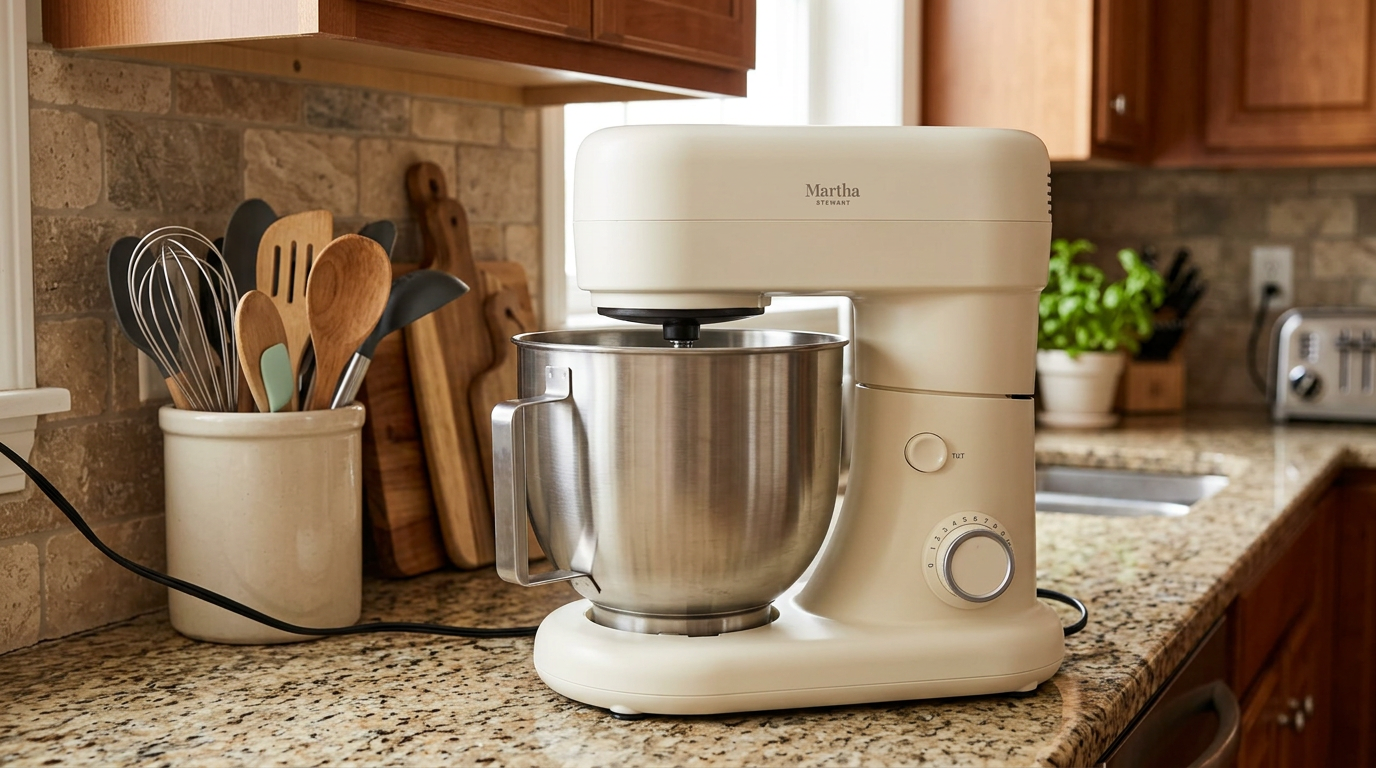
Smooth stone counters give the suction feet the grip they need.
How loud is it?
I'd call the noise normal to quiet for a stand mixer, and I scored it 8.5.
Low speeds produce a smooth, muted hum.
At speeds 10 to 12, it gets louder, as any mixer does.
What it avoids is the harsh, high-pitched mechanical whine you get from cheaper budget models.
I could easily hold a conversation in the kitchen while it ran.
I couldn't find a published decibel figure for this model, so this is my own judgment by ear rather than a measurement.
What 660 watts really tells you
The 660-watt figure stands out, and it's easy to read too much into it.
Most mixer makers list input power, which is how much electricity the motor can draw from the wall.
It doesn't tell you how much power reaches the dough.
Heat, friction and the gear design all affect that, which is why some well-regarded mixers carry much lower wattage ratings.
In other words, you shouldn't assume a 660-watt mixer is twice as strong as a 325-watt one.
The published spec only gets you so far.
What counts is how the mixer behaves with a heavy dough in the bowl.
In my test, the motor didn't stall, strain or overheat, and that tells me more than the number does.
Testing at home can't tell you how the gears will hold up over many years, though.
Three weeks is enough to judge performance, not long-term durability.
How much the 5.3-quart bowl can handle
The bowl is a useful middle size.
It's larger than the common 4.5-quart home mixer without moving into big, bulky 7-quart territory.
The manufacturer's capacity claims are generous.
I didn't test those limits, so take them as maximums rather than promises.
Given the wobble I saw with ordinary batches of dense dough, I wouldn't fill the bowl to the top with stiff bread dough.
Splitting it into two batches is kinder to the gears and easier on the head.
Batters and cookie doughs are a different story, and that's where I'd make the most of the large bowl.
Cleaning and storage
Cleanup was fast and easy.
The bowl and attachments come off quickly, and they washed up well both by hand and in the dishwasher.
The listing marks the bowl and attachments as dishwasher safe.
I'd still hand wash the silicone-edge beater from time to time, because that helps protect the flexible edge.
The main housing only needs a wipe with a soft, damp cloth.
Never put the motor housing in water.
Storage is one of this mixer's real strengths.
Compared with heavy cast-metal machines, pulling it out of a cabinet takes almost no effort.
The tools fit inside the bowl, which keeps everything together.
Just make sure everything is completely dry before you put it away.
Is it worth buying?
I think so, as long as you know what kind of machine you're getting.
Its strengths are the things you'll notice every time you bake: an easy dial, a beater that scrapes the bowl, a large bowl and a body you can actually lift.
Its weaknesses mostly appear when you make heavy dough or want more than mixing.
There's no front hub for add-ons like meat grinders or pasta rollers.
Replacement parts are likely to be harder to find than those for brands that have been around for decades.
It's also not built for commercial-style daily production.
For people who bake on weekends, make holiday cookies and try bread now and then, those limits may never matter.
Owner feedback seems to be broadly positive as well.
On one large US retailer's listing, 66 owner ratings averaged 4.6 out of 5 when I checked.
That's a small sample, but it matches my own positive experience.
Prices change often, so it's worth looking before you decide.
Stand mixer or hand mixer: what actually changes
If you're coming from a hand mixer, this is what you'll notice first.
Your hands are free, so you can measure the next ingredient, zest a lemon or line a pan while the machine works.
The results are more even, because the tool keeps moving around the bowl at a steady speed.
Heavy jobs become realistic too, since a hand mixer isn't designed for kneading bread.
What you give up is space.
Even a light stand mixer needs a spot on the counter or a decent-sized cabinet, and a listed height of nearly 17 inches is worth measuring against yours.
If you only whip the occasional bowl of cream, I'd keep the hand mixer.
If you bake most weekends, the jump is well worth making.
Tilt-head or bowl-lift: which design suits you?
The tilt-head design is a big part of why this mixer is so easy to live with, but it comes with a mechanical tradeoff.
A hinge is one more place where a heavy load can create movement.
That's the flex I saw in my test, and it's a known limitation of the layout, especially in lighter machines.
| Tilt-head | Bowl-lift | |
|---|---|---|
| Access to the bowl | Excellent, head moves away | Tighter, head stays in place |
| Swapping tools | Quick | Slightly more fiddly |
| Rigidity with stiff dough | Lower | Higher |
| Typical size | Compact | Taller and heavier |
| Best for | Everyday baking | Frequent bread making |
For most home bakers, I'd choose the convenience of a tilt head.
For someone who bakes dense sourdough every other day, the rigidity of a bowl-lift mixer is worth having.
How it compares with other stand mixer types
To put my test into context, I compared the published specs with four common kinds of home stand mixer.
The columns below represent typical models in each group, based on specs I gathered from current listings.
| This mixer | Premium 5-qt tilt-head | Classic 4.5-qt tilt-head | Entry 4-qt | Large-bowl budget | |
|---|---|---|---|---|---|
| Rated power | 660 W | 325 W | 275 W | 300 W | 660 W |
| Bowl | 5.3 qt | 5 qt | 4.5 qt | 4 qt | 6.5 qt |
| Speeds | 12 | 10 | 10 | 7 | 6 |
| Body | Light composite | Heavy metal | Heavy metal | Light | Light |
| Add-on hub | No | Yes | Yes | Usually no | Varies |
| Scraping beater | Included | Often optional | Often optional | Rarely | Varies |
Rated power
Bowl size
Speed settings
As I explained above, the wattage bars are about rated input, so they don't directly show mixing strength.
On paper, this mixer offers the best combination of bowl size and speed range in the group.
A heavy metal mixer still has the advantage in rigidity and add-on options.
So the choice comes down to what you value more: a solid machine that lives on the counter, or a lighter one that's easy to move.
Alternatives to consider
If this doesn't sound right for you, the better fit depends on why.
If you make stiff bread dough several times a week, look at a heavier metal mixer, ideally with a bowl-lift design.
The fixed head is much better at resisting the movement I saw here.
If you want to grind meat or roll pasta, choose a mixer with a front attachment hub.
If you bake only now and then and mostly make small batches, a hand mixer takes up less space and may be all you need.
If you regularly bake huge batches, you may want a 6-quart or larger bowl, though you'll also need more storage room.
How to make it last
A lighter mixer rewards a bit of care, and most of it costs you nothing.
Stay within sensible batch sizes, especially with dense dough, because overloading is the quickest way to wear out internal gears.
Bring the speed up gradually rather than starting high.
If the mixer ever feels unusually warm during a long knead, stop and give it a rest.
Keep the silicone edge away from sharp utensils, since a nick in the edge will stop it from scraping cleanly.
Dry everything before storing it, and keep the tools together in the bowl so nothing goes missing.
A mixer only runs for a few minutes per recipe, typically somewhere between 2 and 10, so it uses very little energy over a normal month of baking.
Tips for getting the best results
- Fit the shield first. Twist it on before you attach the tool.
- Check the head lock. Make sure it has clicked down before you start the motor.
- Start low. Begin on speeds 1 to 3, so flour stays in the bowl and the motor isn't suddenly loaded.
- Knead slowly. Bakers generally find higher speeds don't knead better and can strain a motor. Check your manual for its guidance on dough speeds.
- Plan on about 6 to 8 minutes. That's a common kneading range at medium-low speed, and stiffer whole wheat doughs can take longer.
- Use the windowpane test. Stretch a small piece of dough. If it thins enough to let light through without tearing, the gluten is ready.
- Split big, stiff batches. This reduces head movement and strain on the gears.
- Slow down at the end of whipping. Cream can overwhip within moments.
- Wipe the counter first. Suction feet grip best on a clean, smooth surface.
- Lift, don't drag. Raise the mixer straight up when you want to move it.
Martha Stewart 5.3QT stand mixer specifications
From the Amazon listing and published product details.
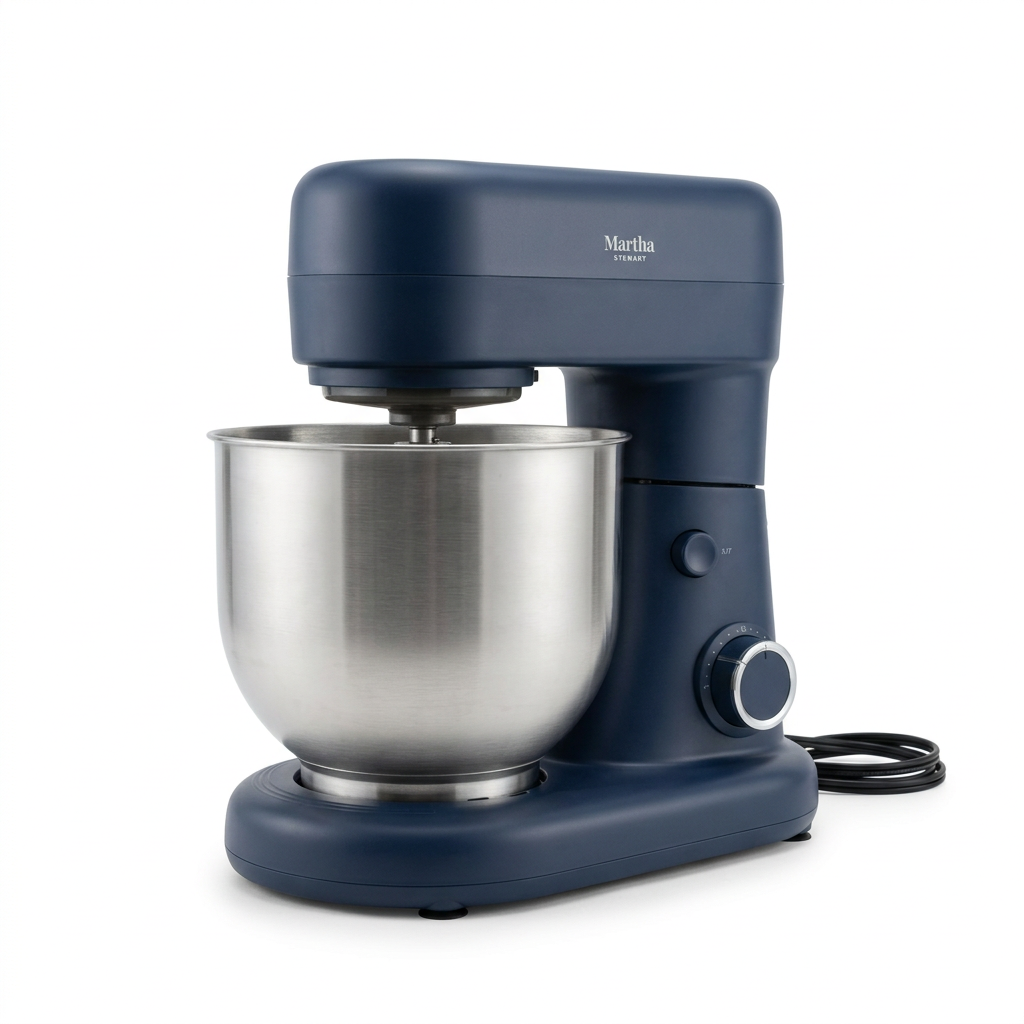
The complete mixer: motor head, stainless steel bowl, dial control and suction-cup base.
How I tested and scored the mixer
I used this mixer for three weeks as my everyday home baking and prep machine.
I used the hook for yeast rolls, pizza dough and corn tortilla dough, the silicone-edge beater for chocolate chip cookies and lemon pound cake, and the whisk for whipped cream, whipped potatoes and shredded chicken.
I scored four things.
- Mixing (8.5): bowl coverage and how fully ingredients combined.
- Ease of use (9.0): the dial, attachment fitting and tilt button.
- Build (7.5): how solid it felt, especially under dense dough.
- Noise (8.5): how pleasant it was to be around at low and high speeds, judged by ear.
The overall score of 8.4 is an editorial rating.
The spec comparison, wattage background, capacity figures and kneading tips come from research rather than my own measurements.
I didn't take lab measurements, and I can't speak to reliability beyond those three weeks.
Martha Stewart 5.3QT stand mixer FAQ
Is the Martha Stewart 5.3QT stand mixer good?
Yes, for everyday home baking. It scored 8.4 out of 10 in my three-week test, with especially strong results for ease of use and mixing. Its main weakness is a lighter body that flexes under heavy dough.
Can it knead bread dough?
Yes. It handled yeast rolls and pizza dough without stalling or overheating in my test. Expect the head to wobble visibly with dense dough.
Does the mixer move on the counter?
It didn’t in my test. The suction-cup feet kept it anchored on smooth quartz and granite. They grip so firmly that you need to lift the mixer to move it.
Do I still need a spatula?
Rarely while mixing. The silicone-edge beater scrapes the bowl as it runs. I only used a spatula to get the last of the wet batter into the pan.
Is it loud?
I found it normal to quiet. It hums softly on low speeds and gets louder on speeds 10 to 12, but without a harsh whine.
How many cookies can it make?
The manufacturer says up to 9 dozen per batch. I didn’t test that maximum.
Are the parts dishwasher safe?
The bowl and attachments are listed as dishwasher safe. Occasional hand washing can help protect the silicone edge of the beater.
Does it work with add-on attachments?
No. It doesn’t have a front hub for extras such as meat grinders or pasta rollers.
What comes in the box?
The mixer, a 5.3-quart stainless steel bowl, a whisk, a dough hook, a silicone-edge flat beater and a removable splash shield with a pour chute.
- Three weeks of hands-on testing by Thomas Walker
- Amazon product listing for the Martha Stewart 5.3QT Tilt Head Stand Mixer (ASIN B0GJG3NNFR), November 2026
- Published specifications and owner ratings from current retail listings, November 2026
- Published baking guidance on kneading and the windowpane test
- Review published.