Ninja AutoBarista AE1002 review: one-touch café drinks, with a thirst
The Ninja AutoBarista Fully Automatic Espresso AE1002 brews espresso, drip coffee and cold drinks, and froths your milk hands-free. It's wonderfully easy to use, but it's hungry for beans and water, and it won't let you take full control of the grinder.
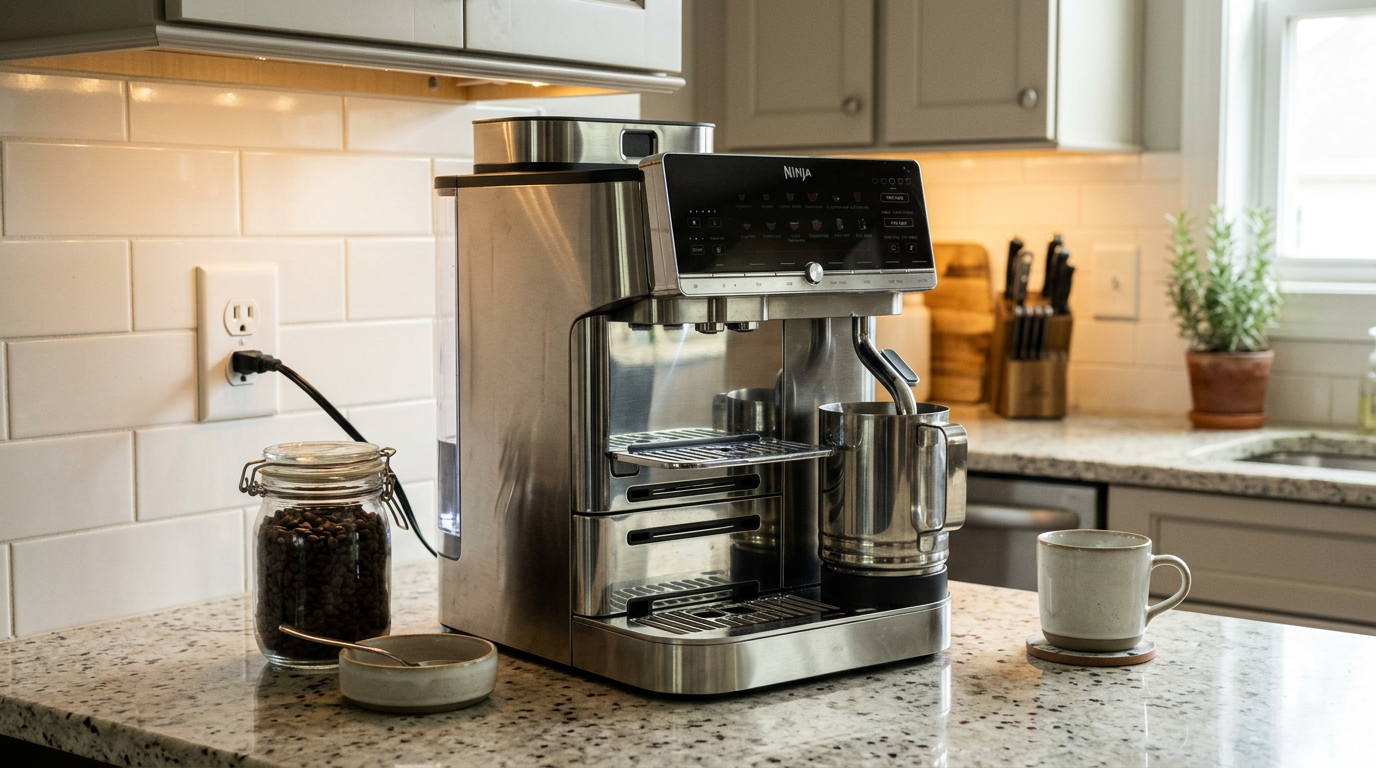
In this review
The Ninja AutoBarista AE1002 is a very capable all-in-one for a household that wants good espresso, drip coffee and milk drinks without learning barista skills. The tradeoffs are slow first drinks, heavy water use and a grinder you can only nudge, so I'd buy it for convenience rather than control.
Ninja AutoBarista AE1002 at a glance
Ninja AutoBarista AE1002 pros and cons
- Espresso, drip coffee and cold drinks in one machine
- Hands-free milk with four froth styles
- Grinder calibrates itself to your beans
- Larger coffee doses than many automatic machines
- Removable brew group and internal drying fan
- Handles tall cups and tumblers
- Very approachable for beginners
- Grind iQ calibration can use a lot of coffee
- No full manual grinder control
- Water-hungry, with frequent tray emptying
- Single hopper makes switching beans a chore
- You still pour the milk yourself
- Cold brew and cold foam results are mixed
- Water tank isn't accessible from the front
Who should buy the AE1002?
- Beginners who find espresso intimidating
- Homes where people want different drinks
- Drip coffee drinkers who also love lattes
- Anyone who wants milk texture without practice
- People who buy one favorite bean again and again
- Espresso hobbyists who enjoy dialing in shots
- Homes that keep regular and decaf on the go
- Small kitchens with tight counter depth
- People who buy small bags of costly beans
- Anyone who wants the milk poured for them
How I reviewed this machine
I want to be upfront about what this review is.
I did not run this machine in my own kitchen for this article, so you won't find invented stories about my mornings with it here.
What I did was go through Ninja's published specifications, its product and care details, independent test results and the feedback from people who own one.
There is one important limit to that evidence: most detailed lab-style testing so far has been done on the AutoBarista Pro, the step-up model in the same family.
The two machines share the same core approach to grinding, brewing and frothing, so those results are useful here.
Even so, whenever a number comes from the Pro, I say so.
Where something is my own judgment, I say that too.
The AE1002 is built to live on the counter, close to an outlet and a water source.
What the Ninja AutoBarista AE1002 actually is
The AutoBarista AE1002 is a fully automatic bean-to-cup machine with a built-in burr grinder, an automatic tamper and an automated milk system.
You fill the hopper and tank, choose a drink, and the machine grinds, weighs, tamps and brews on its own.
Ninja lists 10 one-touch presets: Espresso, Americano, Cappuccino, Flat White, Latte, Drip Coffee, Cold Brew, Cold-Pressed, Over Ice and Hot Water.
That range is what makes this machine unusual.
Most fully automatic machines focus on espresso and treat long coffee as an afterthought.
Ninja designed this brew system to handle true drip-style coffee and rapid cold brew as well, which is why it can replace more than one appliance on your counter.
Pressure comes from a 15-bar system tuned to 9 bars at the brew head, the conventional target for espresso.
A quick note on the model number.
Ninja publishes its US specifications under AE1001, while Amazon sells this machine as the AE1002.
The features on the listing match, and I found no published hardware difference between the two.
One owner who went looking for the same answer concluded that AE1002 is simply the Amazon version.
I'd still check the listing for anything specific before ordering.
Design, size and build
This is a big, heavy machine, and it deserves a measuring tape before you order.
Ninja lists it at 17.81 inches deep, 10.68 inches wide and 15.82 inches tall, and it weighs 36.2 pounds.
At that size it will take up real counter space, and moving it around isn't something you'll want to do often.
One owner noted that the best place to grip it is a set of handholds on the underside, so lift it from there and get help if you need it.
Clearance is the other thing to check.
You'll need room above the machine for pouring beans, and the power cord is only about 53 inches long.
The water tank sits to the side rather than at the front.
Testing on the Pro, which has the same body layout, found that you need to pull the machine forward to remove the tank.
If your counter is shallow or you have cabinets close by, that small chore will happen often.
Opinions on the looks are genuinely split.
Some reviewers found the design premium and some thought it looked a little dated, with a display that can seem dim in a bright kitchen.
Owners have been kinder, describing it as solid, clean and well thought out.
One detail I like from owner reports is the drip tray, which has ramps and channels to steer water and a pop-up indicator that tells you when it needs emptying.
The adjustable cup tray is another useful touch.
Testing on the Pro showed a 20-ounce tumbler fitting comfortably, even with a scale underneath.
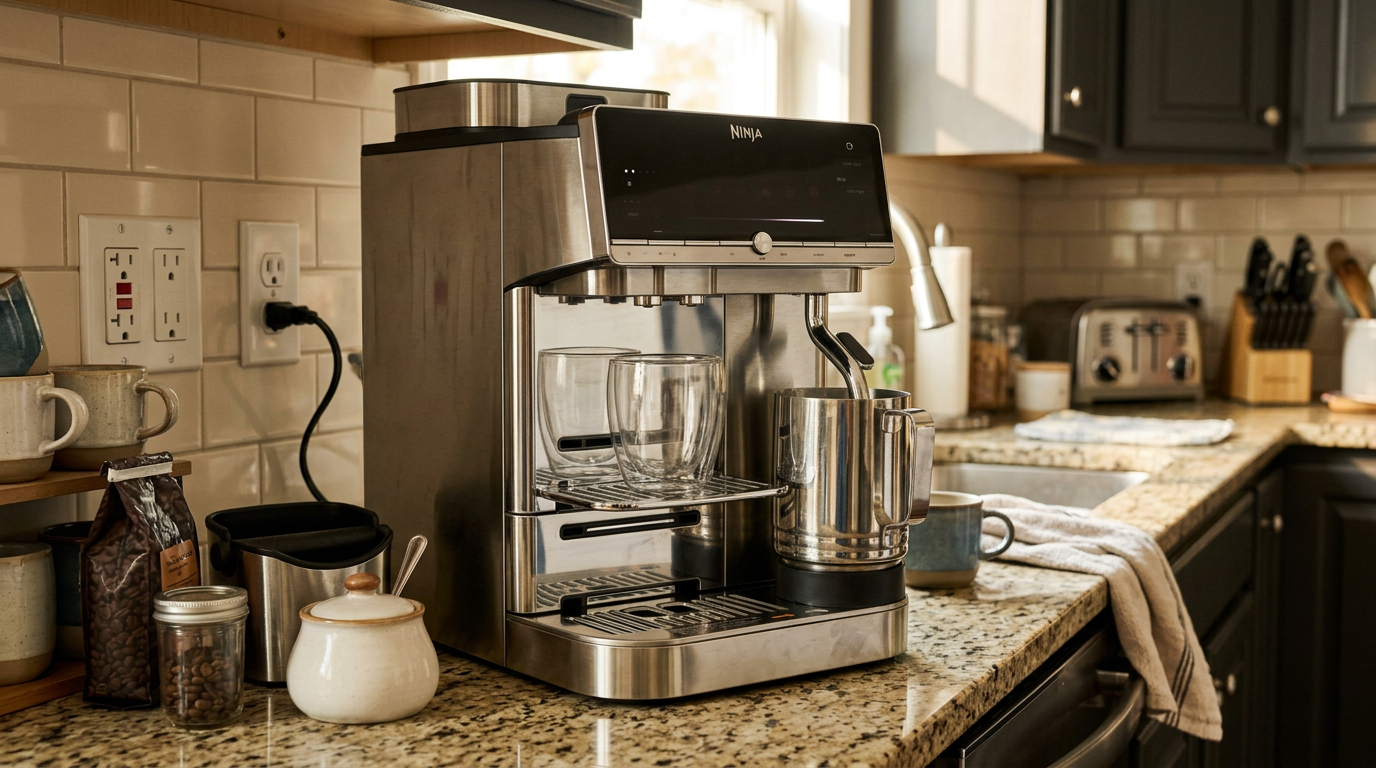
Measure your counter depth and the space under your cabinets before you order.
Setup and the Grind iQ calibration
Physical setup is simple by the standards of this category.
You peel off the packaging, attach the cup rack, fill the hopper and tank, and install the water filter.
The included test kit will tell you your water hardness, and that's worth doing on day one.
The filter needs a few minutes of soaking, and a small dial helps you remember when you installed it.
The part that needs your attention is Grind iQ.
Before your first drink, and whenever you change beans, the machine pulls a few calibration shots to find the right grind.
It measures how the coffee flows, adjusts, and tries again until it's satisfied.
This is clever, and it's the feature that makes the machine so easy for beginners.
It's also the feature that attracts the most complaints.
One published test recorded about six minutes for calibration, and another measured roughly 7 ounces of beans used in the process.
That's almost a full hopper's worth, so I wouldn't calibrate with your most expensive bag.
An AE1002 owner was similarly taken aback by how much coffee went through the machine during calibration.
My advice is simple: calibrate with a bean you're happy to drink for a while, then leave it alone.
Don't judge the machine on the very first drink, either.
One tester found the first cappuccino watery even after calibration, but saw thicker crema once the machine had settled and a different bean was in the hopper.
Coffee quality: espresso and drip
This is where the published opinions diverge the most, and I think that divergence is informative.
Some experienced testers got chocolatey, well-textured shots with good crema.
Another, using lighter artisan beans at the default settings, found the espresso pale and thin, and had to use the strongest level to get a normal-tasting shot.
The likely explanation is the brew group itself.
According to one detailed test of the Pro, it isn't pressurized the way many automatic brew units are, so the beans and the grind have to create the resistance.
That means the machine should reward fresh, good-quality beans and show its weaknesses with stale ones.
So my expectation is this: with fresh medium or medium-dark beans, you should get a very enjoyable shot for a machine that does all the work.
Don't expect it to match a skilled person with a good manual setup, because that isn't what it's built for.
An owner who describes himself as an espresso geek made exactly that point, while admitting he kept reaching for the Ninja anyway on busy mornings.
Drip coffee looks like the pleasant surprise.
Published impressions describe it as bold, hot and close to the real thing, with a lighter body than the espresso.
Owners are more divided on the efficiency, and one AE1002 buyer felt an 18-ounce drip drink used far more grounds than his regular brewer.
Temperature is reasonable rather than scalding.
One test of the Pro measured espresso and drip at about 149°F, and a cappuccino at about 145°F.
If you like your coffee very hot, warm the cup first and use the high temperature setting.
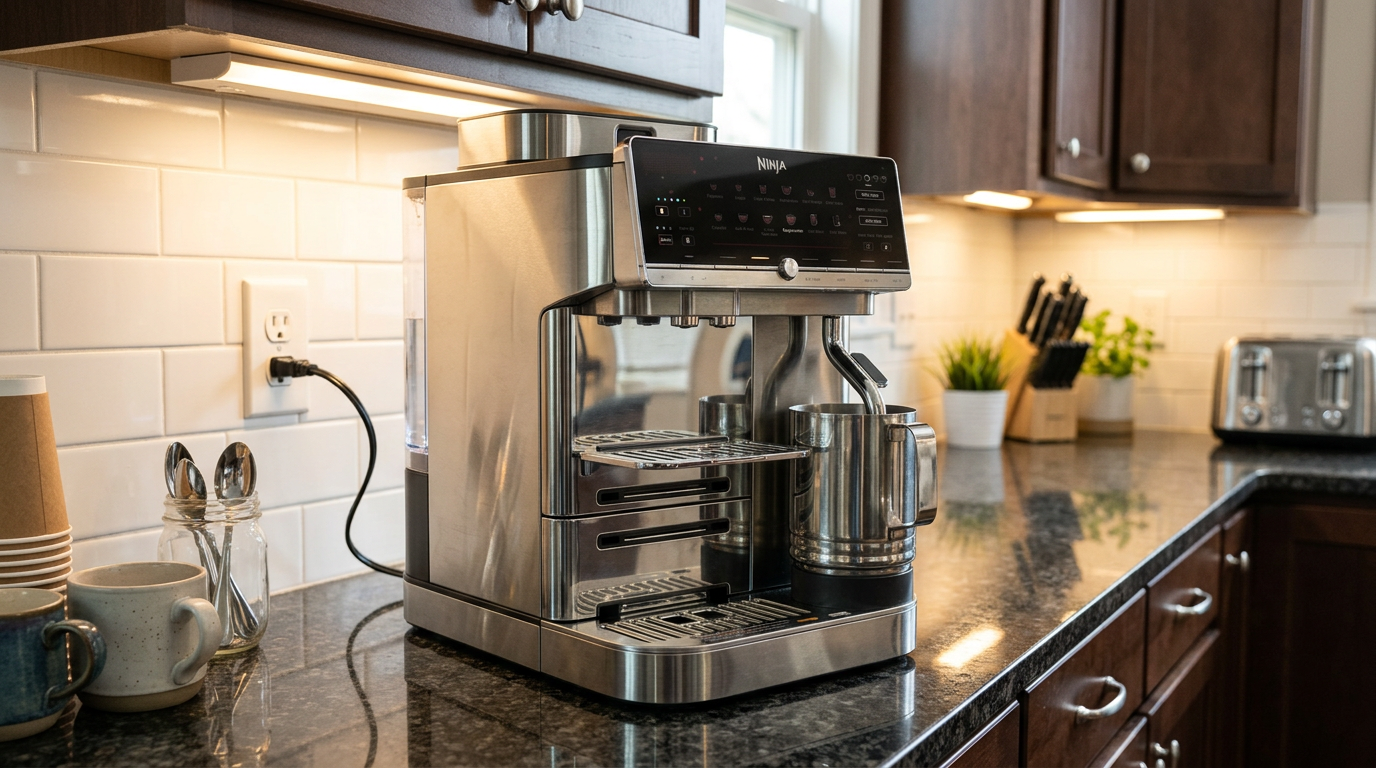
Fresh beans matter more here than on many automatic machines.
The grinder and how much coffee it uses
The stainless-steel burr grinder has 50 settings, far more than the 12 or 13 you'll usually see on an automatic machine.
The catch is that you don't choose among them directly.
Grind iQ makes that decision, and published testing of the Pro describes only a small offset of up to two steps either way.
If you enjoy tinkering, that restriction will be frustrating, and one reviewer called it the machine's biggest annoyance.
If you just want coffee, it's arguably the point of buying this machine.
Dose is a real strength.
The brew basket is about 2.1 inches wide and unusually deep, which allows for much bigger pucks than typical automatic machines can manage.
Here's how the dose scaled in testing on the Pro:
The default two-shot setting is the one I'd start with.
The same tester found a single shot too weak, while the double and triple worked well.
Strength is a separate control, and it's a little confusing because more beans on the display means less water in the cup.
Ninja's documentation describes it as a brew ratio:
In plain English, level 1 runs about three times as much water through the coffee as level 5.
If your espresso tastes thin, move toward level 5 before you change anything else.
One tester settled on level 4 with a double shot as the sweet spot, and that's a sensible place to begin.
Milk frothing: the best part of the machine
If you drink lattes and cappuccinos, this section may decide the purchase.
The AE1002 uses what Ninja calls FrothPerfect, which combines a steam wand with a temperature probe and a whisk in the included jug.
You pour milk to the marked line, set the jug in place and press start.
You get four styles: Steamed Milk, Thin Froth, Thick Froth and Cold Foam, with settings for dairy and plant-based milk.
Published testing has been consistently positive on hot milk.
Reviewers described silky texture, good temperature and a result close to hand-steamed milk without any skill.
This is the area where even the machine's harshest critics found a lot to like.
There's one thing you need to know before your first latte.
The machine steams the milk first and then pulls the espresso, re-engaging the whisk every so often to keep the foam blended.
A tester on the Pro lifted the jug out early and stopped the drink, so leave it in place until the machine has finished.
You do still pour the milk into your cup yourself.
If you're picturing a system that dispenses the finished latte into your mug, this isn't it.
The upside is that you can use any milk, in the amount you want, and there are no hidden milk tubes to clean.
The jug's spout isn't designed for latte art, so buy a proper pitcher if you want to practice that.
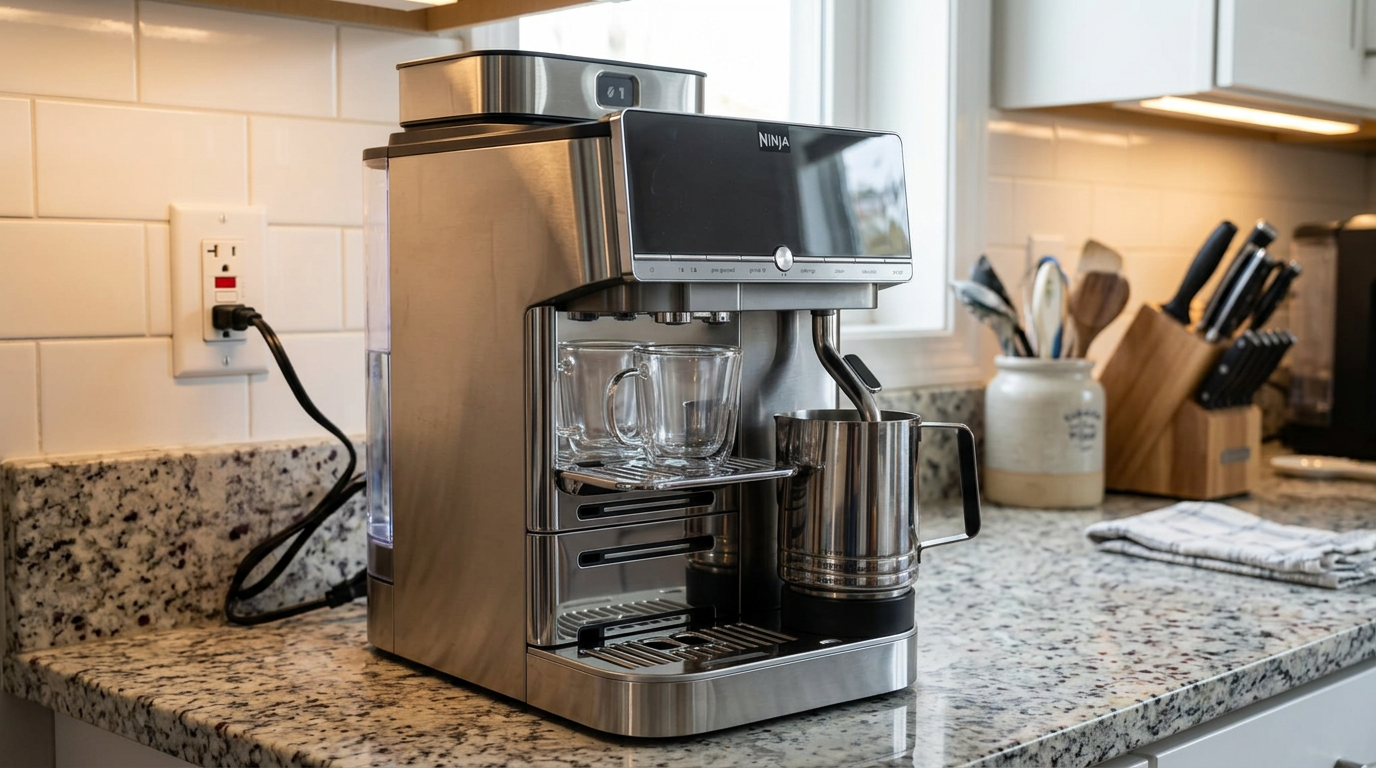
The milk jug stays in place while the machine finishes the espresso.
Cold brew, cold-pressed and iced drinks
The cold menu is one of the headline features, and also the least proven part of the package.
Ninja says its cold brew is made at a lower temperature so that it tastes smooth and naturally sweet, rather than just being hot coffee over ice.
Results vary a lot.
One owner loved having a fast option that doesn't need to be planned the night before.
One independent test found the cold brew very weak and not actually cold, and the same tester saw cold foam collapse within seconds.
I'd treat those drinks as a useful bonus rather than the reason to buy.
Over Ice is the safer choice if you just want a good iced coffee, because it's a hot extraction poured over ice.
Fill the glass first, and use the stronger settings so that melting ice doesn't leave you with a watery drink.
Cold brew also goes through a lot of water, and one tester had to refill the tank after a single drink.
Controls and customization
The control panel is a single surface with drink icons that light up as you select them.
You won't have to dig through layers of menus, which is a plus.
After choosing a drink, you can change strength, size, temperature and froth style, then save your favorites for next time.
Beginners seem to get comfortable quickly, and several owners went from feeling intimidated to using it daily.
More experienced users have a different experience.
One reviewer found the mix of ratios, levels and units confusing, and said the manual was needed to make sense of it.
Secondary settings can also be fiddly, with options shown on a small scrolling display on the Pro.
My suggestion is to start with the defaults for each drink.
Change one thing at a time, and only after you've made a few drinks with the same beans.
Speed and noise
This isn't the fastest machine in its class.
One test of the Pro recorded at least a minute per drink, and another noticed two to three minutes of whirring and preparation before a first cappuccino started to pour.
The machine got quicker after several drinks, but milk drinks will always take longer because of the steaming stage.
The AE1002 also lacks the Brew Two function that the Pro uses to make two shots at the same time.
If you're making drinks for two people before work, build a few extra minutes into your morning.
Noise is noticeable as well.
One measurement of the Pro's grinder came in at 78.5 decibels, which is loud enough to be heard throughout an open-plan home.
The burst is short, but it's worth thinking about if you're up before everyone else.
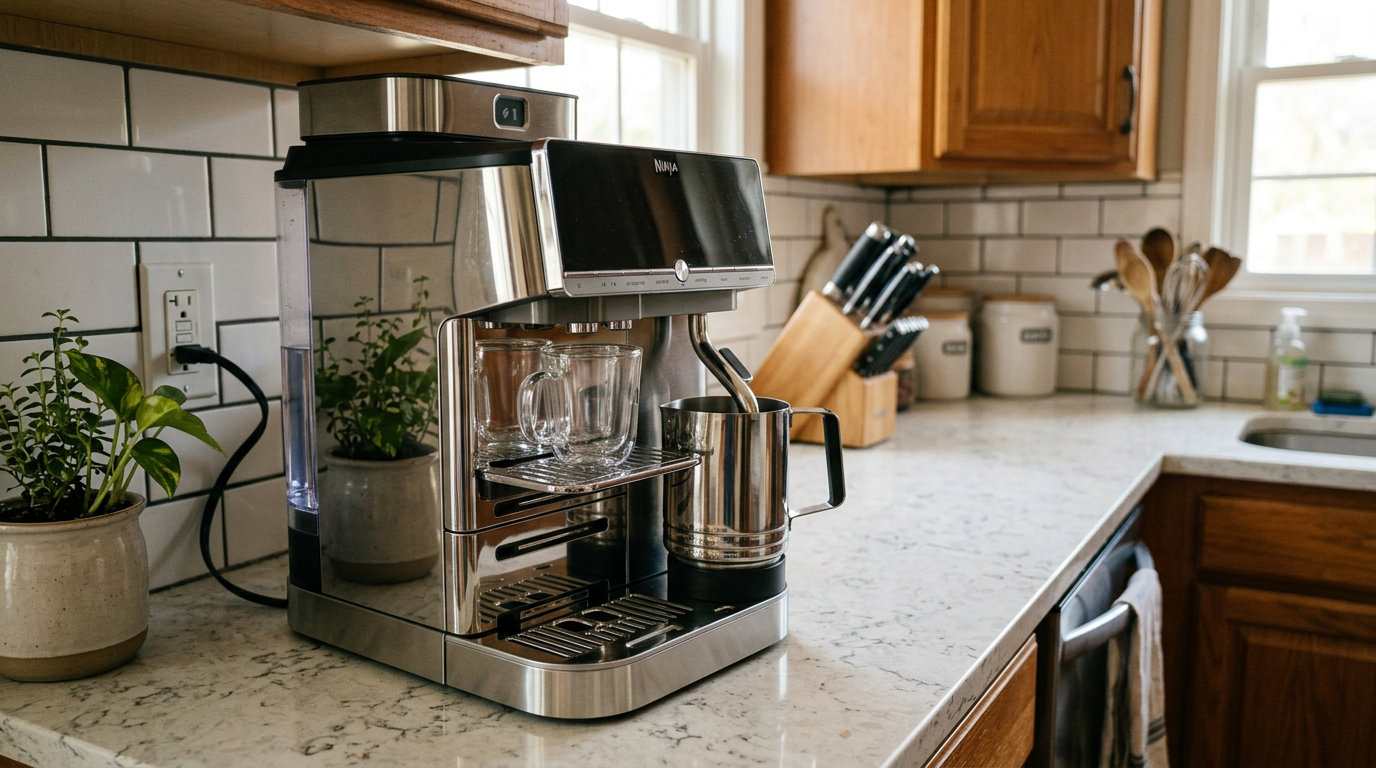
Allow a few extra minutes for milk drinks on busy mornings.
Water use: the catch nobody puts on the box
Every automatic machine rinses itself, but this one seems to be especially thirsty.
Testing on the Pro, which has a larger 80-ounce tank, needed a refill after about four drinks.
The same testing had the drip tray filling up every five drinks or so.
The AE1002 has a 70-ounce tank, so I'd plan on refilling at least that often.
An owner of this exact model made the same complaint, noting that the rinses for the brew path and the frothing wand add up quickly.
Part of that water is the reason the machine stays clean with so little effort, so I don't think of it purely as waste.
It just means that you should place the machine where refilling is easy.
One owner also pointed out that a small amount of water always stays in the tank.
Empty and rinse it regularly rather than topping it up for days at a time.
Cleaning and maintenance
Upkeep is one area where Ninja has clearly done its homework.
The machine rinses itself automatically, and owners report that the frothing wand gets rinsed once the jug is removed.
An interior fan helps dry the inside of the machine, which addresses the moisture problem that many automatic machines have.
The brew group can be removed for cleaning, and on the Pro the cleaning brush and lubricant are stored behind the side panel where you can't lose them.
Ninja includes descaling solution, cleaning tablets, a brush, brew unit lubricant and a water filter in the box.
Used grounds come out as compact pucks, which owners find much tidier than loose grounds.
Fully automatic still doesn't mean maintenance-free, though.
One verified buyer found stray coffee grounds collecting inside the machine around the drip tray, so check that area regularly.
Here's the routine I'd follow:
- After milk drinks: Let the wand rinse, then wipe the outside with a damp cloth and wash the jug.
- Daily: Empty the drip tray and grounds bin when needed, and refresh the water.
- Weekly: Remove the brew group, brush away residue, and vacuum or wipe around the tray area.
- When prompted: Run a cleaning tablet or descale cycle, and replace the filter on schedule.
- Periodically: Lubricate the brew unit as directed in the manual.
Choosing the right beans
Because this machine depends on the beans for resistance, what you buy will have a large effect on the results.
Look for a recent roast date and start with a medium or medium-dark espresso blend.
Avoid very oily beans, and be careful with flavored coffee too.
An owner who used flavored beans struggled with sticky residue and an uneven flow until he recalibrated, and he ended up ordering proper espresso beans.
Stick with one bean for a while, because each change means another calibration.
If you'd like decaf now and then, a couple of owners note that the machine accepts pre-ground coffee for one-off drinks.
For milk, fresh whole milk gives the creamiest result, and a barista-style oat milk is the best plant-based starting point.
What owners say
The ownership data is still young, so read it carefully.
On a recent check of the Amazon listing, the AE1002 had 4.9 out of 5 stars from just 21 ratings.
That's a very small sample, and most of the detailed reviews came from people who received the product for free through Amazon's review program.
I wouldn't treat that score as settled.
Still, the themes are consistent and useful.
On the positive side, owners keep mentioning how little they need to know, the quality of the milk, and how many different drinks the household can make.
The recurring complaints are bean use during calibration, water consumption, and a lack of direct control over how the coffee is made.
Those complaints match what independent testers found, which makes me more confident that they're real.
Longer-term reliability is still unknown, because this machine has only been on sale since 2026.
Tips to get better results
- Calibrate with an affordable bean you like. Save your special bags until you know the routine.
- Start at two shots. A single shot was too weak in published testing.
- Raise the strength before changing the grind. It's the simplest way to fix a thin drink.
- Leave the jug in place. Taking it out too early can stop the drink.
- Fill the glass with ice first. Over Ice works best with a generous amount.
- Keep extra water handy. A pitcher beside the machine saves pulling it forward as often.
- Check the area around the drip tray. Stray grounds can build up there.
- Run the hardness test. It helps the machine prompt descaling at the right time.
What published tests found
Here's a summary of the available evidence and what it means for you.
| Area | What was found | What it means |
|---|---|---|
| Espresso temperature | About 149°F (Pro) | Fine, but warm your cup |
| Cappuccino temperature | About 145°F (Pro) | Easy to drink right away |
| Grinder noise | 78.5 dB (Pro) | Loud in short bursts |
| Calibration | About 6 minutes, about 7 oz of beans (Pro) | Don't use costly beans |
| First drink wait | 2 to 3 minutes in one test (Pro) | Allow extra time |
| Water refills | About every 4 drinks (Pro, 80 oz tank) | Keep the tank accessible |
| Espresso taste | Mixed, depends on beans | Choose fresh, medium roasts |
| Hot milk | Consistently praised | The main strength |
| Cold brew and cold foam | Mixed to poor in one test | Treat as a bonus |
These are results reported by independent testers and owners, not measurements I took myself.
Ninja AutoBarista AE1002 vs AutoBarista Pro
The most useful comparison is with the AutoBarista Pro AE1051, because the two are so closely related.
They share the same core technology, and the differences come down to flexibility and capacity.
| AutoBarista AE1002 | AutoBarista Pro AE1051 | |
|---|---|---|
| Presets | 10 | 13 |
| Extra drinks | None | Lungo, Cortado and more |
| Bean hoppers | 1, about 8.8 oz | 2 swappable, 12 oz each |
| Froth styles | 4 | 5, adds Extra-Thick |
| Water tank | 70 fl oz | 80 fl oz |
| Brew Two | No | Yes |
| Weight | 36.2 lb | About 41 lb |
The swappable hopper is the big one.
If your household keeps both regular and decaf, or if you like rotating beans, the Pro lets you switch without emptying anything or starting over from scratch.
That alone can justify choosing the Pro, especially given how much coffee recalibrating uses.
If you're happy with one bean and you don't care about a cortado or lungo preset, the standard AE1002 gives you the features that matter most.
Ninja AutoBarista AE1002 specifications
From Ninja's published specifications and the Amazon listing.
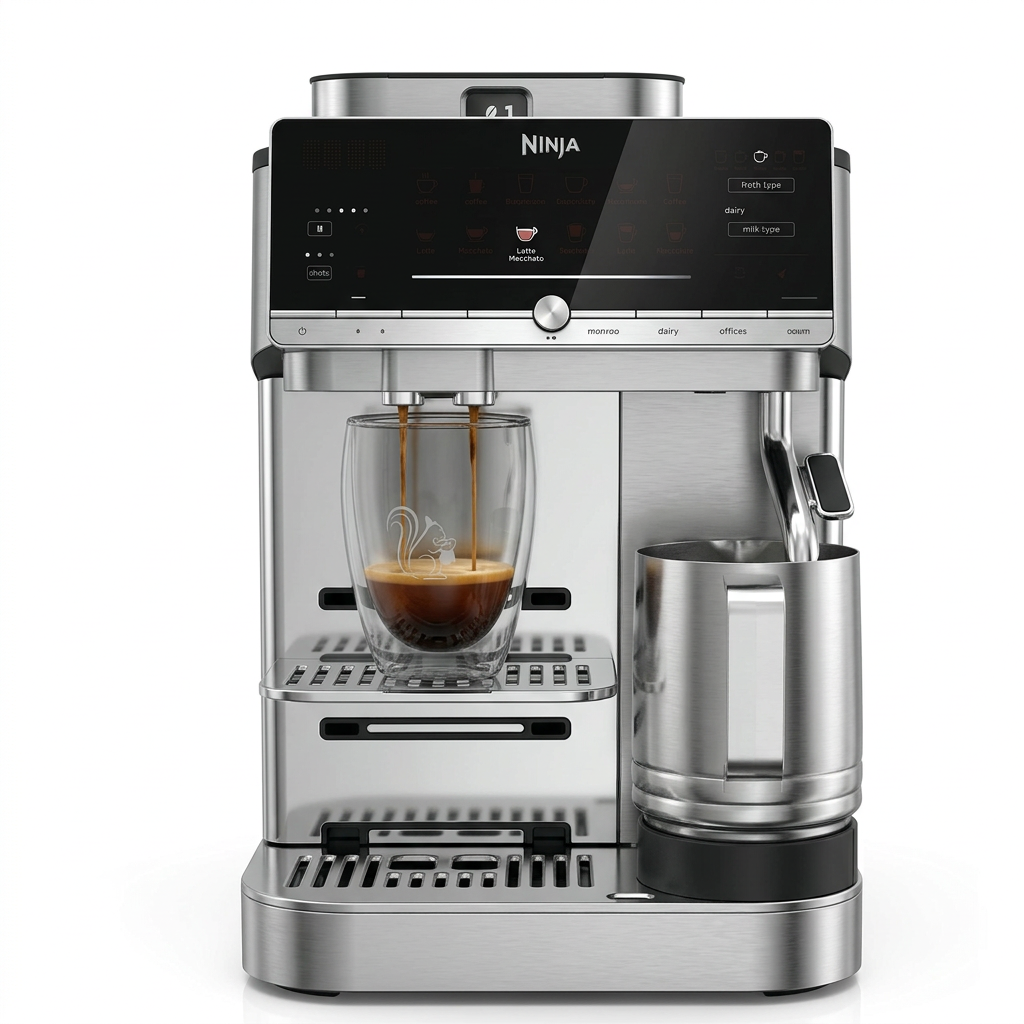
The Ninja AutoBarista AE1002.
Is the Ninja AutoBarista AE1002 worth it?
For the right household, I think it is.
You're paying for a grinder, an espresso machine, a drip brewer and a hands-free milk frother that all work from one panel.
The value is clearest if you often buy milk drinks at a coffee shop and several people at home want different things.
It's less compelling if you only drink a pot of plain drip coffee, since a simple brewer will do that with far less coffee and water.
It's also the wrong tool for anyone who loves the craft of dialing in espresso.
Remember to factor in the ongoing costs of beans, filters, cleaning tablets and descaler.
Prices move, so check the current price on Amazon before you decide.
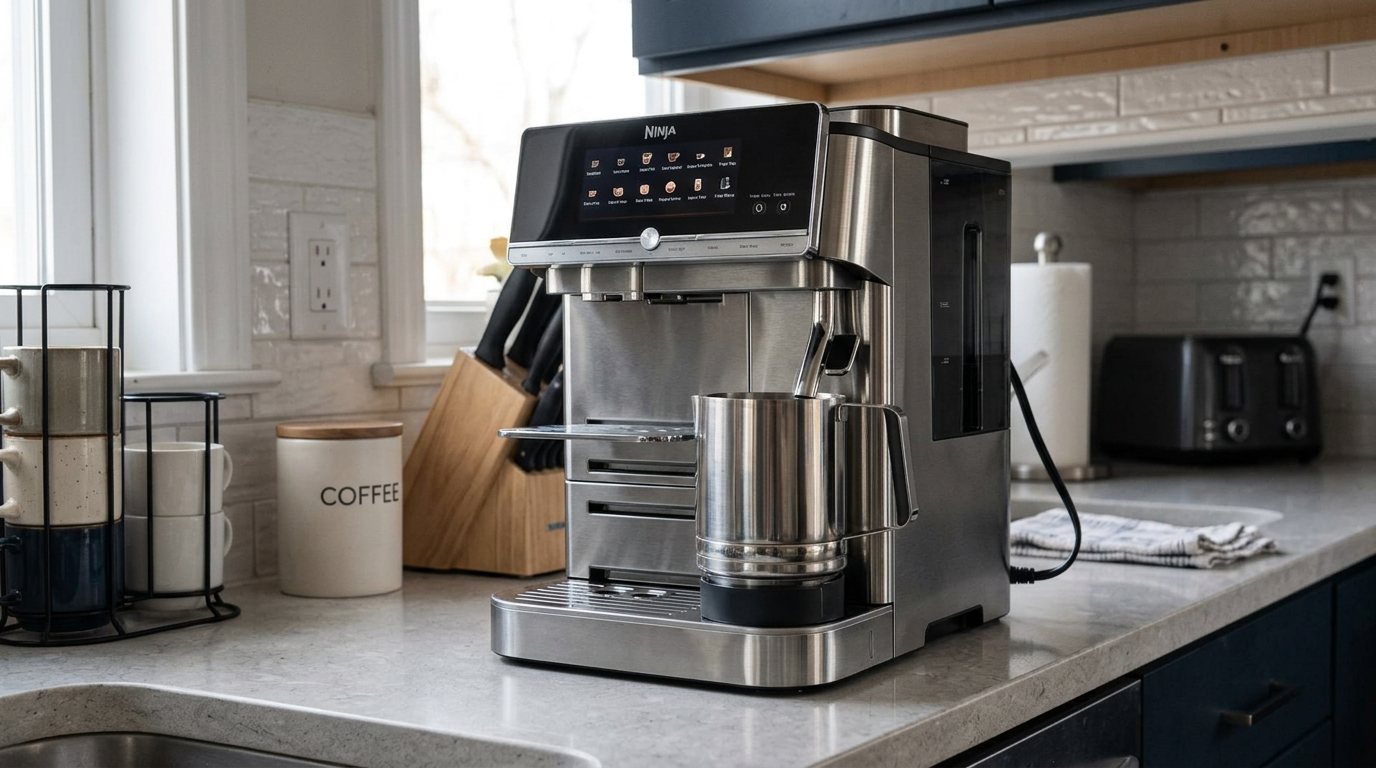
A strong all-rounder for homes that want variety with minimal effort.
How I rated it
My 8.0 overall score is an editorial judgment rather than a lab measurement.
I based it on Ninja's specifications, independent test reports and patterns in owner feedback, with test data from the Pro flagged wherever I used it.
Milk drinks and ease of use scored highest because the evidence there is strongest.
Coffee quality landed lower because results depend heavily on the beans and vary between testers.
Value reflects the machine's breadth, balanced against its appetite for beans and water.
Ninja AutoBarista AE1002 FAQ
Is the Ninja AutoBarista AE1002 worth it?
It is a good fit if you want one-touch espresso, drip coffee and milk drinks from one machine and you mostly stick to one bean. It is a weaker fit if you want manual grinder control or you switch beans often.
What is the difference between the AE1002 and the AE1001?
Ninja publishes its specifications under AE1001. AE1002 is the model number on the Amazon listing, and the listed features match. I found no published hardware difference, but check the listing before you order.
What is the difference between the AutoBarista and the AutoBarista Pro?
The Pro has two swappable hoppers, 13 presets instead of 10, an extra-thick froth setting, a Brew Two function and a slightly larger water tank.
Can I adjust the grind myself?
Only within limits. Grind iQ picks from 50 settings by itself, and on the Pro, published testing describes an offset of up to two steps either way.
How many beans does Grind iQ use?
One published test of the Pro measured about 7 ounces during calibration, which took around six minutes in another test. Expect to use a meaningful amount of coffee whenever you recalibrate.
Does it have a steam wand?
Yes, but it runs automatically. You pour milk into the included jug, the machine steams and whisks it, and then you pour it into your cup.
Does it work with plant-based milk?
Yes. Ninja says the frothing system works with dairy and plant-based milk, and barista-style oat milk is the safest place to start.
Can it make real cold brew?
Ninja says its cold brew uses a lower brewing temperature. Published results are mixed, and one test found it weak and not fully cold, so I would treat it as a bonus.
Can I use pre-ground coffee?
Owners of the AE1002 report using pre-ground coffee, which is handy for an occasional decaf. It is still one hopper for whole beans.
How often will I refill the water?
Testing on the larger-tank Pro needed a refill after about four drinks. With the 70-ounce tank here, plan on refilling at least that often if you make milk drinks.
Is the brew group removable?
Yes. It is designed to be taken out for cleaning, and the Pro stores its brush and lubricant behind the side panel.
What is the warranty?
Ninja lists a one-year limited warranty for this model on its US product page. Check the terms when you buy.


- Ninja US product page and specifications for the AutoBarista (AE1001)
- Amazon product listing for the Ninja AutoBarista AE1002 (ASIN B0HFXD6RXW), November 2026
- Published independent test results for the AutoBarista Pro
- Owner reviews of the AE1002, November 2026
- Review published.