De'Longhi Magnifica Start vs Philips 3300 Series: which one-touch espresso machine should you buy?
Both machines grind fresh beans and make milk drinks at the press of a button. One leans toward a stronger espresso and finer foam, while the other is quieter and takes less work to keep clean. I went through the specs, published test data and more than 1,500 owner ratings to find out which one deserves your counter.
We choose products independently. We may earn a commission through links on this page; your price stays the same. Affiliate policy
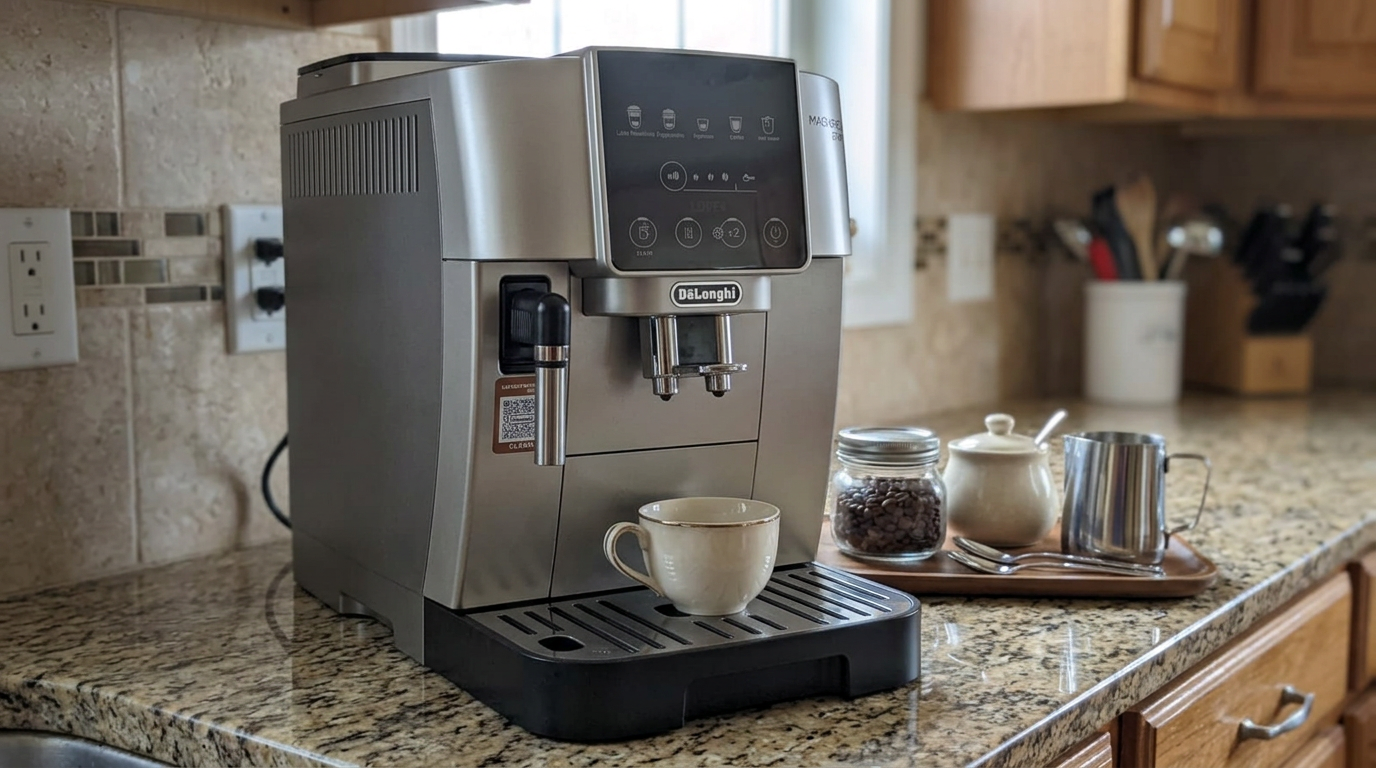
In this comparison
For most homes I would pick the Philips 3300 Series. It is much quieter, its tube-free LatteGo carafe is the easier milk system to live with, and it adds an iced coffee button and a water filter in the box. The De'Longhi Magnifica Start is the better choice if espresso comes first, because it can use more coffee per shot, offers finer foam and takes up a little less height. Just know that neither machine will replace a skilled barista, and both need regular emptying and a weekly brew unit rinse.
The two machines
Ratings checked November 9, 2026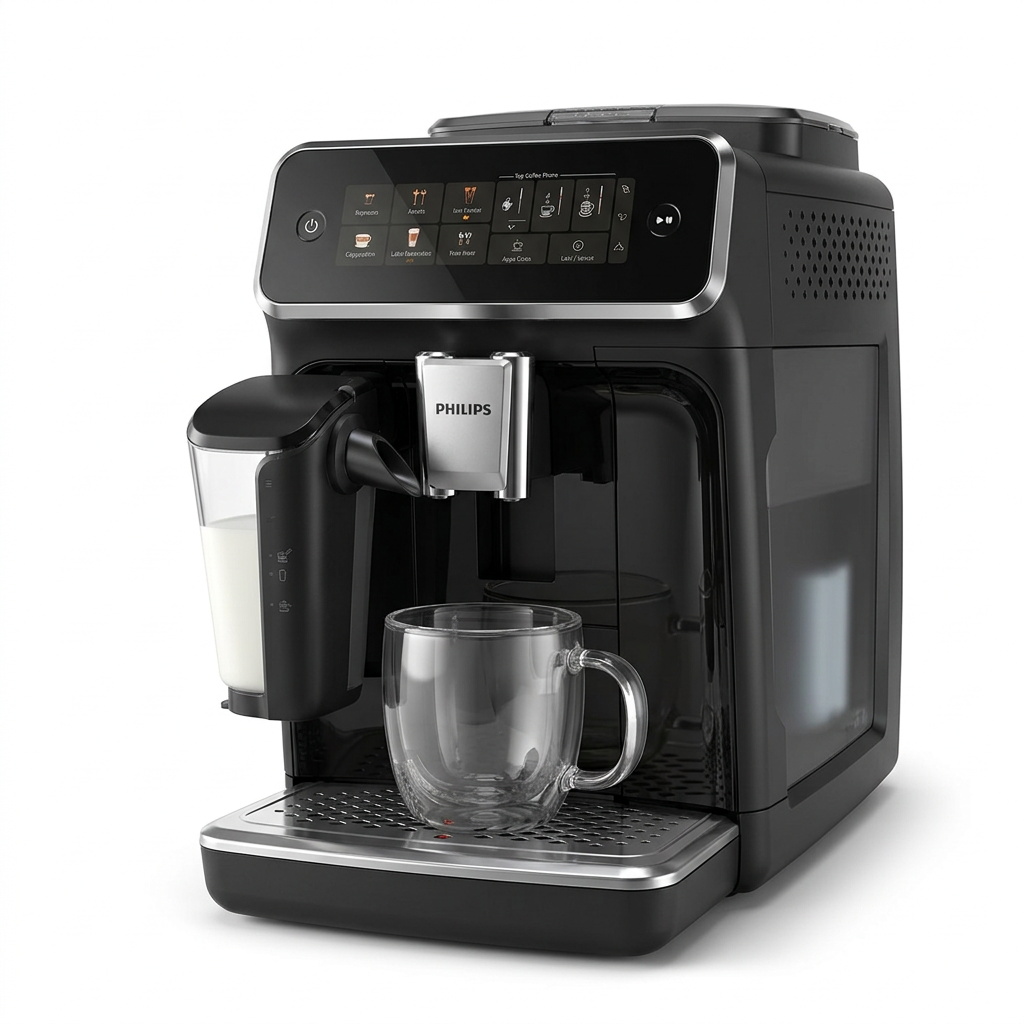
A quiet, low-fuss machine with six one-touch drinks, iced coffee and a tube-free milk carafe that rinses in seconds.
See Today’s Price →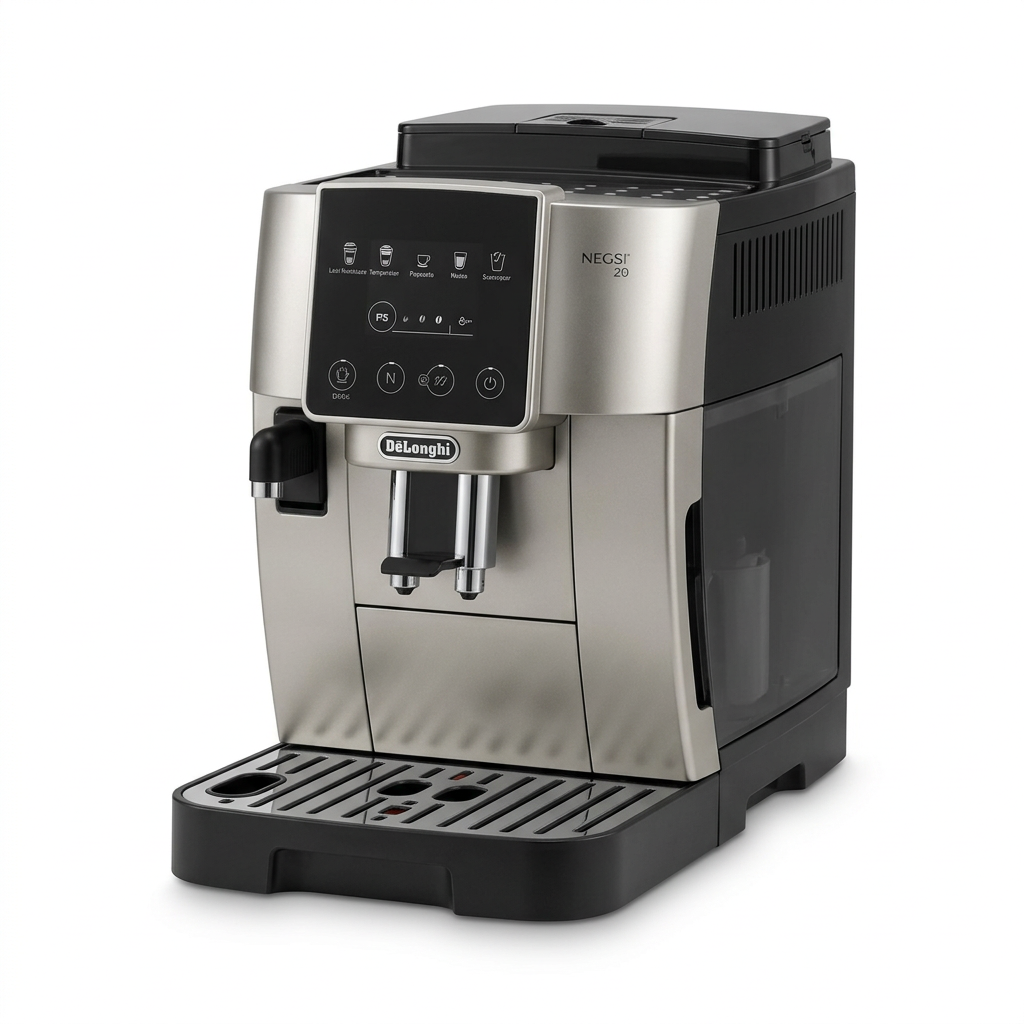
A compact machine with a 13-step conical burr grinder, five one-touch drinks and the LatteCrema automatic milk system.
Reveal Today’s DealMagnifica Start vs Philips 3300 at a glance
- Buy the Philips 3300 Series if you drink lattes or cappuccinos every day and want quiet mornings with as little cleanup as possible.
- Buy the De'Longhi Magnifica Start if you care most about espresso body and finer milk foam, and a louder grinder will not bother anyone.
- Both make milk drinks automatically, so this is not a case of carafe versus steam wand. The real differences are foam style, noise and how the milk parts get cleaned.
Head to head
The better result in each row is marked. Figures come from the manufacturers and Amazon listings unless noted, and rows without a mark are a tie or a matter of taste.
| Spec | De'Longhi Magnifica Start | Philips 3300 Series |
|---|---|---|
| One-touch drinks | 5, no iced coffee | 6, including iced coffee ✓ Best |
| Milk system | LatteCrema carafe | LatteGo carafe |
| Milk cleanup | One-touch flush, dishwasher-safe parts | No tubes, rinses in seconds ✓ Best |
| Carafe size | About 7.4 fl oz | About 8.8 fl oz ✓ Best |
| Foam style | Very fine, close to microfoam ✓ Best | Thick and firm |
| Grinder | Conical steel burrs | Ceramic flat burrs |
| Grind settings | 13 ✓ Best | 12 |
| Coffee doseper shot | About 0.28 to 0.35 oz ✓ Best | About 0.28 oz |
| Pump pressure | 15 bar | 15 bar |
| Grinder noise | Loud, the top owner complaint | 61 to 62 dB, lid on (reported) ✓ Best |
| Water tank | About 61 oz | About 61 oz |
| Bean hopper | About 8.8 oz | About 9.7 oz ✓ Best |
| Grounds bin | About 14 pucks ✓ Best | About 12 pucks |
| Water filter | Optional | AquaClean included ✓ Best |
| Heightunder cabinets | 13.8 in ✓ Best | 14.6 in |
| Width | 9.4 in ✓ Best | 9.7 in |
| Max cup height | About 5.6 in | About 5.5 in |
| Amazon rating | 4.0 (278) | 3.8 (1,290) |
| Rows won | 6 | 6 |
The tally ends level, but those rows do not count equally in daily life. Noise and milk cleanup affect you every morning, while a fraction of an inch in width probably will not.
Is It On Sale? Check NowMagnifica Start vs Philips 3300 pros and cons
De'Longhi Magnifica Start
- Rich, crema-topped espresso
- Higher top dose for bolder shots
- 13 grind settings on a conical burr grinder
- Fine, smooth milk foam
- One-touch flush cleans the milk path
- Compact and shorter than the Philips
- Grounds bin holds a couple more pucks
- Grinder is loud and slightly high-pitched
- No iced coffee button
- Milk can run very hot for some tastes
- Hot water means swapping the carafe for a spout
- Long coffee can taste thin until adjusted
- Hopper lid does not seal tightly
- Two-cup option adds water rather than beans
Philips 3300 Series
- Very quiet grinder for this class
- Tube-free LatteGo carafe rinses in seconds
- Six one-touch drinks, including iced coffee
- Clear picture-based control panel
- AquaClean filter in the box
- Filter can greatly reduce descaling
- Hopper lid has an aroma seal
- Espresso is lighter-bodied at the default strength
- Foam is too thick for latte art
- Milk frothing is the loudest stage
- Drip tray fills quickly from rinse cycles
- Mostly plastic build
- Lower Amazon rating of the two
- Iced coffee needs tweaking
Who should buy which machine?
- Espresso and bold coffee drinkers
- People who prefer finer, smoother milk foam
- Kitchens with tight cabinet clearance
- Anyone who likes adjusting the grind
- Homes where grinder noise is not a problem
- Households that do not need iced coffee
- Daily latte and cappuccino drinkers
- Early risers with light sleepers at home
- Open-plan homes and small apartments
- Anyone who dislikes cleaning milk parts
- Iced coffee fans who want it without planning
- Hard water homes that want fewer descaling cycles
Design, size and setup
On the counter these two look like cousins. Both are narrow, front-loading boxes built mostly from plastic, with a flat panel of touch icons above the spouts.
The Magnifica Start measures about 9.4 inches wide, 17.3 inches deep and 13.8 inches tall. The Philips 3300 is about 9.7 inches wide, 17 inches deep and 14.6 inches tall.
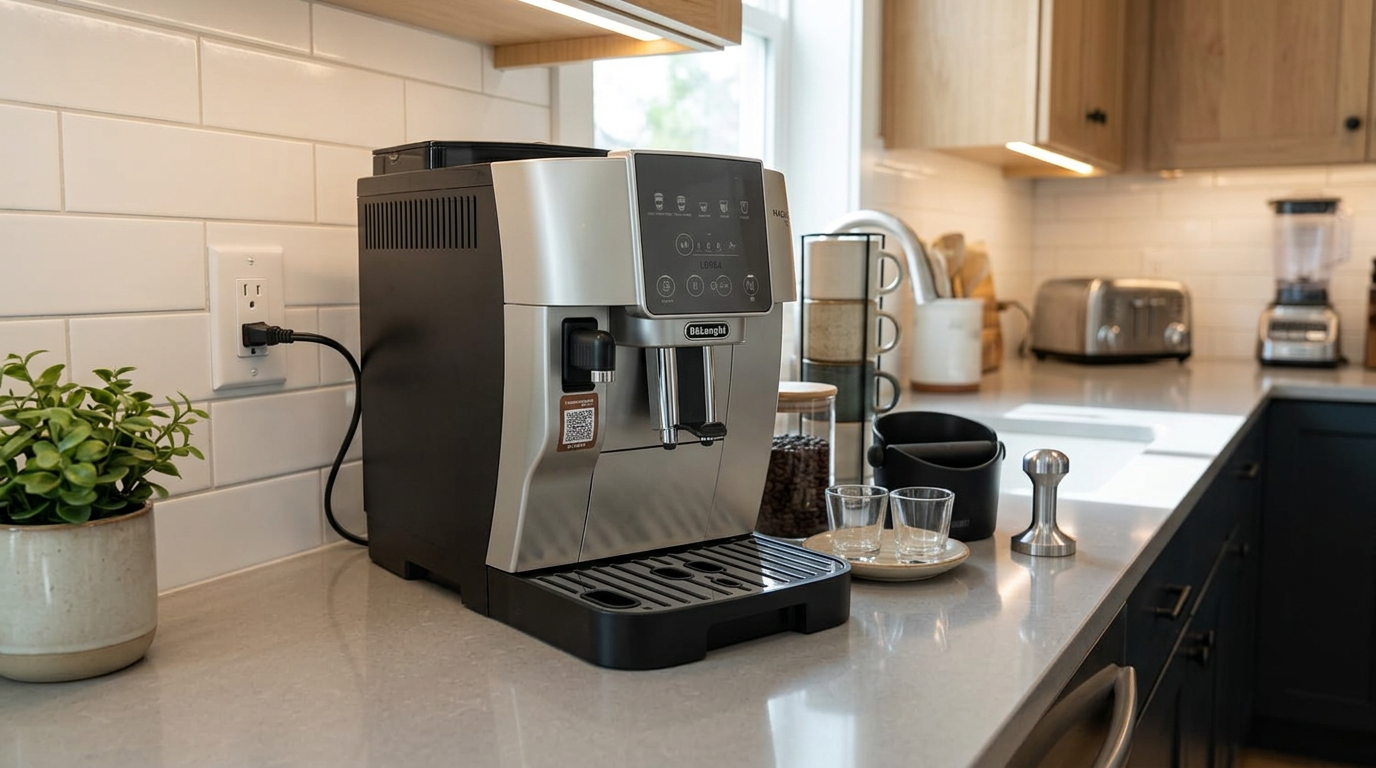
The Magnifica Start has the narrower and shorter body of the two.
That extra 0.8 inch of height will rarely matter, but check your clearance anyway. Both machines load beans from the top, so you need enough room to open the lid or slide the machine forward.
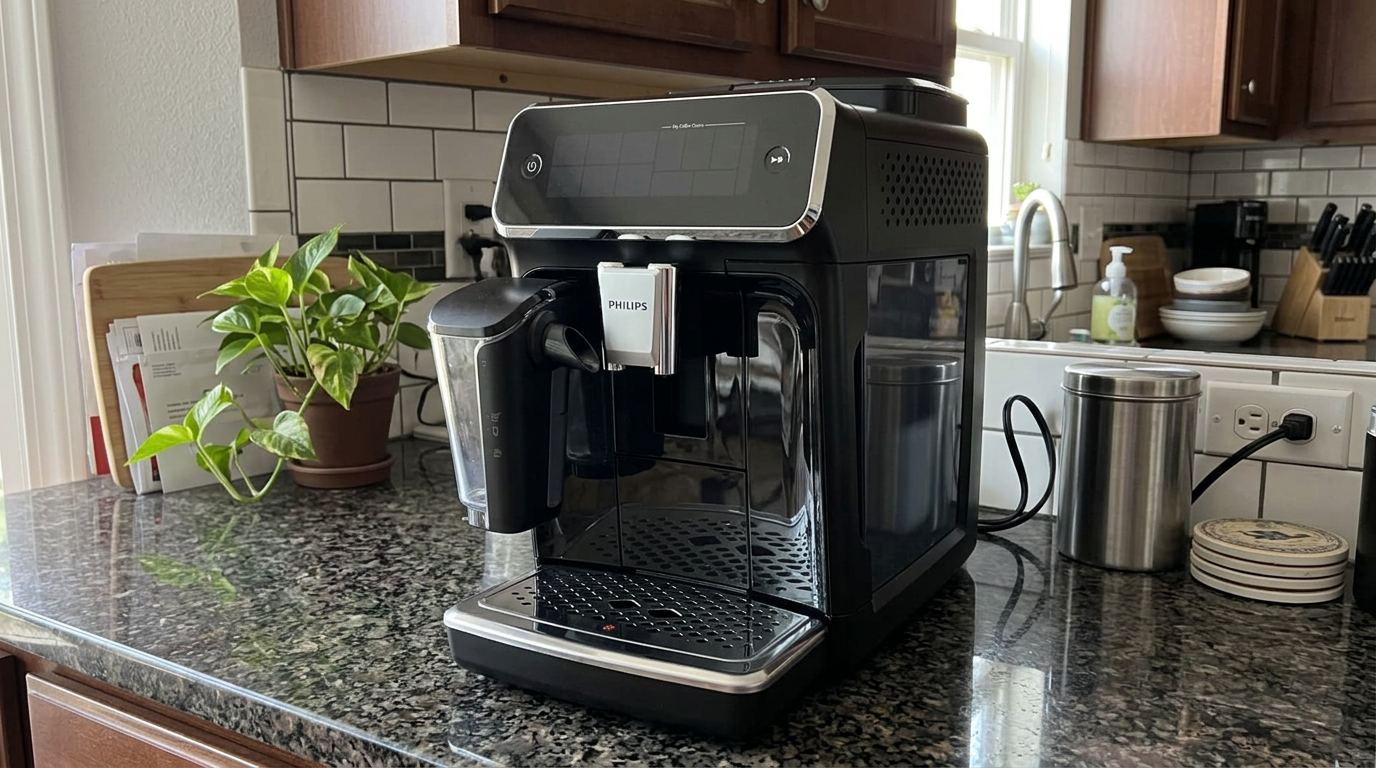
I like the silver front on the De'Longhi, which looks smarter than the price class suggests. The Philips goes for gloss black with chrome-look trim, and that glossy surface will show fingerprints.
Neither one feels like a premium appliance when you handle it. Plastic keeps the weight down, though, at about 19.4 pounds for the De'Longhi and 17.6 pounds for the Philips.
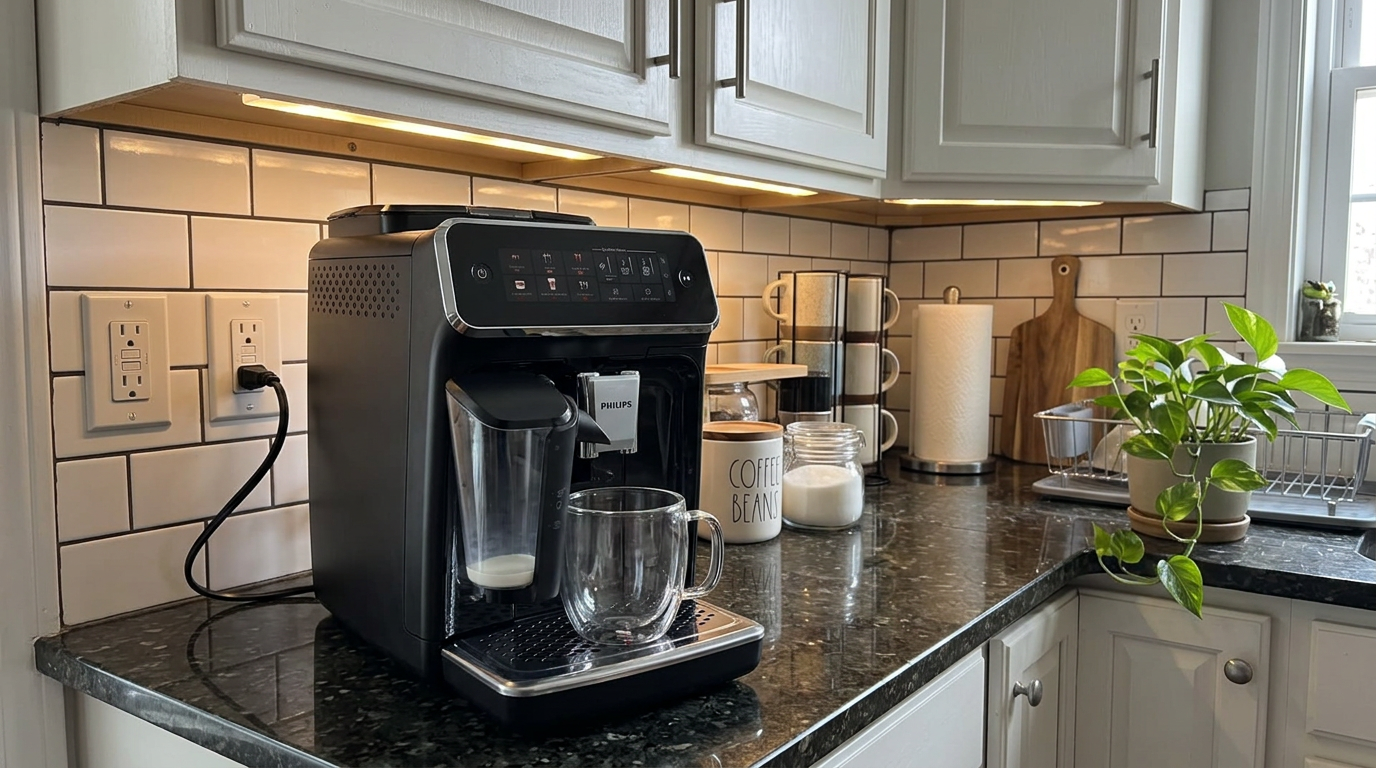
The Philips is slightly taller, but its footprint is almost identical.
Setup is easy on both. You fill the tank, add beans, set the water hardness with the included test strip and let the machine run its first rinse.
The Philips also asks you to fit and activate its filter. Do not skip the activation step, because that is the usual reason owners get an early descaling warning.
Measure first: Check the tallest mug you use every day. The De'Longhi takes cups up to about 5.6 inches and the Philips up to about 5.5 inches, so tall travel tumblers will not fit under either spout.
Espresso and black coffee
Espresso is where the De'Longhi has its clearest advantage on paper. Its strength control runs from about 0.28 to 0.35 ounces of beans per drink, while the Philips tops out at about 0.28 ounces per puck.
More coffee usually means more body, and that matches what owners and tasting panels describe. The Magnifica Start tends to produce a fuller shot with a thick, persistent crema.
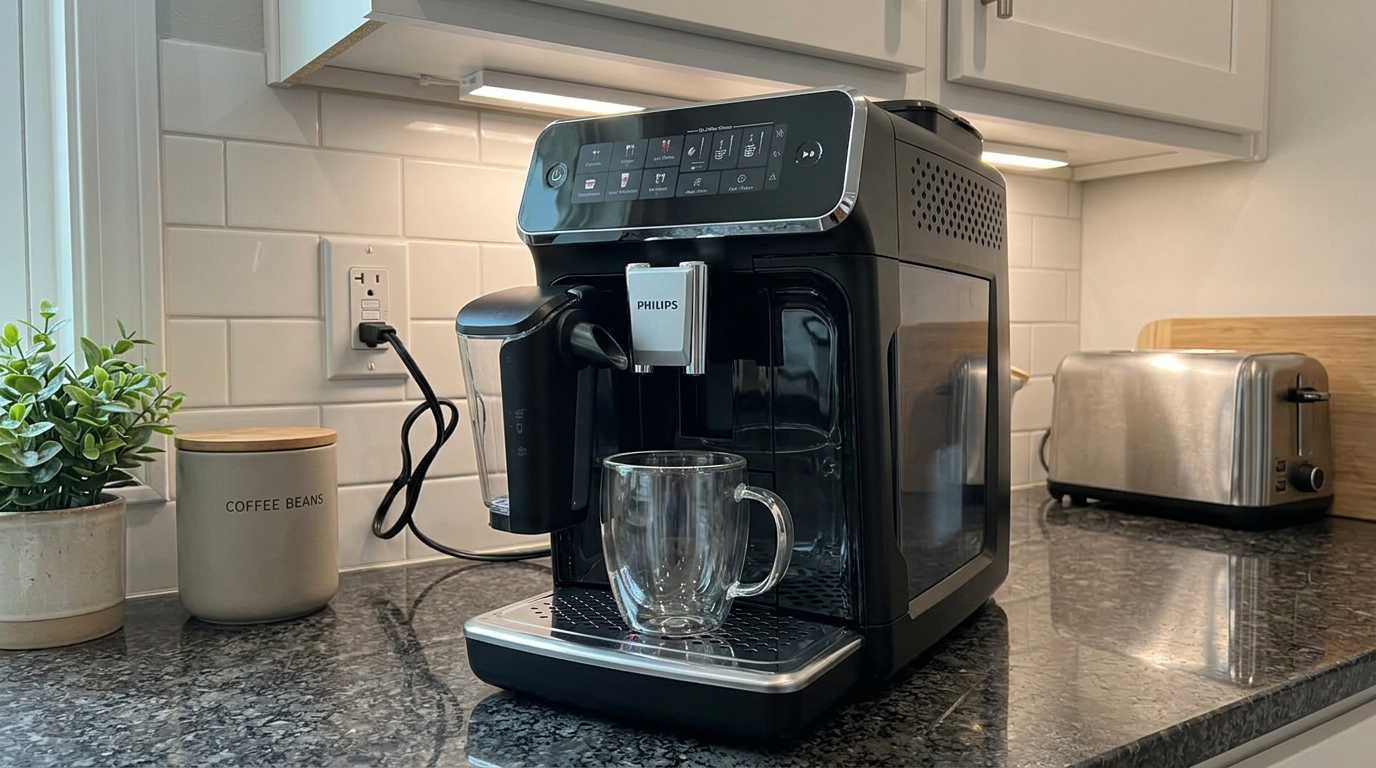
The Philips makes a milder shot, which works well as a base for milk drinks.
The Philips is not a bad espresso machine by any means. With fresh medium-roast beans, a finer grind and the top strength setting, it makes a nutty, slightly sweet shot with a fine layer of crema.
It is simply lighter. One set of measurements put its brewed coffee at about 4.5 to 5.5 TDS, below the 6 to 7 recorded for several other automatic brands.
My own editorial scores from our full reviews put both machines at 8.2 out of 10 for espresso. I rate them level because they get there differently, with the De'Longhi offering more body and the Philips being easier to enjoy in milk.
If you want two drinks at once, read the small print. The Magnifica Start's two-cup option adds more water rather than a second dose of beans, so those cups can taste milder.
For a stronger drink on the Philips, choose its double preparation instead of stretching a single. A recorded double espresso took about 1 minute 34 seconds, compared with 48 seconds for a single.
Black coffee is the closer fight. Long coffee from the De'Longhi can taste thin out of the box because it pushes a lot of water through one dose, and I scored it 6.8 against 7.8 for the Philips.
Espresso tip: Warm your cup with a splash of hot water first. Small shots lose heat quickly in thick, cold ceramic, and this simple habit helps on both machines.
See How Much You’ll SaveGrinder and settings
The De'Longhi uses a conical steel burr grinder with 13 settings, while the Philips has flat ceramic burrs with 12. On a fully automatic machine, that one-step difference will not change your morning.
Both grinders need the same care. Turn the dial only while the grinder is running, move one click at a time and give it two or three drinks before you judge the result.
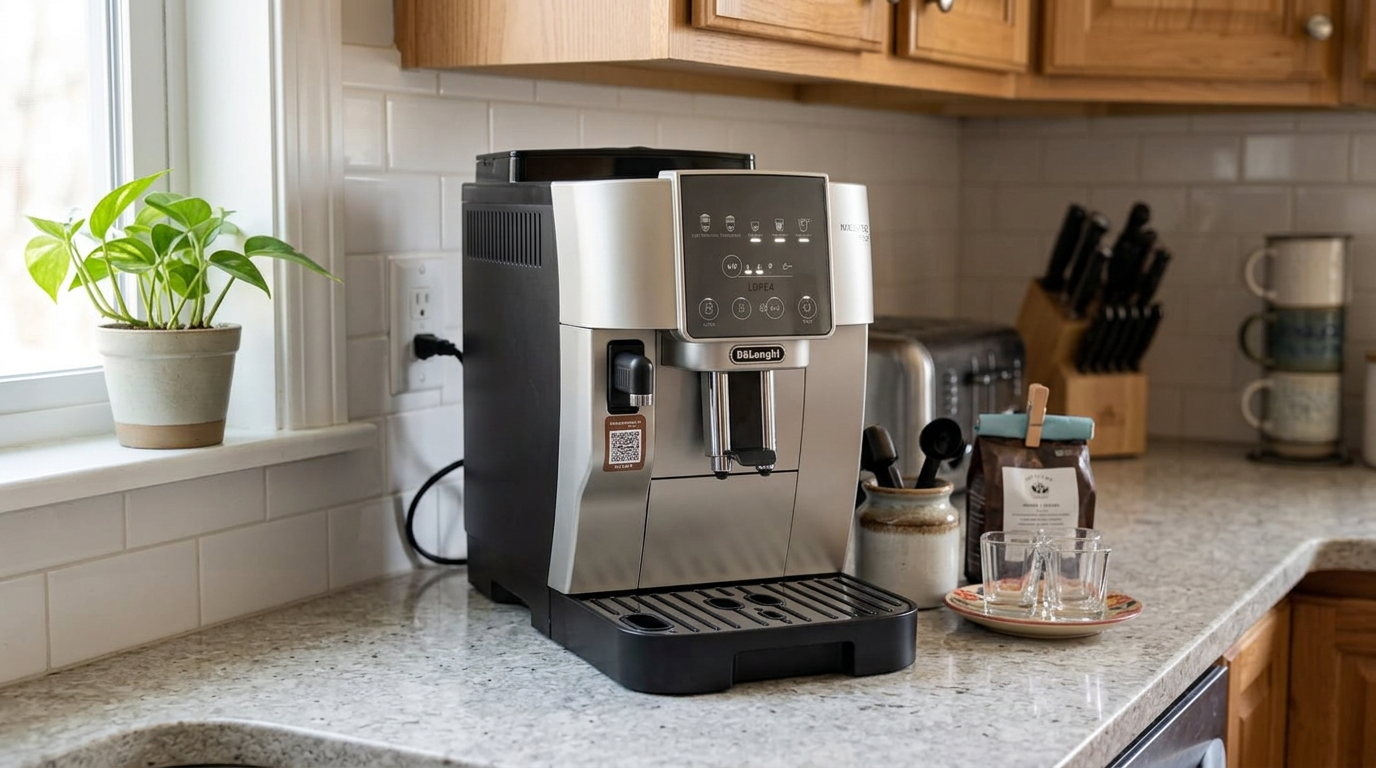
Both machines adjust the grind from a dial inside the bean hopper.
Most Magnifica Start owners who report better flavor have moved two or three steps finer than the factory setting. On the Philips, settings around 3 or 4 work well for fresh beans, and 2 or 3 for older ones.
Bean storage favors the Philips. Its hopper holds about 9.7 ounces and has an aroma seal in the lid, while the De'Longhi holds about 8.8 ounces and its lid does not seal tightly.
Both also take pre-ground coffee through a bypass chute, which is handy for an evening decaf. Add only one level scoop, because overfilling is a common cause of a clogged brew unit.
Milk drinks
This is the section that will decide it for many buyers. The two systems look similar, as each is a small carafe that clips to the front, but they behave differently.
The Magnifica Start uses De'Longhi's LatteCrema system. It makes one-touch cappuccinos and latte macchiatos with very fine, smooth foam that comes closer to true microfoam.
The Philips 3300 uses LatteGo, which draws milk up into the carafe lid, mixes it with air and steam and pours it into your cup. Its foam is thick, firm and spoonable, more like a classic coffee shop cappuccino.
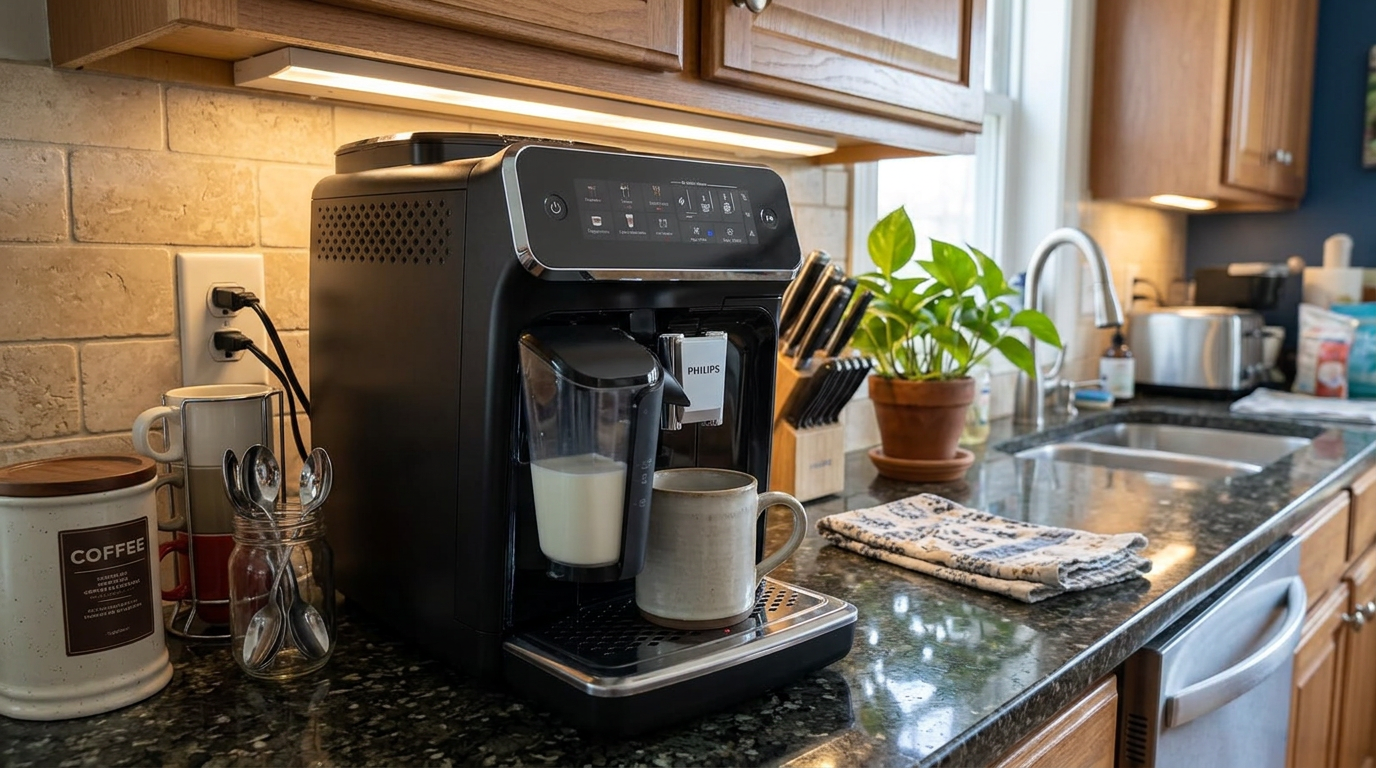
LatteGo has no milk tubes, which makes it very quick to rinse.
If you like silky, blended milk, I think the De'Longhi has the edge. If you want a generous cap of foam on top, the Philips does exactly that, although that thick layer can feel too dense in a latte.
Temperature is worth noting too. LatteCrema tends to run very hot, while reported cappuccino readings on the Philips were about 185 to 187°F, hot enough to drink right away.
Both machines pour the milk first and the coffee second, so neither gives you a choice of order. Neither one offers a true flat white or a separate hot-milk-only drink, so hot chocolate fans should check before buying.
Barista-style oat milk is the best dairy-free choice for either system, based on what owners report. Thin almond milk gives lighter, more fragile foam, and cold milk from the fridge always performs better.
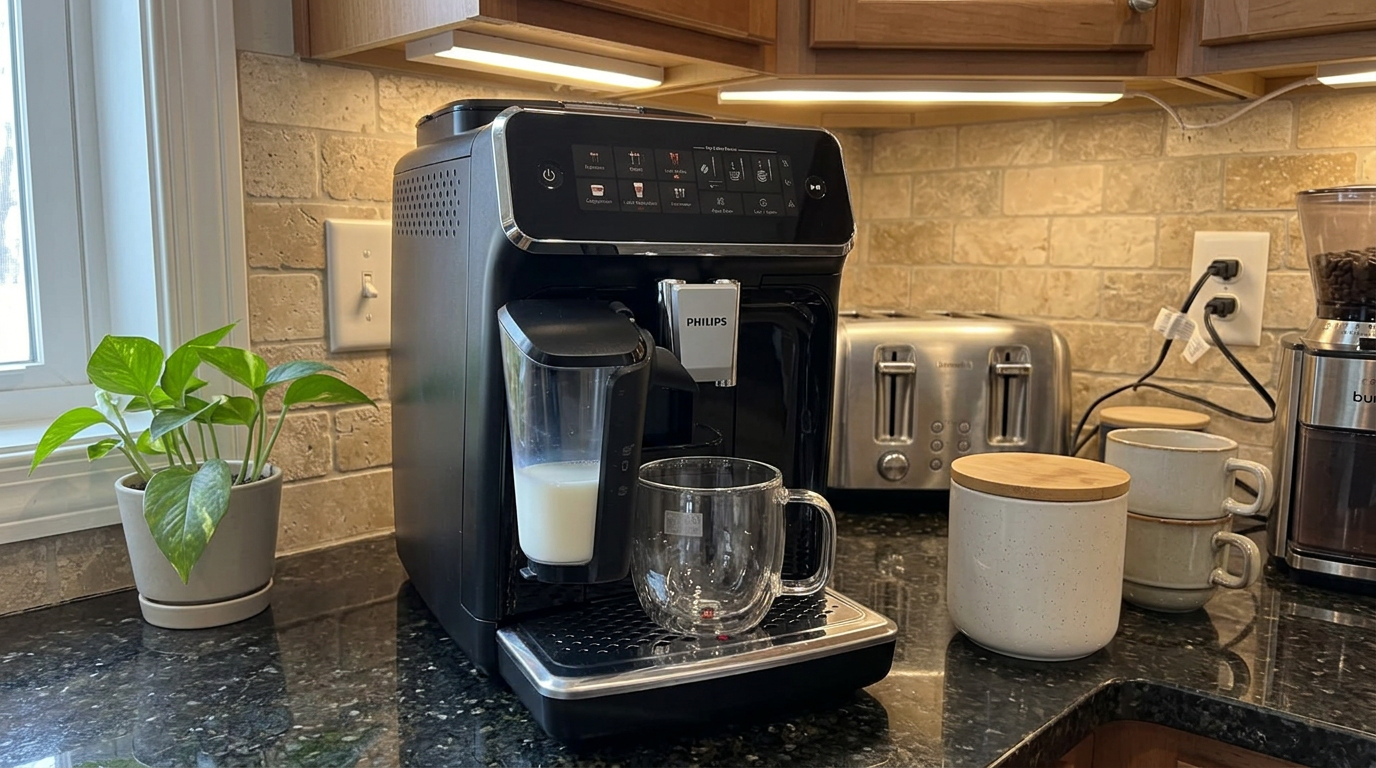
A latte macchiato from the Philips arrives with a thick layer of foam.
The real gap is what happens after the drink. LatteGo has no tubes or hidden milk channels, so you pop it off, rinse it for a few seconds and put it back.
LatteCrema gets a one-touch cleaning flush, which is convenient, and its parts can go in the dishwasher. It still has more pieces to separate and wash than LatteGo, including a narrow milk path.
Milk tip: Remove and rinse either carafe soon after your last drink. Dried milk is much harder to shift, and on the Philips, a part that is not fully clicked together can leak.
Find Out the Price TodayNoise
If you make coffee while someone else is asleep, this could settle the question. The Philips has SilentBrew sound shielding, and reported readings put its grinder at about 61 to 62 dB with the hopper lid fitted.
That is close to the level of a normal conversation, and Philips claims it is 40 percent quieter than its earlier machines. Taking the lid off raises the reading to around 72 to 73 dB, so keep it seated.
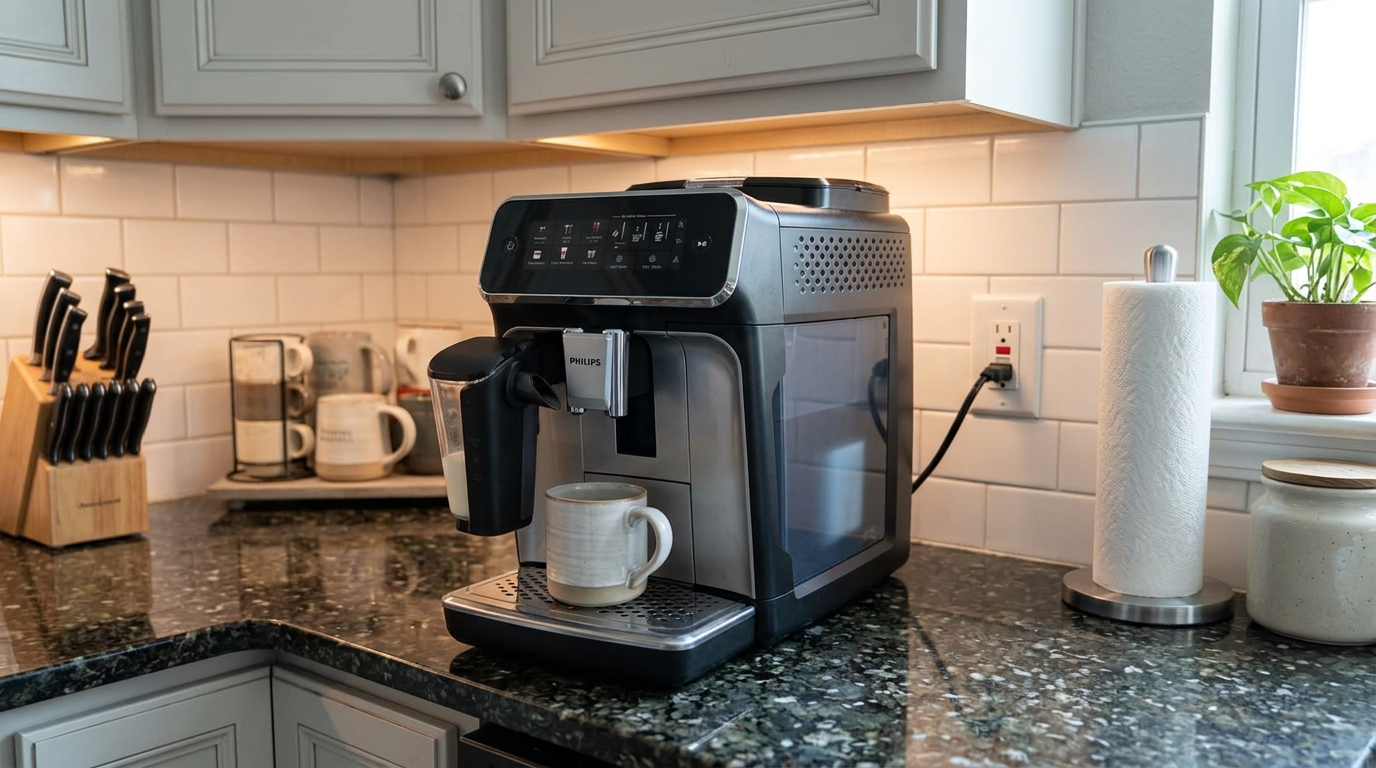
SilentBrew is the Philips 3300's biggest everyday advantage.
The Magnifica Start has no comparable published figure, but owners are consistent about it. Its grinder is loud and slightly high-pitched, and that is the most repeated complaint I found.
I scored noise at 9.2 for the Philips and 5.8 for the De'Longhi in our full reviews. No other category separates these two machines so clearly.
One caveat is that the Philips is not silent all the way through. Milk frothing reached about 82 dB in one measurement, so the quiet advantage is strongest for black drinks and the grind stage.
Quiet tip: A thin rubber or silicone mat under either machine cuts vibration through the counter. It helps most on stone worktops and in open-plan kitchens.
Menu and controls
The De'Longhi gives you five one-touch options: espresso, coffee, cappuccino, latte macchiato and hot water. The Philips covers the same list and adds iced coffee.
Iced coffee on the Philips is useful, but it is not cold brew. It brews a shorter, stronger coffee to pour over ice, and I would fill the glass and raise the strength to stop it from going thin.
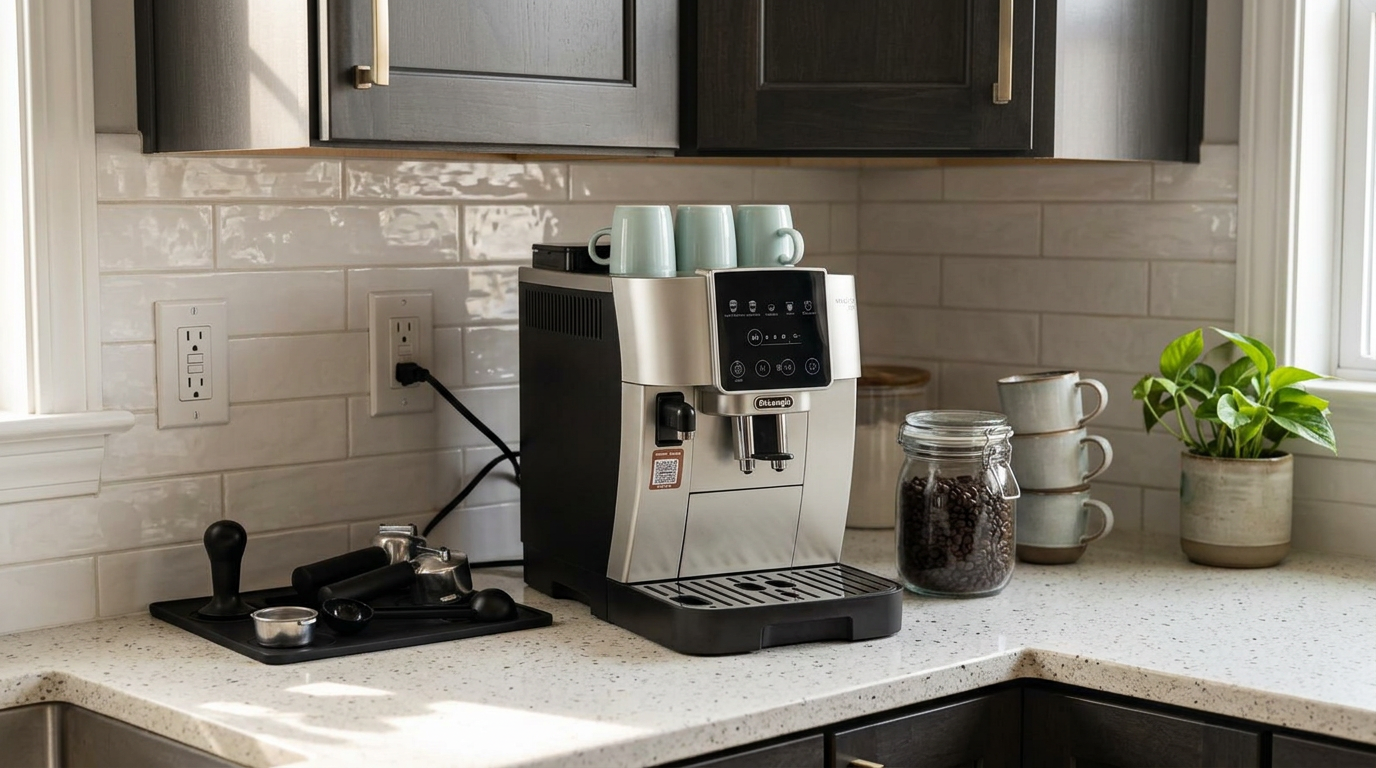
The Magnifica Start uses a simple panel with one icon per drink.
Hot water is simpler on the Philips too, as it has a dedicated button with nothing to swap. On the De'Longhi's LatteCrema version, you exchange the milk carafe for a hot water spout.
You can adjust strength and program volumes on both, but each saves only one set of preferences. If two people want very different cups, someone will be tapping extra buttons every morning.
Cleaning and upkeep
Daily jobs look very similar. You empty the grounds bin and drip tray and rinse the milk parts, and both machines tell you when something needs attention.
The De'Longhi's bin is rated for about 14 pucks and the Philips for about 12. The Philips drip tray fills faster than you might expect because rinse cycles land in it, so plan to empty it daily when the machine sees heavy use.
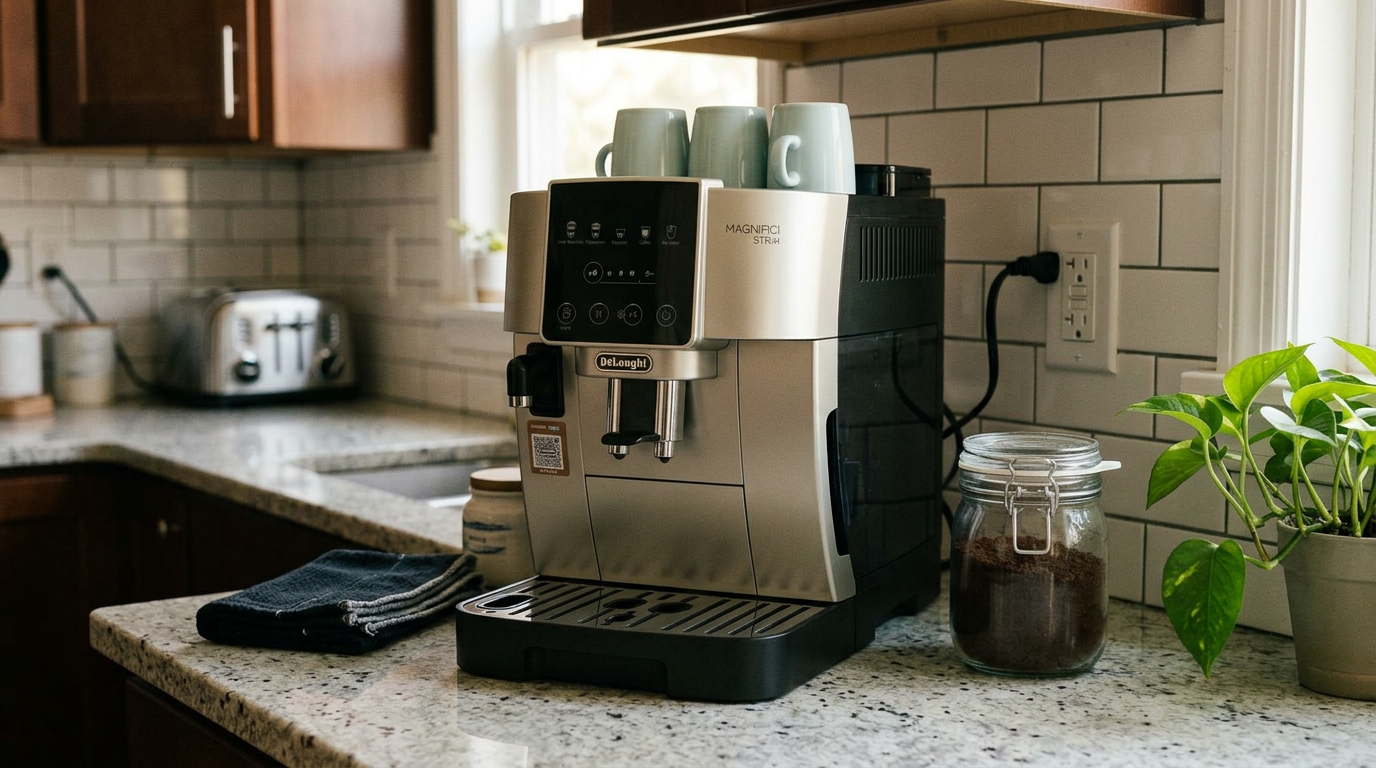
Both machines have a removable brew unit that rinses under the tap.
Each has a removable brew unit, and weekly care is the same. Slide it out, rinse it with lukewarm water, let it air-dry and keep soap and the dishwasher away from it.
The bigger long-term difference is water. The Philips ships with an AquaClean filter, and Philips says you can make up to 5,000 cups before descaling if you replace it when prompted.
That figure is a best case spread across eight filters, each rated for up to 625 cups. Even so, if you live in a hard water area, it can turn descaling from a regular job into a rare one.
The De'Longhi can use a water filter, but expect to run its roughly half-hour descaling cycle whenever the alert comes on. Filters and descaling solution both add small ongoing costs, so the Philips does not get this for free.
The AquaClean filter sits in the Philips water tank.
Hygiene tip: Leave the drip tray and grounds bin out to air-dry once or twice a week. Owners who skip this are the ones most likely to report mold.
Published test data and editorial scores
Direct lab comparisons of these exact two machines are hard to find, so I would not treat any single score as the final word. A consumer lab in Europe ranked a steam-wand Magnifica Start third of 12 machines, describing it as a good entry-level model.
Noise and temperature readings are far more complete for the Philips than for the De'Longhi. The bars below use the editorial scores from our full reviews, out of 10, and I left out milk because our De'Longhi review scored the steam-wand version.
A higher noise score means a quieter machine. The pattern matches the specs: espresso is close, while the Philips pulls ahead in everyday comfort.
What owners say
The Magnifica Start holds a 4.0-star average from 278 ratings, while the Philips 3300 sits at 3.8 stars from 1,290 ratings. The De'Longhi's rating is slightly higher, but it comes from a much smaller group of buyers.
Owners like how quickly they can make a proper shot, and many say it tastes far better than pod coffee.
Grinder noise, frequent emptying and a hopper that needs regular top-ups come up again and again.
A small number of owners report leaks or error lights in the first weeks, which makes the return window important.
Early risers often single out how much quieter it is than the machines they owned before.
The fast carafe rinse and picture-based panel are the features owners mention most.
Owners mention a drip tray that fills quickly, a carafe that leaks if not fully assembled and early filter or descaling alerts.
Which one should you buy?
After weighing everything, I think it comes down to your first drink of the day and who is asleep when you make it. Milk drinks and quiet mornings point to the Philips, while a bolder espresso points to the De'Longhi.
- You make milk drinks every day
- You want the least milk cleanup
- Grinder noise matters to you
- You like having iced coffee on tap
- You drink mostly straight espresso
- You want fine, silky milk
- You want a sturdier-feeling build
- Espresso body comes first
- You prefer finer milk foam
- You have limited height under cabinets
- You do not mind some noise
- Someone sleeps near the kitchen
- You want iced coffee at one touch
- You want the simplest possible milk cleanup
Pick the Philips for quiet mornings, easy milk drinks and low upkeep. Pick the De'Longhi for bolder espresso and finer foam in a slightly smaller machine.
My pick is the Philips 3300 Series. It is the easier machine to live with, thanks to its quieter grinder, simple milk cleanup, iced coffee button and included water filter. Its espresso is lighter, but it makes a very good base for the lattes and cappuccinos most buyers want.
The De'Longhi Magnifica Start is still a strong choice if you want more body in your espresso and smoother foam. Just be ready for a louder grinder.
Whichever you choose, use fresh matte beans, rinse the milk parts promptly and give the brew unit a weekly rinse.
De'Longhi Magnifica Start vs Philips 3300 specifications
From the Amazon listings, manufacturer specifications and published tests. Exact figures can vary by color and regional version. Checked November 9, 2026.
| De'Longhi Magnifica Start | Philips 3300 Series | |
|---|---|---|
| One-touch drinks | Espresso, coffee, cappuccino, latte macchiato, hot water | Espresso, coffee, cappuccino, latte macchiato, iced coffee, hot water |
| Milk system | LatteCrema automatic carafe | LatteGo automatic carafe, no tubes |
| Carafe capacity | About 7.4 fl oz | About 8.8 fl oz |
| Grinder | Conical steel burrs, 13 settings | Ceramic flat burrs, 12 settings |
| Coffee dose | About 0.28 to 0.35 oz | About 0.28 oz |
| Pump pressure | 15 bar | 15 bar |
| Water tank | About 61 oz, removable | About 61 oz, removable |
| Bean hopper | About 8.8 oz | About 9.7 oz, aroma seal |
| Grounds bin | About 14 pucks | About 12 pucks |
| Max cup height | About 5.6 in | About 5.5 in |
| Water filter | Compatible, optional | AquaClean included |
| Reported noise | No published figure | Grinder 61 to 62 dB lid on, frothing about 82 dB |
| Dimensions | 9.4 x 17.3 x 13.8 in (W x D x H) | 9.7 x 17 x 14.6 in (W x D x H) |
| Weight | About 19.4 lb | About 17.6 lb |
| Amazon rating | 4.0 (278 ratings) | 3.8 (1,290 ratings) |
How I researched and compared them
This is a researched comparison built on published data and owner feedback, not a side-by-side test of both machines in one kitchen.
I started with both Amazon listings and the manufacturer specifications, then used the findings from our full reviews of each machine. I also looked at published test results and treated single owner reports as warning signs rather than proof.
- Coffee: espresso body, crema, long drinks and strength options.
- Milk: foam style, temperature, plant milk and cleanup.
- Daily use: noise, controls, size and refills.
- Ownership: cleaning, descaling, filters and reliability patterns.
Magnifica Start vs Philips 3300 FAQ
Is the Philips 3300 better than the De'Longhi Magnifica Start?
For most homes, yes. It is quieter and easier to keep clean, and it adds iced coffee. The De'Longhi is the better choice if you want a bolder espresso and finer foam.
Do both machines make milk drinks automatically?
Yes, in the versions compared here. The Magnifica Start uses a LatteCrema carafe and the Philips uses LatteGo. Some Magnifica Start versions use a manual steam wand, so check the listing before you buy.
Which one makes stronger espresso?
The De'Longhi has the edge on paper, because its strength setting can use up to about 0.35 ounces of beans. The Philips uses about 0.28 ounces per puck, though a double preparation helps.
Which machine is quieter?
The Philips. Its grinder has been reported at about 61 to 62 dB with the lid on, while the Magnifica Start's grinder is its most common complaint.
Which milk system is easier to clean?
LatteGo, because it has no tubes and rinses in seconds. LatteCrema has a one-touch flush and dishwasher-safe parts, but there are more pieces to take apart.
Does either one make iced coffee?
Only the Philips has an iced coffee button. It brews hot coffee to pour over ice, so it is not true cold brew.
Do they need descaling?
Yes. Both prompt you when it is time. The Philips can go up to 5,000 cups at best if you use and replace its AquaClean filter as prompted.


- Amazon product listing for the De'Longhi Magnifica Start (ASIN B0CWCMH762), November 2026
- Amazon product listing for the Philips 3300 Series (ASIN B0CZ4GN5YT), November 2026
- De'Longhi and Philips manufacturer specifications
- Published independent test results
- BrasQ reviews of both machines
- Verified owner reviews and long-term owner discussions
- Comparison published.