Philips 3300 Series review: the quiet, low-fuss latte machine for busy mornings
The Philips 3300 Series grinds, tamps and brews from fresh beans at the touch of a button, and its tube-free LatteGo carafe makes cappuccinos and lattes almost as easy to clean as they are to make.
In this review
For most people who want a real latte or cappuccino in the morning without learning barista skills, yes. The Philips 3300 Series is one of the quietest bean-to-cup machines I have used, its espresso is genuinely good for the class, and the two-part LatteGo carafe is the easiest milk system to clean I know of. It is not a machine for tinkerers: the drink menu is short, there is only one user profile, and volume control is basic. Buy it if you want great everyday coffee with very little effort.
Philips 3300 Series at a glance
Philips 3300 Series pros and cons
- Very quiet grinder and brew cycle for a super-automatic
- Rich, nutty espresso with real crema at the top strength
- LatteGo carafe has two parts, no tubes and rinses in seconds
- Clear, picture-based control panel that anyone can use
- Removable brew group you can rinse under the tap
- AquaClean filter cuts descaling to a rare chore
- Two espressos or coffees at once
- Short menu: no flat white, americano button or user profiles
- Volume only adjustable by holding a drink button
- Iced coffee mode is weak unless you tweak it
- Drip tray fills fast with rinse water
- Mostly plastic body
- Only one milk drink at a time
Who should buy the Philips 3300 Series
- Households that drink lattes and cappuccinos every day
- Early risers who don’t want to wake the house
- People upgrading from pods to fresh beans
- Anyone who hates cleaning milk tubes
- Small kitchens with cabinets above the counter
- Hobbyists who want to tune every variable
- Flat white and cortado fans
- Homes where several people want saved profiles
- Cold brew lovers expecting true cold extraction
First impressions of the Philips 3300 Series
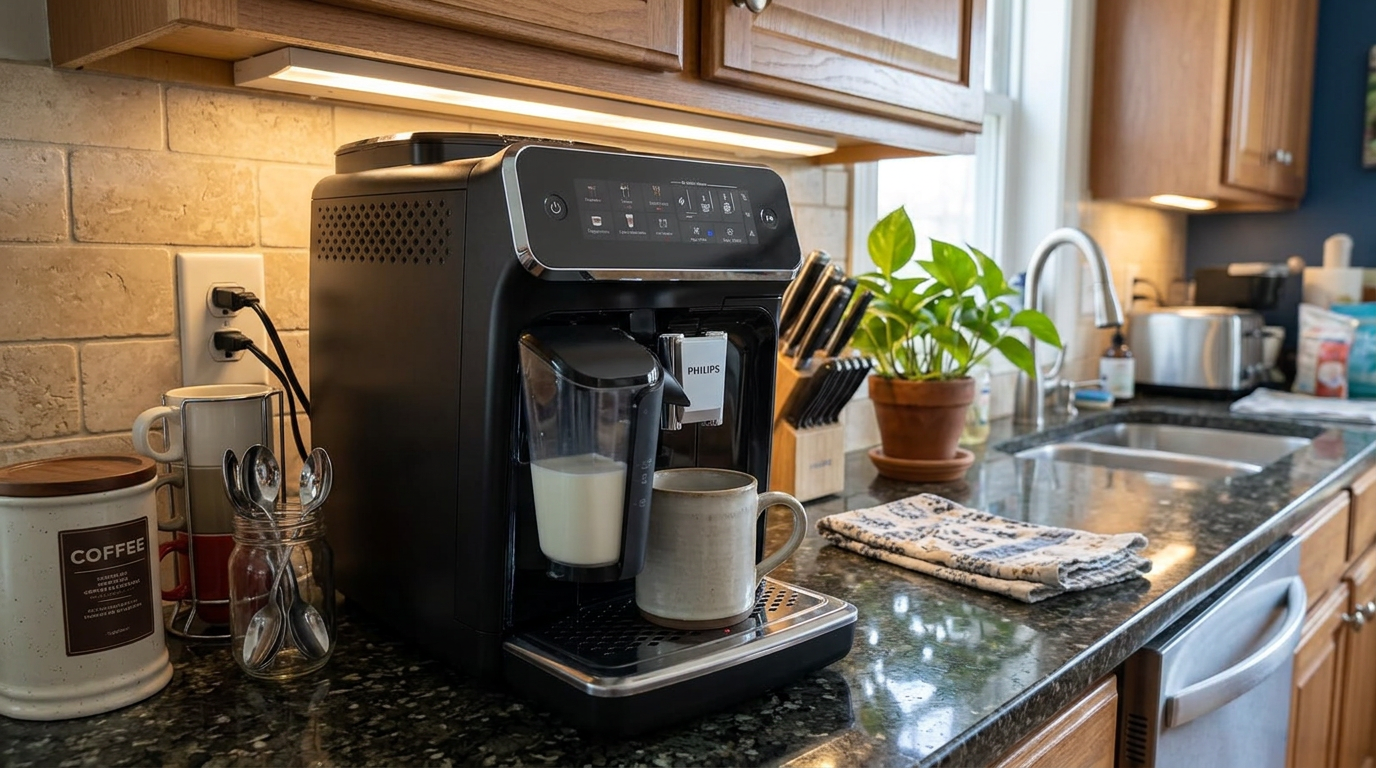
The first thing I noticed when I set the Philips 3300 Series up on my counter was how little space it asked for.
It is narrow, a little under 10 inches wide, so it slides in beside a toaster or a knife block without taking over the kitchen.
At about 17 inches tall it also fits under standard upper cabinets, although I still pull it forward a few inches when I refill the bean hopper on top.
The glossy black front looks smarter in person than in most product photos.
There is a strip of chrome-look trim around the spout and the drip tray, and the color icons on the control panel make it feel more modern than the older Philips machines I have used.
Up close, though, it is clearly a plastic machine.
The side panels and the hopper lid are lightweight, and the drip tray cover rattles a little when you slide it back in.
None of that affects the coffee, but if you are hoping for a brushed-steel showpiece, this is not it.
Setup took me about fifteen minutes from box to first cup.
You rinse the water tank, fit the included AquaClean filter, test your water hardness with the strip in the box, pour in beans and let the machine run its first rinse cycles.
The control panel walks you through it with blinking icons, and I never had to open the manual except to confirm the water hardness setting.
The first espresso was decent, and by the third or fourth cup, once the grinder had settled in, it was good.
That is normal for any bean-to-cup machine, so don’t judge it on the first shot.
The 3300 Series is narrow enough to share a counter with other appliances and short enough for most upper cabinets.
What the Philips 3300 Series is
The Philips 3300 Series is a fully automatic, or super-automatic, espresso machine.
You pour whole beans into the hopper and water into the tank, and the machine grinds, doses, tamps, brews and ejects the used puck on its own.
There is no portafilter to handle and no tamping to get right.
The version I am reviewing is the EP3341/50, which comes with the LatteGo milk system.
Philips also sells 3300 models with a classic steam wand, but for most people the LatteGo version is the one to get, because it makes milk drinks automatically.
The menu covers six drinks: espresso, coffee, cappuccino, latte macchiato, iced coffee and hot water.
Every drink has a button with a picture on it, and you choose strength, cup size and, for milk drinks, the amount of milk with the buttons around them.
Philips calls this My Coffee Choice.
Under the hood, the key parts are a ceramic flat burr grinder with 12 settings, a 15-bar pump, a single heating system and a brew group that you can slide out and rinse.
Philips also adds two marketing names to the spec sheet: SilentBrew, which it says makes the machine 40 percent quieter than its previous models, and Aroma Extract, which balances brewing temperature and flow rate.
I can’t see Aroma Extract working, but I can certainly hear SilentBrew, and I come back to that below.
The grinder and noise: the quietest Philips I have used
Noise is the reason many people give up on super-automatic machines.
A loud grinder at 6 a.m. in an open-plan home is enough to wake a sleeping toddler, and older Philips machines were not shy about it.
The 3300 Series is a real change here.
The grind cycle is a low, steady hum rather than the high-pitched crunch I am used to, and the brew cycle that follows is softer still.
Independent sound measurements put the grinder at around 63 decibels, which is roughly the level of a normal conversation.
That matches what I hear: I can grind and brew a cappuccino in the kitchen while my family is asleep down the hall, and nobody comments on it.
The LatteGo frothing stage is the loudest part of a milk drink.
It is a short, airy hiss for about 20 to 30 seconds, louder than the grinder but quieter than the milk systems on older Philips models.
The grinder itself is a 100 percent ceramic flat burr set with 12 settings.
Ceramic burrs stay sharp for a long time and don’t heat the beans as much as steel, which helps keep the flavor from going flat.
Twelve steps is a sensible range for a machine like this.
The finest setting is fine enough for a full-bodied espresso with medium and dark roasts, and the coarser end helps with very fresh or very oily beans.
One rule matters: only turn the grind dial while the grinder is running.
Turning it while the machine is idle can strain the mechanism, and Philips warns about this in the manual.
I change one step at a time and judge the result after two or three drinks, because the first cup after a change still contains some coffee ground at the old setting.
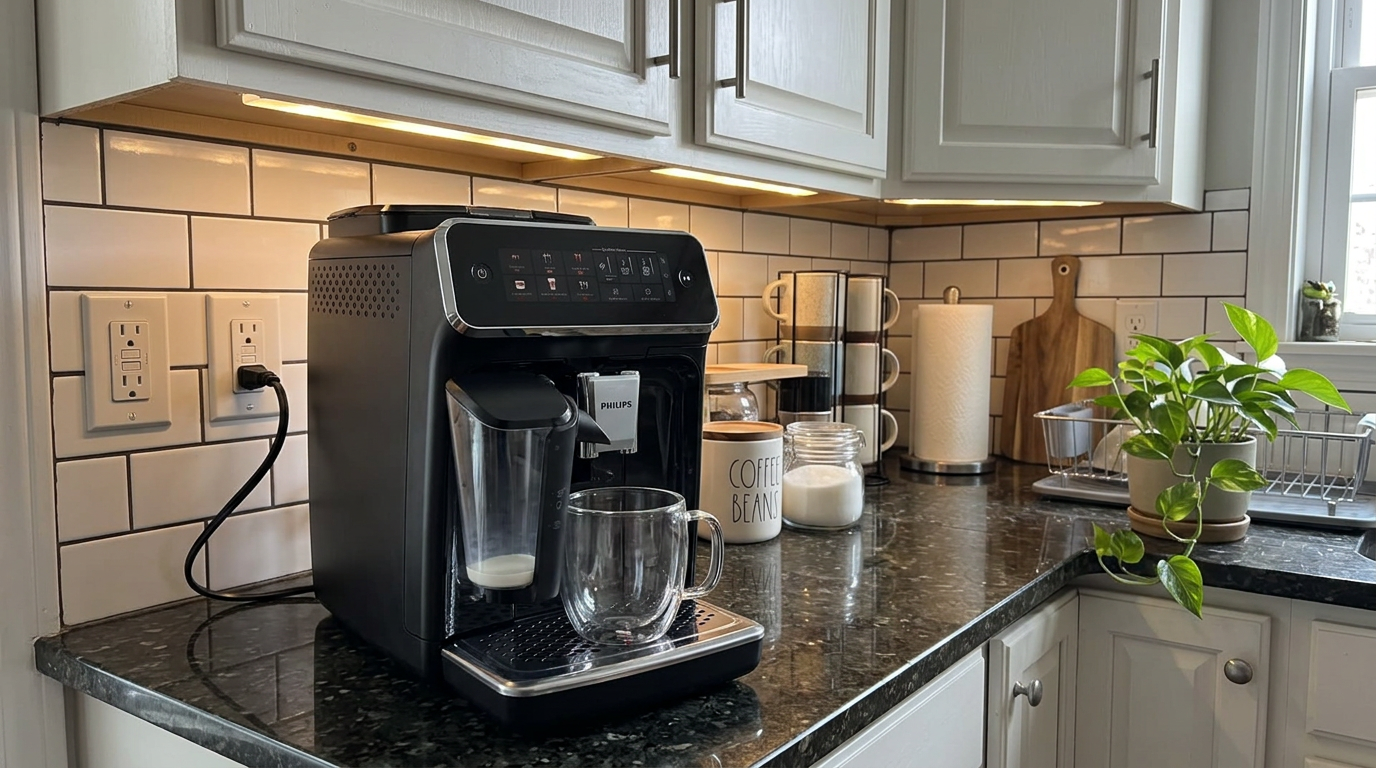
The ceramic flat burr grinder sits under the hopper lid and offers 12 grind settings.
Espresso and coffee quality
I came into this review expecting the usual mid-range super-automatic espresso: hot, brown and a bit thin.
The 3300 Series did better than that.
With a fresh medium roast, the grinder one or two steps finer than the default and the strength turned to the top level, my espresso came out nutty and slightly sweet, with a fine layer of tan crema that held for a minute or two.
It is not the syrupy, intense shot you would pull on a well-tuned manual machine.
Super-automatics use a larger brew chamber and a gentler process, and they rarely hit the same concentration.
But as a base for milk drinks, or as a quick morning espresso, it is genuinely satisfying.
At the default middle strength, I find the espresso a touch mild.
If you drink medium or light roasts, go straight to the top strength setting.
With very dark, oily beans, the middle level is often enough, and you also avoid gumming up the grinder.
The coffee button makes a longer, lighter drink.
It is closer to a lungo than to drip coffee, and it is pleasant for a big morning mug when you don’t want milk.
You can brew two espressos or two coffees at once by pressing the button twice, which is handy when a partner wants one too.
Temperature is the one area where I had to adjust my habits.
Drinks come out hot enough to enjoy right away, but not scalding.
If you brew a small espresso into a thick, cold ceramic cup, it cools fast, so I preheat my cup with a splash from the hot water button first.
That small step made the biggest difference to how hot my drinks stayed.
The LatteGo milk system: the reason to buy this machine
The LatteGo carafe is the best thing about the Philips 3300 Series.
It is a small clear container with a lid that clips on top, and it attaches to the front of the machine with no tubes or hoses at all.
When you choose a cappuccino or latte macchiato, the machine draws milk up into the lid, mixes it with air and steam and pours foam straight into your cup, followed by the espresso.
The foam is fine and glossy rather than big and bubbly.
Cappuccino foam is firm and spoonable, the way most Americans expect from a coffee shop cappuccino.
The latte macchiato gives you more milk and a creamy, layered look in a tall glass.
I find the milk sweet and pleasant, and the coffee still comes through even in the larger drink.
It works with plant milks too.
Oat milk labeled for baristas foams almost as well as whole dairy milk, while thin almond milk produces lighter, more fragile foam.
Cold milk straight from the fridge always froths better than milk that has been sitting on the counter.
Cleaning is where LatteGo earns its reputation.
The carafe has only two main parts, and after a milk drink I pop it off, rinse it under warm running water for a few seconds and put it back.
At the end of the day, both parts go in the dishwasher.
There are no thin tubes to scrub and no hidden milk channels inside the machine, which is where milk systems usually start to smell.
You can also store leftover milk in the carafe in the fridge with the included storage lid.
I do this on weekdays: I fill it in the evening, store it cold and clip it on in the morning.
The trade-offs are small but real.
The LatteGo makes one milk drink at a time, there is no hot-milk-only button, and the foam is too thick for a proper flat white.
If silky, latte-art-ready microfoam matters to you, this is not the right milk system.
For a fast, consistent cappuccino before work, it is hard to beat.
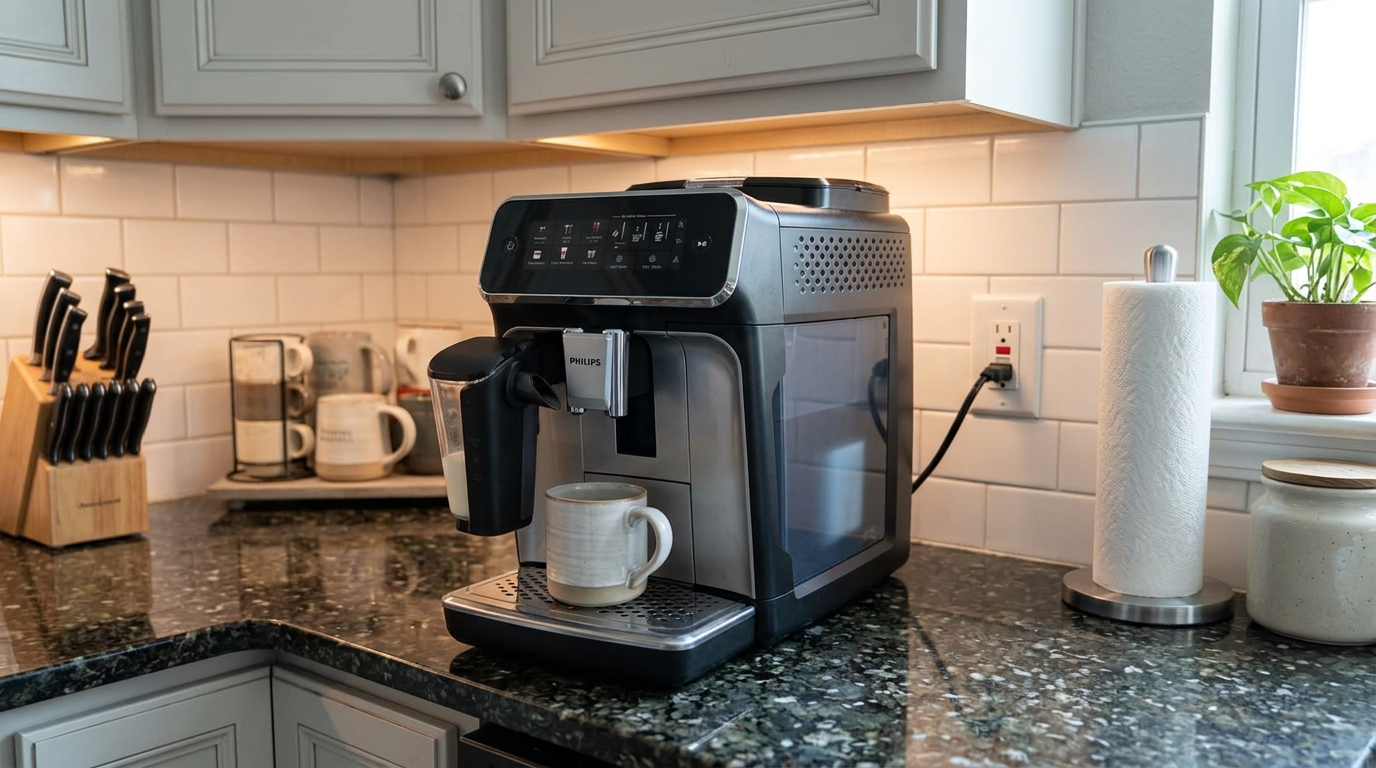
LatteGo pours milk foam straight into the cup and comes apart in two pieces for rinsing.
Iced coffee: useful, but tweak it
Philips promotes the iced coffee button as one of the 3300 Series’ headline features, so I gave it a fair try over several weeks of warm afternoons.
It is not cold brew, and the machine does not chill anything.
The iced coffee program brews a stronger, shorter coffee designed to be poured straight over a glass full of ice.
Used as Philips intends, with the default settings, I find it a little thin once the ice melts.
Two simple changes fix most of that.
I fill the glass to the top with ice, so the coffee cools quickly instead of melting a few cubes and diluting itself, and I set the strength to the highest level.
With a splash of cold milk or a little simple syrup, the result is a refreshing, everyday iced coffee.
It won’t match a slow cold brew for smoothness, but it is ready in about a minute, from fresh beans, with no planning ahead.
For me, that makes it a feature I use more than I expected, even though it is less special than the marketing suggests.
Controls and everyday ease of use
Philips calls the front of this machine a color touch display, and that description oversells it a little.
It is not a screen in the smartphone sense.
It is a panel of touch-sensitive buttons with colorful drink icons and simple bar indicators for strength, cup size and milk.
That said, I think it is the right interface for this kind of machine.
Anyone in my house can walk up, tap the cappuccino icon and get a drink without reading anything.
Guests figure it out in seconds, which I can’t say about machines with deep menus.
Strength has three levels, shown as coffee bean icons.
Cup size also has three steps, and milk drinks let you choose how much milk goes in.
If the presets don’t suit your cup, you can reprogram the volume by holding a drink button for a few seconds and stopping the pour when the cup is full.
This is the clunkiest part of the experience.
You can’t type in an exact number of ounces, and you have to repeat the process for each drink.
Your settings also apply to everyone, since there is only one profile.
If you and your partner like different strengths, one of you will be pressing the strength button every morning.
Philips pairs the machine with its HomeID app, but don’t expect remote brewing or a phone menu.
The app is a source of how-to videos, recipes and reminders for filters and cleaning.
It is useful when you forget how to descale, and that is about it.
Warning lights are easy to read.
The machine flags an empty water tank, a full grounds bin, a missing drip tray and the need to replace the filter or descale with clear icons, and none of the warnings left me guessing.
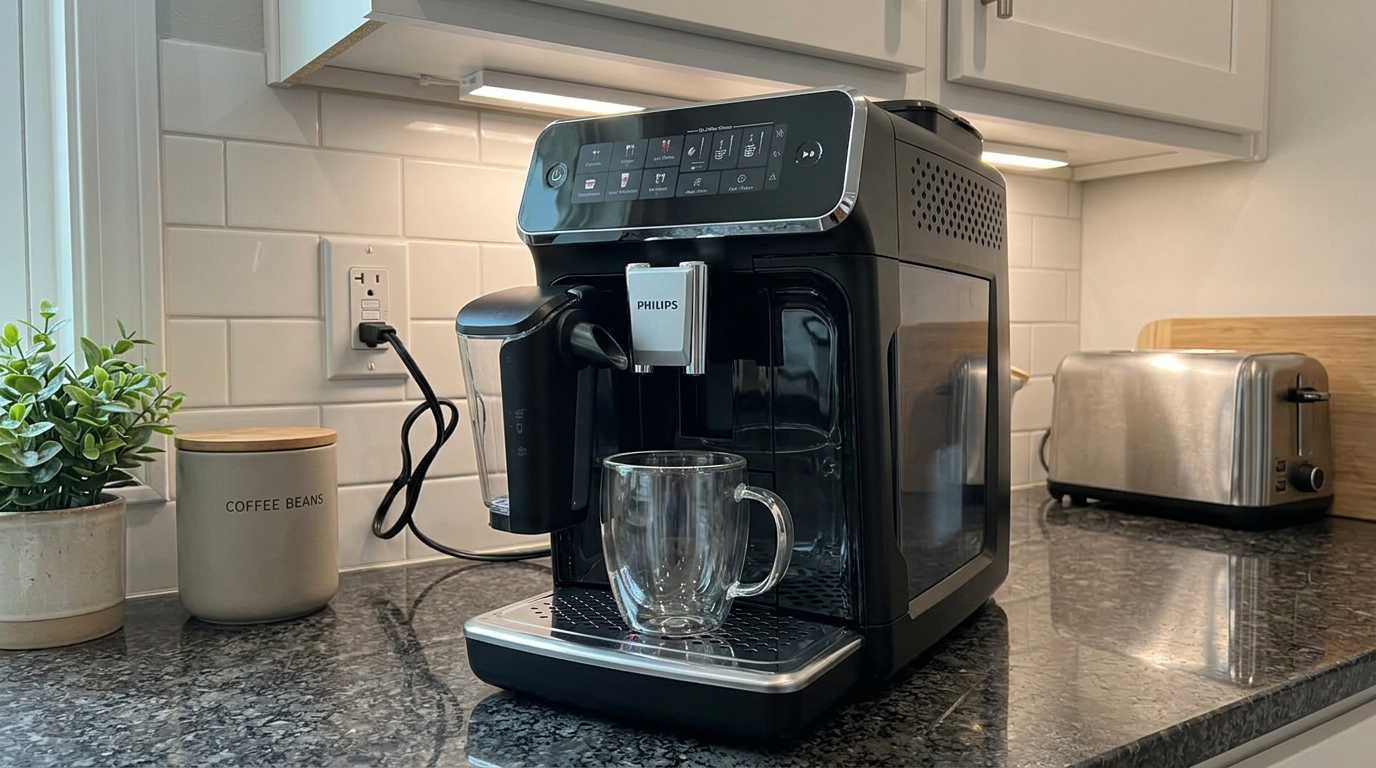
The control panel uses picture icons for each drink plus simple buttons for strength, size and milk.
Daily cleaning and maintenance
Easy cleaning is one of the big reasons people choose Philips machines, and the 3300 Series keeps that promise.
Day to day, there are three jobs.
Rinse the LatteGo after milk drinks, empty the grounds container when the machine asks, and empty the drip tray before it overflows.
The grounds container holds roughly a dozen used pucks, so in my house it gets emptied every two or three days.
The drip tray needs more attention than I expected.
The machine runs a short rinse cycle when it starts up and when it shuts down, and all that water lands in the tray.
On busy days I empty it once a day, which takes ten seconds but is easy to forget.
Once a week I slide out the brew group through the side door and rinse it under lukewarm tap water.
No soap, and let it air-dry before putting it back.
This is the single best habit for keeping espresso tasting fresh and preventing mold in the back of the machine.
While the brew group is out, I wipe the inside of the machine with a paper towel to catch stray coffee grounds.
Every couple of months, depending on how much you brew, the brew group needs a thin coat of the grease that comes in the box.
It takes two minutes and keeps the moving parts sliding smoothly.
Philips also sells coffee oil remover tablets for a deeper monthly clean of the brew group, which I recommend if you use dark, oily beans.
The drip tray, grounds container and LatteGo parts are dishwasher-safe.
The brew group is not, so keep it out of the dishwasher.
Cleaning tip: If the machine ever refuses to accept the brew group, don’t force it. Close the service door, switch the machine off and on so the mechanism resets to its home position, then slide the group back in along the rails without pressing the release button.
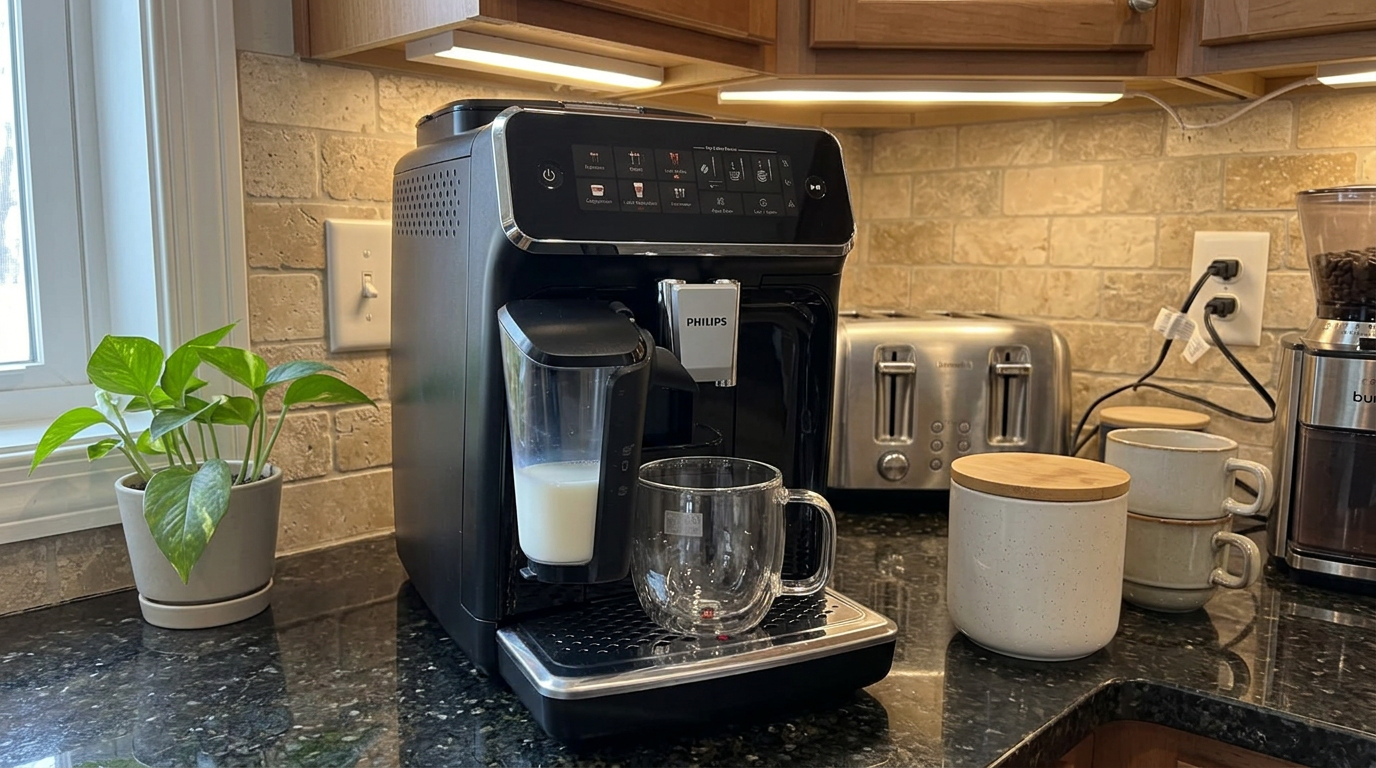
The drip tray, grounds bin and LatteGo parts all come out for the sink or dishwasher.
The AquaClean filter and descaling
Limescale is what kills super-automatic machines, so the water system deserves a close look.
The 3300 Series ships with one AquaClean filter, which sits inside the water tank.
Philips says that if you keep replacing the filter when the machine asks, you can brew up to 5,000 cups without descaling.
That number comes from eight filter replacements, and in real life your cup count depends on your water and how much you rinse.
The practical point is simpler.
With the filter in place and swapped roughly every three months, descaling turns from a monthly chore into something you do very rarely.
If you have hard water, I would not skip the filter.
When you do need to descale, the machine guides you through it with flashing icons, using Philips’ own descaler.
The process takes around half an hour and needs you nearby to empty the drip tray and refill the tank.
It is a little more cryptic without a text screen, but it is a straightforward routine once you have done it once.
One owner complaint I saw repeatedly is that the machine asks for descaling soon after a new filter is installed.
In almost every case, the filter was not activated in the settings menu, so the machine did not know it was there.
Follow the activation step in the manual and that warning goes away.
Living with the Philips 3300 Series
A machine like this is judged less by its best cup and more by how it fits into ordinary weekdays.
Here is what my typical morning looks like with the 3300 Series.
I press the power button as I walk into the kitchen.
It heats up and runs its rinse in well under a minute, and in that time I take the LatteGo carafe out of the fridge and clip it on.
One tap on cappuccino, and about a minute later I have a drink in my hand.
A second cappuccino for my partner follows straight after, and an espresso on top if I want a stronger start.
Before I leave, I rinse the carafe under the tap and drop it back in the fridge, or in the dishwasher if it is the last milk drink of the day.
The machine switches itself off automatically after a period of inactivity.
On weekends, I use the coffee button for a big mug and the hot water spout for tea.
The adjustable spout moves high enough for a tall latte glass and low enough that a small espresso cup doesn’t splash.
The machine holds up to about 5.5 inches of cup height, which covers most mugs but not the tallest travel tumblers.
The side-mounted water tank is a smart detail.
I can pull it out from the side without moving the machine from under the cabinets, and the roughly 61-ounce tank lasts me two or three days of milk drinks.
The bean hopper holds a bit under 10 ounces of beans, which is about a week of coffee for two people.
Its lid has an aroma seal, so the beans stay fresher than in an open hopper.
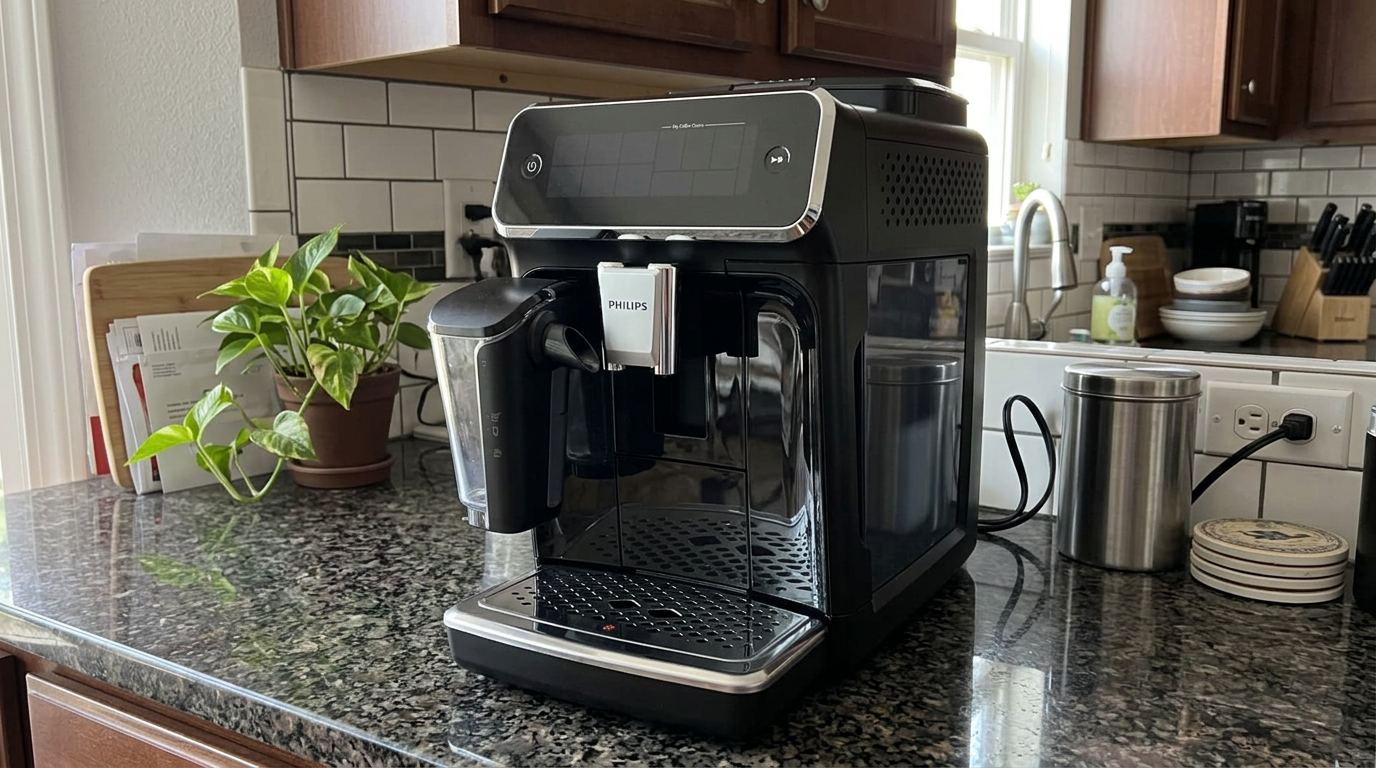
Two espressos or coffees can be brewed at once, though milk drinks are made one at a time.
How I dial in the Philips 3300 Series
Out of the box, the factory settings are safe but cautious.
These are the settings I landed on after a few weeks with a medium roast, and they make a noticeable difference.
Fresh beans from a local roaster, used within a month of roasting, make the biggest single improvement.
Supermarket beans that have sat on a shelf for months will taste flat on any machine.
Avoid very oily, glossy dark roasts if you can.
They clog ceramic grinders over time and leave more residue in the brew group.
If your espresso runs fast and tastes sour, go one step finer on the grinder.
If it drips slowly and tastes bitter, go one step coarser.
Always make the change while the grinder is running, and give it two or three drinks to settle before judging.
Where the Philips 3300 Series falls short
No machine is perfect, and the 3300 Series makes clear compromises to stay simple.
The menu is the most obvious limit.
Six drinks covers what most people actually drink, but there is no americano button, no flat white, no cortado and no hot milk on its own.
You can build an americano with the espresso and hot water buttons, but it takes two steps.
There is only one user profile.
If two people in your home like very different drinks, you will be adjusting settings back and forth.
Volume programming works, but it is basic.
You hold a button and stop the flow by eye, and there is no way to set a precise amount.
The body is mostly plastic.
It feels solid enough in daily use, but the drip tray and hopper lid feel light, and the glossy front shows fingerprints.
The iced coffee is fine once you tweak it, but it is weaker out of the box than the marketing implies.
The drip tray fills quickly because of the automatic rinses.
Owners also mention that the LatteGo can leak from the bottom if the two parts are not clicked together fully.
In my experience, both are habits rather than defects: empty the tray daily and push the carafe parts together until they click.
Finally, drinks are hot but not scalding.
If you like your coffee piping hot, preheat your cups and choose smaller sizes.
Philips 3300 Series test results, drink by drink
This table sums up how each drink and job performed across weeks of daily use, combined with published test data and owner reports.
Ratings are out of 10.
| Drink or task | Rating | What stood out |
|---|---|---|
| Espresso | 8.2 | Nutty, sweet, good crema at top strength |
| Coffee (long) | 7.8 | Smooth, light body; good mug filler |
| Cappuccino | 8.8 | Firm, fine foam; very consistent |
| Latte macchiato | 8.6 | Creamy, layered, coffee still tastes through |
| Iced coffee | 7.0 | Thin by default; good with max strength and full ice |
| Noise | 9.2 | Grinder about as loud as a normal conversation |
| Daily cleaning | 9.0 | LatteGo rinses in seconds, dishwasher-safe parts |
| Customization | 6.8 | Three steps per setting, one profile |
Philips 3300 Series specifications
| Specification | Philips 3300 Series (EP3341/50) |
|---|---|
| Machine type | Fully automatic espresso machine |
| Drinks | Espresso, coffee, cappuccino, latte macchiato, iced coffee, hot water |
| Milk system | LatteGo, 2 parts, no tubes |
| Grinder | 100% ceramic flat burrs, 12 settings |
| Pump pressure | 15 bar |
| Strength levels | 3 |
| Two cups at once | Yes, non-milk drinks |
| Water tank | About 61 fl oz, side access |
| Bean hopper | About 9.7 oz, aroma seal lid |
| Grounds container | About 12 pucks |
| Max cup height | About 5.5 in |
| Water filter | AquaClean, included |
| Brew group | Removable, rinse under tap |
| Power | 1,500 W, 120 V |
| Dimensions | 9.7 × 14.6 × 17 in (W × D × H) |
| Weight | About 17.6 lb |
| In the box | AquaClean filter, measuring scoop, water hardness strip, grease tube, LatteGo storage lid |
| Warranty | 2 years (US) |
Is the Philips 3300 Series worth it?
Value is about what a machine replaces, not just what it costs.
If you currently buy a cappuccino or latte on the way to work most days, a bean-to-cup machine like this pays for itself faster than most people expect.
Fresh whole beans cost a small fraction of a coffee shop drink per cup.
Compared with pod machines, the 3300 Series also wins on flavor and waste.
You grind fresh beans for every drink, the used grounds go into your compost, and there is no stack of empty capsules.
Within Philips’ own range, the 3300 Series sits in the sweet spot.
The cheaper series give up the quieter grinder or the LatteGo carafe, while the pricier ones mostly add more drinks and profiles that many households never use.
For a quiet machine with automatic milk drinks and easy cleaning, the 3300 is the one I would buy.
Prices on this model move around a lot.
It is frequently discounted, so it is worth checking the current price before you buy and waiting for a sale if you are not in a rush.
How I tested and rated the Philips 3300 Series
I used the 3300 Series as my main coffee machine for daily espresso, cappuccinos, lattes, iced coffee and hot water, with both dairy and oat milk.
I cross-checked my impressions against the manufacturer’s specifications, published independent tests and a large set of owner reviews, so the score reflects how the machine holds up over months, not just the first week.
The overall score is a weighted editorial rating built from four parts:
- Ease of use (9.1): setup, controls, noise, refilling and daily cleaning.
- Milk drinks (8.7): foam quality, consistency, plant milk results and how easy LatteGo is to live with.
- Coffee quality (8.2): espresso flavor, crema, body and temperature, plus the coffee and iced coffee programs.
- Value (8.0): what you get compared with coffee shop drinks and pods, long-term running costs and warranty.
I don’t accept payment for reviews, and the manufacturer had no say in this article.
Final verdict on the Philips 3300 Series
The Philips 3300 Series is not the most powerful or flexible espresso machine you can buy, and it does not try to be.
What it does is make the everyday parts of home coffee easy.
It is quiet enough for early mornings, its cappuccinos and lattes are consistently good, and cleaning the milk system takes seconds instead of minutes.
The espresso is better than I expected from Philips, especially at the top strength with fresh beans.
The weak points are a short menu, a single profile, basic volume control and an iced coffee mode that needs tweaking.
If you want to experiment with every variable, look for something more advanced.
If you want a reliable, low-fuss machine that turns fresh beans into a great latte at the touch of a button, the Philips 3300 Series is one of the easiest recommendations I can make.
It earns 8.4 out of 10.
Philips 3300 Series FAQ
Is the Philips 3300 Series worth it?
Yes, if you mostly drink cappuccinos, lattes and espresso and want them with minimal effort. It is quiet, easy to clean and makes very good milk drinks. Skip it if you want a long drink menu or user profiles.
What drinks can the Philips 3300 Series make?
Six: espresso, coffee, cappuccino, latte macchiato, iced coffee and hot water. You can make an americano by combining espresso and hot water.
Is the LatteGo milk system easy to clean?
Very. It has two main parts and no tubes. Rinse it under warm water after use and put it in the dishwasher at the end of the day.
Can I use oat or almond milk?
Yes. Barista-style oat milk foams almost as well as whole milk. Thin almond milk makes lighter, less stable foam. Always use the milk cold.
How loud is the Philips 3300 Series?
It is one of the quieter super-automatic machines. The grinder is roughly as loud as a normal conversation, and the milk frothing is a short, soft hiss.
Does it make real cold brew?
No. The iced coffee program brews a stronger, shorter coffee to pour over ice. For the best result, fill the glass with ice and use the highest strength setting.
How often do I need to descale it?
With the AquaClean filter installed, activated and replaced when the machine asks, descaling becomes rare. Philips rates the system for up to 5,000 cups across eight filter changes.
How do I clean the brew group?
Slide it out through the side service door once a week, rinse it under lukewarm tap water without soap and let it dry. Lubricate it every couple of months with the included grease.
Does it work with an app?
Only for support. The HomeID app offers instructions, recipes and maintenance reminders, but you can’t start drinks from your phone.
Can it make two drinks at once?
Yes, for espresso and coffee. Milk drinks are made one at a time.