Bosch 300 Series review: easy one-touch espresso, but don’t expect a real steam wand
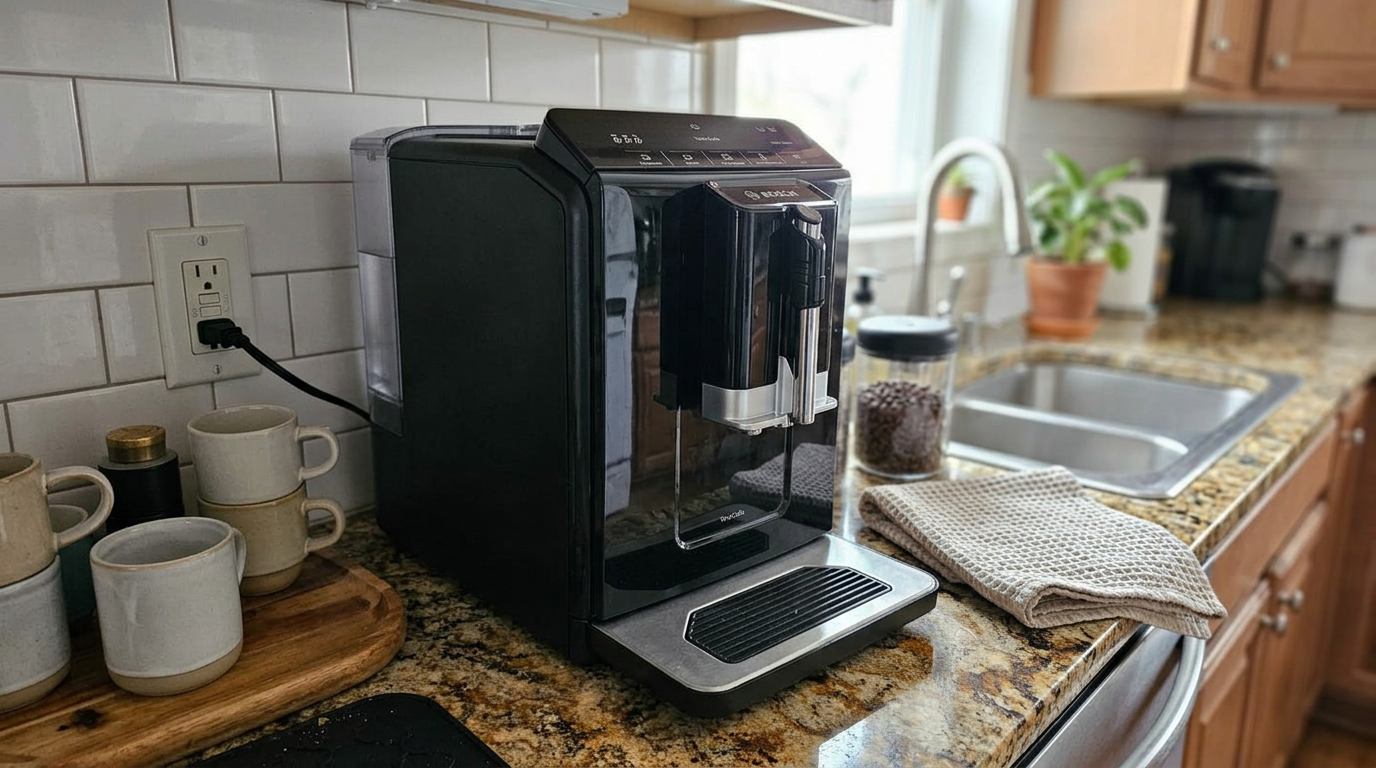
The Bosch 300 Series Fully Auto Espresso Machine grinds whole beans, brews at the touch of a button and froths milk right in your cup. It’s compact and simple to live with. It also has no hot water button, no pre-ground chute and a milk system that isn’t the steam wand its name suggests.
In this review
Yes, if you want fresh-ground espresso and simple milk drinks with almost no learning curve, and you can get it on a good deal. It’s a small, uncomplicated machine that does a short list of things. It isn’t for anyone who wants to texture milk by hand, tune every shot or pull very hot drinks without warming the cup first.
Bosch 300 Series at a glance
Bosch 300 Series pros and cons
- Very simple one-touch controls
- Milk frother with no hoses or carafe to clean
- Removable brew unit that rinses under the tap
- The “steam wand” is really an automatic in-cup frother
- No hot water function
- Some owners find drinks not hot enough
Who should buy the Bosch 300 Series?
- Singles and couples with one to three drinks a day
- Anyone moving up from coffee pods
- Smaller kitchens with limited counter width
- People who want to learn latte art
- Tall tumbler and travel mug users
- Busy homes making many milk drinks in a row
First look at the Bosch 300 Series
The Bosch 300 Series is one of those appliances that doesn’t try to impress you with a big screen.
There’s an LCD touch panel with illuminated sensor keys that stay easy to read in a dim kitchen, a coffee spout you can slide up and down, and a small frother on the front.
That’s more or less the whole interface.
I like that approach for a machine you’ll use before you’re fully awake.
At about 9 3/4 inches wide, 14 7/8 inches tall and 16 1/2 inches deep, it’s narrow but fairly long from front to back.
Measure the depth of your counter under the cabinets before you buy, and leave room to lift the top lid.
The body is mostly plastic, and a few owners call that out directly.
At this tier I don’t see it as a dealbreaker, but it’s worth knowing if you’re expecting a heavy, all-metal feel.
At about 16 pounds, it’s also easy to slide forward when you need to get behind it.
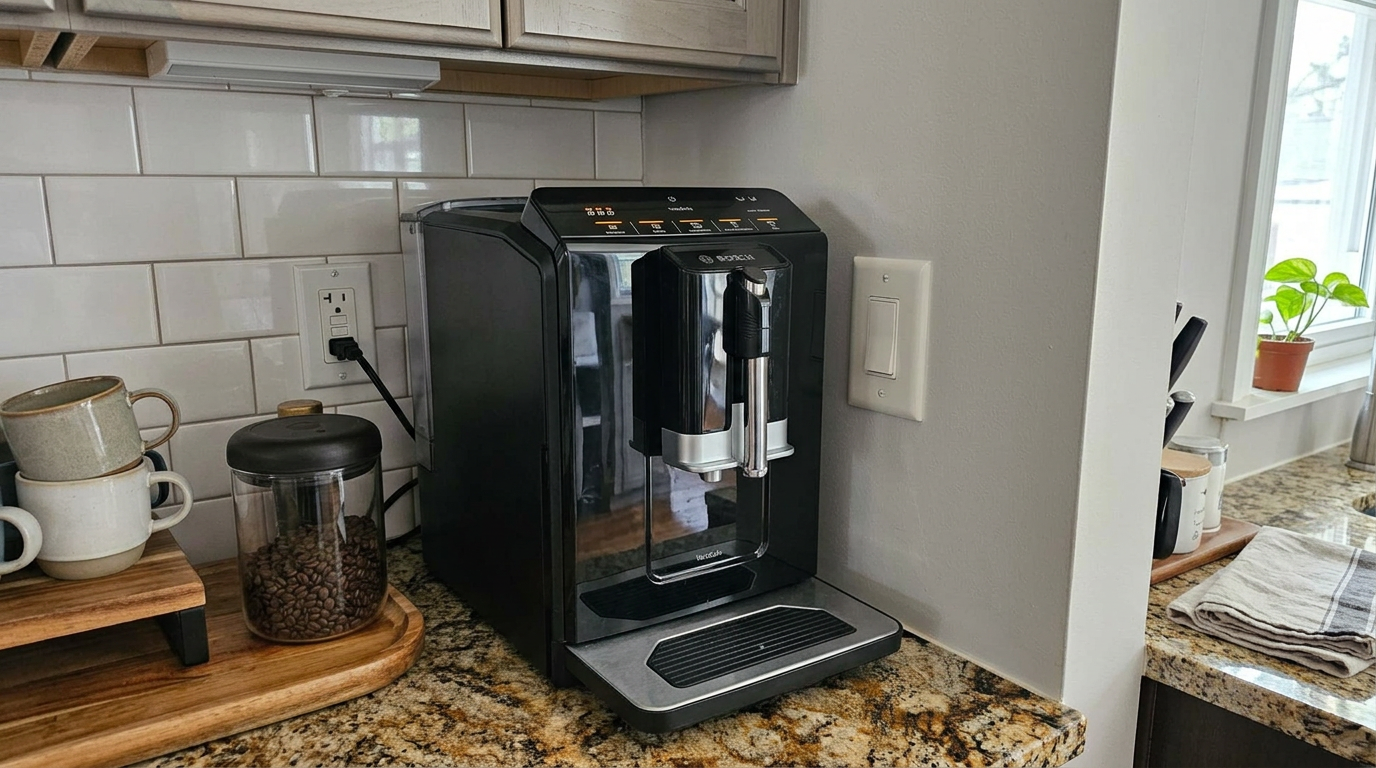
The slim body fits easily between a wall and other small appliances.
What the Bosch 300 Series actually is
This is a fully automatic, bean-to-cup espresso machine.
You pour whole beans into the hopper and water into the tank, and the machine handles the grinding, dosing, tamping, brewing and puck disposal.
Bosch lists five drinks: espresso, coffee, cappuccino, latte macchiato and milk foam.
Now for the part that matters most if you’re shopping by product title.
The listing calls this a machine with a “steam wand,” and that wording is misleading.
Bosch’s own spec sheet calls the milk system Milk Express, which is an automatic in-cup frother.
You don’t steam milk in a pitcher or control the texture with your hand.
You pour cold milk into your cup, set it under the frother, and press a button.
For most people buying a one-touch machine, that’s actually a better fit.
If you were hoping to learn microfoam and latte art, though, this is the wrong tool.
Setting up the Bosch 300 Series
Setup looks straightforward: fill the tank, add beans, run the first rinse and start brewing.
One owner described it as very quick, while also saying the digital manual explained a few steps better than the paper one in the box.
I’d keep that digital manual open on your phone the first time.
The box includes a water filter, a water hardness test strip and a set of cleaning and descaling tablets.
Be careful with the test strip, because you only get one.
One owner ruined theirs while trying to work out what the filter’s settings meant, so read the instructions before you dip it.
Setting the hardness correctly is not busywork.
It tells the machine how often to ask for descaling, and scale is what quietly shortens the life of machines like this.
Hidden settings such as language and sound are reached by pressing two buttons together, which is easy once you know it and impossible to guess.
Our tip: Test your water hardness before the first brew so the descaling prompts are right from day one.
What’s in the box
Espresso and coffee quality
Espresso is where this machine earns its keep.
The recurring theme in positive owner reviews is simple: it’s a clear step up from pods and pre-ground coffee.
That matches what I’d expect from fresh beans, a 15-bar pump and an automatic tamp.
It’s important to set your expectations properly, though.
Fully automatic machines aim for a good, repeatable shot and don’t give you the fine control of a separate grinder and portafilter.
Bosch’s Aroma Max system handles grind flow, water temperature and volume for you, and you can’t see or tune most of what’s going on.
The “coffee” button is also worth understanding.
It makes a longer, espresso-style coffee of around 5 to 7 ounces, closer to an Americano than to a mug of drip.
If you want a big 16-ounce travel cup, you’ll be running two or three cycles.
How far one coffee pour goes (ounces)
A 16-ounce cup takes two or three cycles of the coffee button.
The main complaint on taste is strength.
One owner returned it because they couldn’t get a cup strong enough, even after trying what the machine offers, and that’s a fair warning for anyone who loves very intense coffee.
Other owners on darker roasts are perfectly happy, and one specifically praised the flavor from a French roast.
My take is that bean choice will matter more here than on a machine with more settings.
Start with a fresh medium or medium-dark roast, and avoid very oily beans, which can gum up automatic grinders.
Our tip: Give a new bag two or three drinks before you judge it, because the first cups can still carry the old beans.
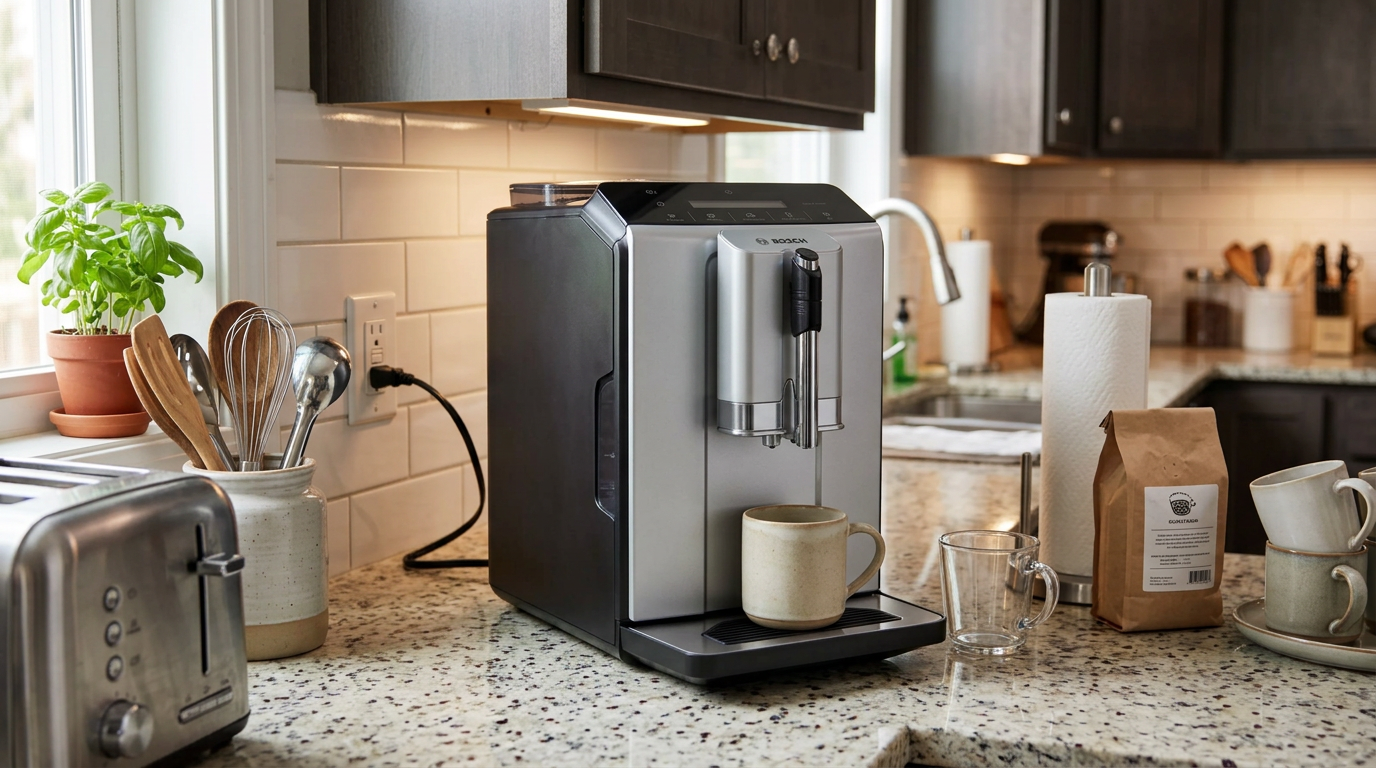
Fresh beans and a medium roast are the easiest way to get a good cup. This photo shows the silver finish; the model I’m reviewing is black.
Grinder, strength and the settings you get
The grinder uses ceramic discs, which Bosch promotes for durability and for not overheating the beans.
Bosch lists three grind settings for this model.
Three steps isn’t many, so you’re choosing a rough zone and not dialing in a recipe.
Our test unit offers five strength levels, set with the coffee-bean icon, so a milder or bolder cup is one tap away.
For most people I’d start in the middle on both, make two or three drinks, and only then change one thing at a time.
Because the grinder only flushes through slowly, a grind change can take a couple of drinks to show up in the cup.
Cup size is adjustable, and the spout slides up to about 5 1/2 inches.
Owners report that mugs around that height just fit, while taller tumblers don’t.
There’s no second chute for pre-ground coffee.
That sounds minor until a decaf drinker in the house wants a cup in the afternoon and the hopper is full of regular beans.
The bean lid has a rubber seal to help keep beans fresh, which is a nice touch since the hopper holds 9 ounces.
That capacity goes faster than you’d think, and one owner was surprised at how quickly a pound of beans disappeared.
Your adjustment range at a glance
Choosing beans for this machine
With only three grind settings, the beans you buy do a lot of the tuning for you.
That’s why I’d think about coffee first and settings second.
Medium to medium-dark roasts are the natural match.
They extract easily, taste balanced in a short shot, and hold their own under milk.
Very light roasts are harder, because they usually want a finer grind and hotter water than a simple automatic can offer.
You may still enjoy them, but expect a sharper and thinner cup.
Very dark, shiny beans come with a different problem.
The oil on the surface can build up in the grinder and make beans stick in the hopper, so I’d use them sparingly.
Skip caramelized or coated beans altogether, because their residue can clog the grinder or interfere with it.
| Roast | Fit | What to expect |
|---|---|---|
| Light | Harder | Sharper and thinner in the cup |
| Medium | Best match | Balanced in a short shot |
| Medium-dark | Best match | Holds its own under milk |
| Very dark and oily | Use sparingly | Oil can build up in the grinder |
| Caramelized or coated | Avoid | Residue can clog the grinder |
Freshness matters as well.
Look for a roast date on the bag and aim to use it within about a month of roasting.
Since the hopper is small, there’s no reason to leave beans sitting in it for weeks, and buying smaller bags will suit this machine well.
If your espresso tastes weak, try a darker blend and the top strength setting before you assume something’s wrong with the machine.
Milk drinks and the in-cup frother
The in-cup frother is the most interesting part of this machine, and also the part most likely to confuse buyers.
Instead of pulling milk from a carafe or a hose, you pour milk straight into your cup and place the cup under the frother.
Press the cappuccino or latte macchiato button, and the machine foams the milk and then adds the coffee.
There’s a real upside to this design.
There are no milk tubes or carafe to clean, so nothing sits inside the machine going sour.
The frother is held on by a magnet, and several owners say it pops off and rinses with very little fuss.
You also control the ratio simply by how much milk you pour in.
One owner found the frother handles about 3 ounces of milk at a time, which swells to about 7 ounces once foamed.
What one frother cycle does to your milk (ounces)
Based on one owner’s report.
Our tip: Stick to about 3 ounces of milk per cycle, and run a second cycle if you want more.
That’s the right scale for a normal cappuccino.
If you want a larger latte, you can froth once, then run a second cycle, as that same owner does.
Bosch says the frother works with milk or milk alternatives.
As with any frother, results will vary between oat, almond and soy, so I’d look for a barista-style version of whichever you prefer.
The foam itself will be good enough for a home cappuccino, and it won’t be the glossy microfoam you’d pour latte art with.
That’s the trade you’re making for the convenience.
For richer foam, keep the milk nozzle in position longer and stop once you have the amount you want.
Very large servings are the catch, since more milk can leave the finished drink tasting less hot.
Bosch does let you adjust froth level and milk temperature, and it even publishes a how-to on frothing hotter milk.
If your first cappuccino feels lukewarm, go there before you decide the machine can’t do it.
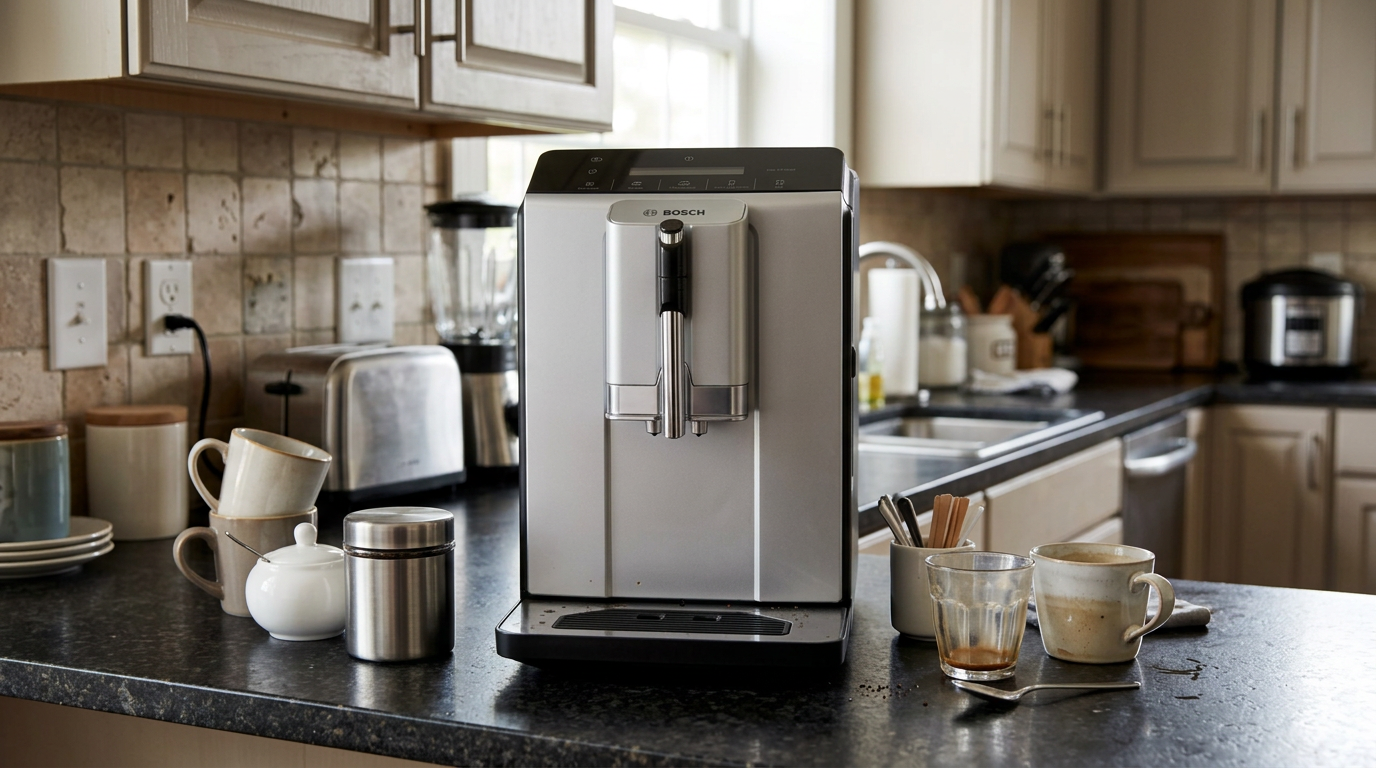
The frother sits on the front, with no carafe or milk hose to store or clean. This photo shows the silver finish.
Which drink should you actually press?
Five buttons don’t need much explaining, but they do behave a little differently from what the names suggest.
| Button | Best in | Use it for |
|---|---|---|
| Espresso | Small warmed cup | Tasting the beans at their purest |
| Coffee | Regular mug | A longer black drink, close to an Americano |
| Cappuccino | Mug with milk poured first | The everyday milk drink |
| Latte macchiato | Tall glass, if it fits | A milkier drink |
| Milk foam | Any mug | Hot chocolate, mochas and topping coffee |
Espresso is the purest test of the machine, and it’s where fresh grinding makes the biggest difference.
Use a small, warmed cup, because a short drink loses heat quickly.
Coffee is a longer pull through the same brew unit, so it has a different character from drip.
If you drink big mugs of black coffee all morning, this isn’t the most natural machine for you.
Cappuccino is the drink I’d expect most buyers to make every day.
Pour in your milk, press once, and you get foam topped with coffee without touching a pitcher.
Latte macchiato leans milkier and looks best in a tall glass, as long as it fits under the spout.
Milk foam is the underrated button.
It’s useful for hot chocolate, for a mocha, or for topping a coffee you’ve already brewed.
One owner uses it to make mochas for the family, and it’s a good way to get more out of the machine than the drink list implies.
Bigger pours, double drinks and iced coffee
The drink list is short, but a few simple tricks stretch it further.
To change the size of an espresso or coffee, press and hold its button and let the machine dispense until you have the amount you want.
For a grande-size latte macchiato, run the program twice. One pass in a big cup can seem short and not quite hot enough, and a second pass builds up the drink.
Iced drinks are easy too. Brew espresso into a separate cup, add milk and syrup if you like, then pour it over ice.
| You want | Do this | Good to know |
|---|---|---|
| A shorter or longer shot | Hold the espresso or coffee button | Match the pour to your cup |
| Two coffees | Use Double Cup | Check your model and manual |
| A grande latte | Run latte macchiato twice | Warm the mug first |
| Iced espresso | Brew into a separate cup, then pour over ice | Add milk and syrup before the ice |
| Richer foam | Keep the milk nozzle in position longer | Stop at the foam level you like |
Temperature: the complaint to take seriously
If I had to name the single issue most likely to disappoint people, it’d be drink temperature.
Temperature comes up again and again in owner feedback, and several people say their coffee isn’t as hot as they’d like.
One otherwise delighted owner warms the cup in the microwave for about 30 seconds before brewing.
This is fairly common with small automatic machines, because a thick, cold mug pulls a lot of heat out of a small drink.
I’d start by preheating your cup with hot water, then look at the temperature setting in the menu.
Bosch’s 300 Series documents list brewing temperature among the settings, so check your manual for exactly how it works on this model.
Milk drinks need more care, since cold milk goes directly into the cup.
Warming the empty mug first and using the hotter froth setting should help.
| Fix | Helps with | Effort |
|---|---|---|
| Preheat the mug with hot water | All drinks | Every cup |
| Microwave the cup about 30 seconds (owner tip, microwave-safe mugs only) | All drinks | Every cup |
| Check the temperature setting in your manual | All drinks | Once |
| Use the hotter froth setting | Milk drinks | Once |
| Keep milk servings smaller | Milk drinks | Every cup |
Our tip: Fill your mug with hot water before you start the machine, then empty it right before you brew.
If you’re someone who likes coffee close to scalding, keep your receipt and check it during your return window.
What daily use looks like
The routine is short.
Owners report about a minute to start up, about a minute for an espresso, and about two minutes for a latte.
How long each step takes (minutes)
Approximate times reported by owners.
After a milk drink, you’ll run the frother’s rinse step and then pull the frother off to rinse it under the tap.
The machine rinses its coffee path when it turns on and when it turns off.
That’s good for hygiene, but the water has to go somewhere.
Move your cup out of the way during the rinse so you don’t dilute your coffee, and plan on emptying the drip tray about once a day.
The 45-ounce water tank is decent for this size, and one owner says it lasts two to three days.
It sits toward the back left and can be awkward to lift out, though you can also top it up from above with a pitcher.
Two gaps stand out in everyday use.
There’s no hot water function, so tea and topping up an Americano need a kettle.
On the plus side, our test unit has a Double Cup function that makes two coffees at once or, depending on the drink, a bigger pour in one cup. Bosch’s product page doesn’t list it for this black version, so confirm it on the unit you buy.
One owner also says there’s no warning when the beans run low, so keep an eye on the hopper before guests arrive.
Our tip: Top off the hopper the night before guests come, since one owner reports no low-bean warning.
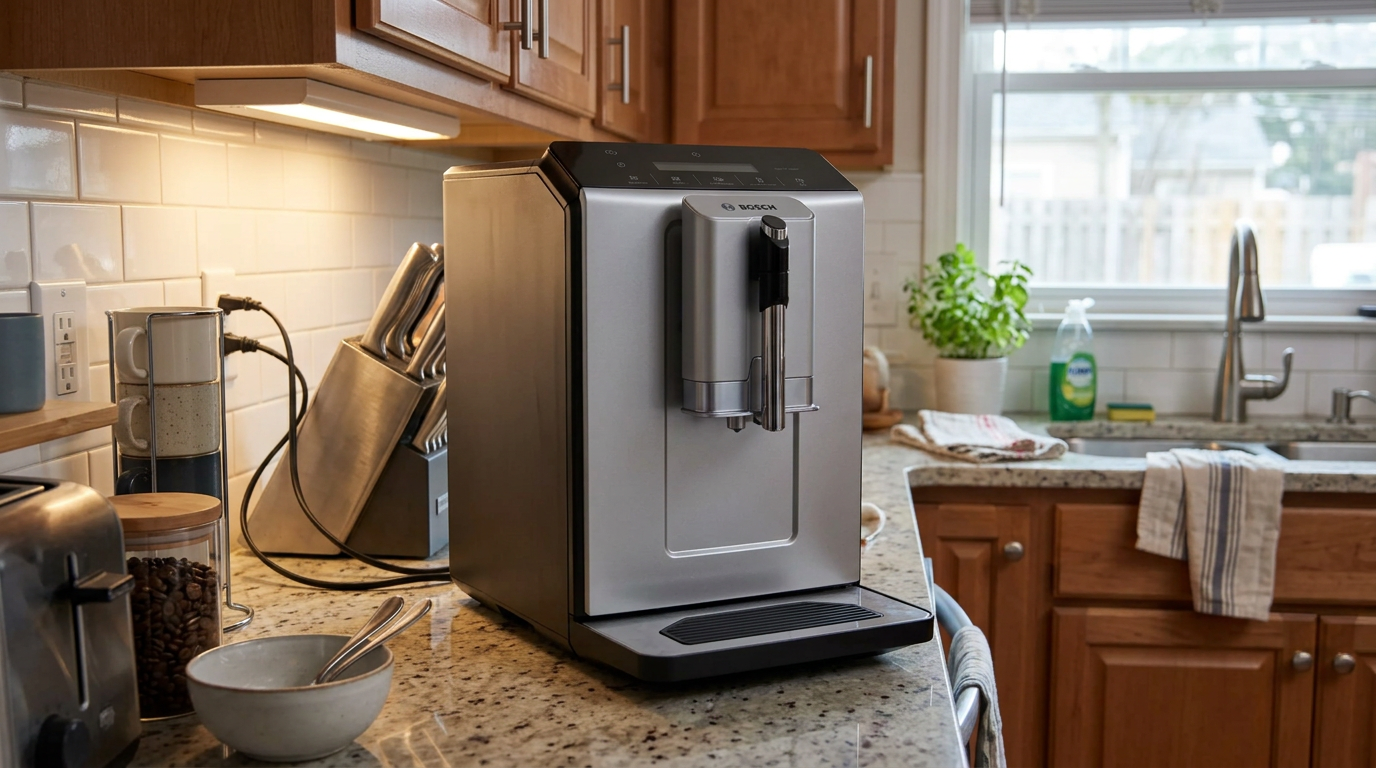
It’s deeper than it is wide, so check your counter space front to back. This photo shows the silver finish.
Where to put it in your kitchen
The narrow width makes this machine easy to fit, but it’s worth thinking about placement before it arrives.
Measure for these before it arrives
The tank sits toward the back, and the top lid needs clearance if you plan to fill it from above.
If your upper cabinets are low, you may need to pull the machine forward each time you add beans.
At about 16 pounds, that’s manageable, but a sliding appliance mat makes it easier on the counter.
The power cord is only about 39 inches long, so check that you have an outlet close by.
I’d also leave a little room at the front so you can open the service door and remove the brew unit without moving everything else.
Keeping it near the sink is a small thing that pays off every day, since the tray, the frother and the brew unit all end up there.
How loud is the Bosch 300 Series?
Like most bean-to-cup machines, this one is loudest while grinding.
Owners describe it as about what you’d expect from a coffee grinder, and it only lasts for a few seconds per drink.
One very noise-sensitive owner calls it not quiet but not excessively loud, though they also felt the motors sounded like they were straining.
If someone in your house sleeps close to the kitchen, an early espresso will probably be heard.
A thin rubber mat under the machine can help take the edge off counter vibration.
Cleaning and maintenance
Cleaning is one of this machine’s best selling points, with one real caveat.
The brew unit comes out through a door at the front and is washed by rinsing it under running water.
That’s a big advantage over sealed designs, because you can actually see and clean the part that handles the coffee.
The drip tray, drip tray cover, grounds container and milk nozzle are all dishwasher safe.
For descaling, Bosch’s Calc’n Clean program combines cleaning and descaling and walks you through each stage.
Set aside some time when you run it, since Bosch says the first half alone takes around 20 minutes.
Using the filter and setting your water hardness correctly should mean you see that prompt less often.
Now the caveat.
Being small means the tray and grounds bin fill up quickly, and one owner who likes the machine still says it needs a lot of cleaning.
Another owner found the brew unit awkward to remove and put back, and warned that it may be hard for anyone with arthritis or weak hands.
If that applies to you, I’d take that warning seriously.
Our tip: Empty the drip tray every time you empty the grounds so you never have to rely on the float.
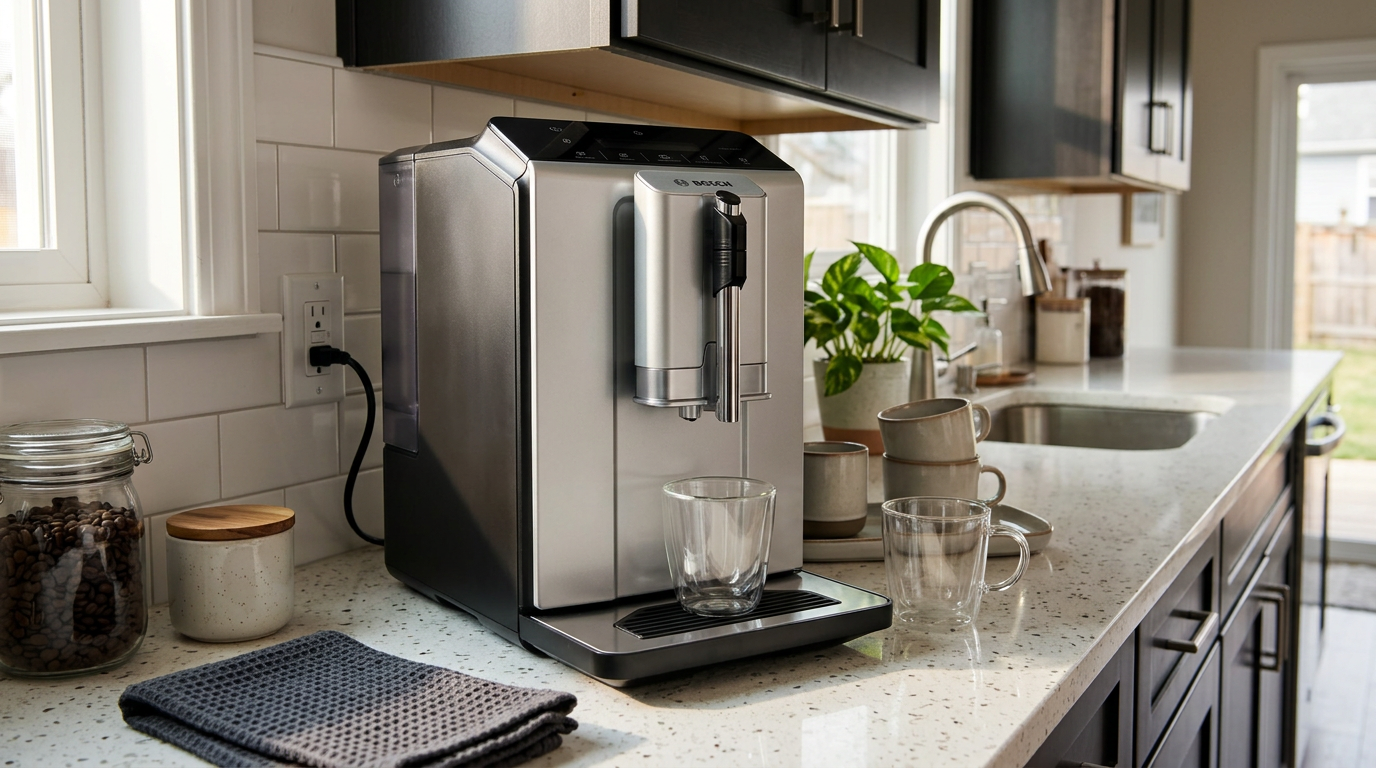
The front-access design makes the brew unit and bins simple to reach. This photo shows the silver finish.
A simple care routine
Most of the upkeep is quick, as long as you keep up with it.
The drip tray slides out from the front once you open the service door, and it collects rinse water and condensation as well as drips.
Rinse water landing there during startup, shutdown and cleaning is normal, which is why the tray needs emptying even when you haven’t spilled anything.
A small float rises as the tray fills, but it’s only a warning. It won’t stop the machine, and a full tray can overflow.
When you take out the brew unit, check the area around it too, then refit the unit properly and close the door before running the machine.
The water filter helps manage mineral buildup, but it doesn’t replace descaling.
| Part | When | What to do |
|---|---|---|
| Milk frother | After milk drinks | Pull off and clean; dishwasher safe |
| Drip tray | Daily, more after several drinks | Empty and rinse before it’s full |
| Grounds container | Regularly | Empty and return it |
| Brew unit | As directed in the manual | Rinse at the sink, let it drain, refit |
| Water tank | When refilling | Use clean water |
| Water filter | On Bosch’s schedule | Replace when due |
| Calc’n Clean | When prompted | Follow each guided step |
Reliability and owner satisfaction
Owner ratings for this model are unusually split.
Nearly half of buyers give it five stars, but close to a quarter give it one star.
How owners rate it (approximate share)
Rough shape of a small pool of ratings, not exact percentages.
It’s not a large pool of ratings, so I wouldn’t read too much into exact percentages, but that shape tells you something.
Most of the happy owners are happy about the same things: taste, simplicity and easy upkeep.
The unhappy ones tend to report a machine that didn’t work out of the box, touch keys that didn’t respond, or disappointment with coffee strength.
- Taste
- Simplicity
- Easy upkeep
- Units that didn’t work out of the box
- Touch keys that didn’t respond
- Coffee strength
One buyer said support walked them through troubleshooting and the unit still wouldn’t run, so they sent it back.
Early faults like that are the reason I’d buy from somewhere with an easy return policy and test everything in the first week.
Bosch’s warranty is a two-year limited warranty on parts and labor, or 7,000 cups, whichever comes first.
For a daily coffee drinker, the two-year mark will usually arrive first.
Is the Bosch 300 Series worth the money?
Value depends heavily on what you pay, because this machine’s street price moves a lot.
At full list price, I think the short feature list is harder to accept.
When it’s on a good sale, it becomes much easier to recommend, and one owner says outright they wouldn’t have kept it at full price.
So I wouldn’t pay attention to the list price at all.
What you’re really buying is convenience, compact size and easy cleaning.
You’re giving up a hot water button, a pre-ground chute and hands-on milk.
- Convenience
- Compact size
- Easy cleaning
- A hot water button
- A pre-ground chute
- Hands-on milk
If those missing features wouldn’t change your morning, the Bosch 300 Series makes a lot of sense.
If two or more of them would bother you daily, I’d skip it and spend more on a machine that has them.
Remember to budget for ongoing costs too: beans, milk, water filters and descaling tablets.
If you often buy coffee at cafés or drive-throughs, the machine can offset some of that spending. For a rough break-even, divide its price by what you’d save per drink after beans and milk.
On a good deal, the black 300 Series is a simple way into fresh-bean espresso.
Who is most likely to regret buying it?
I find it useful to ask who’ll be unhappy, because that’s often clearer than who’ll be pleased.
| Who | Why | Better move |
|---|---|---|
| Steam wand shoppers | No pitcher steaming here | Buy a machine with a manual wand |
| Piping-hot drinkers | Drinks may need a warmed cup | Test it during your return window |
| Several daily milk drinkers | Pour, froth and rinse for every cup | Look at a carafe-style machine |
| Limited hand strength | One owner found the brew unit hard to handle | Try removing it before the return window ends |
The first group is people who bought it for the “steam wand” in the title.
If you pictured yourself steaming milk in a pitcher, you’ll be disappointed the moment you open the box.
The second group is people who want piping hot drinks with no extra steps.
The third is households with several daily milk drinkers, because you’ll be pouring, frothing and rinsing for every cup.
Finally, anyone with limited hand strength should think twice about a machine with a brew unit that at least one owner found hard to handle.
If you don’t fall into any of those groups, there’s a good chance you’ll be happy with it.
Black vs silver: which Bosch 300 Series is this?
Bosch sells more than one machine under the 300 Series name, so check the model number before you order.
The black model I’m covering here is the TIU20109.
On paper, the silver TIU20307 adds an LCD display, five strength levels and double-cup brewing over this black model.
Our black test unit had all three, though, while Bosch’s published TIU20109 specs list three strength levels and no double cup.
Both use the same in-cup frother, 15-bar pump, ceramic grinder, bean hopper and removable brew unit.
If five strength levels matter to you, confirm them on the unit you receive while you can still return it, especially given the complaints about weak coffee.
Finish can signal equipment differences too. A dark silver or dark gray version may include a cup warmer while another finish may not, so check the exact spec if you want one.
If you just want the basics at the best deal you can find, the black one covers them.
| Black TIU20109 | Silver TIU20307 | |
|---|---|---|
| Controls | LCD touch panel | LCD and touch panel |
| Strength levels | 5 on our unit (Bosch specs: 3) | 5 |
| Double cup | Yes on our unit (not in Bosch specs) | Coffee and espresso |
| Milk system | In-cup frother | In-cup frother |
| Beans / water | 9 oz / 45 oz | 9 oz / 45 oz |
Bosch 300 Series specifications
From Bosch’s published specs, our test unit and the Amazon listing.
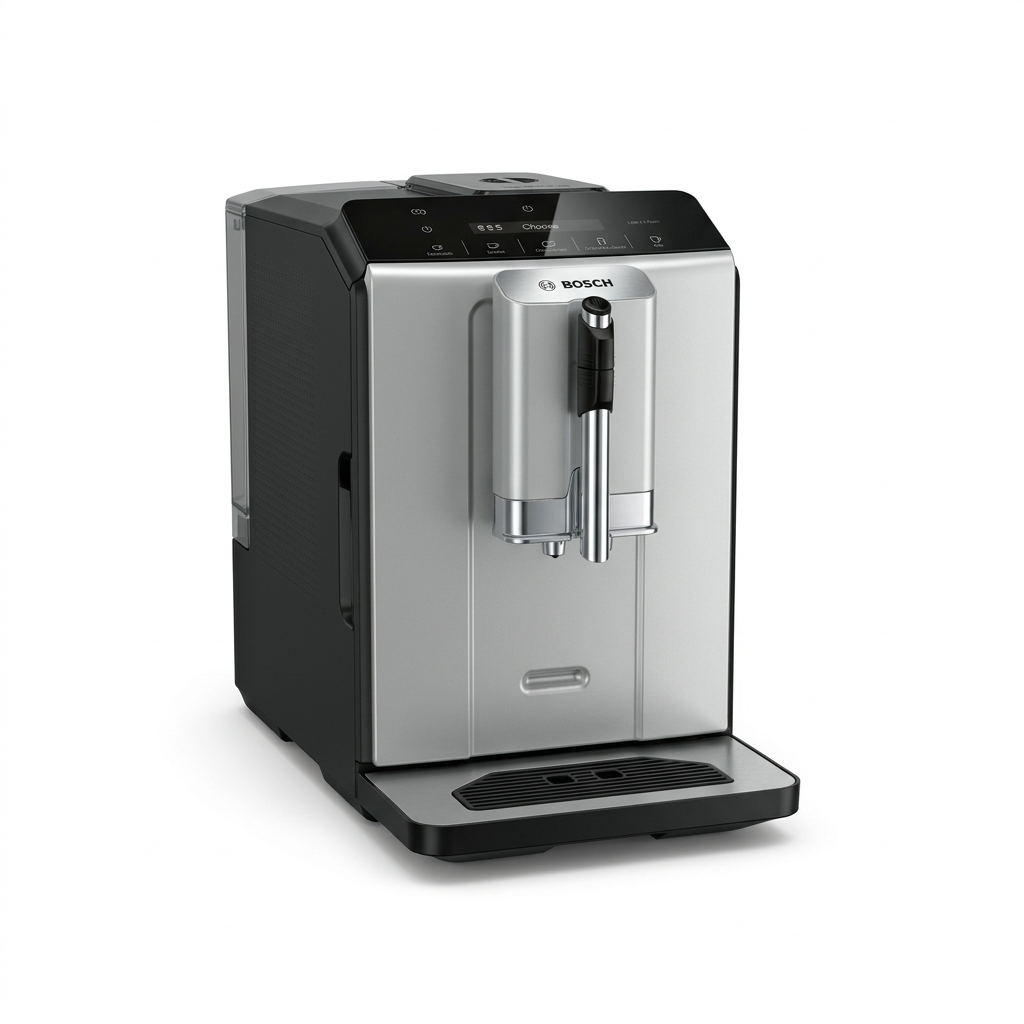
The Bosch 300 Series keeps its controls to one simple panel.
Check these before you buy
Finish and color alone won’t tell you what’s included, so run through this list first.
- The exact model number and spec sheet
- Which drinks are on the panel
- How many strength levels it has
- Whether Double Cup is supported
- Which milk frother is supplied
- Whether a cup warmer is included
- Your counter dimensions, including the clearance under cabinets
- Whether you can comfortably reach the tank at the rear
- Room to open the service door and remove the brew unit
- The price and availability of filters and descaling products
Tips to get the most from the Bosch 300 Series
- Preheat your mug. Run hot water into it or give it a short warm-up, since this is the simplest fix for lukewarm drinks.
- Use fresh, non-oily beans. Medium and medium-dark roasts are the safest place to start.
- Change one setting at a time. Let two drinks pass after a grind change before you judge it.
- Read the test strip instructions first. You only get one in the box.
- Move your cup during rinses. It keeps rinse water out of your coffee.
- Rinse the frother right away. Milk is far easier to wash off before it dries.
- Rinse the brew unit regularly. Follow Bosch’s schedule and let it dry before it goes back in.
- Don’t skip descaling. Scale is the enemy of any machine like this.
- Set your own pour. Hold the espresso or coffee button to match the drink to your cup.
- Try different strengths. Each new bag of beans may suit a different level.
- Run big lattes twice. A second latte macchiato cycle helps in a grande-size cup.
- Make iced espresso separately. Brew first, then add milk, syrup and ice.
- Don’t trust the float to save you. It shows the tray is filling, but the tray can still overflow.
- Avoid coated beans. Caramelized or flavored coatings can clog the grinder.
- Keep filters in stock. The filter still doesn’t replace descaling.
How we tested and scored the Bosch 300 Series
This review combines our hands-on testing notes on the black TIU20109 with Bosch’s product page, spec sheets and support guides, the product listing, and written reports from verified owners.
I gave more weight to complaints that showed up repeatedly, and to details owners could only learn from living with the machine.
Where sources disagreed, I went with Bosch’s own documents, except where our test unit showed otherwise, and I’ve flagged those spots.
Scores weigh espresso, milk drinks, ease of use, maintenance and value.
Bosch 300 Series FAQ
Does the Bosch 300 Series have a real steam wand?
No. Despite the listing title, it uses an automatic in-cup frother called Milk Express. You pour milk into your cup and the machine foams it.
Can the Bosch 300 Series make hot water?
No. It has no hot water function, so you’ll need a kettle for tea.
Can I use pre-ground or decaf coffee?
Decaf beans work, but there’s no chute for pre-ground coffee. To switch to decaf beans, you have to change what’s in the hopper.
How tall a cup will fit?
The spout adjusts up to about 5 1/2 inches, so most mugs fit but tall tumblers usually won’t.
Is the milk frother easy to clean?
Yes. It’s held on by a magnet, comes off for rinsing and is dishwasher safe, and there are no internal milk hoses.
Can it use oat or almond milk?
Bosch says it works with milk alternatives. Foam quality varies by product, so barista-style versions are a good place to start.
Why is my coffee not hot enough?
A cold mug takes a lot of heat out of a small drink. Preheat the cup first, then check the temperature settings in your manual.
Is the Bosch 300 Series loud?
The grinder is noticeable for a few seconds per drink, about like any coffee grinder. The rest of the cycle is quieter.
How many strength levels does it have?
Our test unit has five. Bosch’s published specs for the TIU20109 list three, so check the unit you receive.
Does it have a Double Cup function?
Ours does, for two coffees at once or a bigger pour, depending on the drink. Check your model’s manual, because it isn’t in Bosch’s published specs for this version.
How do I make a larger latte?
Run the latte macchiato program twice in a large cup. Warming the cup first helps too.
Can it make iced coffee?
Not by itself, but it’s easy. Brew espresso into a separate cup, add milk and syrup if you like, and pour it over ice.
Will the drip tray overflow?
It can. The float only shows that the tray is filling and doesn’t shut anything off, so empty it regularly.
Does the water filter mean I can skip descaling?
No. The filter can reduce mineral buildup, but you still need to follow the Calc’n Clean prompts.
Does it have a cup warmer?
It depends on the version. A dark silver or dark gray model may have one, so check the exact spec.
What’s the warranty?
Bosch lists a two-year limited warranty on parts and labor, or 7,000 cups, whichever comes first.


- BrasQ hands-on testing notes on the black TIU20109
- Bosch US product page and spec sheet for the TIU20109
- Bosch 300 Series digital user guide and support pages
- Verified owner reviews
- Amazon product listing (ASIN B0DGWL13JM), November 2026
- Updated with hands-on testing notes; corrected strength levels and Double Cup.
- Draft created.