De'Longhi Magnifica Evo review: easy espresso, hands-on milk
The De'Longhi Magnifica Evo grinds, doses and brews at a touch, then leaves the milk to you. I went through its specs, published measurements and hundreds of owner ratings to see who it really suits. It looks like a strong pick for black coffee and Americano drinkers, with two catches: a loud grinder and a mixed reliability record.
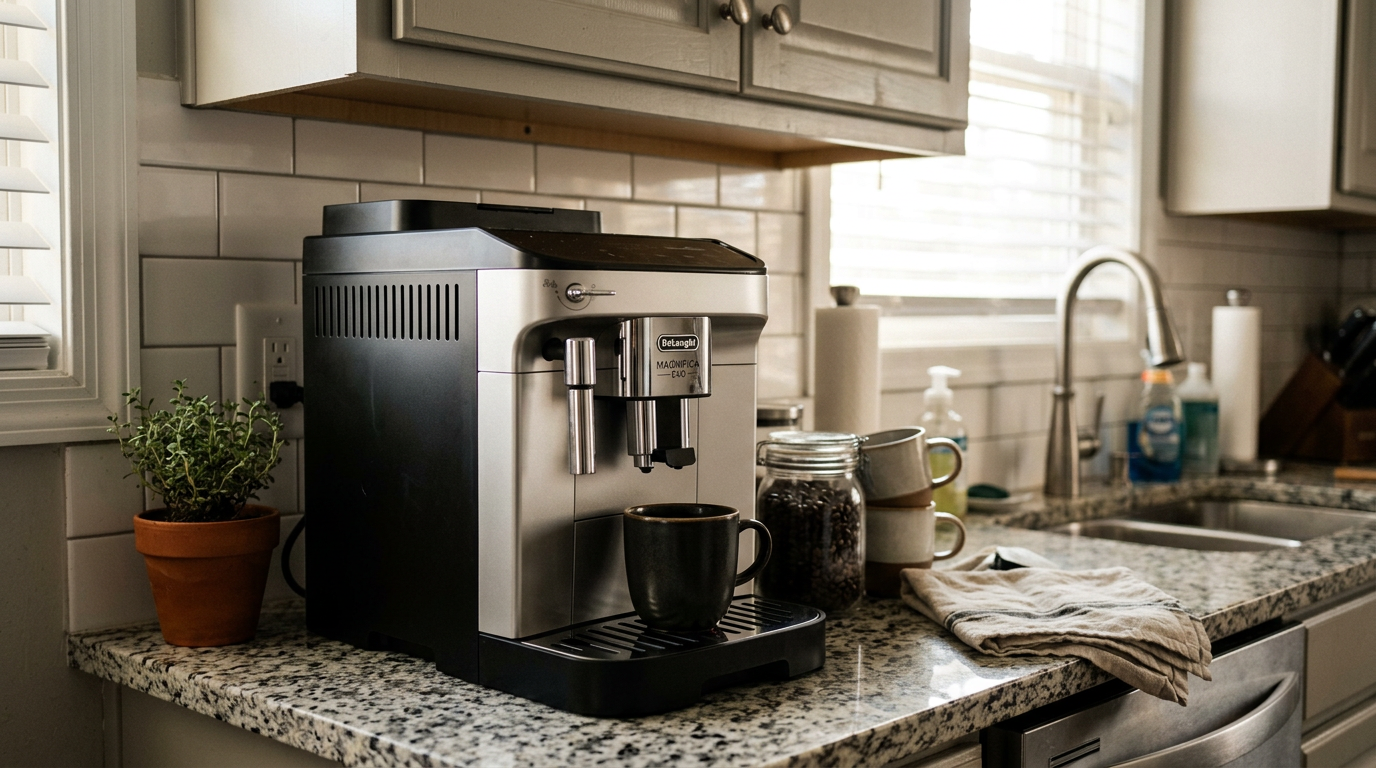
In this review
For someone who mostly drinks espresso, Americanos or iced coffee, I think the Magnifica Evo is one of the most sensible ways into bean-to-cup coffee. It keeps the controls simple and it's easy to clean, and the steam wand has fewer parts than an automatic carafe. If you want one-touch lattes or a silent morning, look elsewhere. And buy from somewhere with an easy return, because early failures show up too often in owner reports.
De'Longhi Magnifica Evo at a glance
De'Longhi Magnifica Evo pros and cons
- Simple one-touch brewing from fresh beans
- Manual frother is easy to clean and handles plant milks
- Compact front-access design with a 60-ounce tank
- Grinder is loud, at up to 78 dB in one published test
- 17% of owner ratings are one star
- Milk drinks take practice and an extra step
Who should buy the De'Longhi Magnifica Evo?
- Espresso and Americano drinkers who want fresh beans without a learning curve
- People who prefer a steam wand to cleaning a milk carafe
- Plant-milk households that want control over foam
- Anyone who wants lattes at a single touch
- Homes where an early-morning grinder would wake someone
- Coffee hobbyists who want full manual control of every shot
First impressions of the De'Longhi Magnifica Evo
Super-automatic machines promise something very appealing.
You press one button, and a machine does the grinding, tamping and brewing that would otherwise take a practiced barista.
The Magnifica Evo sits at the approachable end of that world.
What struck me first in the specs is how little it tries to do.
There's no big touchscreen, no app and no long menu of drinks to scroll through.
You get a panel of color icons, a strength control and a steam wand on the side.
Then I looked at the owner feedback, and a clear pattern came through.
People who wanted a straightforward espresso and read the manual tend to love it.
People who expected a coffee shop in a box, or who got a faulty unit, are far less kind.
That split shapes this whole review, because the machine's strengths and weaknesses are unusually easy to predict.
The Evo is narrow enough to tuck under standard kitchen cabinets.
What the De'Longhi Magnifica Evo actually is
The Magnifica Evo is a super-automatic espresso machine with a built-in grinder.
You load whole beans into the hopper on top and water into a tank at the side, and the machine does the rest.
Inside, a steel conical burr grinder feeds a removable brew unit, which tamps the grounds and pushes hot water through them at up to 15 bar.
Spent coffee drops out as a compact puck into a container behind the drip tray.
This review covers the US model with the manual frother, sold as the ECAM29043SB.
That detail matters, because De'Longhi also sells an Evo with an automatic LatteCrema milk carafe under a similar name.
The two share the same basic layout and grinder, but they're very different machines to live with if you drink milk.
The Amazon listing is inconsistent: the title says seven one-touch recipes, the feature list names five and De'Longhi's comparison chart says six. The named drinks are Espresso, Coffee, Americano, Iced Coffee and Long.
De'Longhi also added a bypass chute for pre-ground coffee.
Owners like it for an evening decaf, because you don't have to empty the hopper to make one.
It's a small feature, and it solves one of the most annoying limits of a single-hopper machine.
Our tip: Keep a small bag of pre-ground decaf next to the machine and use the bypass chute after dinner.
Design and setup
The body is a tall, narrow block about 9.5 inches wide, 17.3 inches deep and 14.2 inches high.
That width is the useful number, because it takes up less counter than many drip coffee makers with a grinder beside them.
The depth is the one to measure, particularly if your outlet or backsplash leaves little room behind it.
Silver trim dresses up the front, though one owner summed the body up fairly by calling it all plastic.
At this level, I'd expect that.
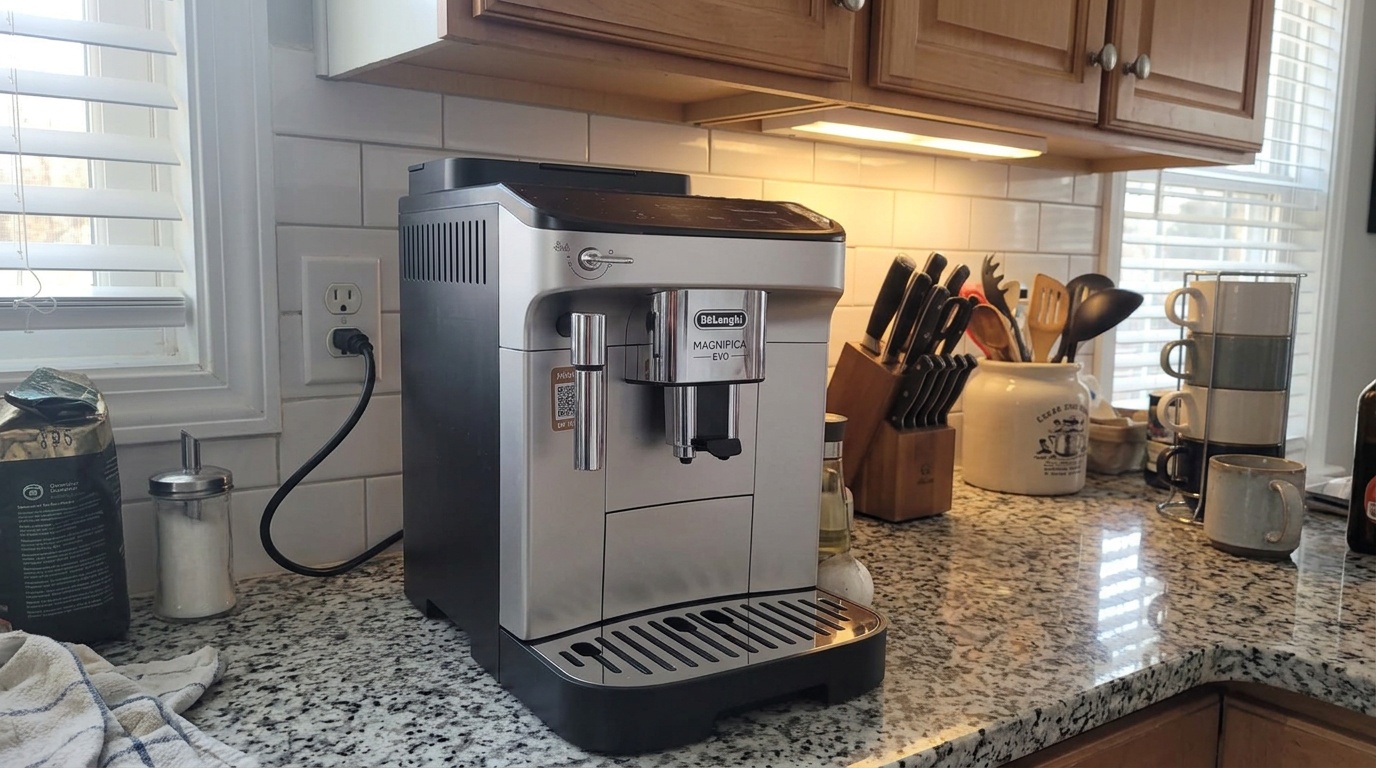
Plan for an outlet nearby and enough clearance to lift the hopper lid under your cabinets.
The control panel
The top panel uses capacitive touch icons rather than physical buttons or a screen.
You tap a drink, tap the bean icon if you want a stronger dose, and that's the daily routine.
The downside appears when you want to change a deeper setting.
With no text display, things like temperature and auto-off rely on button combinations and bean-icon lights.
It's worth keeping the instructions close, because the same manual can cover several model numbers and that has confused some owners.
First-time setup
On startup, the machine runs a self-rinse that takes roughly 30 to 40 seconds and sends a little hot water through the spout.
It rinses again at shutdown, so a cup or small jug under the spout saves you some wiping.
A few owners also reported a first unit that wouldn't prime or start.
If the pump seems dead on day one, check the tank is seated and try running the steam function to pull water through before you assume the worst.
Our tip: Test your tap water with the hardness strip before your first coffee, because the factory setting may trigger descaling alerts too often or too late.
The grinder and dose settings
The grinder is the heart of any bean-to-cup machine, and here it's a steel conical burr unit with 13 settings.
The adjustment wheel sits inside the hopper, so you have to lift the lid to reach it.
Dose is controlled by the bean icons on the panel, which change how long the grinder runs.
That chart explains the single most useful setting on this machine.
The three-bean setting grinds for around seven seconds and doses about 0.35 ounces of coffee.
A fuller dose also tends to form a firmer puck, so it should drop out cleanly instead of crumbling into loose grounds.
If I were setting one up, I'd start at three beans and move the wheel finer in small steps, toward setting 2.
A finer grind restricts the water flow, which should build more resistance, thicker crema and a more intense cup.
There's one rule that you shouldn't break.
Only turn the grind wheel while the grinder is running, because forcing it while the burrs are stopped can cause damage.
Our tip: Change the grind by one step at a time and give it two or three drinks before you judge the difference.
Bean choice matters too.
Very oily dark roasts are a common cause of clogged chutes and sticky grinders in machines like this.
Owners who are happiest with the Evo keep coming back to one piece of advice: use good, fresh, non-flavored beans.
Coffee quality: what the data suggests
The preset espresso from the Magnifica Evo measures about 1.35 fluid ounces.
At the three-bean dose, that works out to a brew ratio of roughly 1:4, which is longer and lighter than the classic 1:2 shot.
That's normal for super-automatics, and it's the main reason some espresso purists find the default drinks a little thin.
The good news is that the volume is adjustable.
One experienced owner reported much better results after shortening the espresso setting so the machine brewed for less time.
That's the first change I'd make if you drink straight shots.
Set strength to 3 beans, move the grind toward setting 2, shorten the espresso volume and raise the temperature to high. Those four changes address the most common complaints about flat or weak coffee.
Espresso and Americano
The machine compresses the grounds, wets them, pauses briefly and then extracts under pressure.
That automatic pre-infusion helps water move evenly through the puck.
Owners frequently describe the espresso as very good for a one-touch machine, and the Americano gets especially warm comments.
One owner said the Americano gave more volume and better flavor than the machine's own Coffee button, and I'd start there if you want a full mug.
The Coffee and Long buttons
The Coffee setting runs more water through the grounds to make a bigger, milder cup.
This is where expectations need managing, because this method can pull bitter notes from a small puck.
It won't taste like a pot of drip coffee, and at least one satisfied owner never managed to dial it in.
The Long setting is De'Longhi's answer, because it grinds and brews in stages for a larger drink.
It's slower and uses more beans, but it spreads the water over more coffee.
Iced coffee
Having a dedicated iced button is a nice extra at this level.
Fill a tall glass with ice, but remember the spout clears only about 5.5 inches at most.
Our tip: For a stronger iced drink, brew over less ice and top it up with more after the coffee has been poured.
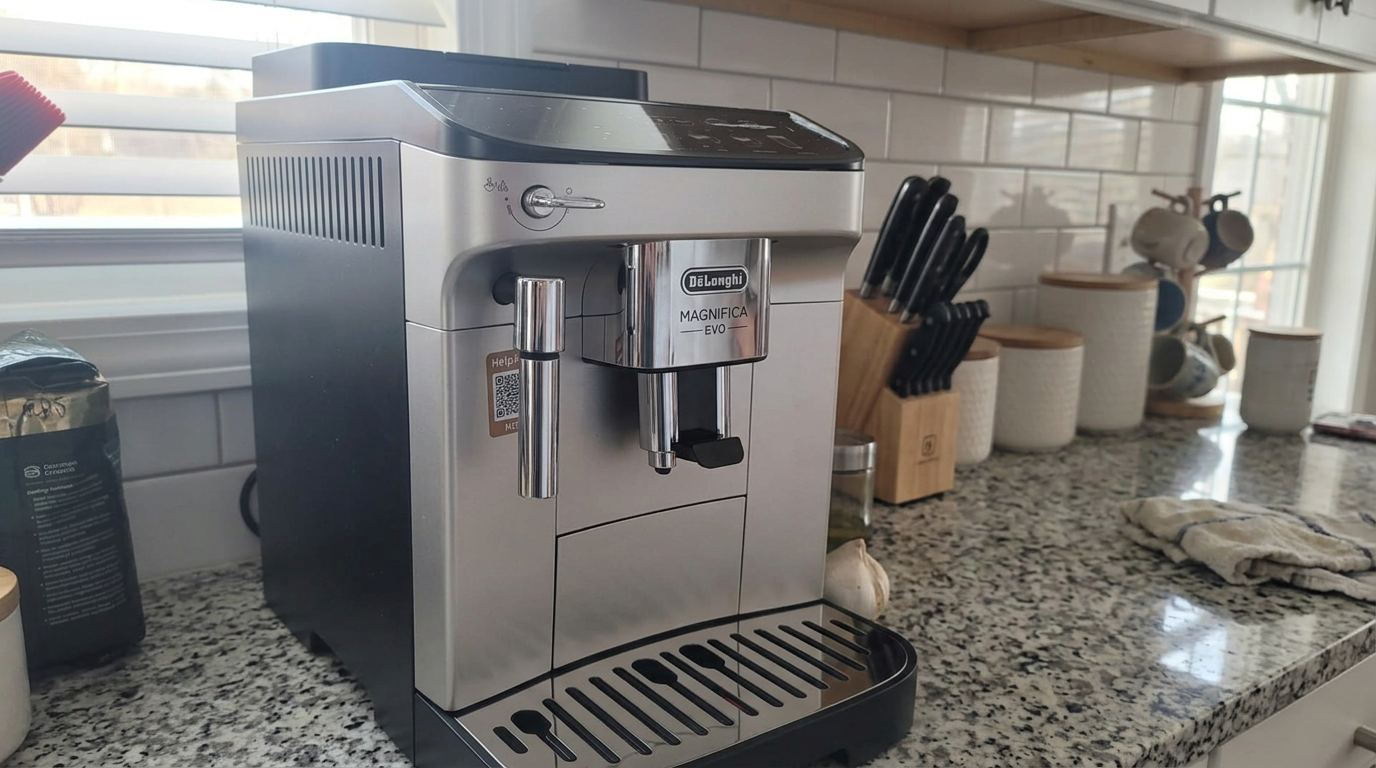
The height-adjustable spout can drop close to a small espresso cup to protect the crema.
Is the coffee hot enough?
Temperature is the complaint I saw most often across the Magnifica family.
Owners of Evo models say the coffee can come out warm rather than hot, and some say that's true even on the top setting.
For context, the widely cited brewing range for espresso is about 195 to 205°F.
But brewing temperature isn't drinking temperature, and a small shot loses heat fast when it lands in a cold, thick cup.
The Evo has three temperature levels, hidden in a settings menu.
To change it, hold the Settings icon for five seconds until the indicators flash, then press the first cup icon.
Next, pick the three-bean icon for high, press the first cup icon to confirm and press Settings to exit.
Icon positions can vary by model, so check them against the manual that came with yours.
Beyond that one setting, a few simple habits should help.
Let the startup rinse finish, run a hot rinse into your cup and empty it before you brew.
The first shot after a cold start will always be the machine's coolest, and a second drink generally benefits from a warmer system.
Our tip: Warm your cup with a quick rinse of hot water, because a cold ceramic mug can pull heat out of a small shot in seconds.
The manual milk frother
The steam wand is what separates this version from its automatic sibling.
You pour milk into a pitcher, hold it under the frother and control the foam yourself.
That means your latte has an extra step and a short learning curve.
It also means there's no carafe, no suction tubes and far fewer places for milk to hide.
Several owners said they chose this version on purpose, and they preferred it because it was easier to clean and made better foam for them.
I think that reasoning is sound.
Carafe systems are convenient right up to the moment a small air hole clogs with milk film.
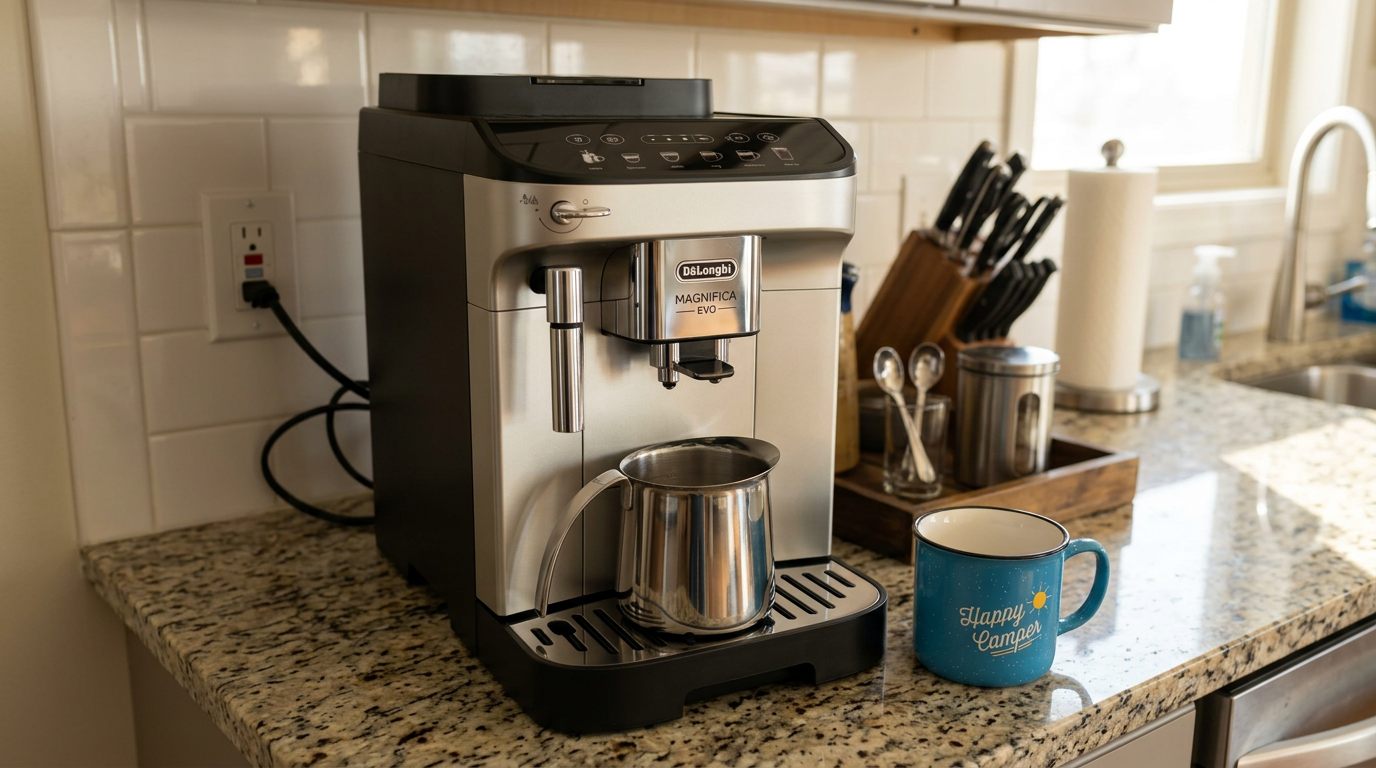
You'll need your own pitcher technique, but the wand makes cleanup much simpler.
Getting good foam
Start with cold milk in a cold pitcher, since that gives you more time to add air before the milk gets too hot.
Whole milk with about 3.5% fat makes the thickest and most stable foam.
Barista-style oat milk is the easiest plant option, and owners report using oat, almond and coconut milks with the wand.
Keep the tip just below the surface to add air, then lower it slightly to spin the milk into a glossy texture.
Our tip: Wipe the frother and purge a burst of steam right after every use, before the milk has any chance to dry on.
Manual frother or LatteCrema?
If you make one milk drink a day and enjoy the ritual, I'd stay with the manual frother.
If several people want cappuccinos before work, the wand becomes a bottleneck.
That's the moment to look at an automatic milk system, which I cover in the comparison below.
How loud is the Magnifica Evo?
The grinder is loud, and the owner reviews say so again and again.
One published test of this machine recorded about 78 dB while grinding and 55 dB while brewing.
Another test of a closely related Evo model found about 75 dB and 62 dB.
Because decibels work on a logarithmic scale, that grinder peak will sound several times louder than the brewing stage.
The saving grace is that it's short.
Even at the strongest setting, the grinder only runs for around seven seconds per drink.
Still, if someone sleeps on the other side of a thin wall, that's seven seconds they'll notice.
A thick mat under the machine can take some of the vibration out of a hard counter, and the pre-ground chute is a quieter option for very early starts.
Cleaning and upkeep
Cleaning is a real strength here, largely because there's no carafe to dismantle.
Even so, every bean-to-cup machine needs regular attention, and this one isn't an exception.
| Job | How often | What to do |
|---|---|---|
| Drip tray and grounds | Daily or when prompted | Empty and rinse so mold can’t start |
| Frother | After every milk drink | Wipe and purge with steam |
| Brew unit | Weekly | Remove and rinse with warm water, then air-dry |
| Descaling | When the alert appears | Run the guided cycle with descaler |
The brew unit
Power the machine down, open the access door, press the two red release buttons and slide the unit out.
Rinse it under warm water, let it air-dry and slide it back until it clicks.
Don't use detergent or the dishwasher on this part, even though other removable parts are dishwasher safe.
Being able to pull out the brew group is a major advantage, since it lets you see and clean the part where old coffee collects.
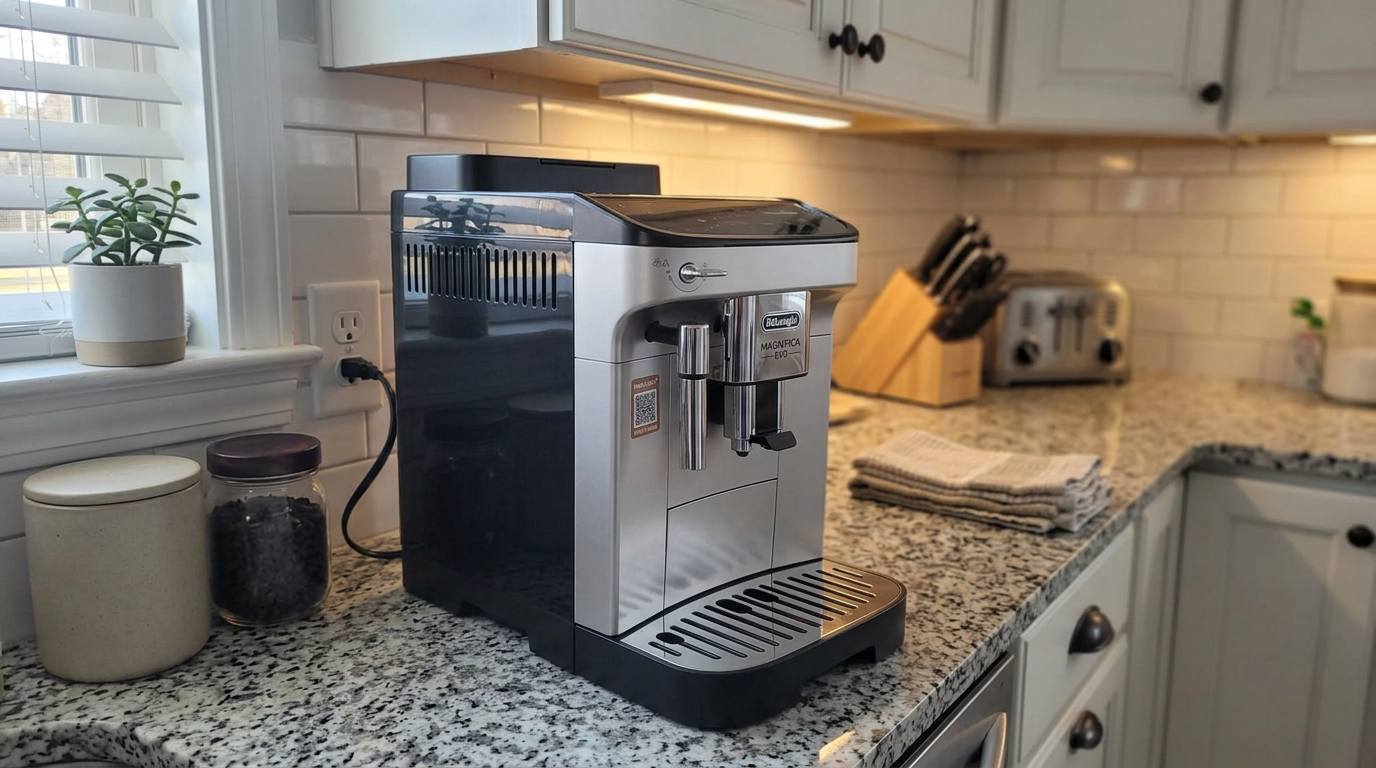
The side access is where the weekly brew unit rinse happens.
Water and descaling
The machine tracks water use and tells you when to descale, based on the hardness level you've set.
One owner with soft water noted that the default setting was stricter than needed, and adjusting it cut down on the alerts.
Set it honestly, though, because scale in the heating circuit is hard to reverse.
A compatible water filter can help as well, but one owner found it had to be bought separately.
Our tip: Refill the tank and hopper before each morning rush, since owners report the machine can stop mid-drink when either runs out.
Rinse into a cup at startup, brew, purge the frother, then empty the drip tray and grounds container before the last person goes to bed.
Reliability: what owners report
This is the section that kept my score below 8.
The Magnifica Evo holds 4.0 out of 5 stars from 756 ratings on Amazon, but the average hides a very split crowd.
Most owners are delighted, and a meaningful minority are very unhappy.
There's little in the middle, which usually points to a machine that works very well until something goes wrong.
Here are the problems that came up most in the reviews I read.
Some of these are nuisances, and some are serious.
The auto-off complaint has an easy fix: hold the settings icon, choose the Coffee button and pick 15 minutes, 30 minutes, one hour or three hours using the bean and pre-ground icons.
The dead-on-arrival reports are harder to explain away.
My advice is to register the machine, keep the packaging for the return window and run every drink and the steam wand during your first few days.
Faults that appear in that period are far easier to resolve.
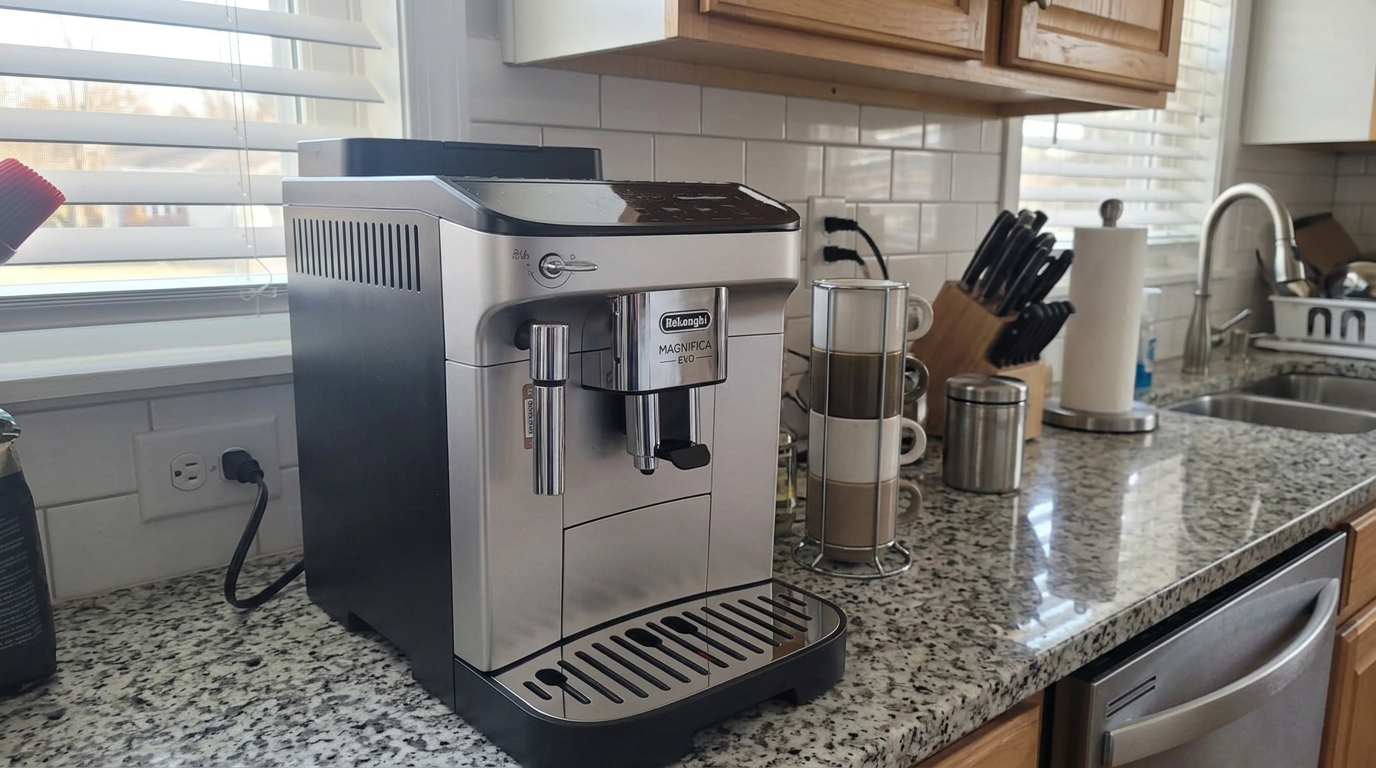
Run every function in the first week, while returning it is still simple.
Where I would start with the settings
The factory settings are a reasonable baseline, but they aren't where I'd leave them.
Every bean behaves differently, so treat the table below as a starting point and adjust by taste.
| Drink | Strength | Grind direction | Adjustment |
|---|---|---|---|
| Straight espresso | 3 beans | Finer, toward setting 2 | Shorten the volume |
| Americano | 3 beans | Medium to fine | Add more or less water to taste |
| Iced coffee | 3 beans | Medium to fine | Use less ice for a stronger drink |
| Latte or cappuccino | 3 beans | Finer | Keep the shot short so milk doesn’t drown it |
| Large mug | 2 or 3 beans | Slightly coarser | Try Long before Coffee |
How to read the taste
If your espresso tastes sharp and sour, the water probably moved through too quickly.
Grind one step finer or raise the temperature, then try again.
If it tastes harsh, dry or very bitter, go the other way with a slightly coarser grind or a shorter drink.
Change one thing at a time, because adjusting grind, dose and temperature all at once makes it impossible to tell what helped.
Fresh beans also make this much easier.
Coffee that has been sitting open for weeks will never give you the crema or flavor the machine is capable of.
I'd buy smaller bags, keep them sealed and add only a few days' worth of beans to the hopper at a time.
Switching beans
The single hopper has no quick-release, so changing roasts means running it down or scooping out what's left.
That's easy enough if you settle on one coffee, and it's a nuisance if you like to rotate.
The grinder will also hold a small amount of the old beans, so expect the first drink after a switch to be a blend of both.
What daily ownership looks like
Owner reviews paint a consistent picture of the routine, and it's a little more involved than the marketing suggests.
Each morning starts with a short rinse, so you'll want an empty cup in place before the machine warms up.
From there, a drink is mostly a matter of tapping an icon and waiting while it grinds and brews.
The ongoing chores are small but constant: water, beans, the drip tray and the grounds container.
One owner put it simply, saying the machine needs some attention every day, and I think that's the right expectation.
The payoff is that nobody in the house needs to learn tamping, timing or dosing to get a decent coffee.
That's the real appeal of the Magnifica Evo, particularly in a home where only one person cares about espresso technique.
Everyone else can tap a button and get on with their morning.
The trade-off shows up with guests, because this machine makes drinks one or two at a time.
The milk step also adds a few minutes for each latte, so a round of six cappuccinos is going to feel slow.
For one or two people, though, the pace should be perfectly comfortable.
Is the De'Longhi Magnifica Evo worth the money?
A super-automatic is a long-term decision, and the value depends on what you'd otherwise be doing.
If you're replacing daily coffee shop visits or a pod habit, whole beans give you far more control over what goes in the cup.
Owners coming from pod machines mention that benefit often, along with having less packaging to throw away.
The Evo's value comes from what it leaves out.
You give up the touchscreen, the automatic milk system and the extra recipes.
In return, you get the same 13-step grinder and a simpler machine with fewer things to clean.
If that's the trade you want, it's a good one.
If you already know you'll want automatic lattes, don't talk yourself into this version just because it's simpler.
De'Longhi Magnifica Evo specifications
From De'Longhi's published specifications and the Amazon listing.
Magnifica Evo vs other De'Longhi automatic machines
The most useful comparison is inside De'Longhi's own lineup, where each step changes how you handle milk and choose drinks.
The Magnifica Evo is the one for people who want good coffee and don't mind doing their own foam.
The Magnifica Start adds the automatic LatteCrema milk system with a simpler drink menu.
The Rivelia goes much further, with 18 preset recipes, a touchscreen and two swappable bean hoppers.
| Magnifica Evo | Magnifica Start | Rivelia | |
|---|---|---|---|
| Milk | Manual frother | Automatic LatteCrema | Automatic LatteCrema |
| One-touch drinks | 6 on De’Longhi’s chart | 5 | 18 |
| Controls | Color touch icons | Soft-touch icons | 3.5-inch touchscreen |
| Grinder | 13 settings | 13 settings | 13 settings |
| Bean hoppers | 1 (8.8 oz) | 1 | 2 swappable (8.8 oz each) |
| Pre-ground | Yes | Yes | Yes |
| Best for | Black coffee, wand fans | Easy milk drinks | Variety and two bean types |
Reviewed hereMagnifica EvoSimple one-touch coffee, with a steam wand for your own milk.Check price on Amazon
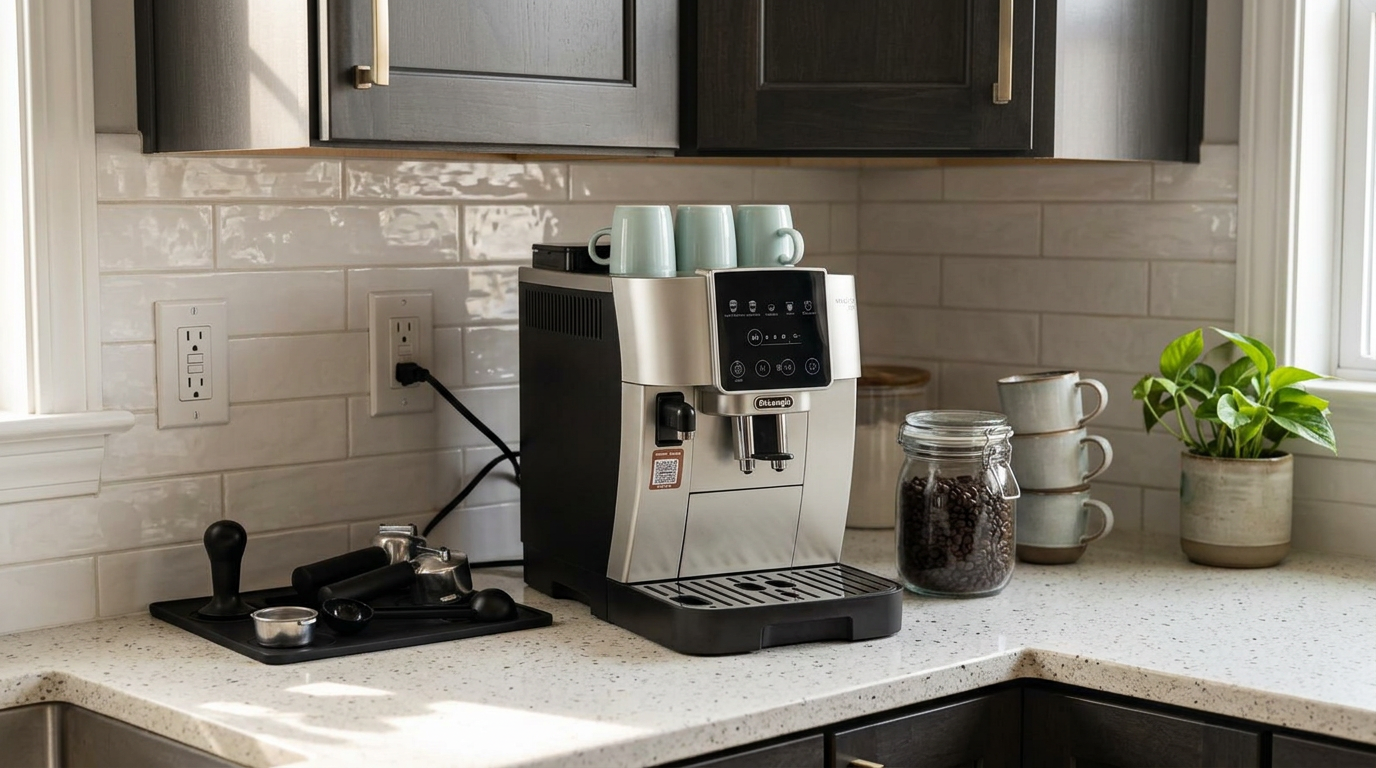 Automatic milkMagnifica StartOne-touch cappuccino and latte macchiato with the LatteCrema carafe.Find Out the Price Today
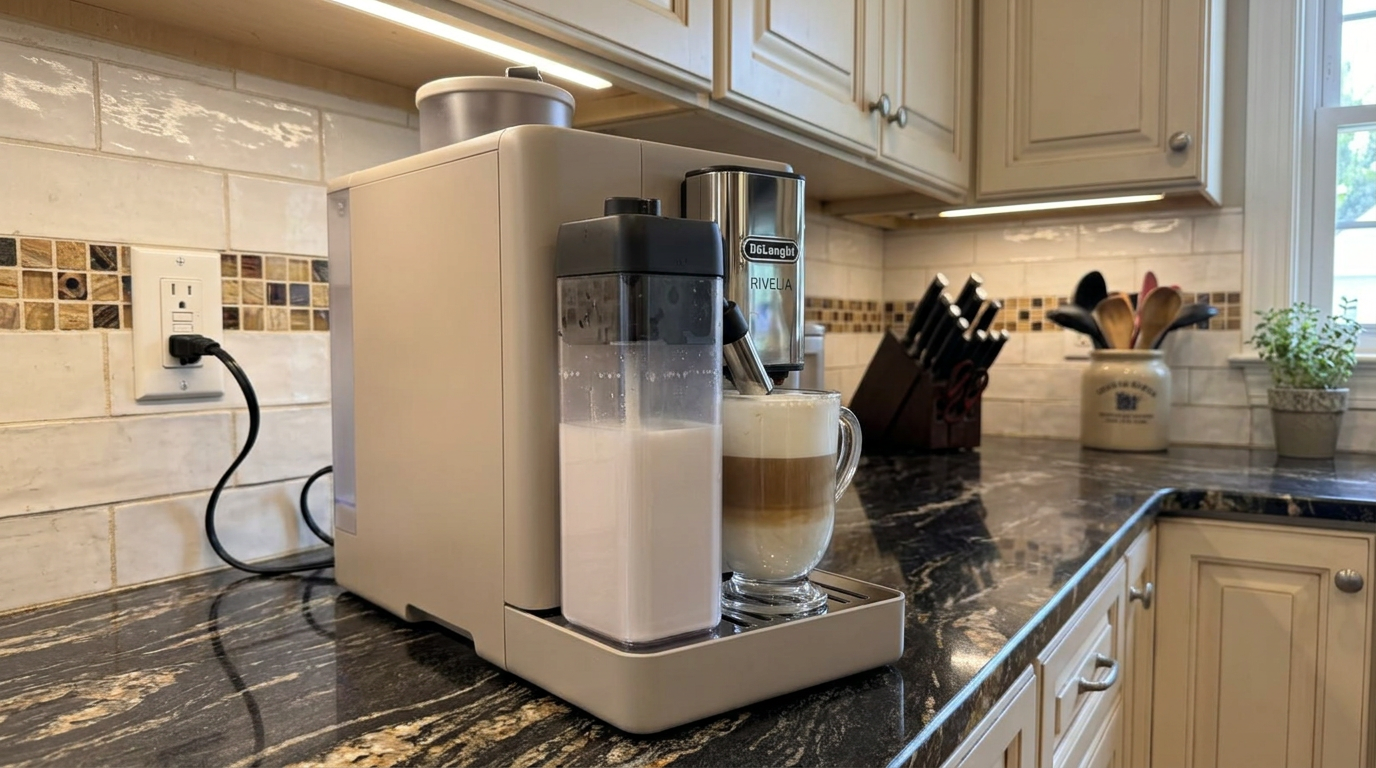 Most varietyRivelia18 presets, a touchscreen and two swappable bean hoppers.See Today’s Price
For most black coffee drinkers, I'd keep things simple and choose the Evo.
If milk drinks are the daily routine, the Start makes more sense even though you'll have a carafe to clean.
And if your household argues over decaf and dark roast, the Rivelia solves a problem the single-hopper Magnificas can't.
How I researched and scored the Magnifica Evo
I did not run this machine through a hands-on test for this review.
I compared De'Longhi's published specifications and the operating details for the machine, then read published test measurements and a large set of owner reviews.
Where sources disagreed, I went with the US listing and the manufacturer's figures, and noted the conflict.
- Coffee quality (8.2): dose, grinder range, extraction settings and owner taste reports.
- Ease of use (8.6): daily controls, setup and how much the machine asks of you.
- Upkeep (7.8): cleaning steps, access to the brew unit and descaling.
- Reliability (6.9): the spread of owner ratings and repeated fault reports.
The overall 7.9 is an editorial rating, based on the average of those four areas.
De'Longhi Magnifica Evo FAQ
Is the De'Longhi Magnifica Evo worth it?
Yes, if you mostly drink espresso, Americanos or iced coffee and want a simple machine. It's less suited to people who want one-touch lattes, and owner reports show a meaningful share of early faults.
Does this Magnifica Evo froth milk automatically?
No. The ECAM29043SB has a manual frother. De'Longhi sells a separate Evo with the automatic LatteCrema carafe.
Can I use oat or almond milk?
Yes. Owners report using oat, almond and coconut milks with the manual frother. Barista-style versions usually foam best.
Can I use pre-ground coffee?
Yes. A bypass chute takes pre-ground coffee, which makes it easy to brew decaf without emptying the hopper.
How do I make the coffee hotter?
Set the temperature to high in the settings menu, let the startup rinse finish and warm your cup with hot water before brewing.
How often do I need to clean it?
Empty the drip tray and grounds as prompted, purge the frother after each use, rinse the brew unit weekly and descale when the machine alerts you.
How loud is it?
Published tests recorded about 75 to 78 dB while grinding and 55 to 62 dB while brewing. The grinder only runs for several seconds per drink.
What size cup fits?
The maximum clearance under the spout is about 5.5 inches, so measure tall travel mugs first.
How do I change the auto-off time?
Owners report holding the settings icon for five seconds, pressing the Coffee button and using the bean and pre-ground icons to choose 15 minutes, 30 minutes, one hour or three hours.
- De'Longhi product specifications and operating details for the Magnifica Evo
- Amazon product listing for the De'Longhi Magnifica Evo (ASIN B0B38KFWNK), November 2026
- Amazon listings for the Magnifica Start and Rivelia, November 2026
- Published noise measurements from independent reviews
- Owner reviews of Magnifica Evo models
- Specialty coffee brewing temperature guidance
- Review published.