Bosch 300 Series vs Philips 3200 Series: which automatic coffee machine should you buy?
Both grind fresh beans and make one-touch espresso and milk drinks in a slim body. One froths milk right in your cup, and the other uses a small carafe and gives you far more settings. I went through our hands-on notes, the spec sheets, published tests and thousands of owner ratings to find out which one deserves your counter.
We choose products independently. We may earn a commission through links on this page; your price stays the same. Affiliate policy
In this comparison
For most homes I would pick the Philips 3200 Series. It has 12 grind settings instead of 3, three temperature settings, a hot water button, a pre-ground chute and a bigger tank you can pull from the front. The Bosch 300 Series still makes sense if you want the simplest possible machine, like pouring milk straight into your cup and would use its five strength levels. Be aware that neither one is built for very light roasts or latte art.
The two machines
Ratings checked November 9, 2026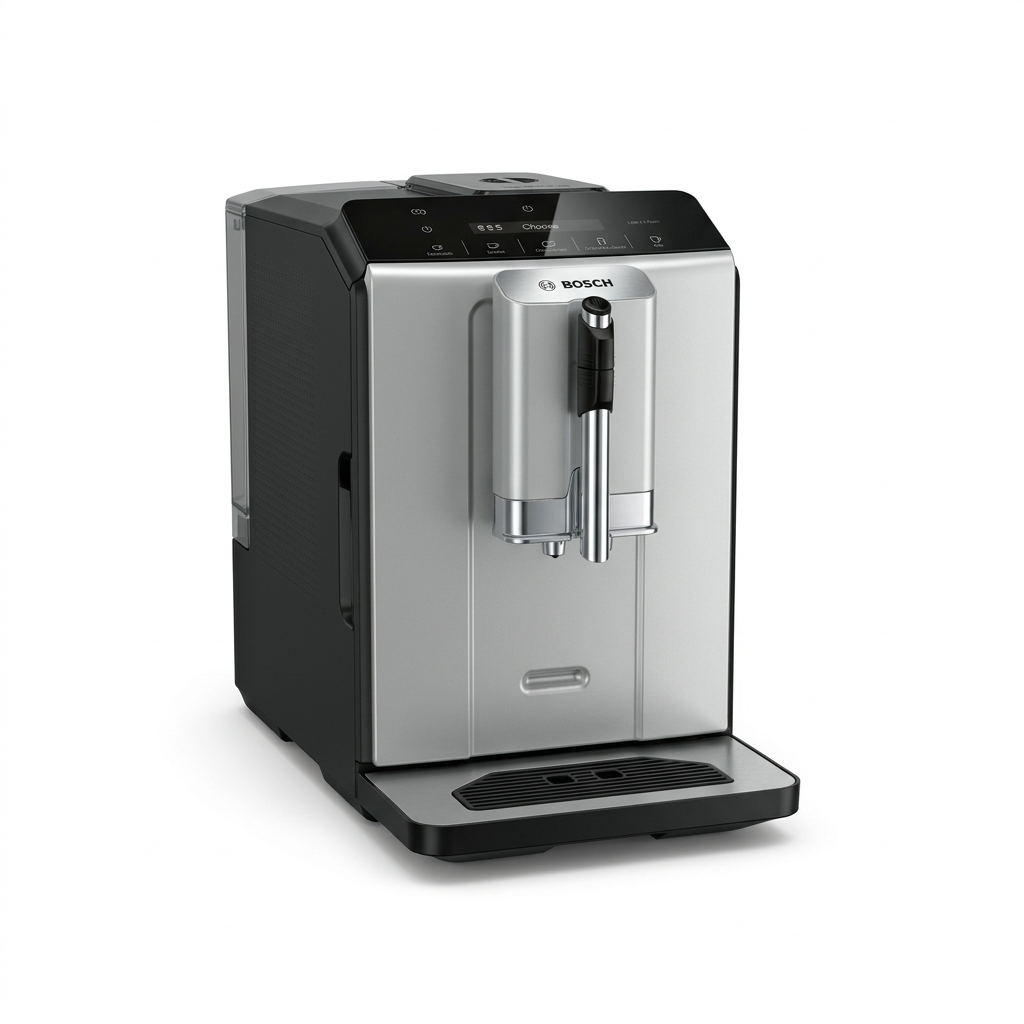
A compact one-touch machine with five drink buttons and a magnetic frother that foams milk right in your cup.
See Today’s Price →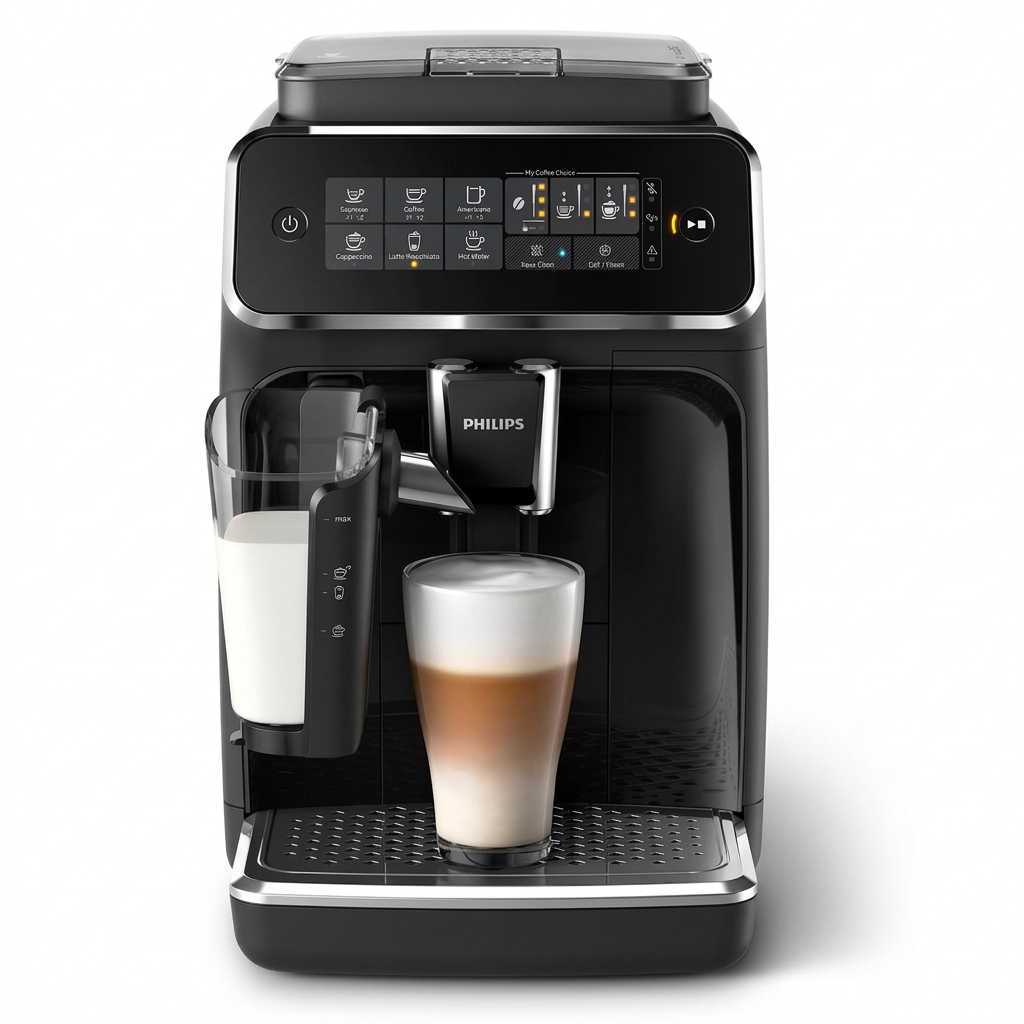
A one-touch machine with a tubeless milk carafe, 12 grind settings, three temperature settings and hot water.
Reveal Today’s DealBosch 300 vs Philips 3200 at a glance
- Buy the Philips 3200 if you want room to adjust your coffee, hot water for tea and an easy way to make several milk drinks.
- Buy the Bosch 300 if you make one or two drinks a day and want the fewest possible decisions before breakfast.
- The Bosch listing mentions a steam wand, but it is really an automatic in-cup frother. Neither machine lets you texture milk by hand.
- Drink temperature is the Bosch’s main weakness. Published cup readings came in cool, while the Philips at least gives you a setting to raise.
Head to head
The better result in each row is marked. Figures come from the manufacturers, the Amazon listings and our test notes; rows without a mark are a tie or a matter of taste.
| Spec | Bosch 300 Series | Philips 3200 Series |
|---|---|---|
| Drink buttons | Espresso, coffee, cappuccino, latte macchiato, milk foam | Espresso, coffee, Americano, cappuccino, latte macchiato |
| Hot water | No | Yes ✓ Best |
| Pre-ground chutefor decaf | No | Yes ✓ Best |
| Grind settings | 3 | 12 ✓ Best |
| Strength levels | 5 on our test unit ✓ Best | 3 |
| Temperature settings | No clear panel setting | 3 ✓ Best |
| Milk system | Automatic in-cup frother | LatteGo carafe, about 8.8 oz |
| Water tank | About 45 oz | About 61 oz ✓ Best |
| Tank access | Toward the back, top-up from above | Front ✓ Best |
| Bean hopper | 9 oz | About 9.7 oz ✓ Best |
| Max cup height | About 5.5 in | About 5.7 in ✓ Best |
| Depthunder-cabinet fit | 16.5 in ✓ Best | 17 in |
| Width | 9.75 in | 9.7 in |
| Weight | About 16 lb | About 17 lb |
| Scale protection | Filter helps, still descale | AquaClean, up to 5,000 cups ✓ Best |
| Pumprated maximum | 15 bar | 15 bar |
| Warranty | 2 years or 7,000 cups | 2 years |
| Amazon rating | 3.5 (62) | 4.0 (6,200+) |
| Rows won | 2 | 9 |
Bosch 300 vs Philips 3200 pros and cons
Bosch 300 Series
- Very simple one-touch controls
- No milk carafe or hoses to clean
- Magnetic frother pops off for rinsing
- Removable brew unit rinses under the tap
- Five strength levels on our test unit
- Slightly shallower body
- Tasting notes praise a soft, balanced espresso
- Only 3 grind settings
- No hot water function
- No pre-ground chute
- Espresso measured cool in one published test
- Small frother batches, so big lattes take two cycles
- Tank sits toward the back
- Small pool of Amazon ratings, with many one-star reviews
Philips 3200 Series
- 12 grind settings to work with
- Three temperature settings
- Hot water button and Americano
- Pre-ground chute for decaf
- LatteGo has two main parts and no tubes
- Front-access water tank
- AquaClean filter can delay descaling for up to 5,000 cups
- Espresso can taste mild, even on a fine grind
- Testers disagree on milk foam density
- Loud grinder and frother
- No milk control beyond volume
- Carafe must clip in securely
- No double option for milk drinks
- Plastic body
Who should buy which machine?
- One or two people with one to three drinks a day
- Anyone who hates storing a milk carafe
- People moving up from coffee pods
- Counters where every half inch of depth counts
- Fans of darker roasts who like bumping strength
- Households making several milk drinks
- Tea drinkers and Americano fans
- Homes with a decaf drinker
- People who like hot coffee
- Anyone who wants to fine-tune a new bag of beans
- Kitchens with low upper cabinets
Design, size and first impressions
Put these two next to each other and the first thing you notice is how similar their footprints are. The Bosch is about 9 3/4 inches wide, 14 7/8 inches tall and 16 1/2 inches deep, while the Philips is about 9.7 inches wide, 14.6 inches tall and 17 inches deep.
Neither is a large machine, and both will slip between a wall and a toaster. The half inch of extra depth on the Philips only matters on a shallow counter.
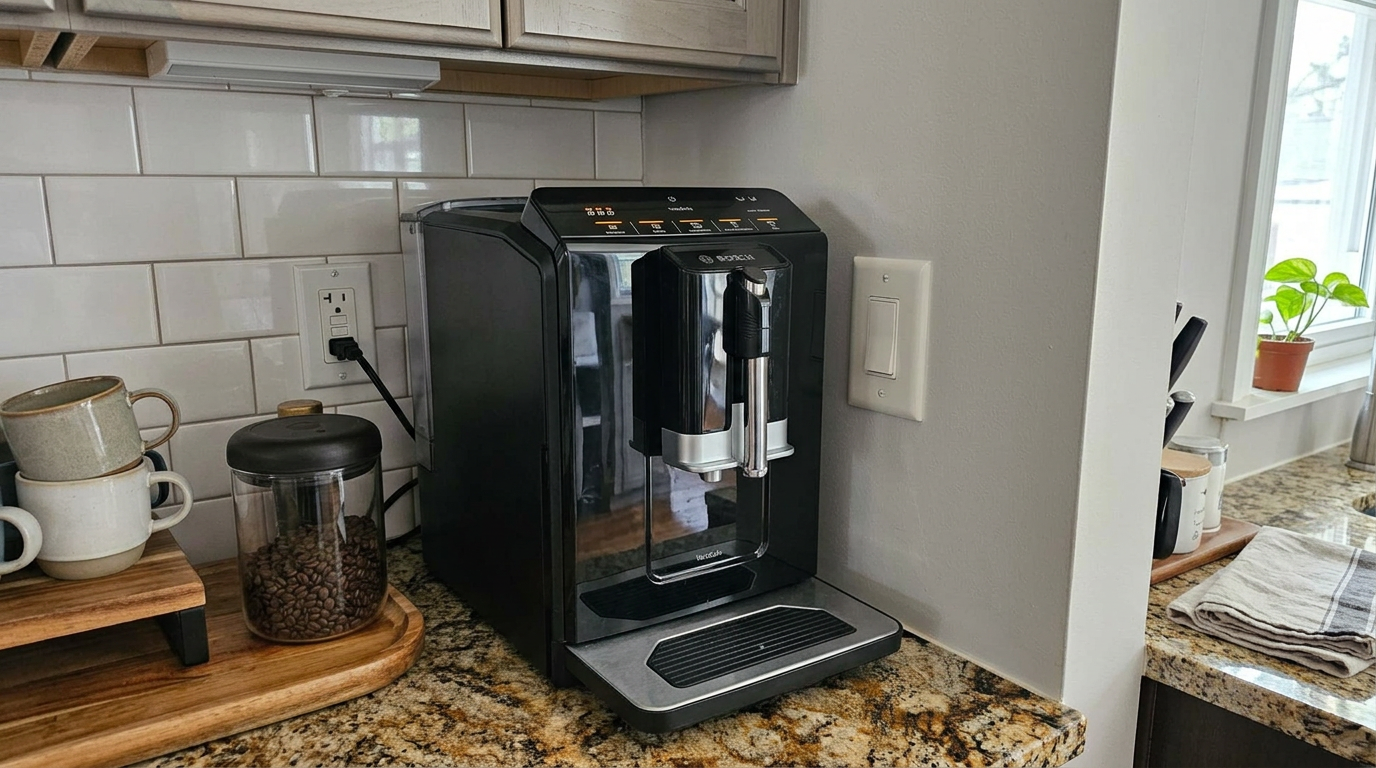
The Bosch is slim, simple and deeper than it is wide.
The bigger difference is how you reach the parts you use every day. The Bosch tank sits toward the back left, and you can top it up from above with a pitcher, but that means clearance under your cabinets.
The Philips tank slides out from the front. If your machine lives under low cabinets, I think that is one of the most useful small details in this comparison.
Both bodies are mostly plastic, so do not expect a heavy, all-metal feel from either. The Philips adds a metal drip grid and glossy trim, and the Bosch goes for a plainer panel with illuminated touch keys.
The Bosch weighs about 16 pounds and the Philips about 17, so either one is easy to slide forward when you need to get behind it.
Tip: Measure under your cabinets before you order. You want room for the height of the machine, plus enough clearance to lift the bean lid.
Espresso and coffee quality
I want to be clear about expectations first. Both of these machines aim for a good, repeatable cup at the push of a button, and neither gives you the control of a separate grinder and portafilter.
Both also have a 15-bar pump rating, which is a maximum figure and tells you very little about the shot in your cup. So I looked at what people actually tasted.
On the Bosch, one independent tester described a velvety espresso with a balanced, chocolatey flavor. That is a good result for a machine with so few controls.
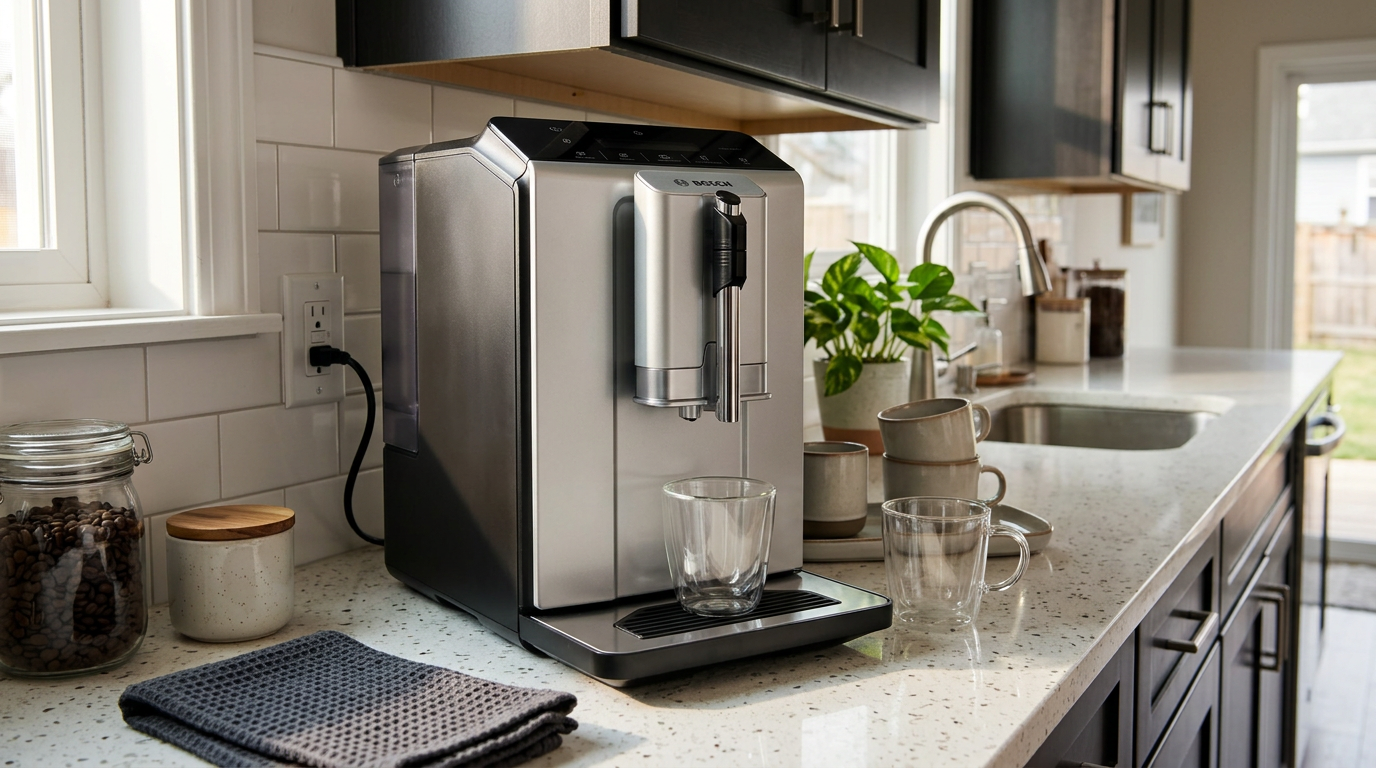
The Bosch keeps things simple, with five drink buttons on one panel.
The same tester preferred the machine’s longer coffee, because it came out fuller and at a more satisfying temperature. Our notes also found that the coffee button pours about 5 to 7 ounces, closer to an Americano than a mug of drip.
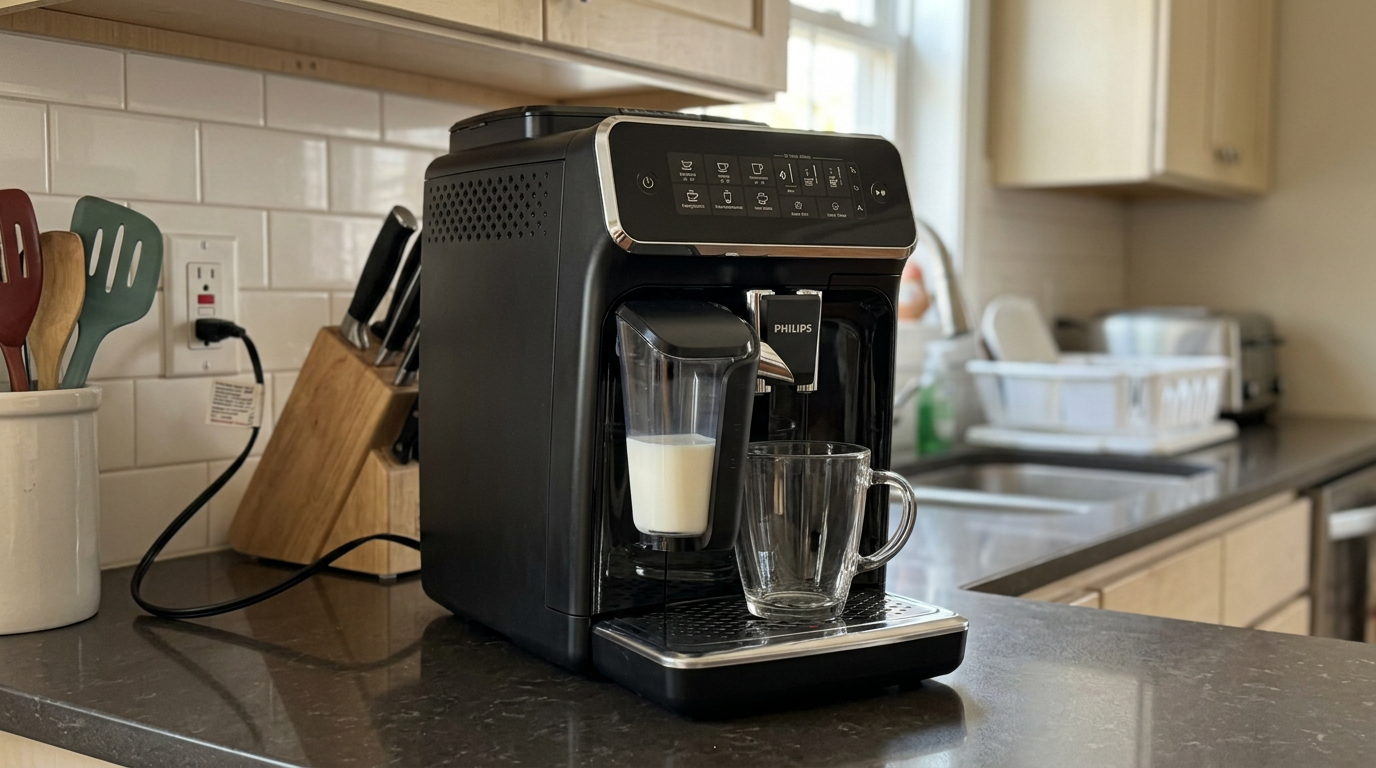
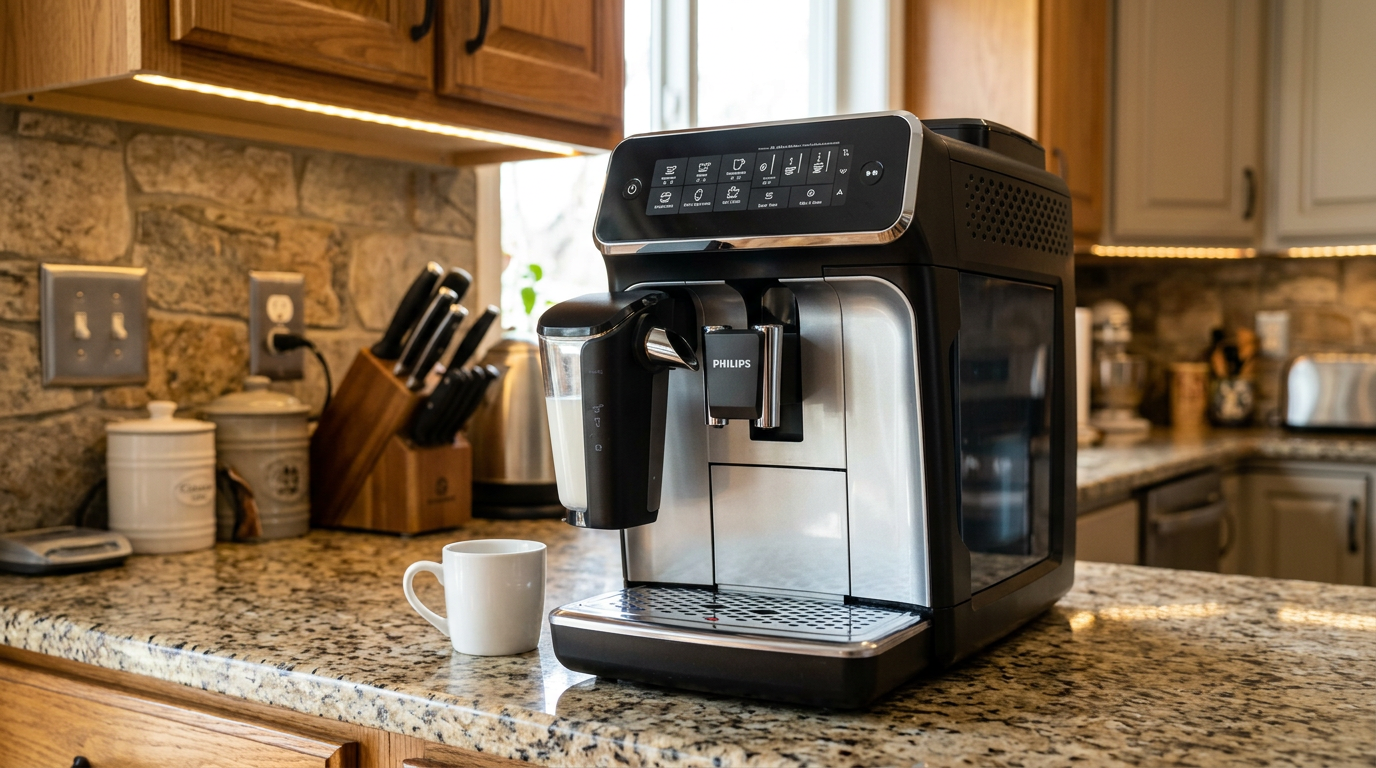
The Philips keeps its drink choices on one touch panel.
The Philips gets more mixed notes. A group of office testers liked the flavor and found it not overly bitter, but they also wanted more punch and a thicker crema, even on the finest grind.
Another tester who brewed with it at home described its shots as sweet and smooth, with a thin but present crema. My read is that the Philips is pleasant and easy to drink, and that it rewards a little grinder adjustment.
The Philips also has automatic pre-brewing, which wets the grounds before full extraction. It is a helpful feature for even flavor at this level, and I could not find it confirmed on the Bosch.
Strength is the complaint both machines share. One Bosch owner returned theirs because the coffee was never strong enough, and Philips owners sometimes add an extra shot to a morning cappuccino.
If you love intense coffee, start with a fresh medium-dark roast and the top strength level on either machine. Both handle medium and medium-dark beans best, and both struggle with very light roasts.
Bean tip: Avoid very oily or flavored beans in either machine. The coating builds up in the grinder and can leave a taste behind that is hard to remove.
Grinder, strength and settings
This is where the Philips pulls clearly ahead. Both machines use ceramic grinders, but the Philips gives you 12 steps and the Bosch only 3.
Three settings let you pick a rough zone and not much else. Twelve give you room to adjust when a new bag tastes sour or thin.
Temperature follows the same pattern. Philips gives you three settings, while one independent test found no way to change the Bosch’s brew temperature from its panel.
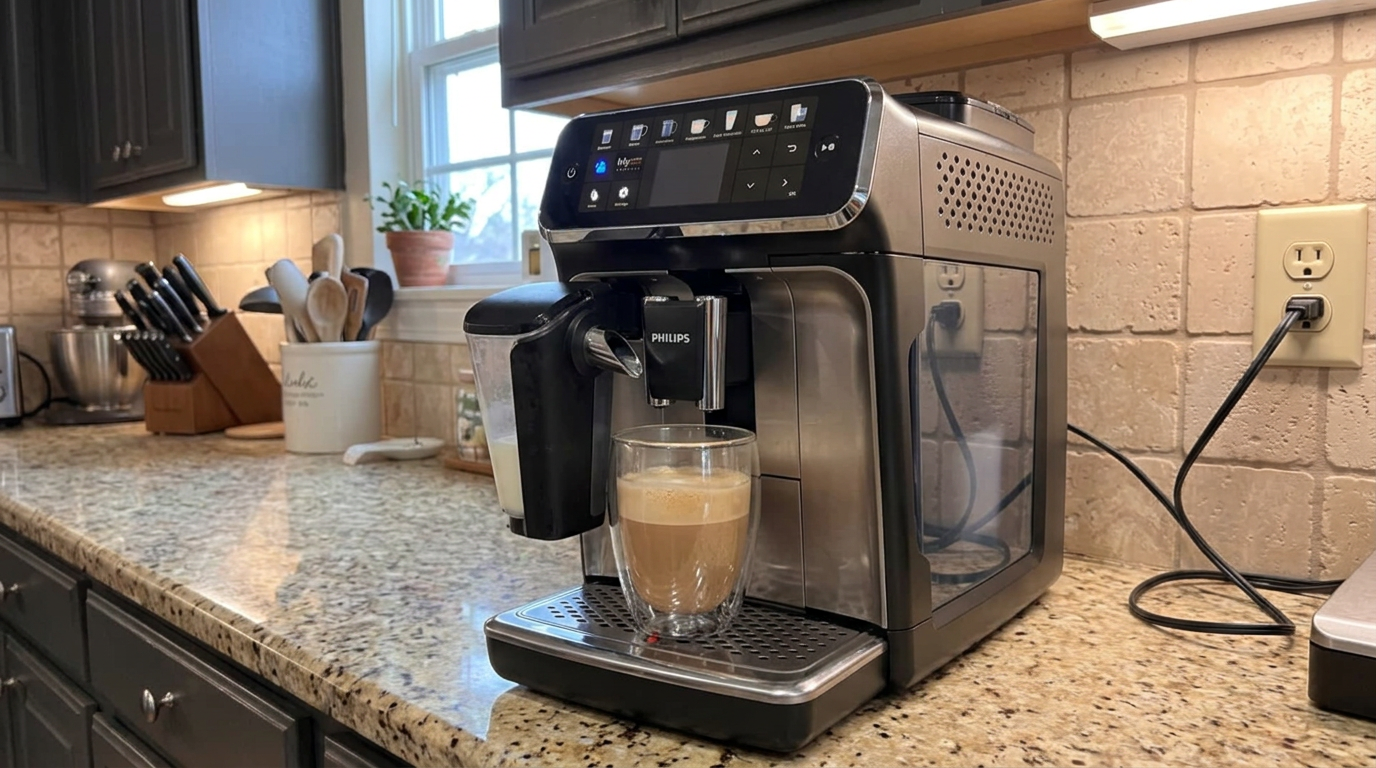
Twelve grind steps give the Philips more room to adjust.
Strength is the one place the Bosch can claim a win. Our black test unit offered five levels through the bean icon, against three on the Philips.
I would double-check this when your Bosch arrives, because Bosch’s published sheet for the black model lists only three. If five levels matter to you, confirm it while you can still send the machine back.
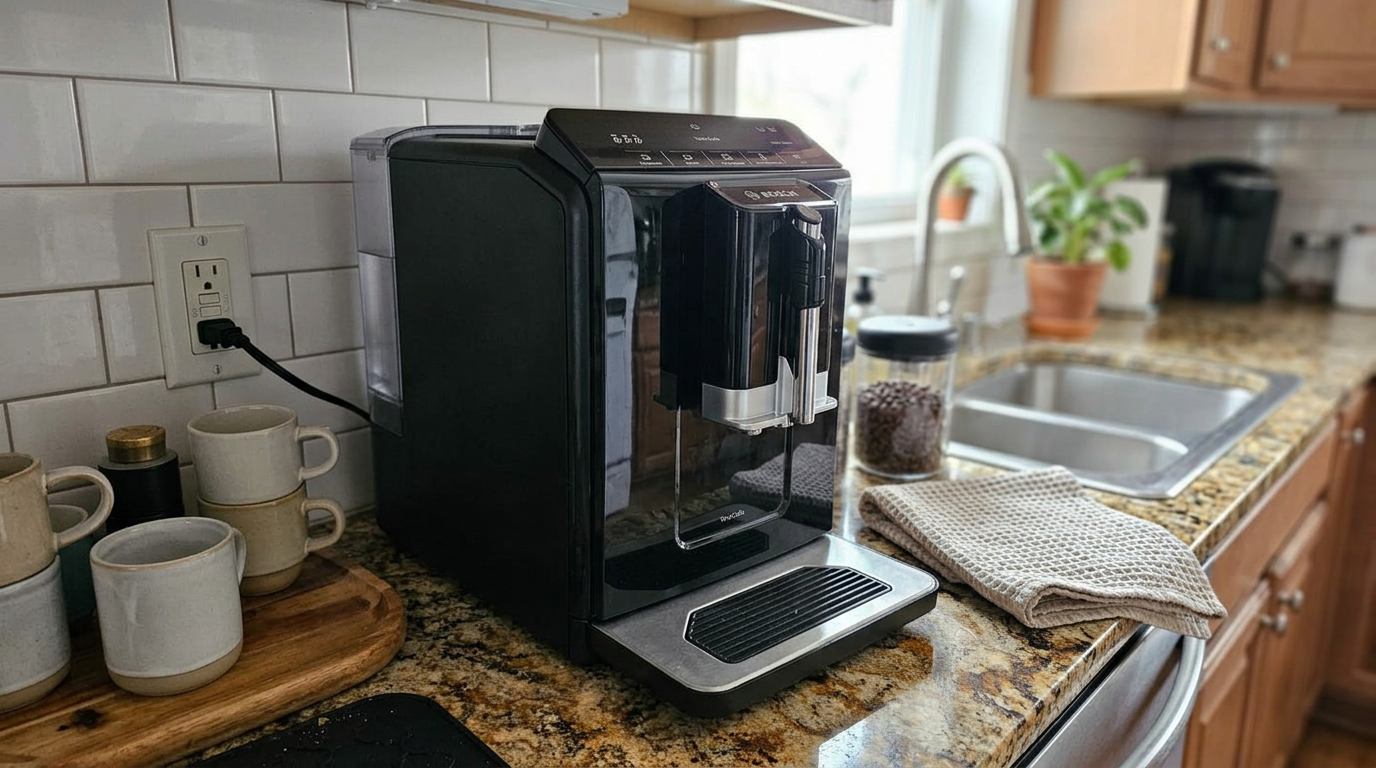
On the Bosch, strength does much of the tuning that the grinder cannot.
The Philips answers with a pre-ground chute, and the Bosch has none. If someone in your house drinks decaf in the afternoon, that small flap on top saves you from emptying the hopper.
Both let you save your own drink length, so your morning cup comes out the same each day. On the Bosch you hold the button down to set your pour, and on the Philips you adjust through its My Coffee Choice controls.
See How Much You’ll SaveGrinder tip: Only change the grind while the grinder is running, on either machine. Then give it two or three drinks before you judge the result.
Milk drinks: in-cup frother vs LatteGo
This is the choice that will shape your mornings most. The two machines both make one-touch cappuccinos, but they go about it in opposite ways.
First, a warning about the Bosch listing. It mentions a steam wand, but what you actually get is an automatic in-cup frother, so you do not steam milk in a pitcher or control the texture by hand.
You pour cold milk into your cup, set it under the nozzle and press a button. The machine foams the milk and then adds coffee on top.
I like how little there is to clean. There is no carafe and no milk line, and the frother is held on by a magnet, so it pops off for a rinse.
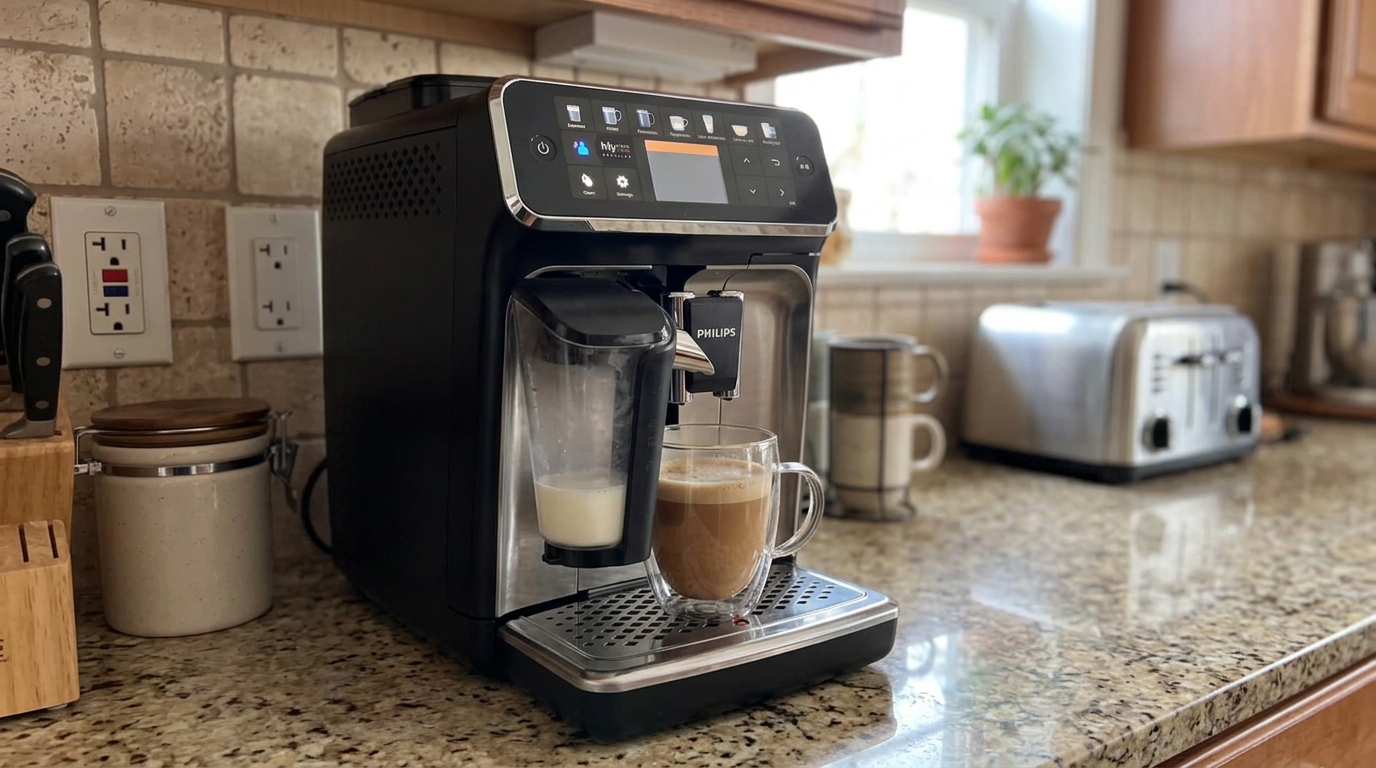
LatteGo keeps the milk in a small clear carafe at the front.
The limit is batch size. One owner found it handles about 3 ounces of cold milk at a time, which grows to about 7 ounces of foam, and a large latte means running a second cycle.
The Philips uses LatteGo, a small clip-on carafe that holds about 8.8 ounces. Milk and air are whipped in a little chamber and poured straight into your cup, with no tubes anywhere.
For more than one milk drink in a row, I think this is the better system. You fill it once, press a button for each cup and put the carafe in the fridge afterward with its storage lid.
Foam quality is not a clear win for either. Our notes on the Bosch rate its foam as fine for a home cappuccino, and one tester found its cappuccino a little too frothy but well textured.
On the Philips, one tester found the foam dense and creamy with 2% milk, while an office panel called it only okay. Whole and low-fat dairy gave the best results, and barista-style plant milks are the safest non-dairy choice.
Neither machine will give you the glossy microfoam you need for latte art. If that is your goal, you want a manual steam wand, and neither of these has one.
Milk tip: On the Bosch, fill your cup no more than about a third with milk so the foam has room to rise. On the Philips, press the carafe until it is firmly clipped in, because a loose fit makes a mess.
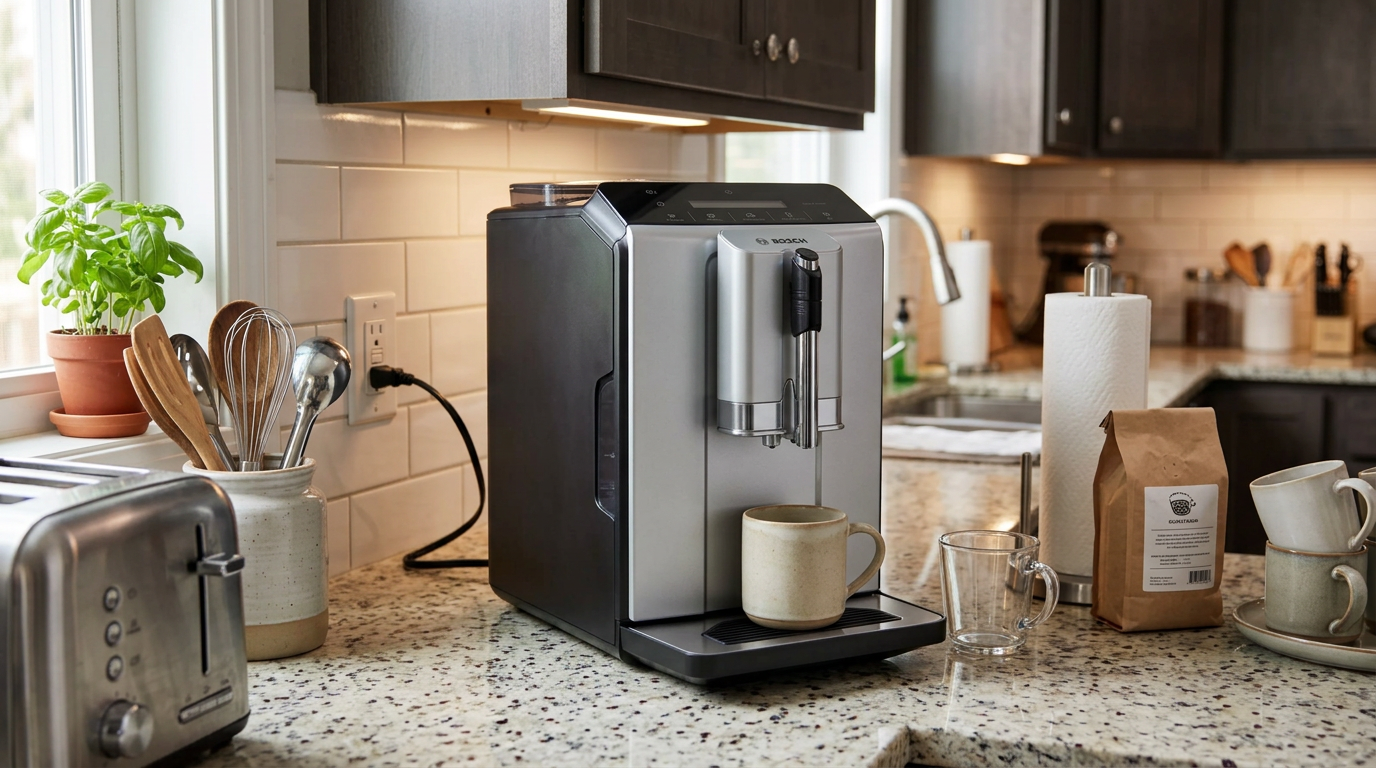
With the Bosch, the milk goes straight into your cup.
Drink temperature
If you like your coffee hot, read this section twice. Temperature is the single complaint most likely to disappoint a Bosch buyer.
In one independent test, a straight espresso from the Bosch came out at about 127°F, which that tester found simply too cool. Preheating cups and pulling two shots in a row did not fix it.
The milk drinks did better, with a cappuccino reaching about 149°F. Owners tell the same story in their reviews, and one warms the mug in the microwave for about 30 seconds before brewing.
Philips says the 3200 keeps its brew water between 194°F and 208°F, and you get three temperature settings to choose from. I could not find a published cup reading to set directly against the Bosch, so I would not claim a measured win.
Owners of the Philips do mention temperature control now and then. Still, a setting you can raise beats having no obvious setting at all.
Heat tip: Fill your mug with hot water before you press start, then empty it right before you brew. On a small drink, a cold cup steals a surprising amount of heat.
Daily use and convenience
Both machines are quick from cold. A published review timed the Philips at about 25 seconds to heat, and Bosch owners report about a minute to start, about a minute for an espresso and about two minutes for a latte.
Controls are simple on both. The Philips uses a touch panel with one icon for each drink, and the Bosch uses illuminated touch keys and a small display.
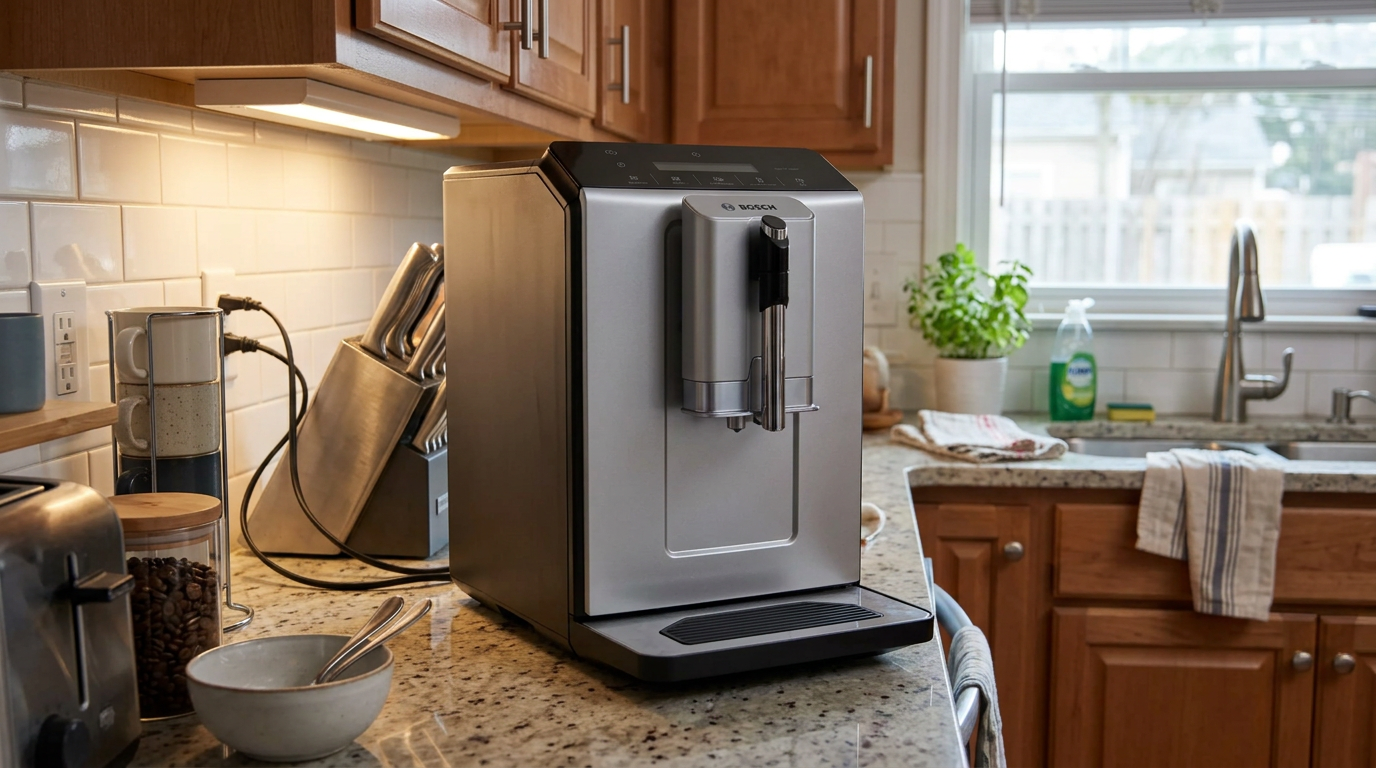
Check where your outlet is, because the cord on either machine is about 39 inches.
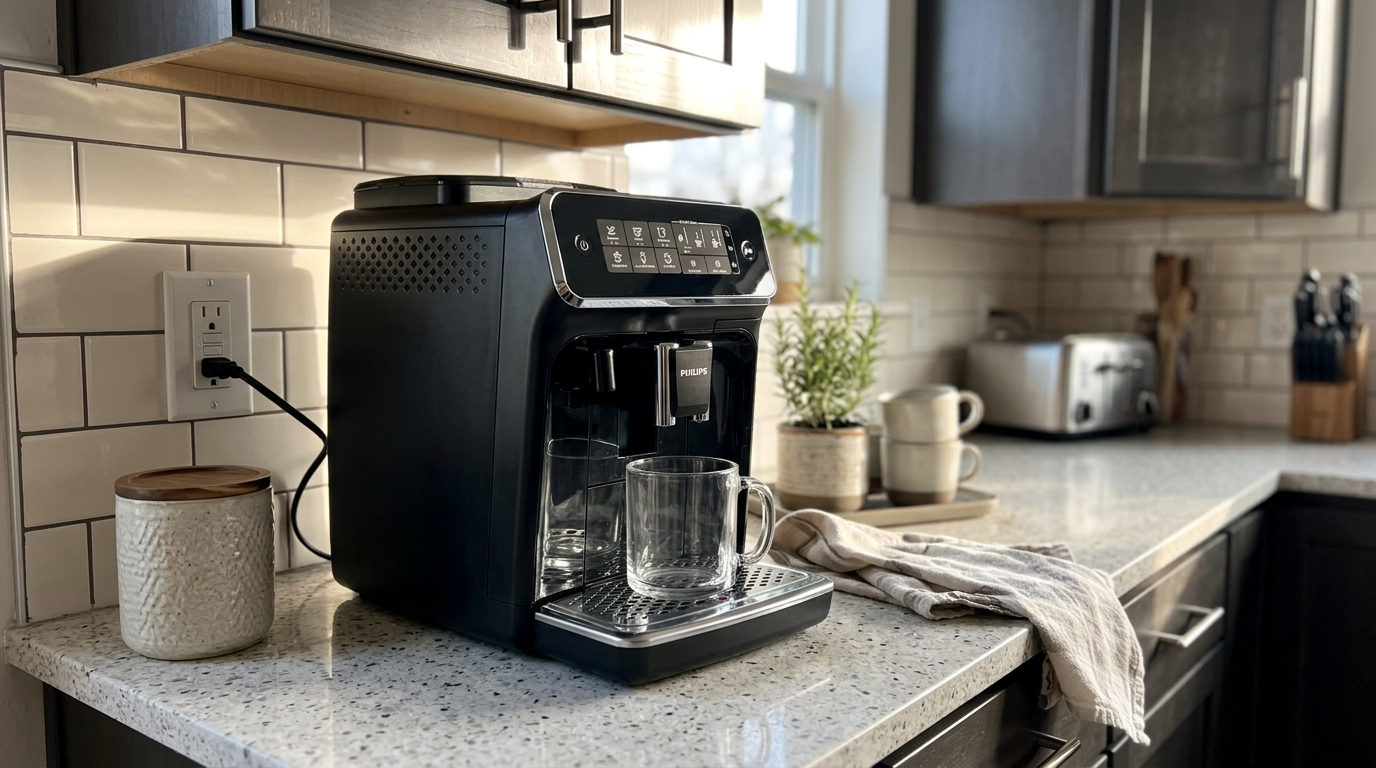
The Philips water tank comes out from the front.
The Philips simply covers more situations. Its hot water button handles tea and Americanos, and the Bosch has no hot water function, so you will still need a kettle.
Capacity leans the same way. The Philips holds about 61 ounces of water and about 9.7 ounces of beans, against about 45 ounces and 9 ounces on the Bosch.
Both can brew two espressos or coffees at once, but check your Bosch unit, because this also differs by model. Neither makes two milk drinks at the same time.
Both spouts slide up and down, with about 5.5 inches of clearance on the Bosch and about 5.7 on the Philips. A normal mug fits under either, but a tall travel mug will not.
Morning tip: Set your cup aside during the rinse cycles on either machine. Both flush water through the spout at startup, and you do not want it in your coffee.
Noise
Neither of these is a quiet machine, and I would not choose between them on noise alone. The grinder is the loud part on both, and it only runs for a few seconds per drink.
One tester measured the Bosch grinder at about 73 dB and compared its sound to a lawnmower going over a branch. Our notes and owner reports are kinder, calling it about what you would expect from a coffee grinder.
A tester who has used many automatic machines called the Philips very loud, pointing at both its grinder and milk frothing. Noise also appears among the common owner complaints, though a few buyers call it quieter than their previous machine.
Quiet tip: Put a thin rubber mat under either machine. It will not silence the grinder, but it takes the edge off the vibration through your counter.
Cleaning and upkeep
Both of these machines are easy to look after by automatic standards, and that is a real selling point. Each has a removable brew unit you can rinse under the tap, so you can actually see the part that handles your coffee.
On the Bosch, the brew unit comes out through a front door. The drip tray, tray cover, grounds container and milk nozzle are dishwasher safe, and the Calc’n Clean program walks you through cleaning and descaling.
The catch is size. The tray and grounds bin fill quickly, and one owner found the brew unit awkward to remove, which is worth knowing if you have limited hand strength.
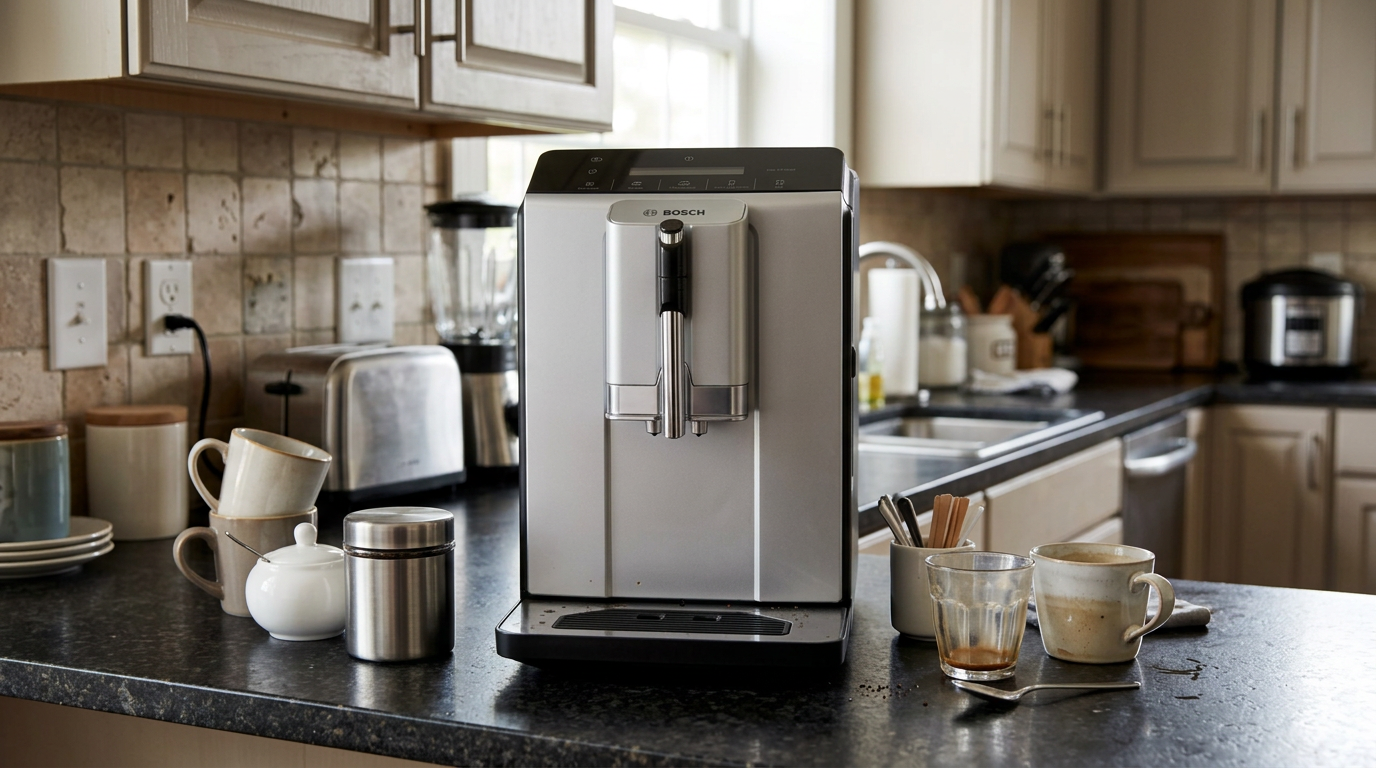
The Bosch has no milk parts to store between drinks.
On the Philips, you remove the water tank and open a side door to reach the brew group. The waste container holds about 12 servings, and the LatteGo comes apart into two main pieces that go in the dishwasher.
The AquaClean filter is the long-term advantage. Philips rates it for up to 5,000 cups without descaling, as long as you replace the filter when the machine asks.
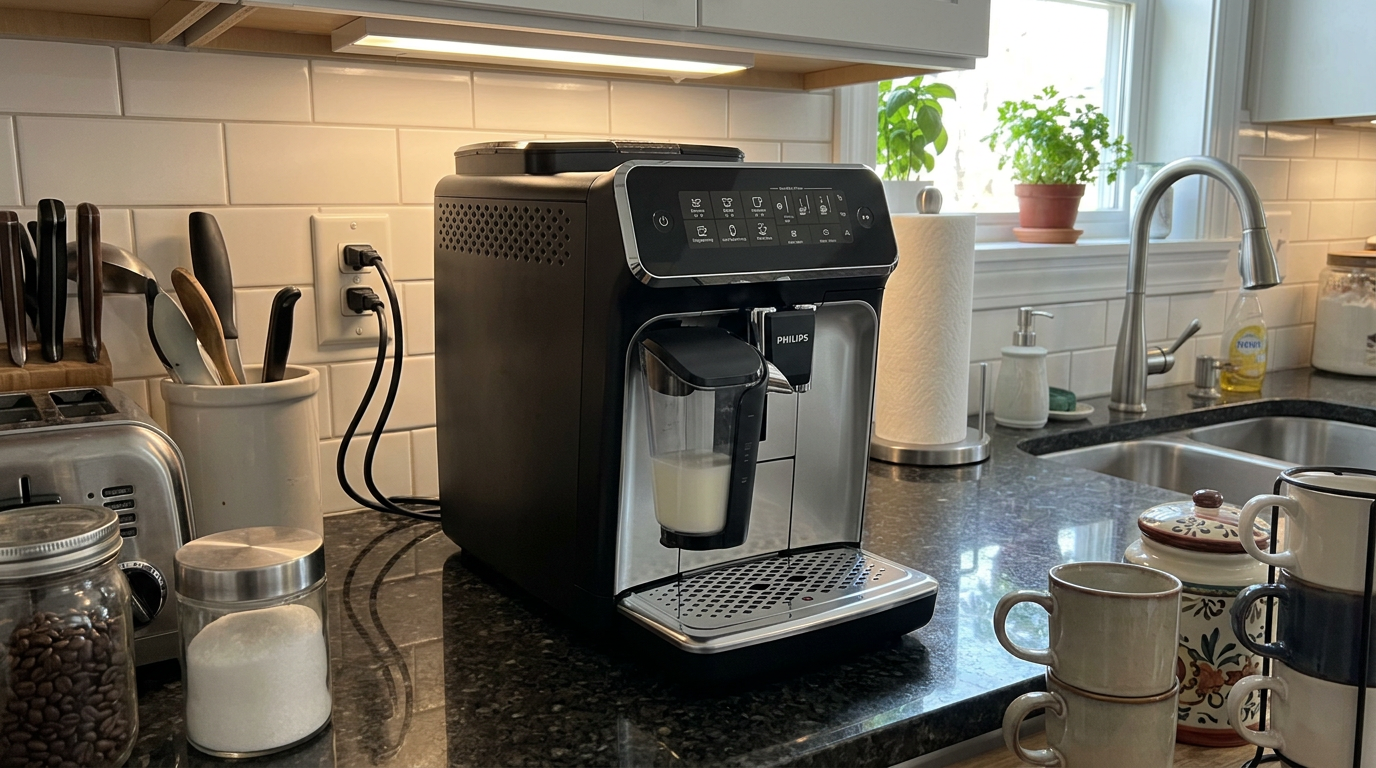
Keeping either machine close to the sink makes rinsing parts easier.
Bosch includes a filter too, but it does not replace descaling. In both cases, set your water hardness correctly on day one, because that decides how often you are prompted.
Upkeep tip: Do not wait for the float on the Bosch drip tray. It shows the tray is filling, but it will not stop the machine, and a full tray can overflow.
Find Out the Price TodayThe numbers side by side
A few specs explain most of what separates these machines. In the bars below, each pair is scaled against the larger of the two values.
Grind settings
Water tank (ounces)
Strength levels
More settings do not automatically mean better coffee. They do mean that you have more ways to fix a cup you do not like, and that is why the Philips comes out ahead for me.
What owners say
The Philips 3200 holds a 4.0-star average from more than 6,200 Amazon ratings, a big sample built up over several years. The Bosch 300 sits at 3.5 stars from just 62 ratings, so treat its average with more caution.
Happy owners keep returning to the taste, the simple controls and how easy the frother is to rinse.
Unhappy owners mention machines that did not work from the box and touch keys that did not respond.
Temperature comes up again and again, along with a smaller number of complaints about strength.
Owners love how little effort the milk system takes, and several call it the easiest part of the machine.
Ease of use and coffee quality are the two most repeated reasons people recommend it.
Noise is a common gripe, and some owners describe frothing faults that needed warranty support.
Reviews cannot tell you exactly how often a problem happens. They do show you what to test during your return window.
Which one should you buy?
After weighing everything, I think it comes down to how much you want to adjust. If you just want a coffee and do not plan to touch a setting, the two are closer than the table suggests.
Once you want hotter drinks, tea, decaf or a fix for a sour bag of beans, the Philips is the one that can help.
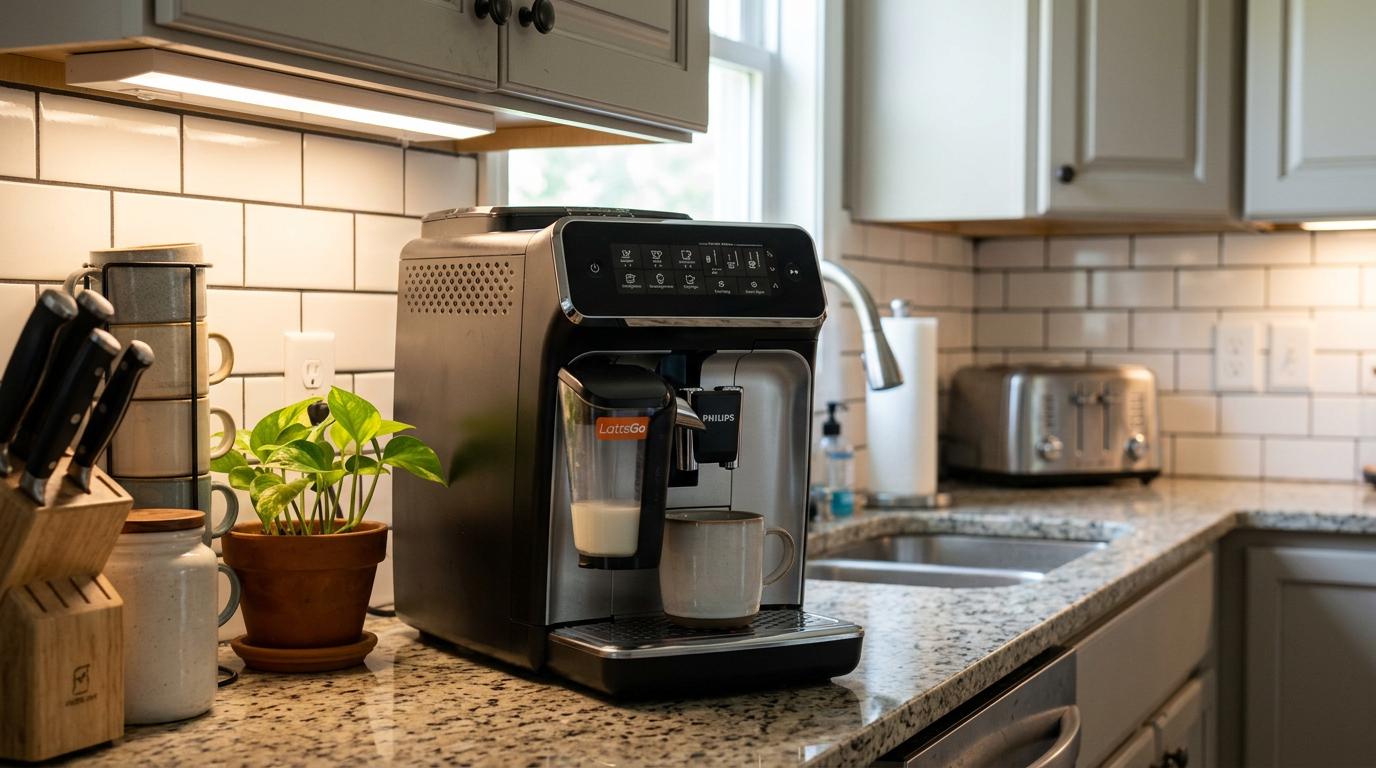
For most homes, the Philips 3200 is the more complete machine.
- You want more control over grind and temperature
- You make several milk drinks at a time
- You drink tea, Americanos or decaf
- Your machine sits under low cabinets
- You want the quietest possible machine
- You love very intense espresso
- You would rather not store a carafe
- You make one to three drinks a day
- You want no carafe at all
- You like a simple panel with few choices
- Your counter is shallow
- You like very hot espresso
- You need hot water or decaf
- You expected a real steam wand
Pick the Philips for more settings, hot water and easier back-to-back milk drinks. Pick the Bosch for a simple in-cup routine in a small household.
My pick is the Philips 3200 Series. It gives you a grinder you can really adjust, temperature settings, hot water and a pre-ground chute, along with a tubeless milk system that handles several drinks with ease.
The Bosch 300 Series is still a pleasant, simple machine for a small household, especially if you like the idea of frothing right in your cup. Just test the temperature during your return window.
Whichever you choose, buy fresh medium-roast beans, preheat your cup and keep up with descaling.
Bosch 300 vs Philips 3200 specifications
From the Amazon listings, manufacturer specifications and published tests. Checked November 9, 2026.
| Bosch 300 Series | Philips 3200 Series | |
|---|---|---|
| Model | TIU20109 (black) | EP3241/54 |
| Type | Fully automatic bean-to-cup | Fully automatic bean-to-cup |
| Drinks | Espresso, coffee, cappuccino, latte macchiato, milk foam | Espresso, coffee, Americano, cappuccino, latte macchiato, plus hot water |
| Controls | LCD touch panel with illuminated keys | Touch display |
| Grinder | Ceramic, 3 settings | Ceramic, 12 settings |
| Strength levels | 5 on our test unit (Bosch sheet lists 3) | 3 |
| Temperature settings | No clear panel setting | 3 |
| Pre-ground chute | No | Yes |
| Hot water | No | Yes |
| Milk system | Milk Express in-cup frother | LatteGo carafe, about 8.8 oz |
| Water tank | About 45 oz | About 61 oz, front access |
| Bean hopper | 9 oz | About 9.7 oz |
| Cup height | Up to about 5.5 in | About 3.3 to 5.7 in |
| Pump | 15 bar | 15 bar |
| Dimensions | 14 7/8 x 9 3/4 x 16 1/2 in | 14.6 x 9.7 x 17 in |
| Weight | About 16 lb | About 17 lb |
| Cord | About 39 in | About 39 in |
| Water filter | Fits inside the tank | AquaClean, up to 5,000 cups without descaling |
| Warranty | 2 years or 7,000 cups | 2 years |
| Amazon rating | 3.5 (62 ratings) | 4.0 (6,200+ ratings) |
How I researched and compared them
This is a researched comparison. I did not run these two machines side by side in one kitchen, so I have tried to be careful about what the evidence supports.
For the Bosch, I used our hands-on notes on the black TIU20109, along with Bosch’s own documents. For the Philips, I relied on the Philips spec sheets, published tests and owner reports.
I then read through owner feedback on both machines, looking for problems that repeat. I treat single owner reports as warning signs and not as proof.
- Drinks: espresso, coffee, milk foam and temperature.
- Control: grind, strength, temperature and drink length.
- Everyday use: tank access, capacity, speed and noise.
- Ownership: cleaning, descaling, reliability and warranty.
Bosch 300 vs Philips 3200 FAQ
Is the Philips 3200 better than the Bosch 300?
For most homes, yes. It has more grind settings, adjustable temperature, hot water and a pre-ground chute. The Bosch is a good fit if you want a very simple machine and like frothing in your cup.
Does the Bosch 300 have a real steam wand?
No. Despite the wording on the listing, it uses an automatic in-cup frother. You pour milk into your cup and the machine foams it for you.
Does the Philips 3200 have a steam wand?
Not this version. It uses the LatteGo carafe, which froths automatically with no tubes.
Which one makes hotter coffee?
I could not find matching cup readings for both. The Philips has three temperature settings, while the Bosch measured cool on espresso in one published test.
Can I use decaf or pre-ground coffee?
On the Philips, yes, through the pre-ground chute. The Bosch has no chute, so you would need to run decaf beans through the hopper.
Can either one make hot water for tea?
Only the Philips has a hot water button.
Which is easier to clean?
Both are easy. The Bosch has less to wash after a milk drink, while the Philips carafe is quick and dishwasher safe. Both have rinseable brew units.
Can they use oat or almond milk?
Yes, but results vary. Look for barista-style versions, which foam more reliably on both machines.
Can I make latte art with either?
No. Neither machine has a manual wand, so you cannot texture milk by hand.
Do they need descaling?
Yes. The Philips AquaClean filter can hold it off for up to 5,000 cups if you change the filter when asked. The Bosch filter helps, but you will still descale.


- Amazon product listing for the Bosch 300 Series (ASIN B0DGWL13JM), November 2026
- Amazon product listing for the Philips 3200 Series (ASIN B07VFY4MXM), November 2026
- Bosch and Philips manufacturer specifications
- BrasQ hands-on notes on the black Bosch TIU20109
- Independent published tests of both machines
- Verified owner reviews of both models
- Comparison published.