Philips 3200 Series review: one-touch lattes with a few trade-offs
The Philips 3200 Series grinds, brews and froths at one touch, and its two-piece milk system is about as easy to clean as they come. Espresso purists will want more punch, and it's not a quiet machine, but for everyday lattes it makes a lot of sense.
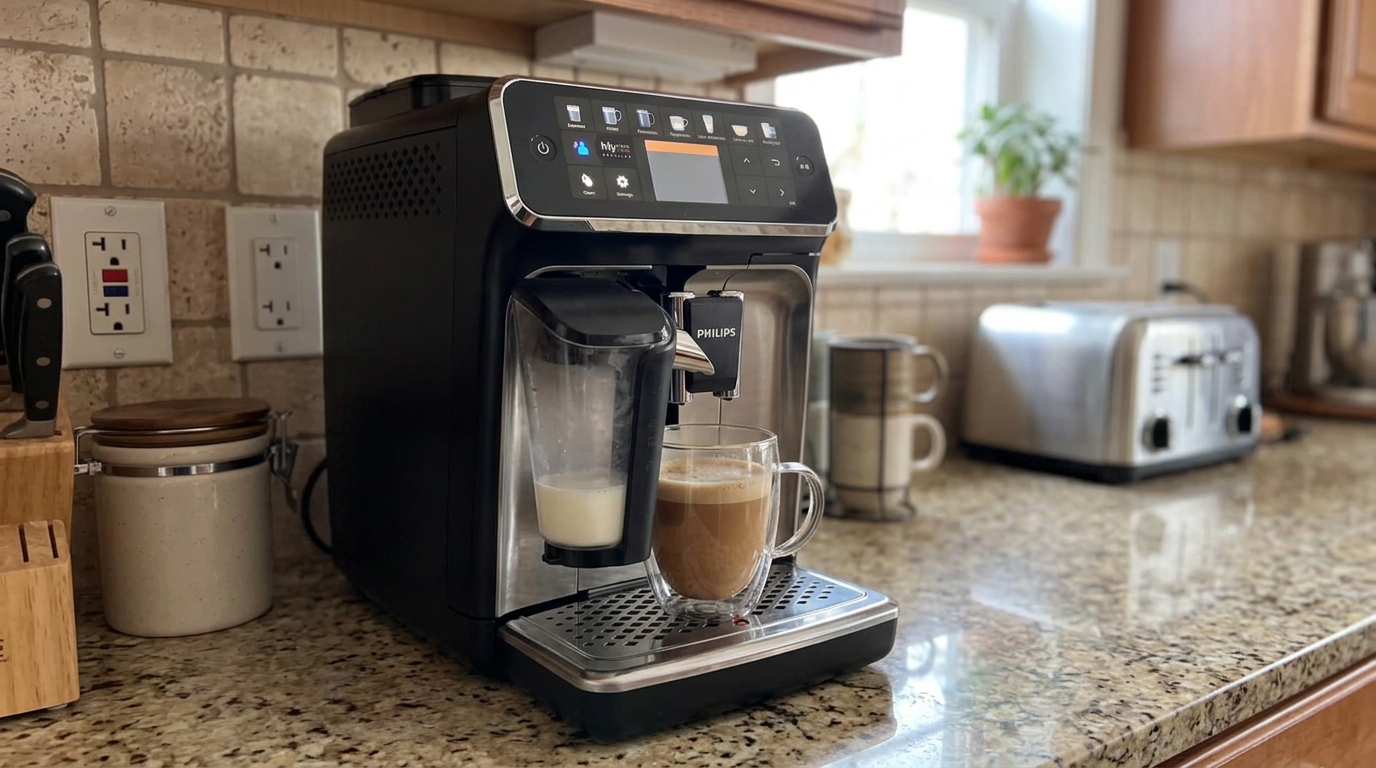
In this review
Yes, if most of your coffee has milk in it. After working through the specifications, published test results and a long trail of owner feedback, I think the Philips 3200 is one of the most sensible ways to get one-touch cappuccinos at home. Its LatteGo milk system removes the chore that makes people give up on these machines. Just don't buy it for intense, syrupy straight espresso, because that isn't what its small dose does best.
Philips 3200 Series at a glance
Philips 3200 Series pros and cons
- Two-piece LatteGo has no tubes and rinses clean fast
- Simple touch controls with one-press milk drinks
- Removable brew group and easy front access to the tank and tray
- Espresso is milder than a manual shot
- Grinder and milk frothing are noticeably loud
- No milk-only option, and no saved user profiles
Who should buy the Philips 3200 Series?
- Latte and cappuccino drinkers who want zero barista skills
- Busy households that hate cleaning milk tubes
- Kitchens with limited counter width
- Espresso lovers chasing thick crema and heavy body
- Early risers in open-plan homes with light sleepers
- People who want many drinks and personal profiles
Why the Philips 3200 stands out
Most people don't stop using a bean-to-cup machine because the coffee gets worse.
They stop because cleaning the milk parts turns into a job.
That's the problem the Philips 3200 Series is built to solve, and it's why this machine keeps coming up in owner discussions years after launch.
When I compared what owners say with what formal tests report, the same picture kept appearing.
People love how easy it is, and they forgive it a lot because of that.
Reviewers are tougher on the espresso, and they're right to be.
Long-term owners tend to mention the same two things: how quickly they got into a routine, and how much noise it makes at 7 a.m.
That split tells you nearly everything you need to know before buying.
This is a convenience machine first and an espresso machine second.
If that order suits you, there's a lot to like.
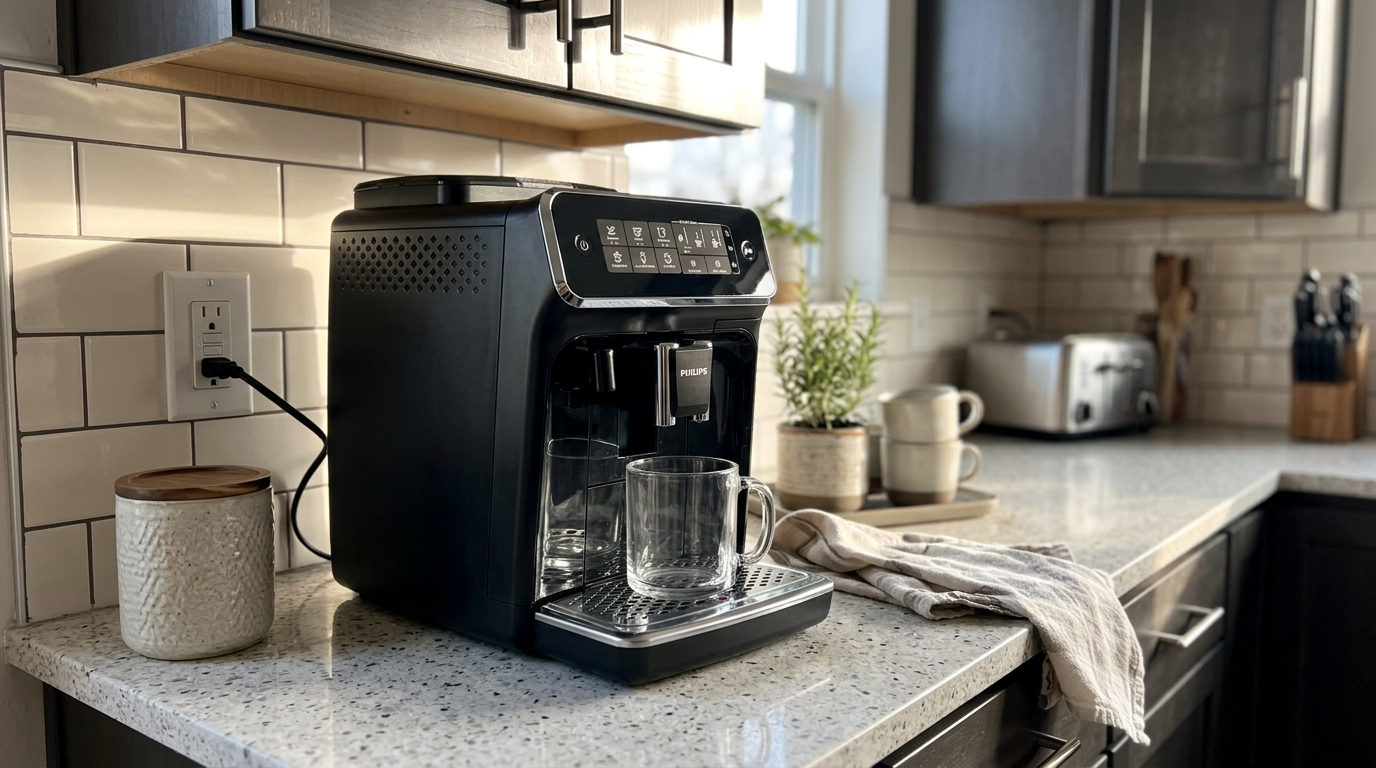
At just under 10 inches wide, the 3200 leaves more counter space free than most machines in this class.
What the Philips 3200 Series actually is
The 3200 Series is a fully automatic espresso machine, also called a super-automatic.
It grinds whole beans, tamps them, brews, and textures milk, all inside one body.
You fill the hopper and the water tank, press a drink, and wait.
The model on Amazon is the LatteGo version, which is sold in the US as the EP3241/54.
Under the hood there's a 15-bar pump and a 1,500-watt heating system.
Philips quotes a brewing range of 194 to 208°F.
The grinder uses ceramic flat burrs with 12 settings, and a dial inside the hopper changes them.
There's also a small chute on top for pre-ground coffee, which is handy if one person in the house drinks decaf.
The controls are touch-sensitive icons with LED level indicators.
It isn't a full screen, even though some listings describe it that way.
That's a good thing if you dislike menus, since everything you need sits on the front panel.
Our tip: Change the grinder dial only while the grinder is running, because turning it while idle can damage the mechanism.
Philips 3200 drinks, sizes and strength
The menu is short and sensible: espresso, coffee, americano, cappuccino and latte macchiato, plus hot water.
Each drink has three strength levels and three volume levels.
Milk drinks add a separate three-level control for how much milk you get.
The machine remembers your last choice for each drink, so a regular order only takes one tap.
The third volume level on each drink can be programmed, so you can stop the pour where you like.
The factory sizes are worth seeing, since they vary more than the buttons suggest.
Those sizes cover a demitasse, a normal mug and a tall glass.
The spout slides up and down, with clearance from about 3.3 to 5.7 inches, so most mugs fit.
Very tall travel tumblers may not, so measure yours first.
A double shot is available for black drinks by pressing the button twice.
Instead of one big dose, the machine runs two full grind-and-brew cycles back to back.
That's slower, but it keeps the extraction sensible and gives you noticeably more caffeine.
Milk drinks don't get a double cup mode, so you'd make two lattes one at a time.
Our tip: For a stronger latte, brew a double espresso first and add milk separately, since milk drinks have no double-shot mode.
The LatteGo milk system
LatteGo is the reason to buy this machine.
It's a clear milk container that clips onto the front, with no hoses going in or out.
Steam passes through a narrow channel, pulls the milk up, and spins it through a small chamber before it pours into your cup.
Philips makes a big deal of having just two parts and no tubes, and I think that claim holds up.
Philips says it cleans in as little as 15 seconds under the tap, and both parts can go in the dishwasher.
Owner reports back that up: a quick rinse is the routine most people settle into.
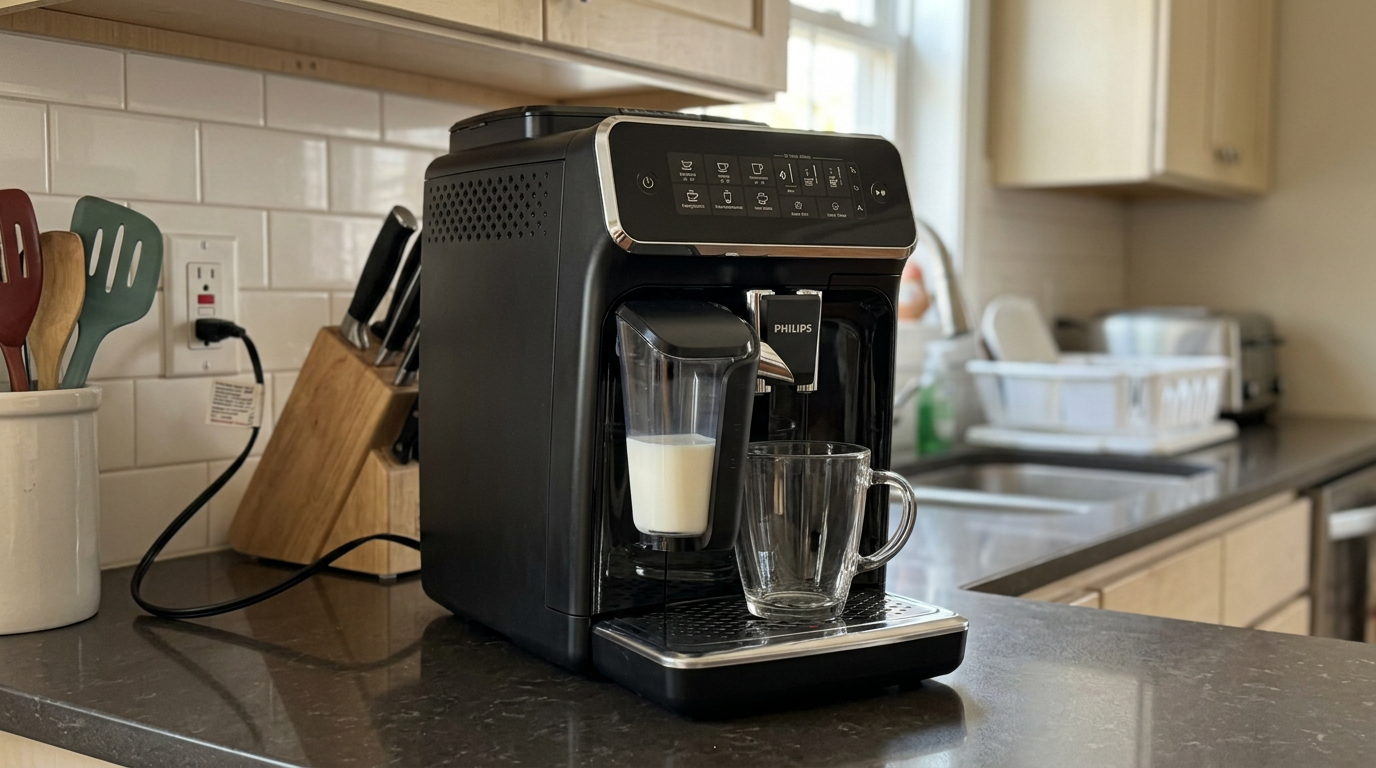
The clear LatteGo container holds about 8.8 fluid ounces and sits right at the front.
How good is the foam?
This is where opinions diverge.
Some testers describe the foam as dense and satisfying, while others find it thinner and less velvety than they wanted.
What they agree on is that it's foam rather than true latte-art microfoam.
You won't pour a rosetta, but you will get a warm, frothy drink that most people would be happy with at breakfast.
Published temperature readings for milk drinks sit around 158°F, which is close to what a café would serve.
You can't change the foam density itself, only the amount of milk, so what comes out is what you get.
Whole milk gives the most reliable foam.
Oat milk can work well too, especially barista-style versions, but thinner plant milks tend to be less consistent.
The limits of the design
There's one catch with a tube-free system.
Because the machine can't flush milk out of it automatically, you do need to rinse it after use.
Leaving it for a day isn't a good idea, especially in a warm kitchen.
It's a very small job, but it's one you can't skip.
The other limit surprised me: the machine has no milk-only button.
If your kids want a hot frothy milk, a standard drink won't give it to them without grinding beans.
The container's small size also means you'll refill it for a big latte.
Make sure it's clipped in firmly, because a loose fit can leave you with a mess on the drip tray.
Our tip: Keep the LatteGo in the fridge with its storage lid on if you'll use leftover milk within the day.
Espresso quality: where the 3200 is honest about its limits
Let's get to the part most glowing reviews gloss over.
The Philips 3200 doesn't make a heavy, intense espresso at its factory settings.
The reason is mostly simple arithmetic.
The brew chamber takes a small dose, and the factory espresso pours more liquid than a traditional shot.
Published measurements put the dose at about a quarter ounce on the lowest strength and a little under 0.4 ounce at the highest.
A café double usually starts with around 0.65 to 0.7 ounce of coffee.
A straight comparison needs a caveat, since the 3200's double runs two separate cycles.
Even so, the result is lighter and less syrupy than a good manual shot.
The brew ratio is closer to a lungo, at roughly 3:1 to 4:1, instead of the richer 2:1 many espresso lovers prefer.
The flavor is smooth and easy to drink, with little harsh bitterness.
Crema tends to be on the thin side, and one group of testers wrote that even the finest grind left them adding an extra shot to their cappuccino.
On the other hand, testers who used darker beans at the finest setting came away with a bold, full-bodied cup.
So your beans matter a great deal here.
Under milk, the mildness is much less of a problem.
A latte doesn't need a monster shot to taste good, and that's why I rate this machine higher as a milk coffee maker than as an espresso maker.
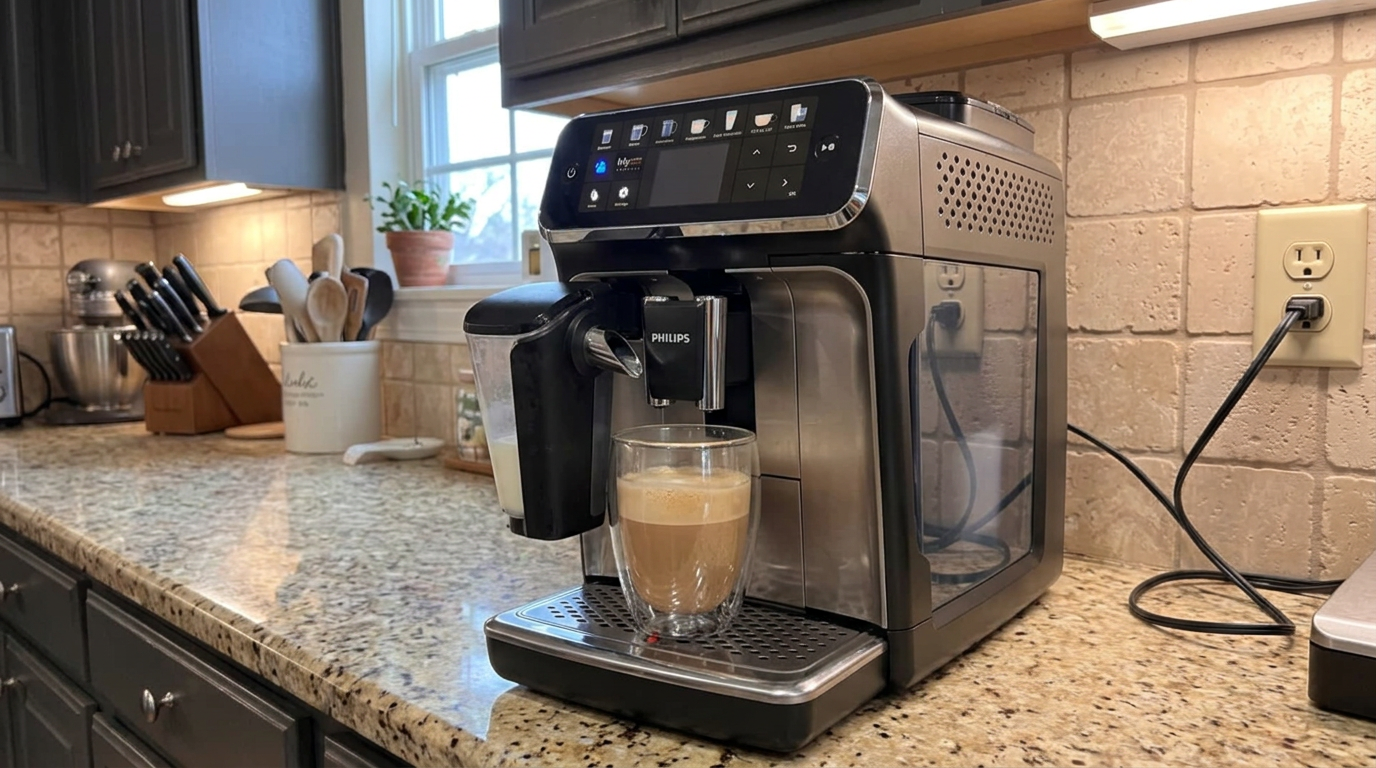
Milk drinks are where the 3200 looks and tastes most at home.
Our tip: Choose a medium or medium-dark roast with a dry surface, because very oily beans can clog the grinder chute over time.
The best Philips 3200 settings for stronger coffee
You can close some of the gap without spending anything extra.
These are the changes that come up again and again among experienced owners and testers.
- Grind finer
Move the dial a few steps finer while the grinder is running. Many users land near the finer end, around setting 3 or 4, and some go all the way down.
- Raise the temperature
With the machine in standby, press and hold the coffee volume button for about 3 seconds, select the top level with the same button, then press start to save it.
- Max strength, less water
Set strength to the top level and volume to the lowest or middle level. Less water through the same puck gives you a denser shot.
- Give it a few cups
Grind changes take a couple of drinks to show up in the cup, so don't judge a new setting by the first one.
One word of caution on the temperature: the setting applies to the whole machine rather than to one drink.
If you make it hotter for espresso, your other drinks will be hotter too.
I'd also treat the finest grind as something to approach gradually.
Grinding too fine can slow the flow and strain the machine with some beans.
Our tip: Run one hot-water rinse into your cup before brewing, since a warm mug keeps a small drink noticeably hotter.
How loud is the Philips 3200?
Noise is the most common complaint in owner reviews, and it's fair.
The ceramic burrs have a reputation for being quiet, but in this machine the grinder is plainly audible.
The frothing stage is usually the loudest part of a milk drink.
Published measurements vary with the room and the microphone, so I'd treat these as a rough guide.
For context, normal conversation is often placed around 60 decibels.
So you won't need ear protection, but you won't sneak a cappuccino past a sleeping toddler either.
The noise comes in stages and doesn't last long.
One owner timed a cappuccino at about a minute and a half, after a warmup of roughly 45 seconds.
The aroma seal around the hopper lid helps a little, but it won't fix this.
If noise is high on your list, the newer 3300 Series is worth a look, because Philips built it with SilentBrew noise reduction.
Cleaning and maintenance
Cleaning is where the 3200 earns its score.
Everything you'd want to remove actually comes out.
The water tank, drip tray and grounds container are all accessed from the front, so you don't need to move the machine around.
The brew group slides out from a door on the side, after you lift out the tank.
Being able to rinse it yourself is a real advantage, since you can see that it's clean.
The downside is that it's one more job you have to remember.
| How often | Task |
|---|---|
| After milk drinks | Rinse both LatteGo parts |
| When prompted | Empty the drip tray and grounds container |
| Weekly | Rinse the brew group under warm water, no soap, and air dry |
| Weekly | Brush out the pre-ground coffee chute |
| Monthly | Grease the brew group and run a coffee oil tablet cycle |
| When prompted | Replace the AquaClean filter or descale |
The included AquaClean filter sits in the water tank and reduces the minerals that cause scale.
Philips says that if you replace it whenever the machine asks, you can get up to 5,000 cups without descaling.
That figure relies on using eight filters in total, so each one covers roughly 625 cups.
If you'd rather skip filters, you'll just descale more often using the guided program.
The drip tray and LatteGo are dishwasher safe.
Don't put the brew group through the dishwasher, and don't use dish soap on it.
Our tip: Test your water with the included strip and enter the result, because the descaling reminders depend on it.
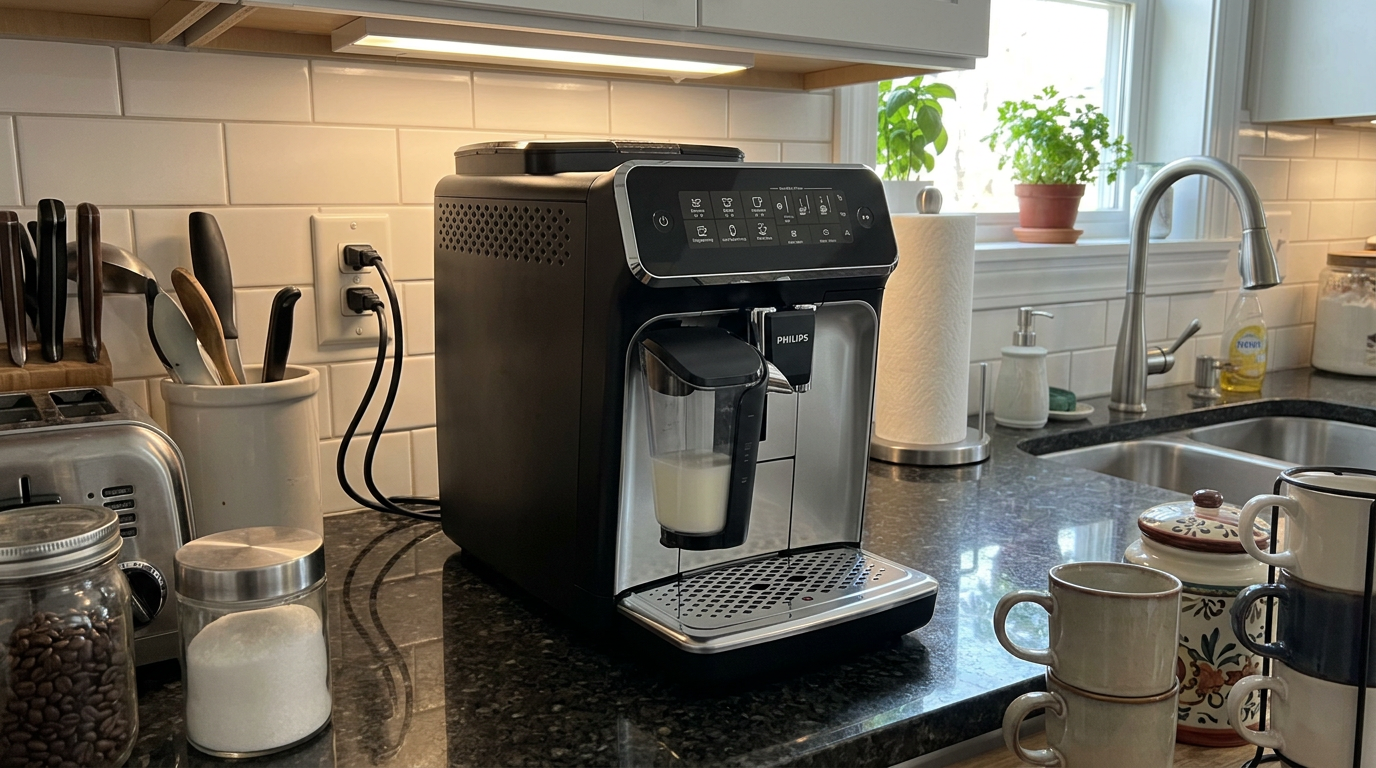
Keep it near a sink if you can, since the milk parts and brew group need regular rinsing.
Which coffee beans work best in the 3200
With so little control over the brew itself, your choice of beans does a lot of the work on this machine.
A gentle light roast can taste thin or sour when it passes through a small puck this quickly.
A medium to medium-dark blend usually gives the Philips 3200 more to work with, particularly chocolate and nutty flavors that hold up under milk.
Blends containing some robusta are also worth trying.
They tend to produce a thicker crema and a stronger hit, which offsets the machine's lighter dose.
I'd avoid very dark beans with a shiny, oily surface.
Those oils can stick inside the grinder path and bean chute, and a clog is far more annoying than a slightly less dramatic espresso.
Flavored beans are also best kept out of the hopper, since their coatings can linger and transfer to your next bag.
If you drink decaf only occasionally, use the pre-ground chute rather than emptying the hopper.
Add just one level scoop, because overfilling can leave you with a watery drink or a mess in the brew chamber.
What daily use looks like
It helps to picture the routine before you buy one of these.
In the morning, you switch the machine on and let it heat and rinse itself.
Owners commonly report a warmup of well under a minute, after which you can start your first drink.
For a cappuccino, you fill the LatteGo, clip it in, press the button and walk away for a minute or two.
Philips pours the milk first and adds the espresso after it, so the drink can look more like a latte than a traditional cappuccino.
It tastes fine, but it's a detail coffee traditionalists tend to notice.
When you're done, you pull off the LatteGo, split the two pieces and rinse them.
Then the machine runs a short rinse of its own on shutdown, so keep a cup under the spout or be ready to empty the tray.
That rinse water is the reason the drip tray fills up faster than you might expect.
None of it is hard, but it is a routine, and a machine like this rewards people who actually stick to it.
Common Philips 3200 problems and easy fixes
Most complaints about this machine trace back to a handful of causes.
Before assuming something is broken, it's worth working through this list.
| Problem | Likely cause | What to try |
|---|---|---|
| Weak or watery coffee | Coarse grind or too much water | Grind finer, raise strength, lower volume |
| Drinks not hot enough | Cold cup or low temperature setting | Warm the cup and raise the temperature level |
| Thin milk foam | Low-fat or warm milk | Use cold whole milk or a barista-style plant milk |
| Milk on the drip tray | LatteGo not fully seated | Reattach it and check that it clicks into place |
| Brew group will not reseat | Group is out of position | Check the manual’s reset steps before forcing it |
| Warning light keeps showing | Tray, grounds bin or door issue | Reseat each removable part fully |
If a problem survives all of that, contact support rather than opening up the machine yourself.
Forcing a stuck brew group is one of the easier ways to turn a small problem into a costly one.
Design and setup
The 3200 measures about 9.7 inches wide, 14.6 inches high and 17 inches deep.
The narrow body is the good news.
The depth is less friendly, so measure your counter from the wall to the front edge before ordering.
At 17.6 pounds it's manageable to pull forward, but you'll want a clear path to the side door for the brew group.
Leave a few inches above it too, since you'll be opening the hopper lid and pouring in beans.
The body is mostly plastic with a metal drip tray cover.
Reviewers tend to think it looks and feels better than its materials suggest, though the water tank is a weaker point.
At 61 fluid ounces, the tank is decent, but heavy latte households will fill it often.
The bean hopper holds about 9.7 ounces, and the grounds container takes about 12 used pucks.
Setup is simple: rinse the parts, fill the tank, add beans, run the first cycle, then install the filter.
Expect to throw away the first few drinks while the grinder settles in.
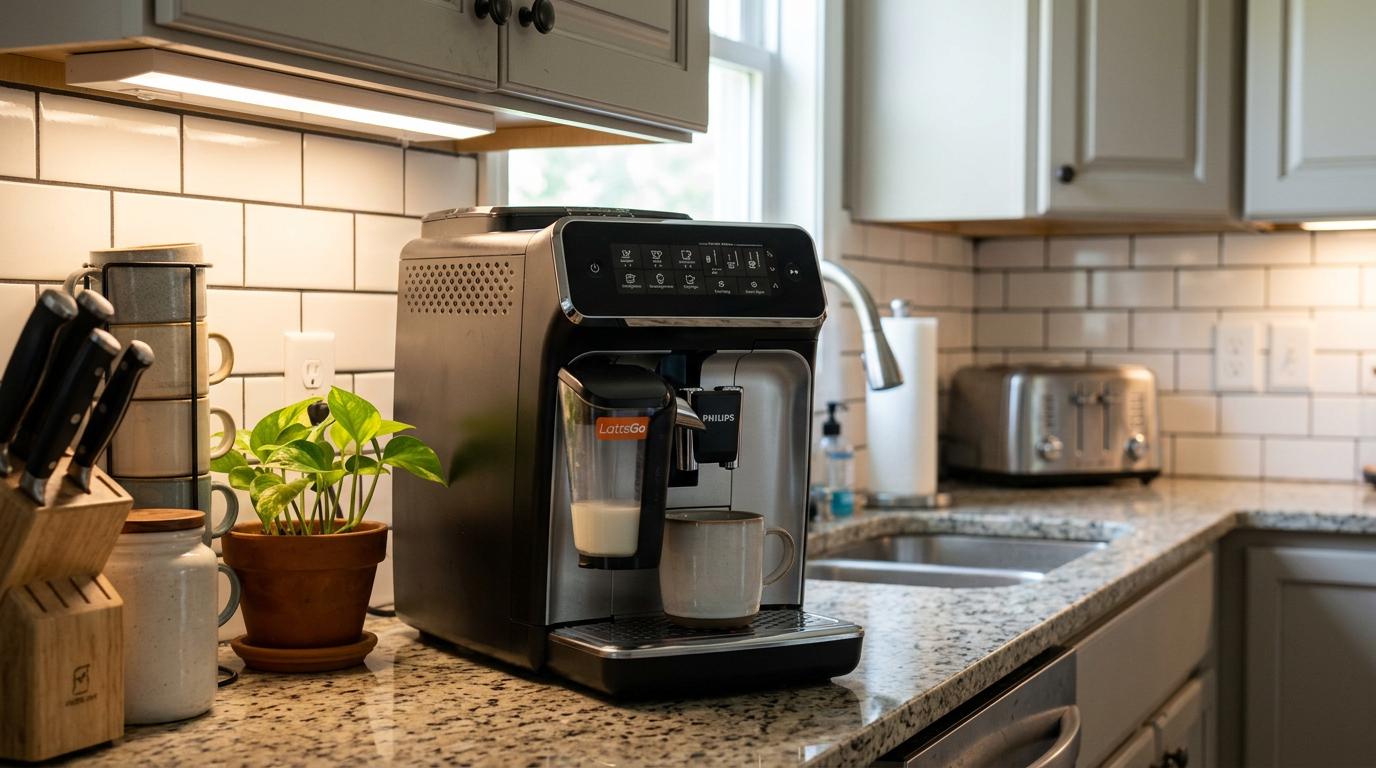
Allow room to reach the side door, where the brew group comes out.
Is the Philips 3200 Series worth the money?
It depends on what you'd otherwise be doing.
If you buy milk drinks at a café a few times a week, the 3200 can pay for itself over time, especially when you factor in beans bought in bulk.
If you drink one black coffee a day, a simpler machine would serve you better.
What you're paying for here is mainly LatteGo and the extra drink options.
The grinder, pump and tank are shared with cheaper machines in the range.
So I'd only pay for the 3200 over a base model if you'll really use the milk system.
Long-term cost is modest but real.
You'll buy beans, filters or descaler, grease and cleaning tablets.
Durability reports are mixed, as they are for most super-automatics.
Plenty of owners report years of daily use, while a minority report failures, so buy from a seller with an easy return policy.
Philips 3200 vs other Philips models
The Philips range is confusing because the numbers look similar and the machines are closely related.
Here's how I'd separate the models that matter.
| 2200 Series | 3200 Series | 3300 Series | 5500 Series | |
|---|---|---|---|---|
| Milk system | Manual frother | LatteGo | LatteGo | LatteGo |
| One-touch drinks | 2 | 5 plus hot water | 5 plus hot water | 20 |
| Controls | Touch icons | Touch icons | Colored touch icons | Color display |
| Quiet tech | No | No | SilentBrew | SilentBrew |
| User profiles | No | No | No | 4 plus guest |
| Best for | Black coffee | Everyday lattes | Quieter mornings | Big variety |
| Shop | Check price on Amazon | See Today’s Price | Reveal Today’s Deal | Is It On Sale? Check Now |
The 2200 Series shares the same core ceramic grinder and pump.
It's the one to get if you drink mostly black coffee and don't mind frothing milk yourself.
The 3300 Series is the most direct upgrade, with the same LatteGo approach, iced coffee presets and SilentBrew.
If you're noise-sensitive, I'd look closely at that one first.
The 5500 Series makes sense for households with lots of different tastes, since it adds a color display, many more recipes and saved profiles.
For a couple who mainly drink lattes and cappuccinos, those extras are hard to justify.
That leaves the 3200 as the straightforward choice in the middle.
Philips 3200 Series specifications
From Philips product documentation and the Amazon listing.
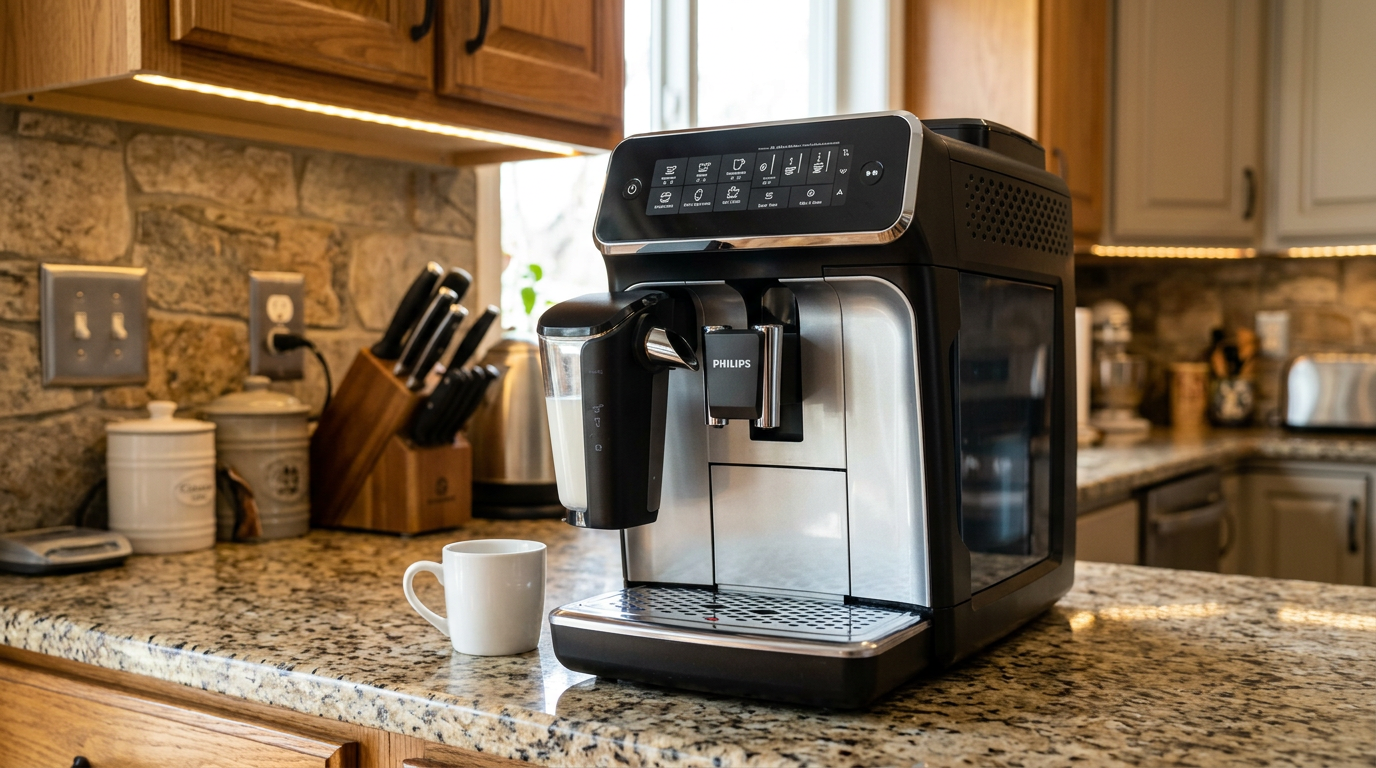
The machine is narrow but deep, so check the distance from your wall to the counter edge.
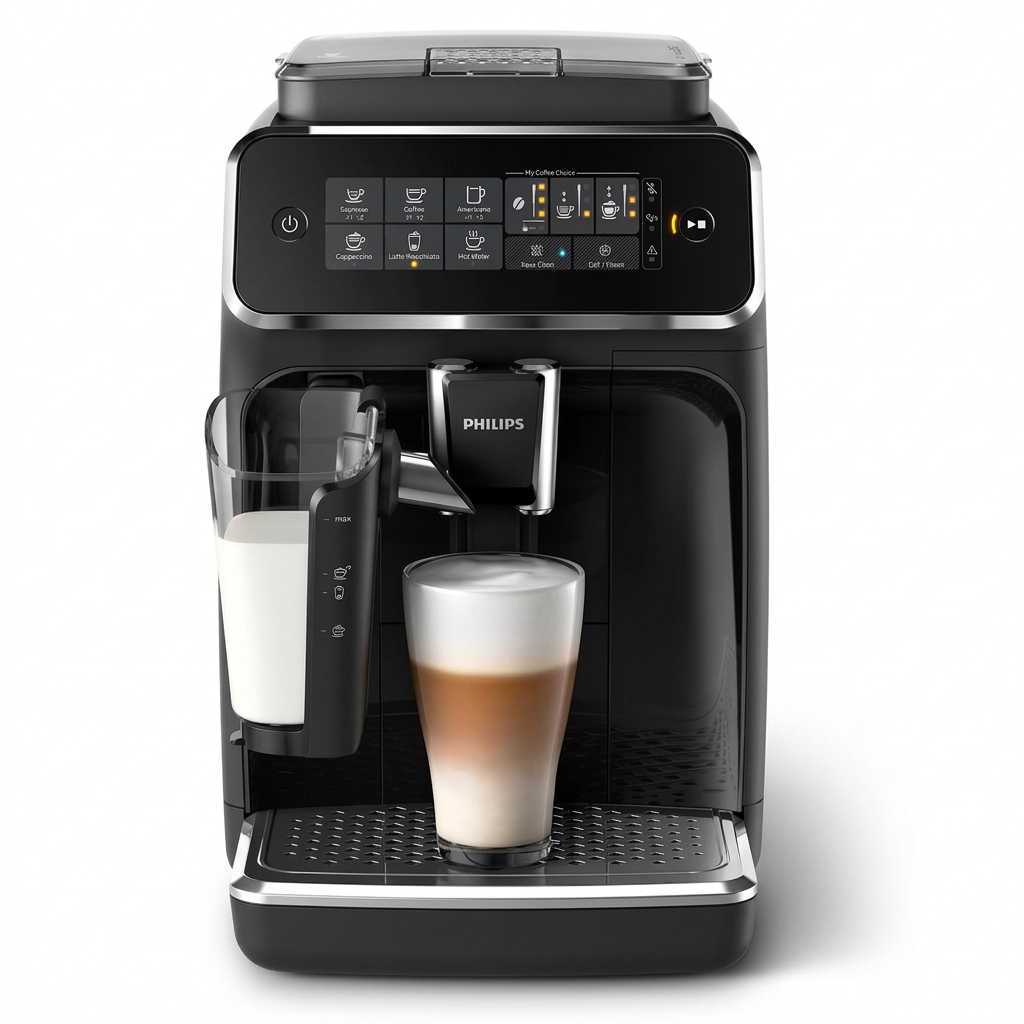
The LatteGo version pours its milk and coffee into the same glass.
How I researched and scored the Philips 3200
This is a researched review, written from the manufacturer's documentation, published test data and owner feedback.
I compared those sources against each other and gave more weight to points that several of them agreed on.
Where measurements differed, such as for noise and foam, I've said so instead of picking the most flattering number.
- Ease of use (8.9): controls, drink selection and everyday workflow.
- Cleaning (8.8): LatteGo, brew group access and maintenance load.
- Milk drinks (8.3): convenience, foam and drink temperature.
- Espresso (7.4): dose, body, crema and adjustability.
- Noise (6.9): published readings and owner complaints.
The overall score of 8.1 is an editorial rating.
Our tip: Buy fresh beans in smaller bags, because even a sealed hopper can't keep them tasting fresh for weeks.
Philips 3200 Series FAQ
Is the Philips 3200 Series worth it?
Yes, if you mostly drink milk coffee and want easy cleaning. It scored 8.1 out of 10 in our researched review. If you mainly want intense straight espresso, it is less of a match.
Does the Philips 3200 make real espresso?
It uses a 15-bar pump and freshly ground beans, but its small dose and longer default pour give a milder, lungo-style shot than a manual machine.
How do I make coffee stronger on the Philips 3200?
Grind finer while the grinder is running, use the highest strength, reduce the volume and raise the temperature setting. A double shot also helps.
Is LatteGo easy to clean?
Yes. It has two main parts and no tubes, and it can be rinsed under the tap or washed in the dishwasher. You should clean it after each use.
Can the Philips 3200 use plant-based milk?
Yes, including oat and almond milk. Results vary, and barista-style versions usually foam best.
Can it make milk without coffee?
Not directly. There is no milk-only button, so standard milk drinks always include a coffee stage.
Is the Philips 3200 loud?
It is noticeable, especially during grinding and frothing. Published readings range from about 50 decibels for black coffee to the 60s at peaks.
Do I have to descale it?
Yes, unless you consistently use AquaClean filters. Philips says that replacing the filter when prompted allows up to 5,000 cups without descaling.
Can I use pre-ground coffee?
Yes. There is a separate chute on top for one scoop of pre-ground coffee, which suits an occasional decaf.
- Philips product documentation for the EP3241/54
- Amazon product listing for the Philips 3200 Series (ASIN B07VFY4MXM), November 2026
- Published independent tests and measurements of the 3200 LatteGo platform
- Owner reviews and long-term owner feedback
- Review published.