Nuwave Induction Wok review: real wok cooking without a gas flame
A dedicated induction base with a 14-inch carbon steel wok, three power levels and temperatures from 100°F to 575°F in 5-degree steps. It brings proper stir-frying to kitchens with an electric stove. The carbon steel wok needs seasoning, though, and the base is a big, single-purpose box.
In this review
If you love stir-fries but cook on a flat electric or glass stove, the Nuwave Induction Wok is one of the most practical fixes around. You get a real 14-inch carbon steel wok, up to 1,500 watts and precise control from 100°F to 575°F. It won't fully match a restaurant gas burner, and the wok needs care, but it gets much closer than a flat pan on a flat stove.
Nuwave Induction Wok at a glance
Nuwave Induction Wok pros and cons
- Real 14-inch carbon steel wok included
- Precise temperature control from 100°F to 575°F in 5°F steps
- Three wattage settings: 600, 900 and 1,500 watts
- Change temperature and time on the fly
- Works on a normal outlet, anywhere in the kitchen
- Induction heats fast and stops fast
- Useful for frying, steaming and simmering too
- The carbon steel wok needs seasoning and drying after every use
- The base only works as a wok station
- At about 14.4 pounds, it's heavy to move around
- 1,500 watts is good, but not a restaurant gas burner
Who should buy the Nuwave Induction Wok?
- Cooks with electric coil or glass-top stoves
- Apartments where gas isn't an option
- Anyone who stir-fries at least once a week
- Kitchens with limited power, thanks to the 600 and 900-watt modes
- Cooking at the table, on a patio or in an RV with a suitable outlet
- Cooks who already have a powerful gas wok burner
- People who want a non-stick pan with zero maintenance
- Small kitchens with no room for another appliance
- Occasional stir-fry makers
First impressions of the Nuwave Induction Wok
Good stir-frying needs a lot of heat, and most home stoves don't deliver it.
On a flat electric or glass top, a round wok barely touches the heat, so food steams instead of searing.
The Nuwave Induction Wok attacks that problem with its own induction base.
My first impression is that it's a serious piece of kit.
The black base has a digital control panel on the front, and the wok sits in it, rather than on a flat surface.
The wok itself is the star.
It's a 14-inch wok made from heavy-gauge carbon steel, the material traditional wok cooks swear by.
That tells me Nuwave is aiming at people who care about the cooking, not just the convenience.
Nuwave is best known for its portable induction cooktops and air fryers, so induction is familiar ground for the brand.
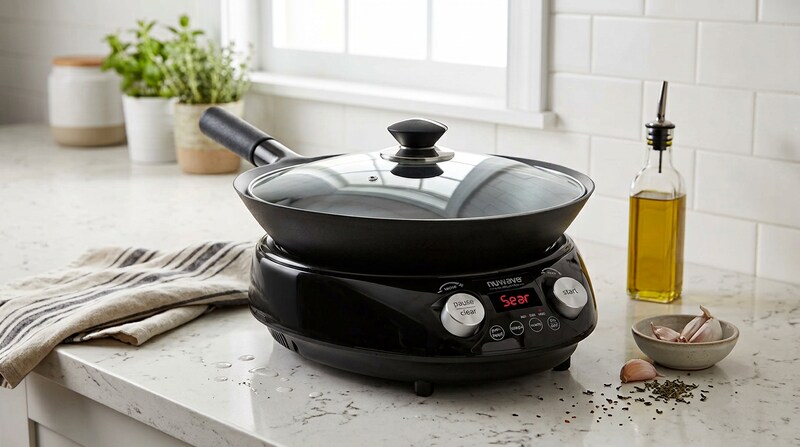
A dedicated induction base with a real carbon steel wok.
What the Nuwave Induction Wok actually is
The Nuwave Induction Wok is a countertop appliance made of two parts: an induction heating base and a carbon steel wok.
It plugs into a regular outlet and runs at up to 1,500 watts.
You can also switch it to 600 or 900 watts, which matters if you're on a weak circuit or sharing an outlet with another appliance.
The temperature range runs from 100°F to 575°F, in 5-degree steps.
Nuwave counts that as 96 preset temperatures, which is a lot more precise than the low, medium and high of a typical stove.
You can also set a cooking time and change both time and temperature while you cook, without starting over.
According to Nuwave, the base uses a patented insulation design that puts the induction coils closer to the wok than competing models.
The goal is faster, more even heating without hot or cold spots.
The whole package weighs about 14.4 pounds.
How induction wok cooking works
Induction doesn't heat a burner.
Instead, a magnetic field in the base makes the metal of the wok itself heat up.
That's why induction is so responsive.
Turn it up and the wok gets hotter right away, turn it down and the heat drops quickly, without a glowing coil holding onto its warmth.
Carbon steel is a perfect match, because it's magnetic and heats fast.
The catch with regular induction cooktops is that they're flat, while a wok is round.
Only a small spot at the bottom of the wok gets heated, and the sides stay cooler.
A dedicated wok base is built around the wok's shape, so more of the pan gets heat and you can push food up the sides like you would over a flame.
That's the core reason to buy a product like this instead of just using a wok on your stove.
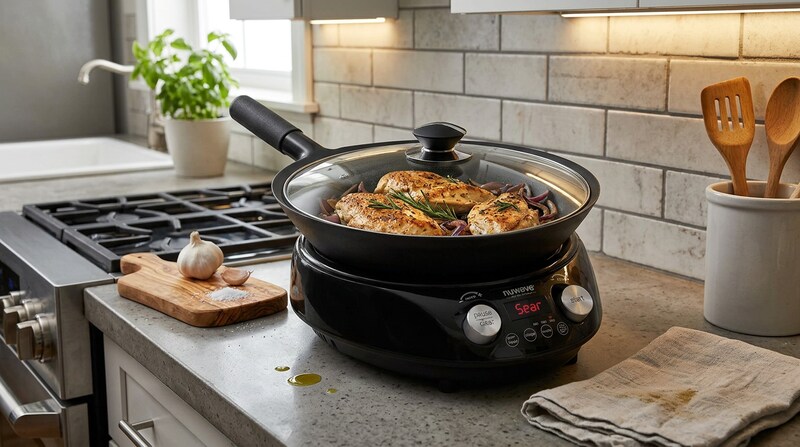
The wok sits in the base, so more of the pan gets heat.
Nuwave Induction Wok design and setup
The base is a compact black unit with a touch control panel.
The display shows the temperature and time, and the wattage setting is chosen from the same panel.
Setup is mostly about the wok.
Carbon steel woks usually come with a protective coating from the factory, and they need to be washed and seasoned before the first use.
Seasoning means heating a thin layer of oil into the steel until it forms a natural non-stick coating.
It takes about 15 to 20 minutes, and the base is a handy tool for doing it.
My advice is to season it outside or near an open window with the extractor fan on, because it smokes.
Once that's done, you place the base on a stable, heat-safe counter, plug it in and you're ready.
Give it some space, because stir-frying throws oil around.
Keep in mind it's a 1,500-watt appliance at full power, so avoid running it on the same circuit as a kettle or microwave.
Nuwave Induction Wok performance
For a wok, performance comes down to heat: how fast it gets hot, how hot it gets and how well it holds that heat when food goes in.
Heat-up speed
Induction is one of the fastest ways to heat a pan, and carbon steel responds quickly.
At 1,500 watts, the wok should be ready for searing in a few minutes, faster than most electric coil or glass-top stoves.
Always preheat fully before the oil goes in, because a properly hot wok is what stops food from sticking.
Heat recovery
This is the big test for any home wok.
When you add a pile of cold meat or vegetables, the temperature drops, and if it drops too far, the food releases water and stews.
1,500 watts is the most a standard US outlet can deliver for an appliance like this, so cooking in smaller batches is still the smart move.
Sear the meat first, take it out, cook the vegetables, then bring it all together at the end.
That's how most restaurant cooks work anyway.
Temperature control
The precise temperature control is where the Nuwave stands out.
Being able to dial in an exact number takes the guesswork out of jobs such as deep-frying, where oil temperature really matters.
At the low end, 100°F and up is gentle enough for melting chocolate or keeping a sauce warm.
And being able to change the temperature in the middle of a recipe makes it feel more like a burner and less like a gadget.
Wok hei
Nuwave markets the wok as able to add wok hei, the smoky, charred aroma of great restaurant stir-fries.
True wok hei comes from very high heat and, in many restaurants, from flames licking over the rim of the wok.
No home electric appliance fully copies a commercial gas wok burner.
But high heat on a seasoned carbon steel wok gets you real browning and some of that charred flavor, which is a big step up from a flat non-stick pan.
What the 600, 900 and 1,500-watt modes are for
The three wattage settings are an unusual and useful feature.
1,500 watts is the mode for stir-frying and searing, when you want as much heat as possible.
900 watts is a good middle ground for shallow frying, steaming and cooking on a circuit you share with other appliances.
600 watts is for places where power is limited.
Think of an RV, a boat, an older building with weak wiring or an outdoor outlet that trips easily.
Lower wattage means slower heating, of course, but it means you can still cook where a full-power appliance would trip the breaker.
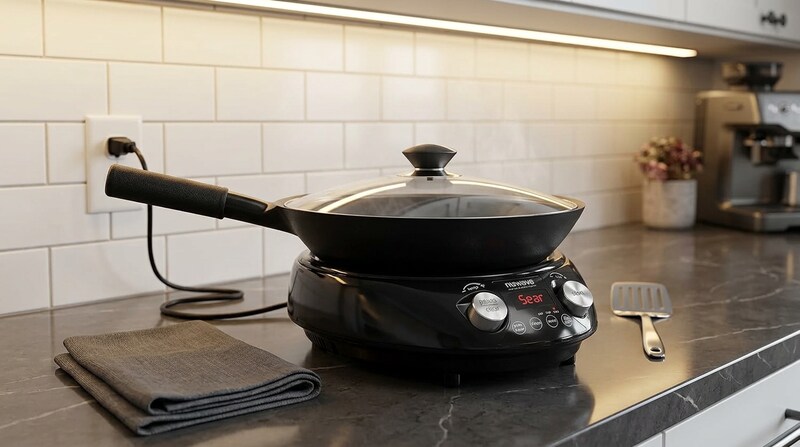
Lower power modes help on shared or limited circuits.
What else you can cook in it
A wok is one of the most versatile pans in the kitchen, and this one is no different.
Deep-frying works well, because the sloped sides need less oil than a pot, and the exact temperature setting helps.
With a bamboo steamer basket on top, it becomes a steamer for dumplings, fish and vegetables.
It can also braise, make curries and fried rice, or toast spices and nuts.
One tip: long simmering of acidic foods like tomato sauce can strip seasoning from carbon steel.
Keep those dishes short, or use another pot.
How to get better stir-fries out of the Nuwave
A great stir-fry is as much about preparation as it is about heat.
These habits make the biggest difference on any home wok, and they matter even more on an electric one.
Prep everything first
Stir-frying moves fast.
Cut all the vegetables, mix the sauce and have the meat ready before the wok gets hot, because there's no time to chop once cooking starts.
Dry your ingredients
Water is the enemy of searing.
Pat meat dry, spin washed greens and let rice cool, ideally overnight, before making fried rice.
Use the right oil
Pick an oil with a high smoke point, such as peanut, rice bran or canola.
Olive oil and butter burn at the temperatures a wok likes.
Cook in batches
Don't fill the wok more than about a third.
Smaller batches keep the temperature up, so meat browns instead of turning gray.
Add sauce at the end
Sauces cool the wok and can burn if they go in too early.
Pour them around the edge in the last minute, so they sizzle and coat everything.
Turn on the extractor
High-heat cooking makes smoke, especially while the seasoning is still building up.
Run the hood or open a window before you start, and your smoke alarm will thank you.
Cleaning and caring for the carbon steel wok
Carbon steel isn't hard to look after, but it does need a routine.
Rinse the wok with hot water while it's still warm, and scrub with a soft brush or sponge.
A little dish soap is fine once the seasoning is well established.
Dry it completely, ideally by putting it back on the base for a minute, then wipe a thin layer of oil inside.
Don't soak it and don't put it in the dishwasher, because carbon steel rusts.
Over time, the wok turns dark and becomes more non-stick with every use.
That patina is a good sign, not a stain to scrub off.
The base just needs a wipe with a damp cloth once it has cooled, and it must never go near water.
Is the Nuwave Induction Wok worth the money?
On Amazon, the Nuwave Induction Wok lists for about $250.
You could buy a portable induction burner and a wok for less, but you'd be back to a flat surface heating a round pan.
Basic electric woks cost less too, but they usually have non-stick coatings that don't love high heat and simple dials instead of exact temperatures.
The Nuwave gives you three things together: a real carbon steel wok, a base shaped for it and precise digital control.
If you stir-fry often and don't have gas, that combination is worth paying for.
If you only make stir-fry once a month, a good flat-bottomed carbon steel wok on your stove is the cheaper compromise.
Buyers seem happy overall, with an average of 4.5 out of 5 stars from more than 600 ratings on Amazon.
Prices move, so check the current price on Amazon before you buy.
Nuwave Induction Wok specifications
From Nuwave's product information and the Amazon listing.
Nuwave Induction Wok vs electric wok vs wok on the stove
Here's how the Nuwave compares with the other ways to stir-fry without a gas wok burner.
| Nuwave Induction Wok | Basic electric wok | Flat-bottom wok on electric stove | |
|---|---|---|---|
| Pan | Carbon steel | Usually non-stick | Carbon steel |
| Max power | 1,500 W | 1,200 to 1,500 W | Depends on stove |
| Temperature control | Exact, 5°F steps | Simple dial | Low to high |
| Heats the sides | Yes | Partly | Mostly the bottom |
| Typical price | About $250 | $50 to $120 | $30 to $80 |
| Best for | Frequent stir-fry cooks | Easy, casual cooking | Tight budgets |
Best Nuwave Induction Wok alternatives
If the Nuwave isn't the right fit, there are a few other routes.
A standard electric wok with a non-stick coating is cheaper and easier to clean, but it can't take the same high heat and won't develop a seasoning.
A flat-bottomed carbon steel wok on your existing stove is the budget option, and it works best on induction or gas cooktops.
If you have outdoor space, a propane wok burner delivers far more heat than any indoor appliance, though it's a very different setup.
And Nuwave's own portable induction cooktops are more versatile, if you want one base for all kinds of pans.
How I scored the Nuwave Induction Wok
I looked at the Nuwave Induction Wok for the job it's built for: high-heat stir-frying at home, plus frying, steaming and everyday wok cooking.
I based the scores on Nuwave's published specifications, the Amazon listing, how induction heating works and how the package compares with other ways to cook with a wok.
- Heating (8.2): power, heat-up speed and how well it suits high-heat cooking.
- Control (8.6): temperature range, precision and the three wattage modes.
- Wok quality (7.8): the carbon steel wok, its size and how it holds up over time.
- Ease of use (7.4): setup, seasoning, cleaning and storage.
The overall score of 7.9 is an editorial rating. BrasQ editor-in-chief Ryan Mitchell reviewed the facts and figures before publication.
Nuwave Induction Wok FAQ
Is the Nuwave Induction Wok worth it?
Yes, if you stir-fry often and cook on an electric or glass-top stove. It scored 7.9 out of 10 in our review for its precise control, three power modes and real carbon steel wok.
How hot does the Nuwave Induction Wok get?
You can set it anywhere from 100°F to 575°F in 5-degree steps.
What are the wattage settings?
You can choose 600, 900 or 1,500 watts. The lower settings help on circuits with limited power.
What wok is included?
A 14-inch wok made of heavy-gauge carbon steel. It needs to be seasoned before first use.
Can I use another wok on the base?
The base is designed around the included wok. Other pans need to be induction-compatible and fit the base, so the included wok is the safest choice.
Is the wok non-stick?
Not out of the box. Carbon steel becomes naturally non-stick as you season and use it.
Can I put the wok in the dishwasher?
No. Wash it by hand, dry it completely and wipe it with a thin layer of oil to prevent rust.
Can I deep-fry in it?
Yes. The exact temperature setting makes it a good fit for deep-frying, but never leave hot oil unattended.
- Amazon product listing for the Nuwave Induction Wok (ASIN B0CVL6FXHF), October 2026
- Nuwave product information for the Induction Wok
- General guidance on seasoning and caring for carbon steel woks
- Review published.