Marcato Atlas 150 with Motor review: fresh pasta with both hands free
A classic Italian pasta roller with a motor in place of the crank. Ten thickness settings, fettuccine and tagliolini cutters, and a free hand to guide the dough. It does take practice, and it never goes near the sink.
In this review
I came away from my time with the Marcato Atlas 150 with Motor convinced that this is the nicer way to make fresh pasta at home. The motor frees up a hand for guiding the dough, the ten thickness settings cover everything from thick sheets to delicate ones, and the build feels like it will last decades. It does ask for patience while you learn the right dough, and cleaning is a dry-brush job only. If you make pasta more than now and then, it is a worthwhile upgrade over cranking by hand.
Marcato Atlas 150 with Motor at a glance
Marcato Atlas 150 with Motor pros and cons
- Motor frees a hand to guide the dough through the rollers
- Ten thickness settings, from thick sheets to very thin
- Fettuccine and tagliolini cutters included on the classic machine
- Solid, chrome-plated steel build made in Italy
- Compact enough to store in a cupboard
- The motor also drives other Atlas cutting accessories
- You need to learn the right dough consistency to avoid tearing and sticking
- Cannot be washed under running water or in a dishwasher
- The motor adds cost over the hand-crank version
- Check the listing contents so you know whether the machine itself is included
Who should buy the Marcato Atlas 150 with Motor?
- Home cooks who make fresh pasta every week or two
- Anyone who finds cranking and feeding at the same time awkward
- Lasagna, ravioli and filled-pasta sheets
- Fettuccine and tagliolini lovers
- People who want a traditional Italian tool that lasts
- Occasional pasta makers who are fine with a rolling pin
- Cooks who expect everything to go in the dishwasher
- Extruded shapes like rigatoni or penne
- Very small kitchens with no free counter edge
First impressions of the Marcato Atlas 150 with Motor
I have always liked the idea of fresh pasta more than the process of making it.
Rolling dough by hand is slow, and a hand-crank machine asks you to do two jobs at once.
The Marcato Atlas 150 with Motor takes one of those jobs off your hands.
That is the whole idea, and it is a good one.
The Atlas 150 is the classic Italian pasta roller that a lot of nonnas and chefs swear by.
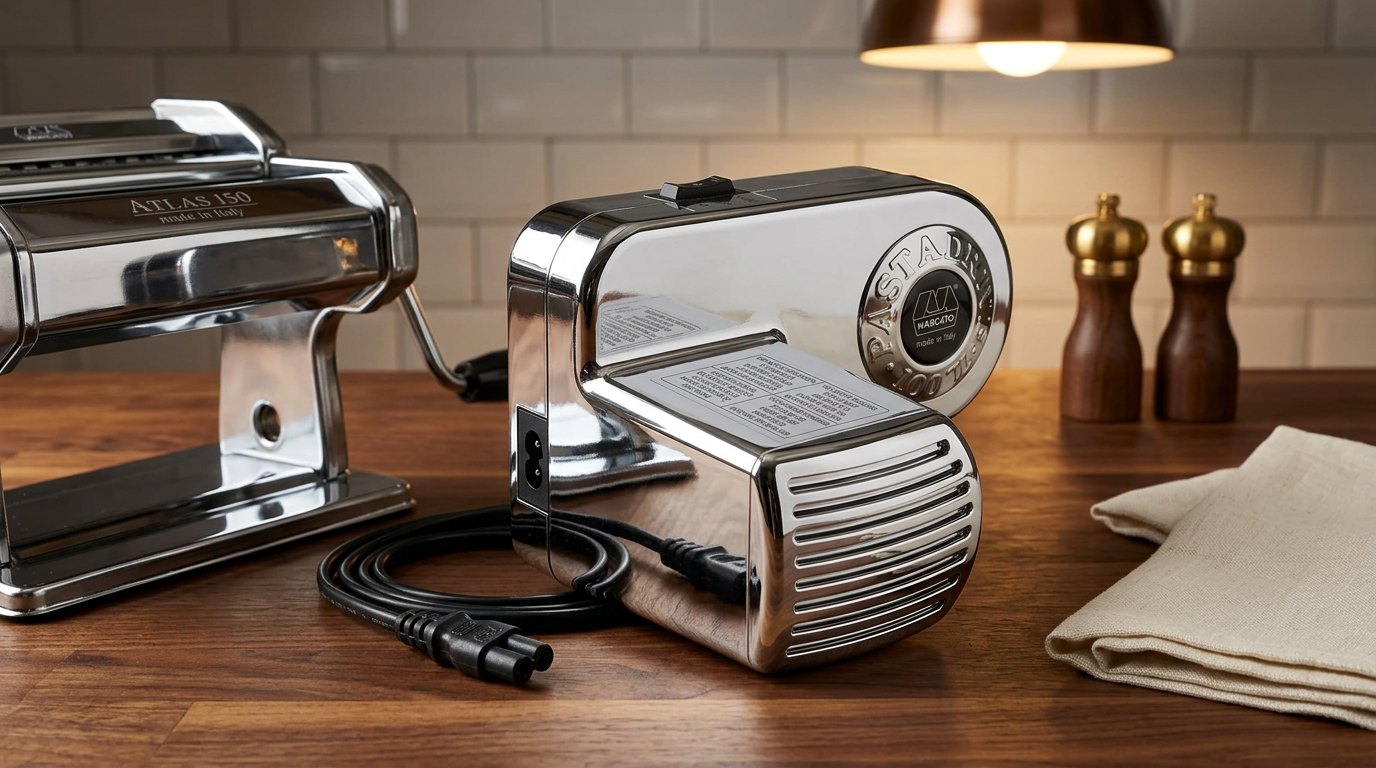
Here, the crank makes way for a small motor that clips into the side of the machine.
Press the switch and the rollers turn on their own at a steady pace.
That leaves one hand to feed the dough and the other to catch the sheet as it comes out.
My first reaction was that this is how the machine should have worked all along.
The steady speed makes the whole process feel calmer and more controlled.
You stop wrestling with the machine and start paying attention to the dough.
It brings the process closer to traditional Italian cooking, just with less effort in the rolling stage.
The Atlas 150 and its motor are built to stay on the counter while you work.
What the Marcato Atlas 150 with Motor actually is
The Atlas 150 is a manual pasta machine made by Marcato in Campodarsego, near Padua in Italy.
The 150 in the name refers to the width of the rollers, which is 150 millimeters, or roughly 6 inches.
That is wide enough for lasagna sheets and for most filled pastas.
On the classic version, a double cutter sits on the back of the machine for fettuccine and tagliolini.
Retailers list those cutters at about 6.5 millimeters and 1.5 millimeters wide.
The motor is Marcato's own add-on, sometimes sold as the Pastadrive.
It slots into the same side holes the crank uses, so the machine itself stays the same.
Marcato also says the motor fits its other Atlas accessories, such as spaghetti, linguine, bigoli and capellini cutters.
One thing to check before you order: Amazon names this listing "Atlas 150 110V Folder Motor".
Its included-components field mentions the motor, while the main photo shows the motor fitted to an Atlas 150.
I would read the current listing carefully, or ask the seller, so you know whether you are buying the full machine with motor or the motor alone.
The motor runs on standard 110 to 120 volt US power.
Amazon lists the motor unit at about 2.5 pounds, which tells you it is a compact, solid little drive rather than a big appliance.
How the Marcato Atlas 150 with Motor works
The basic process is the same as with any roller-style pasta machine.
You start with a firm dough of flour and eggs, or flour and water, that has rested for a while.
You flatten a piece by hand, then feed it through the rollers at the widest setting.
After a few passes, often with a fold in between, you work your way down the thickness dial one notch at a time.
The dial runs from 0 to 9, which gives you ten thickness settings.
Retailers list the range at roughly 4.8 millimeters at the thickest and about half a millimeter at the thinnest.
Thicker settings are useful for rustic noodles and recipes that need some bite.
The thinnest settings are where delicate pasta and ravioli sheets live.
Once the sheet is as thin as you want, you move it to the cutter and run it through to get ribbons.
With the motor fitted, the rollers turn at a constant speed when you switch it on.
That steady pace is the main benefit.
You can lay the dough in with one hand and support the emerging sheet with the other.
With a crank, one hand is always busy turning, so long sheets tend to fold over or stretch unevenly.
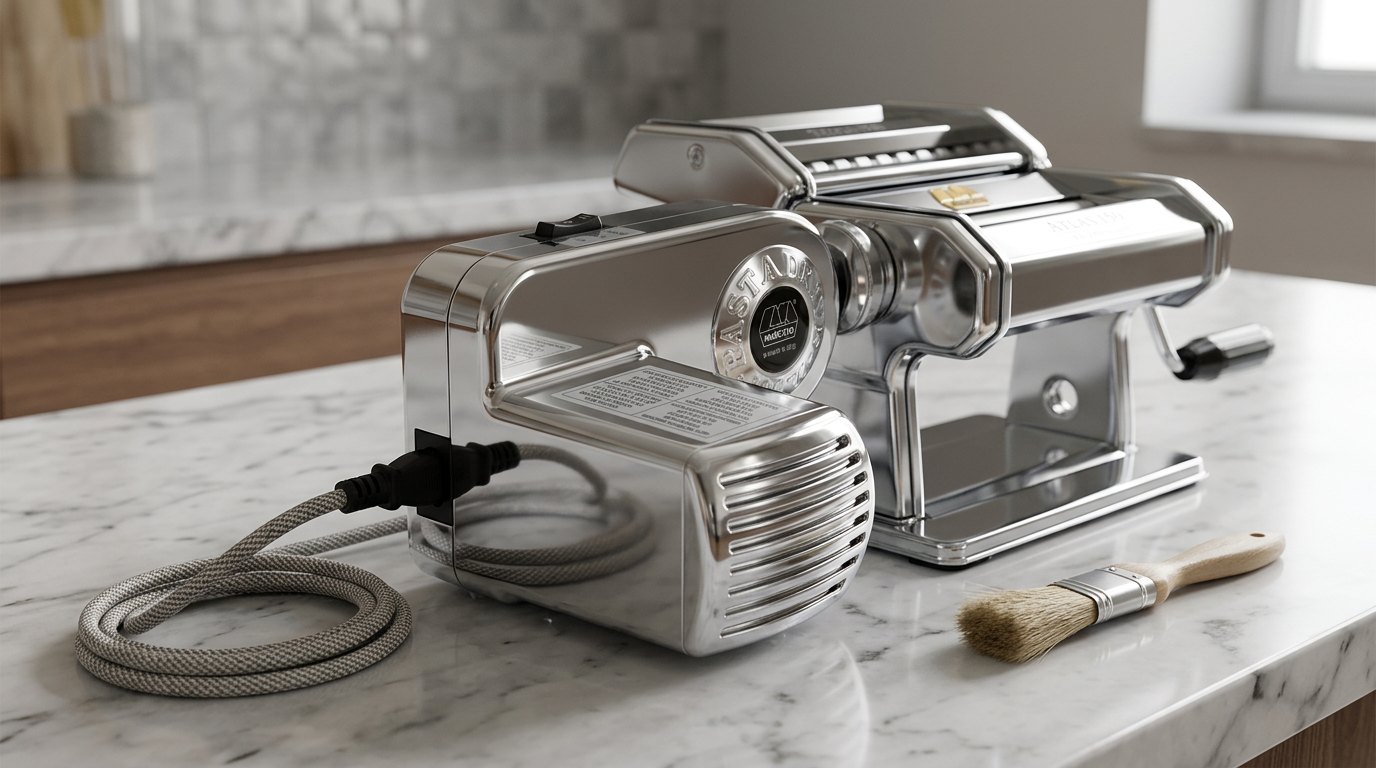
The motor clips into the side of the Atlas 150 in place of the hand crank.
Marcato Atlas 150 with Motor design and setup
The Atlas 150 looks like what it is: a piece of Italian kitchen hardware.
The body is chrome-plated steel with a bright, polished finish.
Retailers list the rollers as anodized aluminum, which is the part that touches the dough.
The motor housing matches the machine with a ribbed chrome shell.
It looks more like an accessory than a separate appliance, which I like.
The whole setup is compact.
It fits on a corner of the counter and stores in a cupboard when you are done.
That is appealing if you do not want another large countertop appliance.
Setup takes a couple of minutes.
You clamp the machine to the edge of a table or counter with the included clamp.
Then you push the motor into the drive hole on the side where the crank would normally go, and plug it in.
A firm, stable clamp matters more than it sounds.
If the machine wobbles, the dough feeds unevenly and you start fighting it.
A thick, flat counter edge is ideal, and you need an outlet nearby for the motor cord.
I would also keep a clean, lightly floured surface on the exit side for the finished sheets.
What I like about the design
The thickness dial clicks into place, so it is easy to repeat the same setting from one batch to the next.
The cutters are fixed to the machine on the classic version, so there are no small parts to lose.
And because the motor uses the same mounting point as the crank, you can always go back to manual if you want to.
Marcato Atlas 150 with Motor performance
The real question with a pasta machine is simple: do you end up with even, smooth sheets and clean ribbons?
With the Atlas 150 and its motor, the answer depends more on your dough than on the machine.
That is not a weakness of the Atlas, it is how pasta works.
Rolling sheets
The rollers press the dough evenly across their full width.
Working down the dial gives you thin sheets for delicate dishes or thicker ones for recipes that need more structure.
With the motor doing the turning, I could guide the sheet straight and keep it from folding on itself.
That makes long lasagna sheets far less stressful.
Cutting fettuccine and tagliolini
The double cutter on the classic Atlas 150 covers two of the most useful shapes.
Fettuccine is the all-rounder for butter, cream and ragù.
Tagliolini is the finer ribbon that suits lighter sauces, seafood and a simple butter and cheese finish.
Having both on one machine gives me plenty of room to experiment with different sauces and ingredients.
A lightly floured sheet that has dried for a few minutes cuts cleanly.
A sheet that is still tacky can clump in the cutter, so a short rest between rolling and cutting helps.
The learning curve
This is the part to be honest about.
There is a learning curve with dough consistency and feeding technique.
Dough that is too wet sticks to the rollers.
Dough that is too dry cracks and tears at the edges.
Feeding the sheet in at an angle can make it bunch up instead of rolling flat.
None of this is unusual for a roller machine, and the motor does not solve it for you.
What the motor does is give you a free hand and a steady pace, which makes it easier to fix problems as they happen.
Speed and noise
The motor runs at one steady speed.
That is a good speed for learning, and it stays consistent from the first pass to the last.
It makes a gentle mechanical hum while it runs, which is about what you would expect from a small motor.
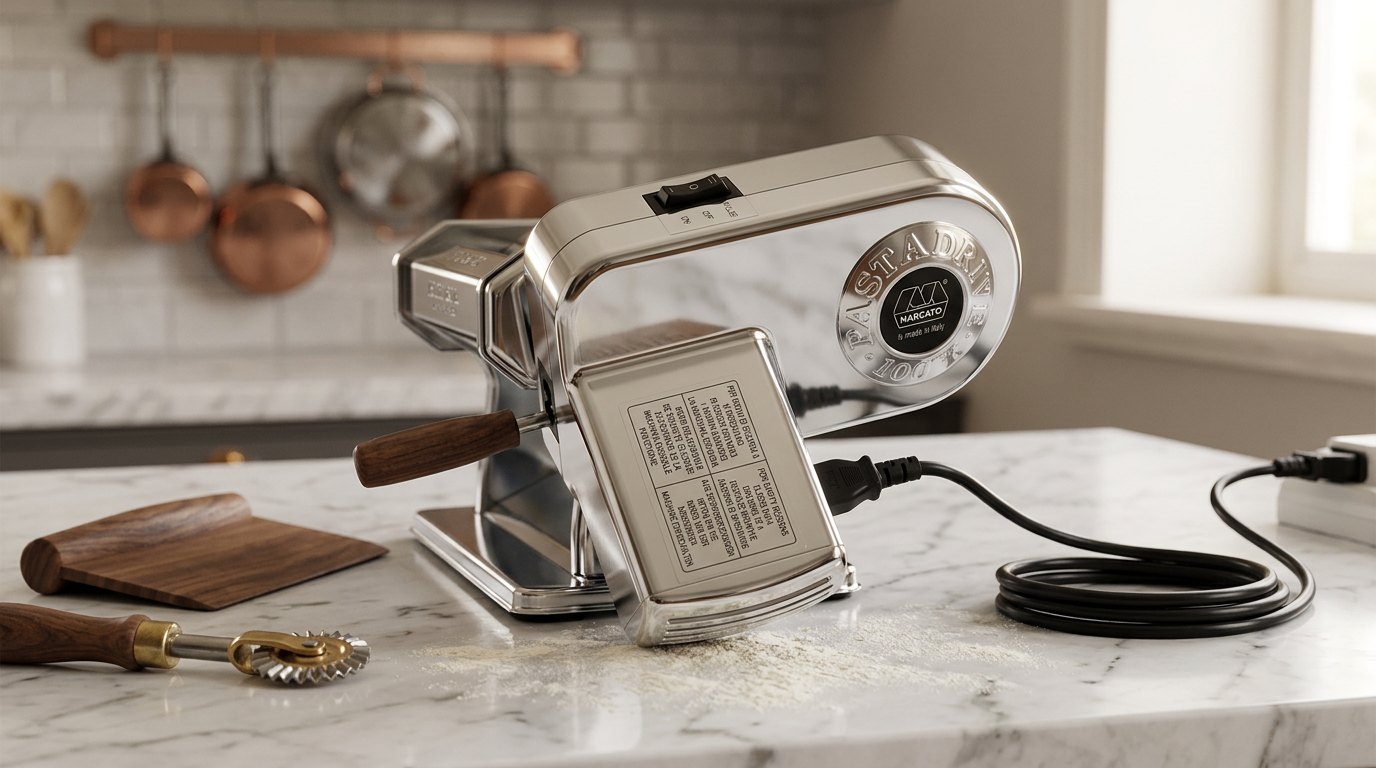
A dough scraper and a dry brush are the two tools I'd keep next to the machine.
Cleaning the Marcato Atlas 150 with Motor
This is where the Atlas asks for a little discipline.
You should not wash the machine under running water, and it does not go in the dishwasher.
Water can get into the rollers and the mechanism and cause rust or sticking parts.
Marcato's guidance is to clean the machine dry.
Let any dough left on the rollers dry out, then brush it away with a dry pastry brush.
A wooden skewer or toothpick helps clear dough from the cutter teeth.
A soft, dry cloth takes care of the outside.
Keeping the rollers and cutting combs free of residue is the single most important part of the routine.
Old dough hardens and can make the next batch stick or tear.
For the motor, a wipe with a dry cloth is all it needs.
Keep it away from water and flour dust as much as possible, and unplug it before you remove it from the machine.
If you follow these steps, the Atlas is built to last a very long time.
Retailers list a two-year manufacturer warranty on the motorized Atlas.
What the Atlas 150 is best at
Ribbon pasta
Fettuccine and tagliolini are the obvious starting point, because the cutter is right there.
Pappardelle is easy too, because you can cut wide strips by hand from a finished sheet.
Lasagna and filled pasta
The 150 millimeter rollers give you sheets wide enough for lasagna.
They also suit ravioli, tortellini and other filled shapes, which need thin, even sheets to cook properly.
This is where the motor shines, because long, thin sheets are hardest to handle with one hand busy cranking.
Extra shapes
Marcato sells separate cutters that clip onto the Atlas 150.
According to Marcato, the motor drives those accessories too, including spaghetti, linguine, bigoli and capellini.
What it cannot do
It is a roller and cutter, not an extruder.
Tube shapes such as penne, rigatoni and macaroni need a different kind of machine.
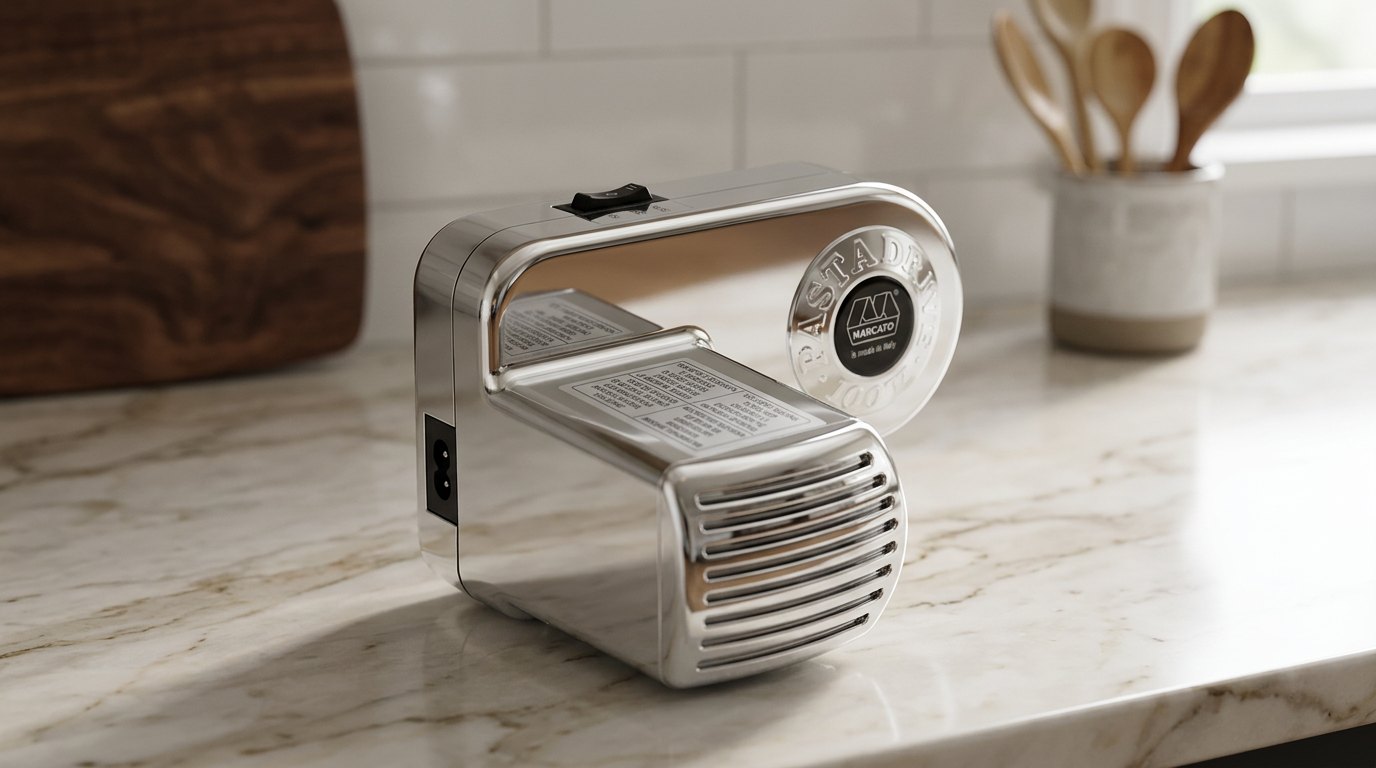
The motor is compact and plugs into a standard outlet.
Is the Marcato Atlas 150 with Motor worth the money?
At the time of writing, this listing costs about $178 on Amazon.
That is a lot more than the hand-crank Atlas 150 on its own.
So the real question is whether the motor is worth the extra.
If you make pasta once or twice a year, I would say no.
The manual Atlas does the same rolling and cutting, and you can live with cranking for one evening.
If you make fresh pasta regularly, the answer changes.
A free hand makes every batch easier, and it makes long sheets for lasagna and ravioli much less fiddly.
It also helps if you cook alone, because there is no second person to turn the handle.
The build quality is another part of the value.
This is a machine people keep for decades, not something you replace in two years.
Compared with an electric all-in-one pasta maker, the Atlas gives you more control over thickness and texture.
It does ask more of you, though, from mixing the dough to cleaning the rollers.
Prices move, so check the current price on Amazon before you buy.
My tips for better pasta with the Atlas 150
- Let the dough rest, wrapped, for at least 30 minutes before rolling so the gluten relaxes.
- Start every piece at the widest setting and go down one notch at a time.
- Fold and re-roll at the widest setting a few times for smoother, stronger sheets.
- Dust the sheet lightly with flour, ideally semolina, if it feels tacky.
- Let sheets dry for a few minutes before cutting so the ribbons separate cleanly.
- Keep a dry pastry brush next to the machine and brush the rollers after every session.
- Never rinse the rollers, and store the machine in a dry place.
Marcato Atlas 150 with Motor alternatives
If the price puts you off, the hand-crank Atlas 150 is the obvious alternative.
It is the same machine, just with a handle in place of the motor.
If you already own a stand mixer, a roller and cutter attachment is another way to get motorized rolling.
It ties the job to your mixer, though, and it takes up more counter space while you work.
If you mainly want tube shapes, look at an extruder-style pasta maker instead of a roller.
And if you want to keep the classic Atlas but add more shapes, Marcato's clip-on cutters are the most flexible upgrade.
Marcato Atlas 150 with Motor specifications
From Marcato, retailer listings and the Amazon listing.
How I tested and scored the Marcato Atlas 150 with Motor
I used the Marcato Atlas 150 with Motor the way it is meant to be used: rolling sheets for ribbon and filled pasta at home, and cutting fettuccine and tagliolini on the built-in cutter.
I paid attention to four things, and each one gets its own subscore.
- Ease of use (8.2): setup, clamping, feeding the dough and how much the motor helps.
- Pasta results (8.8): how even the sheets are and how cleanly the cutters work.
- Build quality (9.0): materials, fit and finish, and how durable it feels.
- Cleaning (7.0): how easy it is to keep the rollers and cutters clean without water.
The overall score of 8.3 is an editorial rating. I also checked Marcato's published specifications and retailer listings. BrasQ editor-in-chief Ryan Mitchell reviewed the facts and figures before publication.
Marcato Atlas 150 with Motor FAQ
Is the Marcato Atlas 150 with Motor worth it?
Yes, if you make fresh pasta regularly. The motor frees a hand to guide the dough, the ten thickness settings are versatile and the build is excellent. If you only make pasta occasionally, the hand-crank Atlas 150 is the better value.
What does the Atlas 150 motor do?
It replaces the hand crank. It fits into the same side holes and turns the rollers at a steady speed, so you can feed and catch the dough with both hands.
Is the pasta machine included with this listing?
Check before you buy. Amazon names this listing "Atlas 150 110V Folder Motor" and lists the motor as the included component, while the main photo shows the motor on an Atlas 150 machine.
How many thickness settings does the Atlas 150 have?
Ten, set with a dial from 0 to 9. Retailers list the range at about 4.8 mm at the thickest and about 0.5 mm at the thinnest.
What pasta shapes can it make?
The classic Atlas 150 cuts fettuccine and tagliolini and rolls sheets for lasagna, ravioli and other filled pasta. Marcato sells extra clip-on cutters for shapes such as spaghetti and linguine.
Can I wash the Atlas 150 in water?
No. Do not rinse it under running water or put it in the dishwasher. Let dough dry, then brush it off with a dry brush and wipe the outside with a dry cloth.
Is the motor loud?
It makes a steady mechanical hum while it runs, about what you would expect from a small motor. It is not a quiet appliance, but it is not harsh either.
Can I make penne or rigatoni with it?
No. The Atlas 150 is a roller and cutter. Tube shapes need an extruder-style pasta maker.
- Hands-on use of the Marcato Atlas 150 with motor by Thomas Walker
- Amazon product listing for the Marcato Atlas 150 motor (ASIN B078SCWRWD), October 2026
- Italian Cookshop: Marcato Atlasmotor specifications
- Marcato care and cleaning guidance for Atlas machines
- Review published.