iSpring RO500AK review: fast tankless reverse osmosis with an alkaline finish
A compact, tankless under-sink RO system with NSF/ANSI 58 certification, a quick 0.4-gallon-per-minute flow and a 2:1 pure-to-drain ratio. Owners love the taste and the space it saves. It needs an outlet under the sink, though, and it isn't cheap.
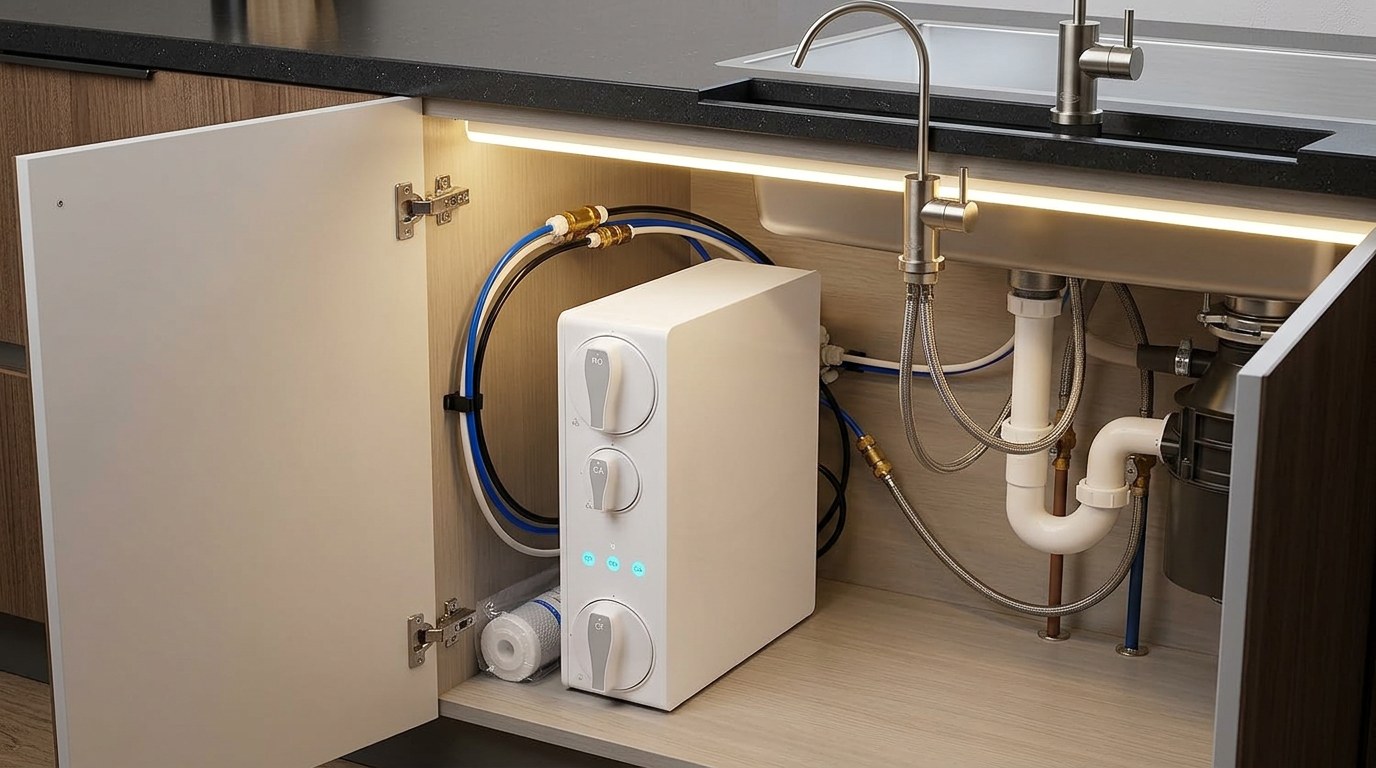
In this review
The iSpring RO500AK is one of the more convincing tankless reverse osmosis systems for a typical kitchen. It carries a full-system NSF/ANSI 58 certification, fills a glass in about ten seconds and wastes far less water than old-style RO units. The alkaline stage takes the flat edge off RO water, and owners consistently praise the taste. The trade-offs are the price, the need for an outlet under the sink and a filter schedule you have to keep up with. If you drink a lot of tap water and you have the cabinet space and power, it's an easy system to recommend.
iSpring RO500AK at a glance
iSpring RO500AK pros and cons
- NSF/ANSI 58 certification covers the complete system
- Fast 0.4 GPM flow, about ten seconds for an 8-ounce glass
- 2:1 pure-to-drain ratio wastes much less water than older RO systems
- Tankless design frees up most of the cabinet
- Alkaline remineralization gives RO water a rounder taste
- Auto-flush, filter lights and a buzzer take the guesswork out of maintenance
- Strong owner ratings and US-based tech support
- Expensive compared with tank-based RO systems
- Needs a power outlet under the sink
- Stops producing water during a power cut
- Some owners report a lower flow or more pump noise than expected
- Only a 1-year warranty on a system this price
Who should buy the iSpring RO500AK?
- Families that fill bottles, pitchers and pots with filtered water every day
- Kitchens with crowded sink cabinets
- People worried about lead, PFAS or high dissolved solids in city water
- Anyone who finds plain RO water flat or bland
- Confident DIYers who can drill a faucet hole if needed
- Cabinets without an outlet nearby
- Well water with very high TDS or heavy iron and sediment
- Renters who can't modify the sink or countertop
- Buyers on a tight budget
What the iSpring RO500AK actually is
The iSpring RO500AK is an under-sink reverse osmosis system that skips the storage tank.
Instead of slowly filling a pressurized tank and serving water from it, it filters on demand.
A small built-in pump pushes tap water through the membrane fast enough to fill a glass in real time.
That's why it needs electricity, and why it can be so compact.
The whole unit is a slim white box, roughly 16 inches long, 5 inches wide and 16 inches tall.
iSpring says it saves up to 70 percent of the under-sink space a traditional tank system takes.
The "AK" in the name stands for the alkaline stage.
After the RO membrane strips out almost everything, a final cartridge adds some minerals back and nudges the pH up.
The system comes with its own brushed nickel gooseneck faucet, tubing, a feed-water adapter, a drain saddle and a power supply.
iSpring is a US brand based in Georgia that has sold RO systems since 2007, and the RO500 range is one of its main tankless lines.
On Amazon, the RO500AK holds a 4.6 out of 5 average from more than 1,600 ratings, with 83 percent of them five stars.
How the RO500AK works: three stages, no tank
Where older RO systems use five or six separate canisters, the RO500AK packs everything into three cartridges.
Fewer cartridges means fewer connections that can leak and a faster filter change.
Stage 1: sediment and carbon (FCF500)
The first cartridge combines a polypropylene sediment layer with a carbon block.
It catches sand, rust and grit, and the carbon reduces chlorine, which would otherwise damage the RO membrane.
Stage 2: the RO membrane (MRO500)
This is the part that does the heavy lifting.
iSpring rates the membrane at 0.0001 microns, fine enough to reject dissolved salts, metals and many other contaminants.
Water that doesn't pass through is flushed to the drain, carrying the rejected contaminants with it.
Stage 3: carbon and alkaline (FCA500)
The last cartridge polishes the taste with carbon and adds back minerals.
The Amazon listing gives the output pH as above 8.
Between uses, the system flushes the membrane automatically if it has sat idle for 24 hours.
That keeps stale water out of the first glass and helps the membrane last longer.
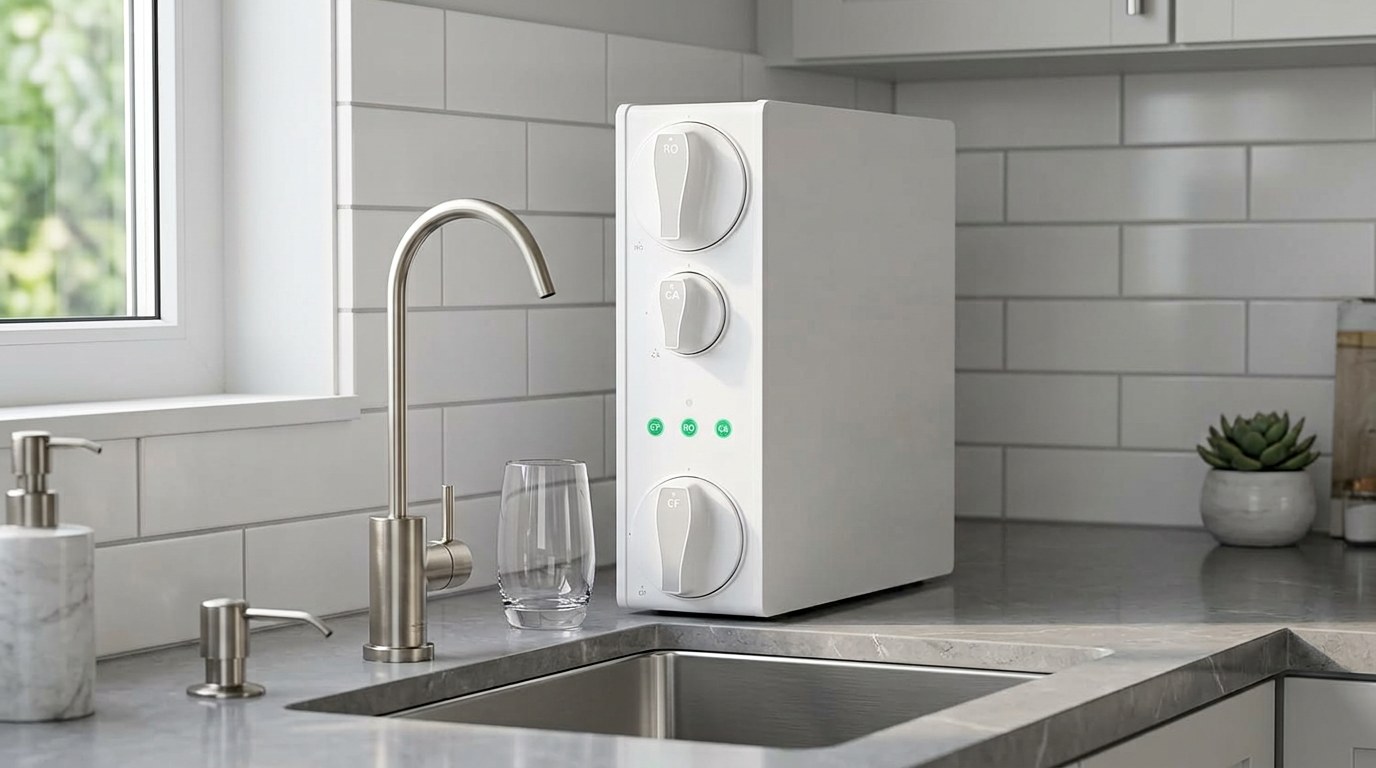
Illustration: the three dials on the front are the three filter cartridges, with the status lights in between.
Filtration and NSF certification
Certification is the first thing I look at with any water filter, because marketing claims are easy to make.
The RO500AK is NSF/ANSI 58 certified for TDS reduction, and the listing stresses that the certification covers the complete system.
That matters more than it sounds.
Plenty of filters advertise "certified components," which only means one part was tested on its own.
A full-system certification means the whole assembled unit was tested for performance and for materials that are safe in contact with drinking water.
The listing references certificate OM-1680 and a QR code on the box that links to the official report.
Beyond TDS, iSpring says the membrane removes up to 99 percent of contaminants including lead, PFAS, fluoride, arsenic, chromium, radium and chlorine.
Those are realistic claims for a good RO membrane, but they come from iSpring rather than from the certification itself.
If one contaminant is your main concern, check the NSF listing for that specific claim before you buy.
Owner feedback backs up the TDS performance.
One owner quoted in Amazon's review summary saw TDS readings drop from the 180s to under 15 ppm, which is typical of a healthy RO membrane.
A cheap TDS meter is worth having if you want to keep an eye on this yourself.
When the reading at the faucet starts creeping up over months, it's a sign the membrane is wearing out.
Flow rate and wastewater
The RO500AK is rated at 500 gallons per day, which works out to about 0.4 gallons per minute at the faucet.
iSpring translates that into an 8-ounce glass in roughly ten seconds.
For a tankless system that's a useful pace for drinking water, coffee and filling a pitcher.
It's still slower than your main kitchen tap, so filling a big stockpot takes some patience.
What owners say about flow
Flow is the one area where owner reviews split.
Many describe the flow as great, while others find it lower than they expected.
That isn't surprising, because tankless RO output depends heavily on incoming water pressure and temperature.
The system is rated for 15 to 70 psi and for water between 41 and 100°F.
Cold winter water and low pressure both slow an RO membrane down, so expect a bit less flow in January than in July.
The 2:1 drain ratio
Reverse osmosis always sends some water down the drain.
Older tank systems often waste three or four gallons for every gallon of filtered water.
The RO500AK is rated at 2:1, so two gallons of filtered water for every gallon flushed away.
If your family drinks and cooks with a couple of gallons a day, that difference adds up over a year.
The alkaline stage and taste
Pure RO water is extremely low in minerals, and a lot of people find it tastes flat.
The alkaline cartridge is iSpring's answer to that.
It adds a small amount of minerals back and raises the pH slightly above neutral.
Taste is the category owners mention most after installation, and the comments are overwhelmingly positive.
Words like fresh, smooth and amazing come up again and again.
I'd treat the alkaline stage as a taste feature rather than a health feature.
The mineral amounts are small, and you still get most of your minerals from food.
If you specifically want the purest possible water, for an aquarium or a steam iron, the plain RO500 without the alkaline stage makes more sense.
For drinking, coffee and tea, the AK version is the one most people will prefer.
Installation: what to expect
iSpring markets the RO500AK as a DIY install, and installation is the most praised aspect in owner reviews.
The quick-connect fittings support both 1/2-inch and 3/8-inch cold water lines.
The basic steps are the same as any under-sink RO system.
- Shut off the cold water and fit the feed-water adapter to the cold line.
- Mount the drain saddle on the sink drain pipe, above the P-trap.
- Install the dedicated faucet in a spare sink hole, or drill one.
- Connect the tubing, plug in the power supply and flush the system as the manual describes.
Three things decide how easy your install will be.
The first is power.
The pump needs an outlet in or near the cabinet, and many kitchens only have one for the garbage disposal.
The second is the faucet hole.
If your sink has a spare hole or a soap dispenser you can remove, you're set; if not, drilling a stone countertop is a job for a pro.
The third is space for the unit itself, though at about 5 inches wide it fits beside most drain setups.
Plan on an hour or two if you've done basic plumbing before.
If you haven't, a plumber can do it quickly, and it's worth checking for leaks again the next morning either way.
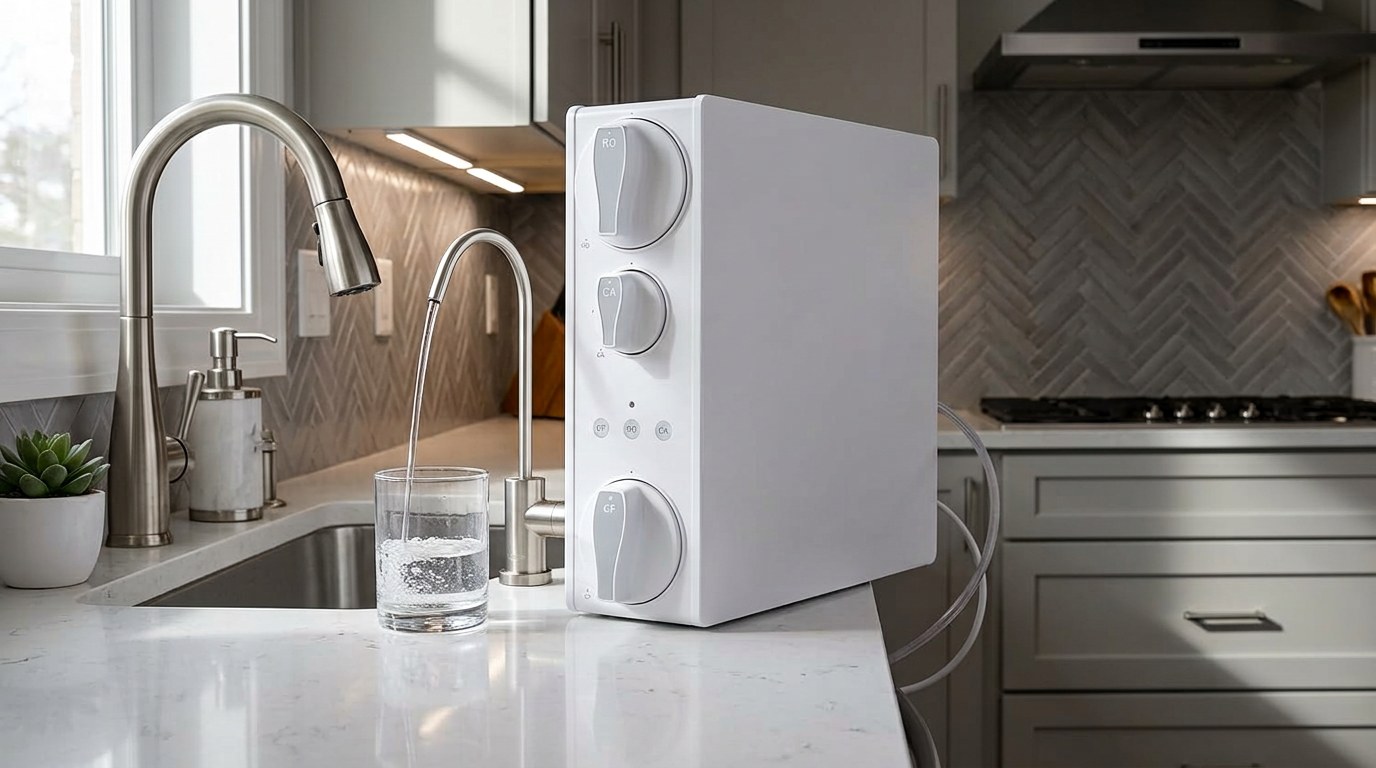
Illustration: the included gooseneck faucet sits next to your main tap; the unit itself goes in the cabinet below.
Noise and daily use
Because there's a pump inside, a tankless RO system makes some sound when it runs.
Owner opinions are mixed here too.
Some call the RO500AK very quiet, while others notice a hum while the faucet is open.
It only runs while you're drawing water or during the automatic flush, so it isn't a constant noise.
Day to day, the appeal is that filtered water is simply there whenever you open the faucet.
There's no tank to run empty after filling several bottles, which is a common complaint with 50- or 75-gallon-per-day tank systems.
The one real catch is a power outage.
With no pump and no stored water, the RO faucet stops working until the power comes back, so keep a jug filled if outages are common where you live.
Filter changes and running costs
Maintenance is where an RO system either becomes a habit or a chore.
iSpring has made it fairly painless on the RO500AK.
The cartridges twist out in seconds without shutting off the water or touching any tubing.
Lights on the top panel and a buzzer tell you when each filter is due.
iSpring's suggested lifespans on the Amazon listing are:
- FCF500 sediment and carbon: up to 6 months (one spec table says 12)
- FCA500 carbon and alkaline: up to 12 months
- MRO500 RO membrane: up to 24 months
Since the listing contradicts itself on the first filter, I'd plan on six months, and sooner if your water is hard or sandy.
iSpring also sells a bundle, the F7-RO500AK, that covers about two years of filters.
Proprietary cartridges are the long-term cost of any compact system like this.
Check the current filter prices before you buy, so the running cost doesn't come as a surprise.
Is the iSpring RO500AK worth the money?
When I checked in October 2026, Amazon listed the RO500AK at about $594, down from a list price of $692.99.
That's a lot more than a classic tank-based RO system, which often costs a third of that.
So what are you paying for?
Mainly three things: on-demand flow with no tank to run dry, a much better drain ratio and a cabinet that's still usable.
You also get a full-system NSF/ANSI 58 certification, which not every cheaper system can claim.
If you only drink a glass or two of filtered water a day, a pitcher or a simpler system will do.
If you're replacing bottled water for a whole family, the math looks very different.
A household that buys cases of bottled water can recover the cost within a couple of years, even counting filters.
The 1-year warranty is the weak spot at this price.
iSpring does offer lifetime technical support from its team in Georgia, and owners often mention helpful support in reviews.
Prices move a lot on Amazon, so check the current price before you buy.
RO500 vs RO500AK vs RO500AK with UV: which should you buy?
iSpring sells the tankless 500 GPD system in a few versions, and the names are easy to mix up.
| RO500 | RO500AK | RO500AK with UV | |
|---|---|---|---|
| Alkaline stage | No | Yes | Yes |
| UV light | No | No | LED UV at the faucet |
| Taste | Very pure, flatter | Rounder, slightly alkaline | Rounder, slightly alkaline |
| Best for | Lowest mineral content | Most kitchens | Extra peace of mind |
For most people, the RO500AK is the sweet spot.
The UV version mainly makes sense if you're on a private water source and want an extra layer against microbes.
iSpring RO500AK specifications
From iSpring and the Amazon listing.
Tankless RO vs tank RO vs a filter pitcher
The RO500AK competes with two very different ways of getting filtered water. Here's how they stack up in general terms.
| iSpring RO500AK | Typical tank RO | Filter pitcher | |
|---|---|---|---|
| Filtration | Reverse osmosis | Reverse osmosis | Mostly carbon |
| Flow | On demand, 0.4 GPM | Fast until the tank runs low | Slow, batch by batch |
| Wastewater | 2:1 pure to drain | Often 1:3 or worse | None |
| Cabinet space | Slim box | Canisters plus tank | None |
| Needs power | Yes | Usually no | No |
| Upfront cost | High | Medium | Low |
Best iSpring RO500AK alternatives
If the price or the power requirement of the RO500AK puts you off, there are good alternatives.
iSpring's own RCC7AK is a classic tank-based RO system with an alkaline stage.
It costs much less and works without electricity, but it takes up more of the cabinet and wastes more water.
Waterdrop's tankless G3 series is the most direct rival, with smart faucets that show TDS readings.
Compare certifications carefully, because they vary by model.
If you can't modify the sink at all, a countertop RO unit that you fill by hand is the renter-friendly option.
And if your main concern is chlorine taste rather than dissolved solids, a certified carbon filter or pitcher may be all you need.
How I researched and scored the iSpring RO500AK
This is a research-based review. I didn't install the iSpring RO500AK myself.
Instead, I went through iSpring's specifications, the full Amazon listing and its certification details, and the patterns in more than 1,600 owner ratings.
I then scored it in four areas.
- Filtration (9.0): certification, membrane rating and reported TDS results.
- Flow and efficiency (8.6): rated flow, drain ratio and owner reports on real-world flow.
- Installation (7.8): fittings, space, power and faucet requirements.
- Running costs (7.6): filter lifespans, proprietary cartridges and warranty.
The overall score of 8.4 is an editorial rating based on that research. The photos on this page are illustrative scenes generated from the product's listing image, not photos from a test. BrasQ editor-in-chief Ryan Mitchell checked the facts and figures before publication.
iSpring RO500AK FAQ
Is the iSpring RO500AK worth it?
For households that drink and cook with a lot of filtered water, yes. It has full-system NSF/ANSI 58 certification, fast on-demand flow and a 2:1 drain ratio. If you only need a glass or two a day, a cheaper system or pitcher will do.
Does the iSpring RO500AK need electricity?
Yes. It's tankless, so a built-in pump pushes water through the membrane on demand. You need an outlet under or near the sink, and it won't make water during a power cut.
How fast is the flow?
iSpring rates it at 500 gallons per day, or about 0.4 gallons per minute, enough to fill an 8-ounce glass in about ten seconds. Low water pressure or cold water will slow it down.
How much water does it waste?
It has a 2:1 pure-to-drain ratio, so about one gallon goes to the drain for every two gallons of filtered water. That's much better than older tank systems.
How often do the filters need changing?
The listing suggests up to 6 months for the sediment and carbon filter, up to 12 months for the alkaline filter and up to 24 months for the RO membrane. Indicator lights and a buzzer remind you.
What does the alkaline filter do?
It adds a small amount of minerals back to the RO water and raises the pH slightly, mainly to improve the taste.
Can I install it myself?
Most owners do. It uses quick-connect fittings for 1/2-inch and 3/8-inch lines. You'll need a spare sink hole or to drill one for the faucet, plus a nearby outlet.
Does it work with well water?
It's rated for feed water up to 1,000 ppm TDS and 15 to 70 psi. Well water with lots of sediment, iron or very high TDS may need pre-treatment first.
- Amazon product listing for the iSpring RO500AK-BN (ASIN B09CHBC9CP), October 2026
- iSpring specifications and NSF/ANSI 58 certification details as listed (certificate OM-1680)
- Verified Amazon owner reviews and Amazon's review summary, October 2026
- Lowe's: iSpring RO500AK-BN-UVF8 listing
- Review published.