GRAEF H9 review: a hand-cranked slicer with no motor and no fuss
A German all-metal slicer with a 190 mm serrated blade, a wooden crank and a removable stainless carriage. It's quiet, needs no outlet and slices bread, cheese and cold cuts from paper-thin to 15 mm. It asks for a bit of arm work, though, and it isn't cheap.
In this review
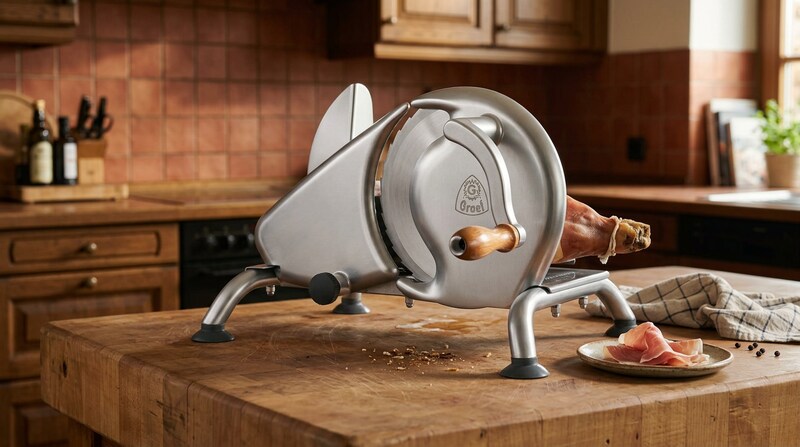
The GRAEF H9 is the slicer for people who want deli-style slices at home without another motor on the counter. The all-metal build, the serrated 190 mm blade and the 0 to 15 mm thickness range cover bread, cheese, salami and ham with ease. You do the work with the crank, and the price is high for a manual tool, but it's built to last for decades.
GRAEF H9 at a glance
GRAEF H9 pros and cons
- Silent, with no motor and no power cord
- Slice thickness from paper-thin up to 15 mm
- 190 mm serrated, hardened stainless steel blade
- Solid all-metal construction
- Removable stainless steel carriage for cleaning
- Suction feet keep it steady on the counter
- Food holder protects your fingers on the last pieces
- Expensive for a manual slicer
- Slower than an electric slicer for large batches
- Cranking takes two hands and a bit of effort
- Takes up real counter space, about 15 by 14 inches
Who should buy the GRAEF H9?
- Home bakers who slice crusty loaves several times a week
- Cheese and charcuterie lovers
- Kitchens where you'd rather not hear a motor
- Cabins, boats or outdoor kitchens without a handy outlet
- Anyone who values tools that last for decades
- Hunters and home butchers slicing pounds of meat at once
- People with limited grip or wrist strength
- Small kitchens with very little counter space
- Shoppers on a tight budget
First impressions of the GRAEF H9
Most home slicers today have a motor and a plastic body.
The GRAEF H9 goes the other way.
It's a manual slicer, with a crank and a genuine wooden handle instead of a switch.
My first impression is that it looks like something from a small European deli.
The round silver blade housing, the chunky metal frame and the wood handle give it an old-school feel that I like.
It's also heavier than it looks, at roughly 6 pounds.
That weight is part of the design, because a slicer that slides around is a slicer you can't trust.
GRAEF is a family company from Arnsberg in Germany, and slicers are its specialty.
It makes everything from small household models to bigger electric machines, and the H9 is its classic hand-operated option.
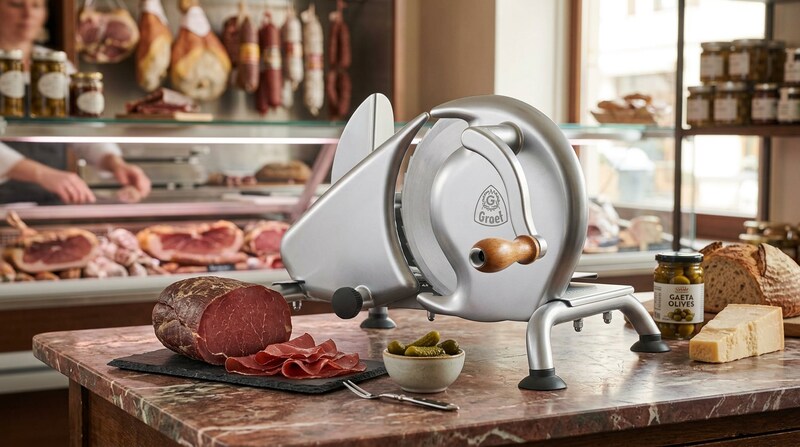
A slicer with no motor, no cord and a wooden crank handle.
What the GRAEF H9 actually is
The H9 is an all-purpose food slicer for the home kitchen.
GRAEF calls it an all-purpose slicer because it's meant for bread, cheese, sausage, ham and other cold cuts, not just one food.
The heart of it is a 190 mm serrated blade, which is about 7.5 inches across.
The blade is made of fully hardened stainless steel.
Serrated blades are the right choice for an all-rounder, because they grip crusty bread and firm sausage without tearing.
Slice thickness is adjustable from 0 to 15 mm.
At the low end, you get see-through slices of prosciutto, and at the top you get thick slabs of sourdough.
The carriage that holds the food is made of stainless steel and comes off for cleaning.
Suction rubber feet hold the slicer in place, and a food holder lets you push the last bit of a loaf or salami safely toward the blade.
The whole machine measures about 375 by 365 by 245 mm, or roughly 14.8 by 14.4 by 9.6 inches.
How a manual slicer like the GRAEF H9 works
There's no motor, so the power comes from you.
You set the thickness with the adjustment knob, which moves the guide plate in front of the blade.
Then you place the food on the carriage, press it against the plate and turn the crank.
The crank turns the blade, and you guide the carriage past it with your other hand.
Each pass produces a slice, which falls off the far side of the blade.
It sounds like more work than an electric slicer, and it is a bit.
But it also gives you a lot of control, because you set the speed of the blade yourself.
Slow and steady works best for soft cheese and fresh bread, while firm salami can take a quicker pace.
The biggest benefit is the silence.
There's no whine, no buzz and no worrying about waking anyone up while you make sandwiches early in the morning.
GRAEF H9 design and setup
The H9 needs almost no setup.
You take it out of the box, clip the carriage into place and press it down on a clean, flat counter so the suction feet grip.
That's it.
The suction feet work best on smooth surfaces such as stone, laminate or glass.
On rough or textured wood, they won't hold as firmly, so a smooth cutting board underneath can help.
Because there's no cord, you can put it anywhere you have room.
That's a small but real advantage in kitchens where outlets are already crowded with a kettle, a toaster and a coffee maker.
The flip side is the footprint.
At about 15 by 14 inches, it's not a gadget you hide in a drawer.
My advice is to decide where it will live before you buy, because a slicer you have to dig out of a cupboard tends to stay there.
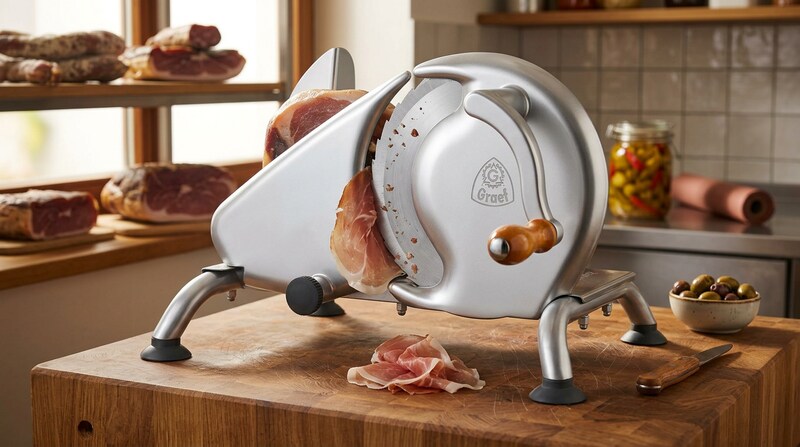
Plan for a footprint of about 15 by 14 inches on the counter.
GRAEF H9 performance: bread, cheese and cold cuts
A slicer earns its spot on the counter if it makes neat, even slices faster than a knife.
Here's how the H9 lines up for the foods it's built for.
Bread
Bread is where an all-purpose slicer often gets the most use.
The serrated blade bites into hard crusts instead of crushing them, which is what you want for sourdough, rye and country loaves.
With the thickness set, every slice comes out the same, so toast browns evenly and sandwiches stack neatly.
Very fresh, soft bread is harder for any slicer.
Let it cool completely and turn the crank slowly, and you'll avoid squashed slices.
Cheese
Semi-hard and hard cheeses such as Gouda, Emmental and aged cheddar are a good match.
A thin setting gives you deli-style sheets for sandwiches, and a thicker one gives you slices for a cheese board.
Very soft cheeses stick to any blade, so I'd keep brie and fresh mozzarella for the knife.
Chilling cheese well before slicing makes a big difference.
Cold cuts and sausage
This is where a slicer beats a knife by a mile.
Thin, even slices of salami, ham or cured sausage are hard to cut by hand and easy with the H9.
Buying whole pieces and slicing them at home also tends to be cheaper than pre-sliced packs, and the meat stays fresh longer.
Cooked roasts slice well too, once they're fully chilled.
Fruit and vegetables
Firm vegetables such as cucumbers, zucchini and onions can work for even slices.
Wet, soft produce like ripe tomatoes is better done with a knife.
What it doesn't do
The H9 isn't built for large batches.
If you're slicing several pounds of jerky meat or a whole leg of ham, the cranking gets tiring, and an electric slicer with a bigger blade makes more sense.
It's also not meant for frozen food or anything with bones.
Tips for getting the best slices from the GRAEF H9
A manual slicer rewards a little technique.
These are the habits I'd build from day one.
Chill what you slice
Cold food holds its shape better against the blade.
Cheese, salami and cooked roasts all slice more cleanly straight from the fridge, and half an hour in the freezer helps with very soft cuts.
Let the blade do the work
Pushing the food hard into the blade gives uneven, torn slices.
A light, steady pressure against the guide plate and a smooth crank give much better results.
Start thicker, then go thinner
Every food has a sweet spot.
Start a step thicker than you think you need, then turn the knob down until the slices still hold together.
For most bread, that lands somewhere around 10 to 12 mm, and for salami it's often just a millimeter or two.
Slice bread for the freezer
If you bake on the weekend, slice the whole loaf once it has cooled and freeze the slices in a bag.
Even slices go straight from the freezer into the toaster, and nothing goes stale.
Use the food holder
The end of a loaf or a sausage is where accidents happen.
The holder keeps your hand away from the blade and lets you slice almost all the way to the end, so less goes to waste.
Keep the blade in good shape
A serrated blade stays sharp for a long time in a home kitchen.
Avoid bones, frozen blocks and hard rinds, and wipe it clean after every use so dried food doesn't build up on the teeth.
Is a manual slicer safer than an electric one?
Any slicer has a sharp blade, and the H9 is no exception.
The difference is that the blade only moves while you're turning the crank.
Stop turning and it stops, which gives you a lot of control.
The food holder is the most important safety part.
Use it for the last few inches of a loaf or a sausage, so your fingers never get near the blade.
Set the thickness back to zero when you're done, so the blade edge is covered by the guide plate.
And keep it out of reach of small children, motor or no motor.
Cleaning the GRAEF H9
Cleaning is what makes or breaks a slicer.
If it's a pain, it ends up in the cupboard.
The removable stainless steel carriage is a big help, because the part that touches the food most can go straight to the sink.
The rest of the machine is wiped down with a damp cloth.
For the blade, wipe from the center outward, never along the edge.
A cut-resistant glove makes this a lot more comfortable.
Because there are no electrical parts, you don't have to worry about water near a motor.
Still, dry everything well before you put it away, and don't put the main frame or the wooden handle in the dishwasher.
My advice is to clean it right after use, especially after cheese, because dried cheese is much harder to remove.
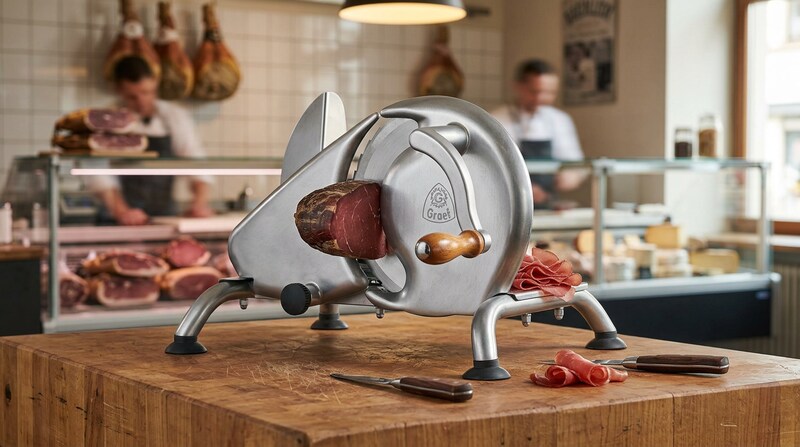
Thin, even slices of cured meat are where a slicer beats a knife.
Where the GRAEF H9 fits best
Home bakers
If you bake bread every week, a slicer turns a round loaf into neat, even slices in seconds.
That makes freezing slices for later a lot easier too.
Breakfast and lunch tables
In many European homes, breakfast means bread, cheese and cold cuts on the table.
The H9 is made for exactly that kind of routine.
Cabins, boats and outdoor kitchens
No motor means no power needed.
That makes the H9 a good fit for places where electricity is limited or outlets are hard to reach.
Charcuterie and entertaining
Thin slices of cured meat and cheese make a board look generous.
With the H9, you can slice right before guests arrive, so everything tastes fresh.
Is the GRAEF H9 worth the money?
On Amazon, the GRAEF H9 sells for about $290.
That's more than many basic electric slicers, which can be found for under $100.
So you're not paying for power or speed.
You're paying for build quality, silence and a tool that should keep working for a very long time.
A manual slicer has no motor to burn out, no switch to fail and no gears to strip under load.
If you'll use it several times a week for bread, cheese and cold cuts, the price spreads out nicely over the years.
If you'd use it a few times a year, a cheap electric slicer or a good bread knife will do.
It's also popular with buyers, with an average of 4.6 out of 5 stars from more than 2,000 ratings on Amazon.
Prices move, so check the current price on Amazon before you buy.
GRAEF H9 specifications
From GRAEF's product information and the Amazon listing.
GRAEF H9 vs electric home slicer vs bread knife
The H9 sits between a good knife and an electric slicer, with some strengths of both.
| GRAEF H9 | Budget electric slicer | Bread knife | |
|---|---|---|---|
| Power | Hand crank | Electric motor | Your arm |
| Even slices | Yes, 0 to 15 mm | Yes | Depends on skill |
| Noise | Silent | Motor noise | Silent |
| Big batches | Tiring | Good | Slow |
| Typical price | About $290 | $60 to $150 | $20 to $80 |
| Best for | Daily bread and deli | Bulk slicing | Occasional use |
Best GRAEF H9 alternatives
If the price or the hand crank of the H9 puts you off, there are a few other directions.
GRAEF itself makes electric slicers with similar build quality, which are a better fit if you slice a lot at once.
Budget electric slicers from kitchen appliance brands cost much less and handle bigger batches, but they're louder and usually more plastic.
For serious meat work, such as jerky or whole roasts, a commercial-style slicer with a 10-inch blade is the right tool.
And if you mostly slice bread, a long serrated bread knife and a slicing guide get you surprisingly close for a fraction of the price.
How I scored the GRAEF H9
I looked at the GRAEF H9 for the jobs it's built for: bread, cheese and cold cuts in a home kitchen.
I based the scores on GRAEF's published specifications, the Amazon listing, retailer information and how manual slicers compare with electric ones.
- Slicing (8.4): the blade, the thickness range and how well it suits bread, cheese and cold cuts.
- Build (8.8): materials, stability and how long it should last.
- Ease of use (7.6): setup, cranking effort and how practical it is for bigger jobs.
- Cleaning (7.8): the removable carriage and how easy the rest is to wipe down.
The overall score of 8.0 is an editorial rating. BrasQ editor-in-chief Ryan Mitchell reviewed the facts and figures before publication.
GRAEF H9 FAQ
Is the GRAEF H9 worth it?
Yes, if you slice bread, cheese or cold cuts several times a week and want a quiet, long-lasting tool. It scored 8.0 out of 10 in our review. For occasional use, a cheaper electric slicer or a good knife is enough.
Is the GRAEF H9 electric?
No. It's a manual slicer with a hand crank and a wooden handle. It needs no power outlet.
How thin can it slice?
The thickness is adjustable from 0 to 15 mm, so you can go from paper-thin cold cuts to thick slices of bread.
What size is the blade?
It has a 190 mm, or about 7.5-inch, serrated blade made of hardened stainless steel.
Can it slice bread?
Yes. The serrated blade suits crusty bread well. Let fresh bread cool completely first for the cleanest slices.
Can I slice frozen food or meat with bones?
No. It's meant for bread, cheese, cold cuts and similar foods. Frozen food and bones can damage the blade.
How do I clean it?
Remove the stainless steel carriage and wash it by hand, then wipe the rest of the slicer with a damp cloth. Wipe the blade from the center outward, ideally with a cut-resistant glove.
Where is GRAEF from?
GRAEF is a family-owned German company based in Arnsberg that specializes in food slicers.
- Amazon product listing for the GRAEF H9 all-purpose slicer (ASIN B002QZW85W), October 2026
- GRAEF product information for the H9 manual slicer
- European retailer listings for the GRAEF H9 (culinaris.de, aio.lv)
- Review published.