Cadco CSR-3T review: a commercial hot plate built to last
A 1,500-watt single burner with an 8-inch tubular element, a Robertshaw infinite control and a stainless steel body made in the USA. It costs far more than a supermarket hot plate, and owners say the difference shows. It has one burner, though, and the low end of the dial isn't perfect for everyone.
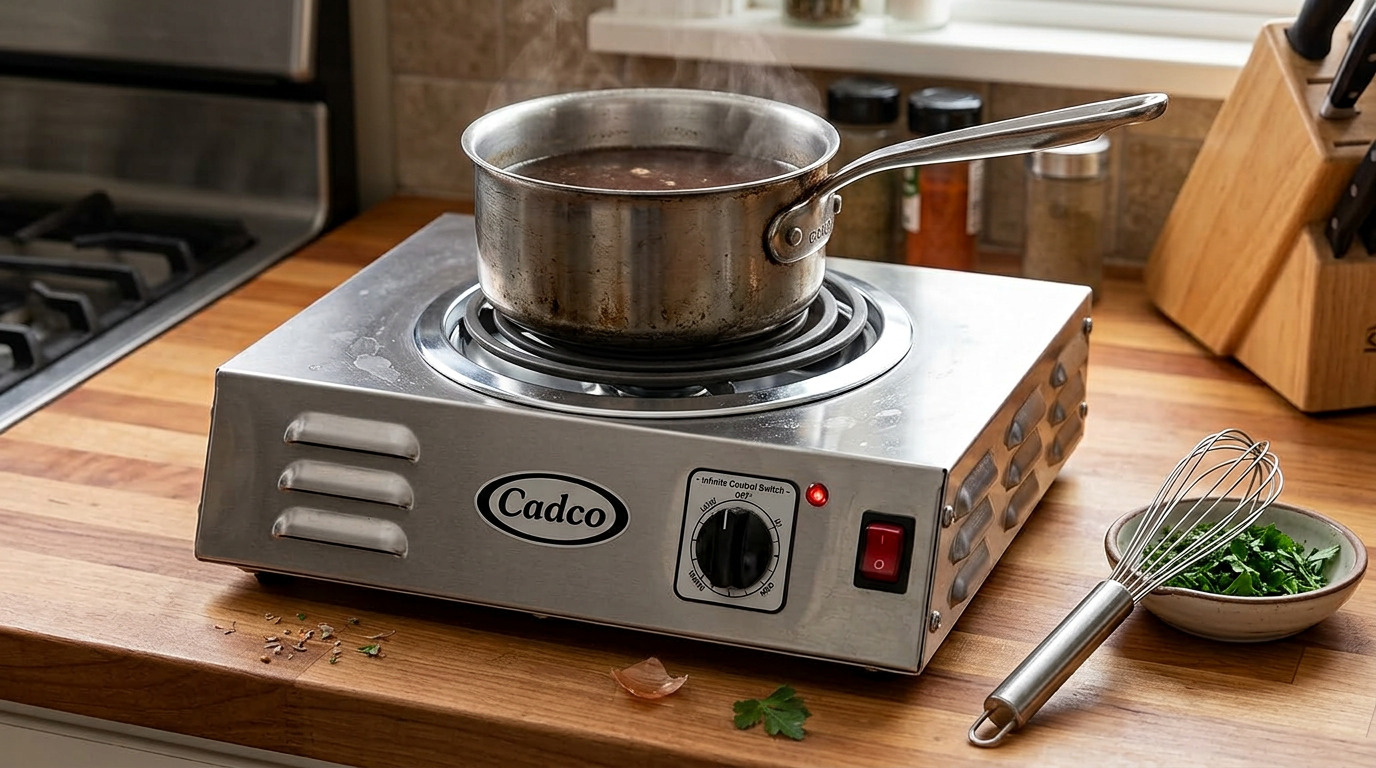
Images are AI-generated illustrations based on the manufacturer's product photo.
In this review
The Cadco CSR-3T is the hot plate I'd pick if I wanted one burner that keeps working for years. The 1,500-watt tubular element, the infinite control and the all-metal body put it in a different class from cheap coil burners, and owner reports of units lasting a decade back that up. It's expensive for a single burner, and a few owners struggle with very low simmers. But if you need dependable extra heat for canning, a small kitchen or a food stand, it's money well spent.
Cadco CSR-3T at a glance
Cadco CSR-3T pros and cons
- Full 1,500 watts, the most a standard 120-volt outlet allows
- 8-inch tubular element suits most pots and pans
- Infinite Robertshaw control instead of a few fixed steps
- Heavy, stainless steel housing with non-skid feet
- Works with any flat-bottomed cookware, not just induction pans
- Owners report units lasting 4 to 10 years
- Made in the USA and UL listed
- Expensive for a single burner
- Some owners find the lowest setting too hot for a gentle simmer
- Only a 1-year warranty, and retailers warn that home use can void it
- Takes more counter space than budget hot plates
- A few reports of cheap plastic on the indicator light
Who should buy the Cadco CSR-3T?
- Home canners who need a stable, separate burner
- Small apartments, dorms or RVs without a full range
- Food trucks, cafés, carts and catering setups
- Anyone who keeps burning out cheap hot plates
- Cooks who want to keep using cast iron, stainless and aluminum pans
- Cooking several dishes at once
- People who only need a burner once or twice a year
- Very delicate, low-temperature cooking like holding melted chocolate
- Anyone who wants the fastest boil times, where induction is quicker
Why I looked closely at the Cadco CSR-3T
Most hot plates on Amazon cost between $25 and $60.
The Cadco CSR-3T costs several times that, so the obvious question is what you get for the extra money.
To answer it, I went through Cadco's specifications, retailer listings from commercial suppliers and hundreds of owner reviews.
I also compared it with the rivals people usually cross-shop, from the Waring WEB300 to cheap induction plates.
The pattern that came out of that research is clear.
This is a restaurant-supply hot plate that happens to be sold on Amazon, not a consumer gadget dressed up in stainless steel.
That explains both the price and the reputation.
Owners keep coming back to the same words: sturdy, heavy-duty and built like they used to make things.
One verified buyer wrote in 2026 that his first unit was still working after ten years and that he was back to buy a second.
That kind of comment is rare in this category, and it's the main reason the CSR-3T is worth a closer look.
Illustration: the CSR-3T is designed as a supplemental burner you can set up wherever you need it.
What the Cadco CSR-3T actually is
The CSR-3T is a portable, single-burner electric hot plate.
Cadco calls it a "Hi-Power" model, and the number backs that up: 1,500 watts on a standard 120-volt outlet.
That's essentially the ceiling for anything you plug into a normal household socket.
The heat comes from an 8-inch tubular element, the same kind of spiral you'd find on a traditional electric range.
Many cheap hot plates use a smaller 6-inch coil or a flat cast iron plate instead.
Cadco is a US company best known for commercial countertop equipment like convection ovens and hot plates.
The CSR-3T is sold mostly through restaurant-supply stores such as KaTom, TigerChef and WebstaurantStore, which tells you who it was designed for.
It's built for food service, catering and mobile kitchens, where a burner gets used every day.
There's also a 220-volt version, the CSR-3T(220), for markets and kitchens that need it.
The model I'm reviewing here is the standard 120-volt CSR-3T.
How the Cadco CSR-3T works
The design is simple, and I mean that as a compliment.
There's an on/off rocker switch on the front with a built-in power light.
Next to it is a single dial connected to a Robertshaw infinite control.
Robertshaw is a long-established American maker of appliance controls, and you'll find its parts in plenty of commercial kitchens.
"Infinite" means the dial isn't limited to a handful of fixed steps.
You can turn it to any point between low and high.
Like the controls on most electric coil ranges, it works by cycling the element on and off.
At high, the element stays on almost constantly, and at lower settings it switches off for longer stretches.
That's why you'll see the element glow and dim during cooking, and it's normal.
A separate signal light shows when the burner is drawing power.
There are no digital screens, timers or touch buttons.
For a piece of equipment that should last a decade, I think that's the right call.
Fewer electronics usually means fewer things that can fail.
Cadco CSR-3T design and setup
The CSR-3T has a plain, squared-off stainless steel housing.
It measures 14 inches wide, 12¼ inches deep and about 4 inches tall.
Retailers list it at around 8 pounds, which is heavier than most budget hot plates.
That weight is useful.
Combined with four rubber non-skid feet, it keeps the unit planted when you put a heavy stockpot or canner on top.
One long-time owner specifically praised the wide base and dense rubber feet for staying stable under heavy kettles of soup.
The controls sit on the front panel, so you can reach them without leaning over a hot pan.
Setup is as simple as it gets.
Put it on a heat-safe, level surface, plug it into a standard NEMA 5-15 outlet and switch it on.
There is one practical point I'd plan for.
The CSR-3T draws 12.5 amps at full power.
On a typical 15-amp kitchen circuit, that leaves little room for a kettle, toaster or microwave on the same circuit.
If your breaker trips, move the hot plate to a different circuit rather than using an extension cord.
The footprint is another thing to check.
At 14 by 12 inches, it takes more counter space than compact hot plates, and one KaTom reviewer mentioned exactly that.
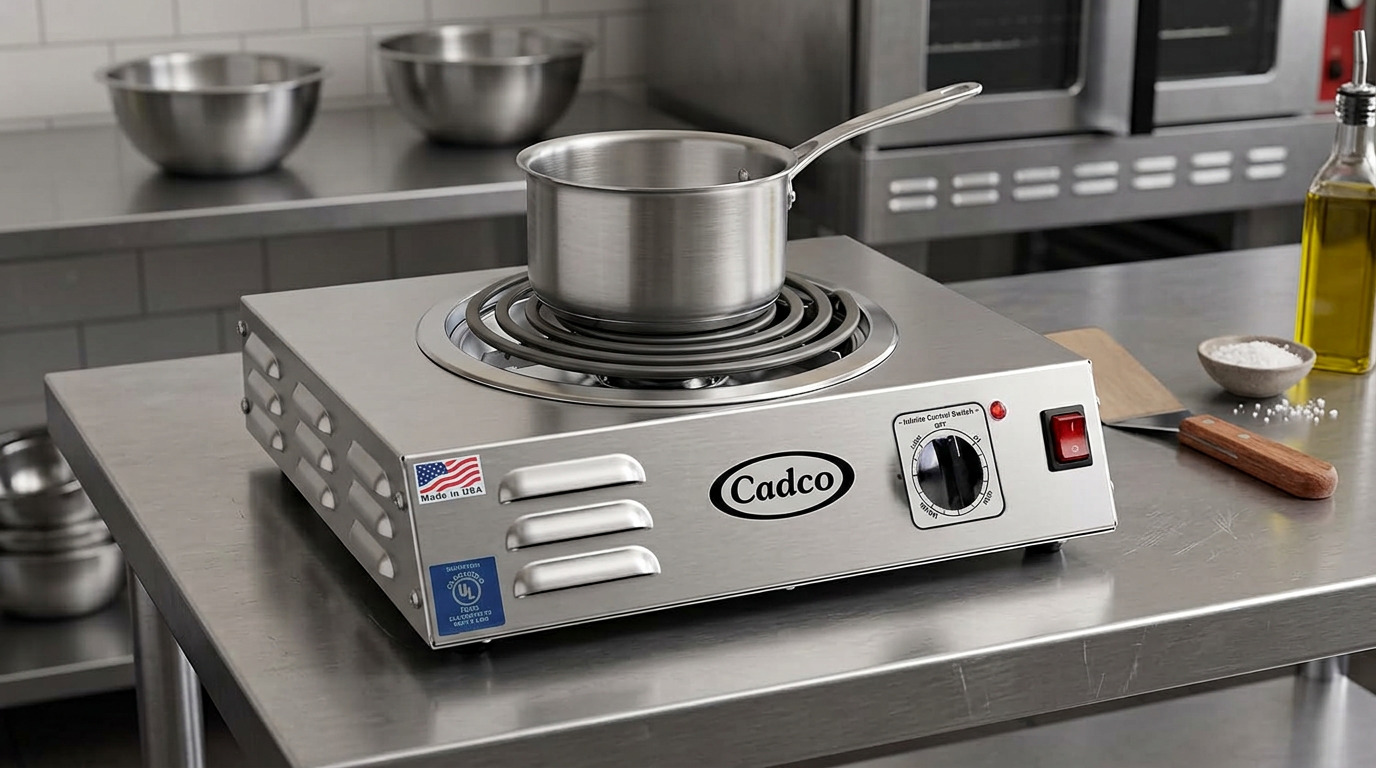
Illustration: plan for a 14 by 12-inch footprint plus clearance around the sides.
Cadco CSR-3T performance: power, simmering and cookware
The specs look good, but what matters is how the hot plate behaves in real kitchens.
Here's what owners and the published data say.
Power and heat-up speed
Speed is the most common compliment in owner reviews.
Several KaTom reviewers say it boils water quickly, and one said it heats water about twice as fast as their previous hot plate.
Amazon buyers describe it the same way: it heats up fast, cooks evenly and cools down quickly.
That makes sense on paper.
A 1,500-watt tubular element puts more energy into the pan than the 1,000 to 1,100-watt elements on many budget burners.
I'd still keep expectations realistic.
A boat owner who has cooked on electric and propane for 14 years noted that it doesn't match a 25,000 BTU propane burner for raw output and takes longer to bring things to a boil.
Induction plates are also faster at boiling water, because they heat the pan directly.
Among traditional resistance hot plates, though, the CSR-3T sits near the top.
Simmering and low heat
This is where owner opinions split.
Many owners love the low end.
One Amazon reviewer called the range "from the gentlest simmer to a full, rolling boil" and said holding a long, slow simmer was the reason he bought it.
The boat owner said he can run a stew at a steady temperature for hours without burning the pot.
Others have a different experience.
One KaTom reviewer couldn't get it low enough for a simmer, and the liquid boiled instead.
Another said the control eventually stopped behaving predictably, which made heat levels hard to judge.
My read is that the low end works well for most owners, but it depends on the pot and the volume.
A heavy, wide pot with plenty of liquid will hold a gentle simmer far better than a small, thin saucepan.
If you need very precise low heat, for example for melting chocolate, a diffuser plate or a double boiler is the safer choice.
Cookware compatibility
This is one of the CSR-3T's quiet advantages over induction.
It works with any flat-bottomed cookware: stainless steel, aluminum, copper, cast iron, enamel and more.
One canner pointed out that she likes it precisely because it works with all her pans, not just induction-ready ones.
The 8-inch element covers the base of most everyday pots and pans.
Even 12-inch frying pans usually have a base of 9 to 10 inches, so they sit comfortably on it.
TigerChef lists a maximum load of 15 pounds per element.
For stockpots and braising pans, it recommends no more than 1 inch of overhang beyond the element.
I'd follow that advice, because oversized pans heat unevenly and trap heat around the housing.
Canning
Canners are one of the CSR-3T's most enthusiastic groups of owners.
One Amazon reviewer uses it with a large All American pressure canner and says it holds heat and maintains pressure with ease.
A KaTom reviewer used it for canning green beans.
Another owner bought it so heavy pots would stop damaging the glass top on their stove.
That's a common reason people buy a separate burner.
Many glass and ceramic cooktop manufacturers advise against heavy canners, so an external burner protects your range.
Before canning, check your canner manufacturer's guidance on electric burners and the weight limit above.
A full water-bath canner can approach or exceed 15 pounds.
Heat and safety
Any exposed-element hot plate needs respect, and the CSR-3T is no exception.
The tubular element gets red hot and stays hot for a while after you switch it off.
The two indicator lights help here.
One shows the unit is on, and the other shows when the burner is drawing power, so it's harder to walk away from a live burner by mistake.
The housing seems to manage heat well.
One reviewer noted that the body stayed cool and didn't heat their granite countertop.
Another owner said the sides and base stay cool enough to handle, which is a good sign for build quality.
The unit is UL and cUL listed, and TigerChef describes it as UL Sanitary classified as well.
There's no automatic shut-off timer, which is typical for commercial burners.
I'd keep it away from curtains, paper towels and the edge of the counter, and switch it off when you're done.
Cleaning and long-term durability
Cleaning is straightforward.
The stainless steel housing wipes down with a damp cloth once the unit has cooled.
The tubular element burns off most small spills on its own the next time you heat it.
Owners regularly describe cleanup as "a breeze".
Avoid soaking the unit or pouring water over it, because the controls sit just beneath the surface.
Durability is where the CSR-3T really earns its price.
One KaTom reviewer said their unit was still working after about four years and had outlasted several cheaper burners.
Another wrote that it "should last me my lifetime".
On Amazon, an owner reported ten years of use and noted that the only thing that had changed in that decade was the price.
Not every report is perfect, and I think it's fair to mention them.
One Amazon buyer said their unit stopped heating after two uses.
Another said the red plastic cover on the burner light came apart quickly, leaving an opening in the front panel.
A KaTom reviewer said the bracket holding the element came loose during cleaning.
These complaints are in the minority, but they show that even commercial gear can have weak spots or a bad unit.
Cadco gives a 1-year parts and labor warranty.
KaTom notes that the unit is intended for commercial use and that non-commercial use can void the manufacturer's warranty.
If you're buying for home use, I'd check the warranty terms with the seller and keep your receipt.
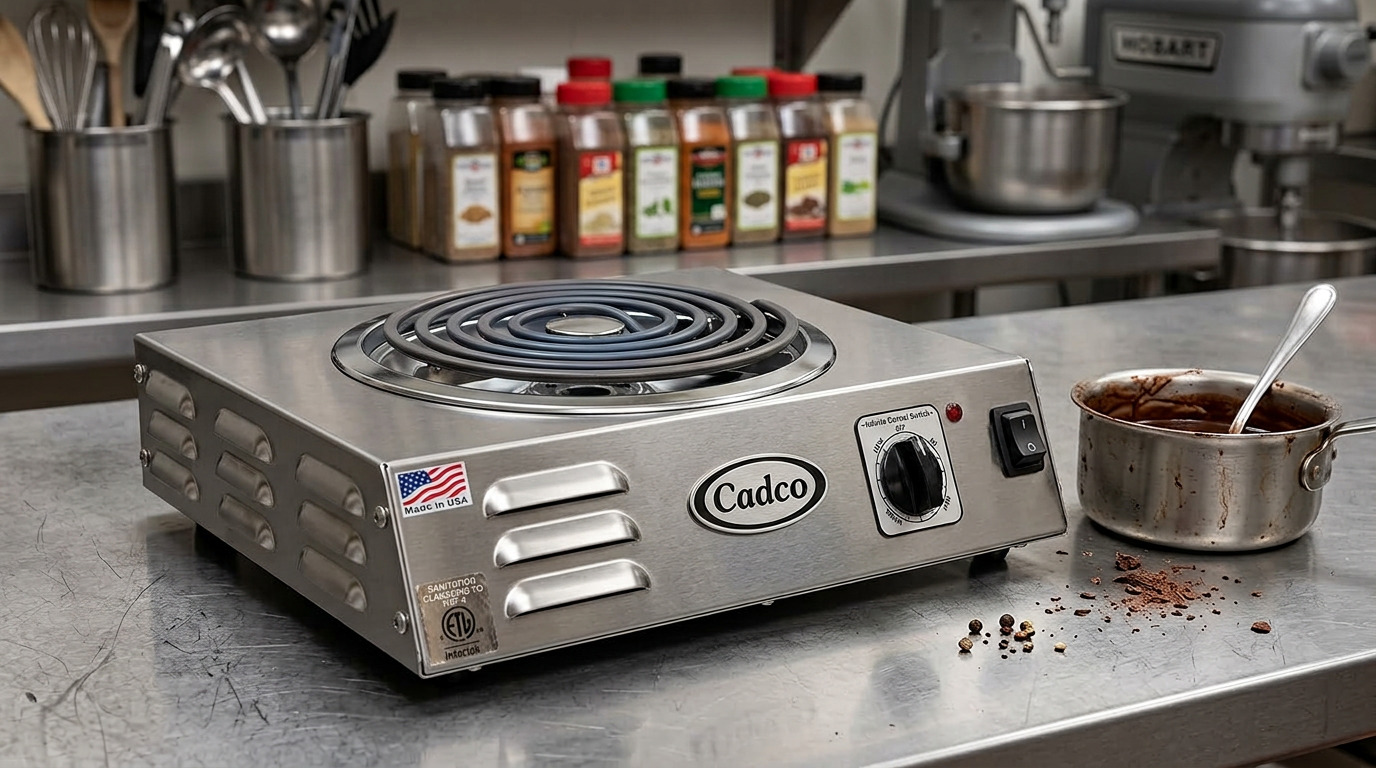
Illustration: the tubular element and simple front controls are the core of the design.
Where the CSR-3T fits best
The CSR-3T makes the most sense in a few specific situations.
Home canning
If you can every summer, this is probably the strongest use case.
It gives you a separate, stable burner that can handle long sessions, and it keeps heavy canners off a glass cooktop.
Small kitchens, apartments and boats
In a studio, dorm, RV or boat galley, a single good burner can do most of your daily cooking.
The boat owner I mentioned earlier is a good example: he cooks on it all summer at the marina.
Just check the rules where you live, because some dorms and rentals don't allow hot plates.
Extra burner for holidays and big meals
Thanksgiving and family dinners are when four burners stop being enough.
A CSR-3T can take over the gravy, the potatoes or a big pot of stock while the range handles the rest.
Food trucks, cafés and catering
This is the market Cadco designed it for.
TigerChef specifically lists food trucks, cafés and mobile carts as target uses.
In a commercial setting, the stainless body, UL listing and repairable design matter more than they do at home.
Is the Cadco CSR-3T worth the money?
At the time of writing, the CSR-3T sells for about $223 on Amazon.
Restaurant suppliers list it between about $200 and $233.
That's a lot of money for one burner.
One owner who first bought it for $115 in 2016 pointed out that the price has roughly doubled while the product itself hasn't changed.
So is it worth it?
If you'll use it rarely, I don't think so.
A $40 hot plate will boil water for the occasional pot of pasta.
If you'll use it often, the math changes.
Several owners say they bought the Cadco after cheap burners kept failing or couldn't regulate heat.
Replacing a $40 burner every year or two quickly adds up, and the frustration costs something too.
One owner who lives on a boat summed it up well: it's pricey, but you get what you pay for.
For canners, small-space cooks and food businesses, I think the CSR-3T is a sound long-term buy.
Prices change, so check the current price on Amazon before you buy.
Cadco CSR-3T vs CSR-1T: which should you buy?
Cadco sells a lower-powered sibling, the CSR-1T, in the same 14-inch housing.
The difference is in the element.
The CSR-3T has an 8-inch, 1,500-watt element, while the CSR-1T has a 6-inch, 1,100-watt element.
The prices are usually close, so I'd pick the CSR-3T for nearly everyone.
| Cadco CSR-3T | Cadco CSR-1T | |
|---|---|---|
| Power | 1,500 W | 1,100 W |
| Element | 8-inch tubular | 6-inch tubular |
| Housing | 14 × 12¼ in, stainless | 14 × 12¼ in, stainless |
| Best for | Large pots, canning, faster boils | Small pans, lighter loads |
Pick the CSR-1T only if you mainly use small saucepans and want slightly lower power draw.
Cadco CSR-3T specifications
From Cadco's published specifications, retailer listings and the Amazon listing.
Cadco CSR-3T vs Waring WEB300 vs Duxtop induction
These are the three burners people most often weigh against each other. The Cadco wins on build and cookware compatibility, the Waring is cheaper, and induction wins on speed and price but needs magnetic pans.
| Cadco CSR-3T | Waring WEB300 | Duxtop 9100MC | |
|---|---|---|---|
| Type | Tubular coil | Cast iron plate | Induction |
| Power | 1,500 W | 1,300 W | 1,800 W |
| Cookware | Any flat pan | Any flat pan | Magnetic only |
| Controls | Infinite dial | Adjustable thermostat | Digital buttons |
| Typical price | About $200–$233 | About $178 | Well under $100 |
| Best for | Durability, canning | Light commercial use | Fast boils on a budget |
Best Cadco CSR-3T alternatives
If the price or the single burner puts you off, there are a few sensible alternatives to the CSR-3T.
The Waring WEB300 is another commercial single burner, with a 1,300-watt cast iron plate.
It's a little cheaper, but cast iron plates heat up and respond more slowly, and its owner reviews at KaTom are much more mixed.
If speed and price matter most, an induction plate like the Duxtop 9100MC boils water faster for a fraction of the cost.
The trade-off is that you need magnetic cookware, and the electronics are less likely to last as long as a simple coil burner.
If you need two burners, Cadco also makes double hot plates, though they need a dedicated circuit at full power.
And if you only cook on a hot plate a few times a year, a basic $30 to $50 coil burner is the honest budget choice.
How I evaluated and scored the Cadco CSR-3T
This is an expert review, not a hands-on test.
I based it on Cadco's specifications, listings from commercial retailers, verified owner reviews on Amazon and KaTom, and comparisons with competing burners.
I scored four areas, each with its own subscore.
- Power (8.6): wattage, element size and what owners report about heat-up speed.
- Heat control (7.8): the infinite control's range, with owner reports on simmering and reliability.
- Build quality (9.0): materials, stability, certifications and long-term owner reports.
- Value (7.4): price against what it delivers and what rivals cost.
The overall score of 8.2 is an editorial rating. BrasQ editor-in-chief Ryan Mitchell reviewed the facts and figures before publication.
Cadco CSR-3T FAQ
Is the Cadco CSR-3T worth it?
Yes, if you'll use it often. It scored 8.2 out of 10 in our expert review thanks to its 1,500-watt element, commercial build and strong long-term owner reports. If you only need a burner a few times a year, a cheaper hot plate will do.
How many watts is the Cadco CSR-3T?
It's rated at 1,500 watts and 12.5 amps on a standard 120-volt outlet. A 220-volt version, the CSR-3T(220), is also available.
Can I use the Cadco CSR-3T for canning?
Many owners do, including with large pressure canners. Check your canner maker's guidance and keep the load within the 15-pound limit per element listed by retailers.
Does it work with cast iron and stainless steel pans?
Yes. It's a resistance burner, so it works with any flat-bottomed cookware, including cast iron, stainless steel, aluminum and copper. You don't need induction-compatible pans.
Can it simmer on low?
Most owners say yes, and some hold stews at a gentle simmer for hours. A few find the lowest setting too hot, especially with small pots. A heavy pot or a heat diffuser helps.
What's the difference between the CSR-3T and CSR-1T?
The CSR-3T has an 8-inch, 1,500-watt element. The CSR-1T has a 6-inch, 1,100-watt element in the same housing.
Where is the Cadco CSR-3T made?
Cadco and its retailers list it as made in the USA.
What warranty does it have?
Cadco offers 1 year of parts and labor coverage. Some retailers note that non-commercial use can void the warranty, so check the terms with your seller.
Is it safe to use at home?
It's UL and cUL listed. Like any open-element hot plate, keep it on a heat-safe surface, away from flammable items, and never leave it on unattended.
- Amazon product listing and verified owner reviews for the Cadco CSR-3T (ASIN B003Z4A0CQ), October 2026
- KaTom: Cadco CSR-3T specifications and owner reviews
- TigerChef: Cadco CSR-3T specifications and load limits
- GoFoodservice: Cadco CSR-1T specifications
- KaTom: Waring WEB300 specifications and owner reviews
- Review published.